Highlights

π-plasmon dispersion in free-standing graphene by momentum-resolved electron energy-loss spectroscopy

S. C. Liou, C.-S. Shie, C. H. Chen, R. Breitwieser, W. W. Pai, G. Y. Guo, and M.-W. Chu

Phys. Rev. B 91, 045418 (2015) - Published 13 January, 2015

This paper reports an experimental observation of the square root q behavior of π-plasmons in free-standing graphene. The authors used very high resolution EELS measurements to be able to probe plasmonic excitations in the long wavelength limit.

Valence-specific magnetization of the charge-ordered multiferroelectric LuFe2O4 using soft x-ray magnetic circular dichroism under 30 T pulsed high magnetic fields

Yasuo Narumi, Tetsuya Nakamura, Kota Saito, Takayuki Morioka, Yukimasa Fukada, Takashi Kambe, Naoshi Ikeda, Yoshinori Kotani, Toyohiko Kinoshita, Koichi Kindo, and Hiroyuki Nojiri

Phys. Rev. B 91, 014410 (2015) - Published 12 January, 2015

LuFe2O4 is being actively studied in the context of an unconventional electronic ferroelectricity that appears due to charge ordering of Fe2+ and Fe3+ oxidation states. LuFe2O4 displays a high magneto-electric coupling, giant magnetic coercivity, and other unusual features, some of them highly controversial. In this study a group of researchers from Japan present their XMCD results in pulsed magnetic fields reaching 30 Tesla. Their technique allows them to measure valence-specific magnetization of Fe2+ and Fe3+ ions above and below the charge-ordering temperature and provides a unique view on the coupling between the charge and spin degrees of freedom in LuFe2O4.

Distributed twofold ordering in URu2Si2

S. Kambe, Y. Tokunaga, H. Sakai, and R. E. Walstedt

Phys. Rev. B 91, 035111 (2015) - Published 12 January, 2015

The identification of hidden order in URu2Si2 is currently a hot topic in condensed matter physics. By performing a much more detailed lineshape analysis of their own NMR data previously published in PRL, a strong argument is put forward that nematic/orthorhombic distortion is not the primary hidden order parameter and that this parameter may be sensitive to disorder. Many local defects were found, even in the best quality samples.

Probing the spatial electron distribution in InAs nanowires by anisotropic magnetoconductance fluctuations

T. S. Jespersen, J. R. Hauptmann, C. B. Sørensen, and J. Nygård

Phys. Rev. B 91, 041302(R) (2015) - Published 12 January, 2015

The authors introduce an approach to investigate the spatial distribution of the electrons in InAs nanowires using the anisotropy of low temperature magneto-conduction fluctuations. With this technique, the authors argue that the electrons responsible for transport in the nanowire are distributed through the bulk of the wire as opposed to being confined to the wire’s surface.

Ultrafast scattering processes of hot electrons in InSb studied by time- and angle-resolved photoemission spectroscopy

H. Tanimura, J. Kanasaki, and K. Tanimura

Phys. Rev. B 91, 045201 (2015) - Published 12 January, 2015

Ultrafast scattering of highly energetic carriers in semiconductors is of great interest to both basic research and technological development. Using the technique of two-photon photoemission, instead of the more common ultrafast optical spectroscopy, in this study provides the ability to probe the conduction-band electron distributions in energy, momentum, and time on femtosecond to picosecond time scales. Deeper insight is obtained into the physics underlying hot-electron relaxation in InSb, a model system for semiconductors with a narrow band gap.

Critical exponents and intrinsic broadening of the field-induced transition in NiCl2·4SC(NH2)2

E. Wulf, D. Hüvonen, R. Schönemann, H. Kühne, T. Herrmannsdörfer, I. Glavatskyy, S. Gerischer, K. Kiefer, S. Gvasaliya, and A. Zheludev

Phys. Rev. B 91, 014406 (2015) - Published 9 January, 2015

A collaboration of authors from Switzerland, Estonia, and Germany present the results of neutron diffraction experiments, AC magnetometry and specific heat measurements for an organic quantum magnet NiCl2⋅4SC(NH2)2 (often abbreviated as DTN).For more than a decade, DTN has been considered as a prominent candidate for BEC realization in quantum magnets. However, the presented results suggest that previous interpretations of data were strongly affected by distribution of transition magnetic fields in the samples, and that the critical exponents describing the transition are incompatible with the BEC universality class.

Superabsorption of acoustic waves with bubble metascreens

Valentin Leroy, Anatoliy Strybulevych, Maxime Lanoy, Fabrice Lemoult, Arnaud Tourin, and John H. Page

Phys. Rev. B 91, 020301(R) (2015) - Published 6 January, 2015

Antireflective acoustic coatings for hiding submarines and other watercraft could be made much thinner than those in use today.

Hydrostatic pressure-induced modifications of structural transitions lead to large enhancements of magnetocaloric effects in MnNiSi-based systems

Tapas Samanta, Daniel L. Lepkowski, Ahmad Us Saleheen, Alok Shankar, Joseph Prestigiacomo, Igor Dubenko, Abdiel Quetz, Iain W. H. Oswald, Gregory T. McCandless, Julia Y. Chan, Philip W. Adams, David P. Young, Naushad Ali, and Shane Stadler

Phys. Rev. B 91, 020401(R) (2015) - Published 5 January, 2015

By means of alloying appropriate amounts of MnNiSi and MnFeGe, materials are found that undergo a paramagnetic to ferromagnetic transition close to room temperature, accompanied by a huge volume change. Thanks to this volume change, application of moderate pressures leads to a remarkable enhancement of the magnetocaloric response. Work like this may open new opportunities in the development of new solid-state magnetic refrigeration devices.

Phase-change memory function of correlated electrons in organic conductors

H. Oike, F. Kagawa, N. Ogawa, A. Ueda, H. Mori, M. Kawasaki, and Y. Tokura

Phys. Rev. B 91, 041101(R) (2015) - Published 5 January, 2015

The invention and development of memory devices are important tasks for facilitating continued innovation in the field of information technology. The authors achieve repeatable switching between a high-resistivity charge-crystalline (or charge-ordered) state and a low-resistivity quenched charge glass via both optical and electrical heating in an organic conductor, θ-(BEDT-TTF)2X. They observe switching that is one order of magnitude faster in another isostructural organic conductor that requires faster cooling (>103 K/s) to kinetically avoid charge crystallization, indicating that the material’s critical cooling rate can be a useful guideline for pursuing a faster “correlated-electron phase-change memory (PCM)”. These results establish a clear case whereby practically stable glassy electronic states hidden behind long-range ordered states can be uncovered by adopting hitherto-untried quenching rates and thus underlies a new class of non-volatile PCM.

YbN: An intrinsic semiconductor with antiferromagnetic exchange

H. Warring, B. J. Ruck, J. F. McNulty, E.-M. Anton, S. Granville, A. Koo, B. Cowie, and H. J. Trodahl

Phys. Rev. B 90, 245206 (2014) - Published 29 December, 2014

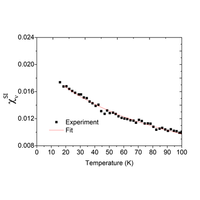
Using modern thin film growth techniques, and performing structural, magnetic, optical and electrical transport measurements on YbN thin films, the authors show that these films are antiferromagnetic and semiconducting, unlike other rare-earth nitrides that are either para- or ferromagnetic.

Topological superconductivity induced by ferromagnetic metal chains

Jian Li, Hua Chen, Ilya K. Drozdov, A. Yazdani, B. Andrei Bernevig, and A. H. MacDonald

Phys. Rev. B 90, 235433 (2014) - Published 24 December, 2014

Recent spectroscopic imaging experiments have showed evidence of one-dimensional topological superconductivity and Majorana bound states in fabricated iron atomic chains on the surface of lead. In this follow-up paper the authors present an extensive theoretical analysis of ferromagnetic atomic chains deposited on a conventional superconductor.

Möbius molecules and fragile Mott insulators

Lukas Muechler, Joseph Maciejko, Titus Neupert, and Roberto Car

Phys. Rev. B 90, 245142 (2014) - Published 23 December, 2014

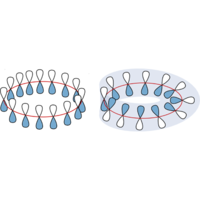
Strongly correlated fermionic systems have been one of the most studied fields in condensed matter theory. The competition between Coulomb-repulsion and kinetic energy leads to a manifold of individual phases, especially in lower dimensions. Famous examples are Luttinger liquids in one dimensions, Mott-insulators or topological phases such as spin liquids. Recently a new class of non-trivial insulators has been introduced, the fragile Mott insulator (FMI). In this paper the authors extend the concept of an FMI to the case of ring-shaped molecules and study the interplay between symmetry, strong correlations as well as strong interactions which ultimately determine the electronic structure of the system.

Current inversion at the edges of a chiral p-wave superconductor

Adrien Bouhon and Manfred Sigrist

Phys. Rev. B 90, 220511(R) (2014) - Published 22 December, 2014

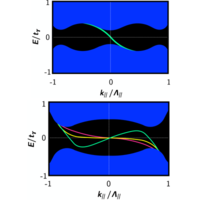
This paper analyzes the edge states and spontaneous edge current of a chiral p-wave superconductor. In particular, the authors show with both a lattice model and a quasiclassical approach that the edge state dispersion and current can be strongly affected by the orientation of the surface.

Beyond extended dynamical mean-field theory: Dual boson approach to the two-dimensional extended Hubbard model

Erik G. C. P. van Loon, Alexander I. Lichtenstein, Mikhail I. Katsnelson, Olivier Parcollet, and Hartmut Hafermann

Phys. Rev. B 90, 235135 (2014) - Published 22 December, 2014

The dual boson method provides a systemic way to do diagrammatic expansion on top of extended dynamical mean-field theory (EDMFT) and can be very useful for the computational research on many strongly correlated systems. The authors present the first application of the method and give a very detail description for both its analytical basis and its numeral realization.

Classifying symmetry-protected topological phases through the anomalous action of the symmetry on the edge

Dominic V. Else and Chetan Nayak

Phys. Rev. B 90, 235137 (2014) - Published 22 December, 2014

The study of Symmetry-Protected Topological (SPT) phases has become a very active research fields in condensed matter with ramifications to a wide variety of areas such as quantum computation, photonics and spintronics. In this paper the authors propose a new method to classify interacting bosonic symmetry-protected topological phases in arbitrary spatial dimensions.

Three- to two-dimensional crossover in time-dependent density-functional theory

Shahrzad Karimi and Carsten A. Ullrich

Phys. Rev. B 90, 245304 (2014) - Published 22 December, 2014

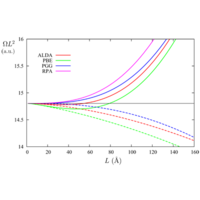
How well the various approximate exchange-correlation functionals in density functional theory capture the 3D to 2D crossover, observed, for example, for plasmon modes in quantum wells that approach the strictly two-dimensional limit? This work, inspired by several ground-state DFT studies performed a few years ago, examines this question in the dynamical case, using time-dependent DFT, and reveals that the (semi)local 3D exchange eventually breaks down, but remains valid for most practical applications. Also, it demonstrates that nonlocal, orbital-dependent functionals are the appropriate way to handle the dimensional crossover.

Bosonic many-body theory of quantum spin ice

Zhihao Hao, Alexandre G. R. Day, and Michel J. P. Gingras

Phys. Rev. B 90, 214430 (2014) - Published 18 December, 2014

By taking into account quantum fluctuations, the authors develop a theory of the interactions between spinons and photons in quantum spin ice.

Transport measurements of the spin-wave parameters of thin Mn films

S. Buvaev, S. Ghosh, K. Muttalib, P. Wölfle, and A. Hebard

Phys. Rev. B 90, 214429 (2014) - Published 17 December, 2014

This paper provides an experimental description and theoretical explanation of how disorder affects electronic transport in antiferromagnetic thin films. The authors find a quantum correction to the conductivity which survives to high disorder strength because of a high rate of inelastic scattering of electrons off of gapped antiferromagnetic spin waves. The data provide first-time estimates of the spin-wave energy gap and exchange energy derived solely from transport measurements. The focus on the unexplored effect of antiferromagnetism on electronic transport provides new perspectives on the role of electronic transport and spin alignment in disordered magnetic systems.

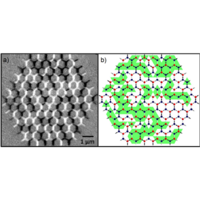
Kinetic pathways to the magnetic charge crystal in artificial dipolar spin ice

I. A. Chioar, B. Canals, D. Lacour, M. Hehn, B. Santos Burgos, T. O. Menteş, A. Locatelli, F. Montaigne, and N. Rougemaille

Phys. Rev. B 90, 220407(R) (2014) - Published 17 December, 2014

The authors study a kagome artificial spin ice cooled from above its Curie temperature. They argue that the system after cooling, while appearing locally to be in the expected spin ice 2 phase, globally seems to be in some non-equilibrium state.

Interaction of localized surface plasmons with chiral molecules

T. J. Davis and D. E. Gómez

Phys. Rev. B 90, 235424 (2014) - Published 15 December, 2014

A complete theoretical methodology of the interactions between chiral molecules and the evanescent fields of localized surface plasmons generated in a metallic nanostructure of arbitrary shape. The calculations confirm various previous results on the enhancement of the absorption of light and subsequent circular dichroism by surface plasmons. They also predict a chirality-dependent absorption arising from the metallic nanostructure illuminated with linearly polarized light.

Sign In to Your Journals Account

Filter

Section

Filter

Article Lookup

Enter a citation