Highlights

Antiferromagnetic and nematic phase transitions in BaFe2(As1−xPx)2 studied by ac microcalorimetry and SQUID magnetometry

X. Luo, V. Stanev, B. Shen, L. Fang, X. S. Ling, R. Osborn, S. Rosenkranz, T. M. Benseman, R. Divan, W.-K. Kwok, and U. Welp

Phys. Rev. B 91, 094512 (2015) - Published 23 March, 2015

Using high-resolution specific heat and SQUID magnetization measurements, this group studies the thermodynamic phase transitions of BaFe2(As1-xPx)2 (x=0.0, 0.3). The experiments, assisted by theoretical modeling, show that there is no additional 2nd order “true” nematic phase transition at temperatures above the conventional antiferromagnetic/structural transition.

Distributions of phonon lifetimes in Brillouin zones

Atsushi Togo, Laurent Chaput, and Isao Tanaka

Phys. Rev. B 91, 094306 (2015) - Published 20 March, 2015

A collaboration of researchers from Japan and France present a comprehensive study of phonon lifetimes and thermal conductivity for 33 zincblende- and wurtzite compounds using linearized phonon Boltzmann equation and first-principles anharmonic phonon calculations. The software that the authors created for this study will be released as an open source package and should be of help in the search of new materials for thermoelectric applications.

Two-photon lasing by a superconducting qubit

P. Neilinger, M. Rehák, M. Grajcar, G. Oelsner, U. Hübner, and E. Il'ichev

Phys. Rev. B 91, 104516 (2015) - Published 19 March, 2015

This European research team reports the first observation of two-photon lasing in a superconducting circuit consisting of a pair of flux qubits strongly coupled to a coplanar waveguide.

Strong reduction of exciton-phonon coupling in single-wall carbon nanotubes of high crystalline quality: Insight into broadening mechanisms and exciton localization

V. Ardizzone, Y. Chassagneux, F. Vialla, G. Delport, C. Delcamp, N. Belabas, E. Deleporte, Ph. Roussignol, I. Robert-Philip, C. Voisin, and J. S. Lauret

Phys. Rev. B 91, 121410(R) (2015) - Published 18 March, 2015

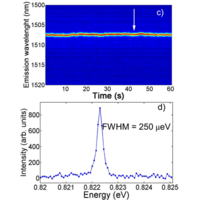
The emission linewidth is a key figure of merit for a quantum emitter. This paper reports on the possibility of reducing the spectral linewidth of single-wall carbon nanotubes. It demonstrates an order of magnitude narrower linewidths compared to the available data due to the enhanced crystalline quality of the carbon nanotubes synthesized by using a laser ablation technique.

Edge-entanglement spectrum correspondence in a nonchiral topological phase and Kramers-Wannier duality

Wen Wei Ho, Lukasz Cincio, Heidar Moradi, Davide Gaiotto, and Guifre Vidal

Phys. Rev. B 91, 125119 (2015) - Published 11 March, 2015

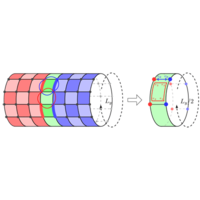
For chiral topological phases there exist analytical proofs of a one-to-one correspondence between the low lying spectrum of edge states and that of the entanglement spectrum. Whether or not such an edge-entanglement spectrum correspondence could apply to non-chiral phases has been unclear. Here it is shown that in the Wen-plaquette model, a non-chiral Z2 topological phase, such a correspondence is exact in the absence of perturbations. While no such correspondence exists in the case of a general perturbation, the correspondence can be shown to apply for perturbations restricted to be translation invariant along the edge/entanglement cut.

Quasiparticle self-consistent GW calculations of the electronic band structure of bulk and monolayer V2O5

Churna Bhandari, Walter R. L. Lambrecht, and Mark van Schilfgaarde

Phys. Rev. B 91, 125116 (2015) - Published 10 March, 2015

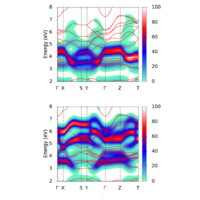
The electronic band structure of monolayer V2O5 is examined in detail via quasiparticle self-consistent GW calculations. There is much interest currently for such layered systems, especially compared to the bulk. Sophisticated calculations like the ones done here can provide key information on the reasons why DFT calculations significantly overestimate or underestimate the band gap in such materials, a perennial issue. The lattice polarization is the major missing ingredient responsible for the discrepancy in this system.

Dynamics of excitons bound to nitrogen isoelectronic centers in GaAs

P. St-Jean, G. Éthier-Majcher, and S. Francoeur

Phys. Rev. B 91, 115201 (2015) - Published 9 March, 2015

The first comprehensive study is made of the exciton dynamics and spin-relaxation processes in isoelectronic centers in GaAs, single excitons bound to two nitrogen atoms. Such atomic defects may offer advantageous properties for quantum information applications over the more established quantum dots and NV centers in diamond. Time-resolved spectroscopy is coupled with a unique analytical model.

Nonlinear pulse propagation in InAs/InP quantum dot optical amplifiers: Rabi oscillations in the presence of nonresonant nonlinearities

O. Karni, A. K. Mishra, G. Eisenstein, and J. P. Reithmaier

Phys. Rev. B 91, 115304 (2015) - Published 9 March, 2015

There is interest in what happens to ultrashort light pulses propagating through a quantum-dot semiconductor optical amplifier waveguide. In this experiment, the influence of nonresonant propagation effects, such as linear dispersion, two-phonon absorption, and Kerr-like, on the intensity and frequency profile of the pulses is shown to be strong enough that they must be included in any modeling.

Cooper pairing in non-Fermi liquids

Max A. Metlitski, David F. Mross, Subir Sachdev, and T. Senthil

Phys. Rev. B 91, 115111 (2015) - Published 4 March, 2015

Whether the non-Fermi-liquid behavior of fermionic systems, developing in the proximity of a quantum critical point, is stable or not toward the formation of Cooper pairs is an interesting and challenging open question in the physics of strongly correlated systems. In this new and interesting contribution to the field, the authors study systems where the non-Fermi-liquid behavior arises as a result of the interaction of a gapless bosonic mode with fermions in the vicinity of the Fermi surface.

Chiral bosonic phases on the Haldane honeycomb lattice

Ivana Vasić, Alexandru Petrescu, Karyn Le Hur, and Walter Hofstetter

Phys. Rev. B 91, 094502 (2015) - Published 3 March, 2015

Recent experiments in ultracold atoms and photonic systems have realized lattice models with artificial gauge fields. Here the authors introduce a bosonic version of the Haldane Hubbard Hamiltonian on the honeycomb lattice and use several analytical and numerical methods to uncover a consistent picture of the phase diagram. Three distinct phases are found: chiral superfluid, uniform superfluid, and a plaquette Mott insulator, all of which should be accessible to future experiments.

Coexistence of excited polarons and metastable delocalized states in photoinduced metals

Sharareh Sayyad and Martin Eckstein

Phys. Rev. B 91, 104301 (2015) - Published 3 March, 2015

Using a nonequilibrium dynamical mean-field theory the authors study relaxation of a hot-electron distribution coupled to optical phonons. Their main interest is in the adiabatic regime of phonon frequencies smaller than the electronic bandwidth and in an extended analysis of photoemission spectra. In this limit initial coherent phonon oscillations become strongly damped, leaving the system in a mixture of excited polaron states and metastable delocalized states.

Real-time decay of a highly excited charge carrier in the one-dimensional Holstein model

F. Dorfner, L. Vidmar, C. Brockt, E. Jeckelmann, and F. Heidrich-Meisner

Phys. Rev. B 91, 104302 (2015) - Published 3 March, 2015

Nonequilibrium dynamics of interacting quantum many-body physics has recently attracted great attention. The authors address here the nonequilibrium dynamics of a single electron interacting through a Holstein-like coupling with dispersionless phonons on a one dimensional lattice. Using diagonalization in a limited functional space, they identify two different regimes: (1) the relaxation regime where, during a characteristic time scale, a net energy is transferred between the electronic and the phononic subsystem; and (2) the stationary regime, characterized by zero energy transfer and by persisting coherent oscillations in the dynamics of observables.

High-temperature superconductivity stabilized by electron-hole interband coupling in collapsed tetragonal phase of KFe2As2 under high pressure

Yasuyuki Nakajima, Renxiong Wang, Tristin Metz, Xiangfeng Wang, Limin Wang, Hyunchae Cynn, Samuel T. Weir, Jason R. Jeffries, and Johnpierre Paglione

Phys. Rev. B 91, 060508(R) (2015) - Published 27 February, 2015

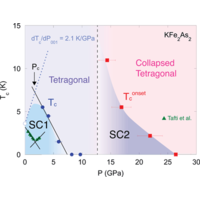
By investigating transport and structural properties of KFe2As2 under pressures up to 33 GPa, this group reveals the presence of two superconducting phases that appear distinct, and each showing strong enhancements in their transition temperature as a function of pressure. The second, higher-Tc phase abruptly appears upon collapse of the tetragonal structure at higher pressures.

Hidden order as a source of interface superconductivity

Andreas Moor, Anatoly F. Volkov, and Konstantin B. Efetov

Phys. Rev. B 91, 064511 (2015) - Published 27 February, 2015

In this work the authors present a novel mechanism for interfacial superconductivity which has been observed in many materials including high-Tc superconductors. The suggested mechanism is based on an interplay between competing order parameters: superconducting order parameter, and charge- or spin-density wave.

Topology versus Anderson localization: Nonperturbative solutions in one dimension

Alexander Altland, Dmitry Bagrets, and Alex Kamenev

Phys. Rev. B 91, 085429 (2015) - Published 27 February, 2015

This paper presents a comprehensive study of the interplay of Anderson localization and topological phase transitions in five symmetry classes that allow topological insulators in one dimension.

Very large magnetoresistance in Fe0.28TaS2 single crystals

Will J. Hardy, Chih-Wei Chen, A. Marcinkova, Heng Ji, Jairo Sinova, D. Natelson, and E. Morosan

Phys. Rev. B 91, 054426 (2015) - Published 26 February, 2015

There is great interest in understanding the physics of magnetic ordering and electronic transport in materials of reduced dimensionality with strong spin-orbit coupling. This paper presents magnetotransport measurements of Fe0.28TaS2 single crystals, which are found to exhibit very large magnetoresistance (MR) for magnetic fields along the easy axis. The authors believe that such a large MR arises from spin disorder scattering and propose to use this mechanism as a design principle for materials with large MR. Further tests are needed to fully rule out contributions from a more conventional anisotropic MR mechanism.

Hydrogen centers and the conductivity of In2O3 single crystals

Weikai Yin, Kirby Smithe, Philip Weiser, Michael Stavola, W. Beall Fowler, Lynn Boatner, Stephen J. Pearton, David C. Hays, and Sandro G. Koch

Phys. Rev. B 91, 075208 (2015) - Published 24 February, 2015

Transparent conducting oxides, such as In2O3, are optically transparent wide band gap semiconductors with high electrical conductivity and are used in applications such as transparent electrical circuits and flat panel displays. Some previous research has argued that conductivity in In2O3 is caused mainly by oxygen vacancies, as in other transparent conducting oxides. Using infrared absorbtion spectroscopy on single-crystal In2O3, the authors show that, consistent with theory, interstital hydrogen forms shallow donors, which make an important contribution to the n-type conductivity.

Multiscale approach to the electronic structure of doped semiconductor surfaces

Ofer Sinai, Oliver T. Hofmann, Patrick Rinke, Matthias Scheffler, Georg Heimel, and Leeor Kronik

Phys. Rev. B 91, 075311 (2015) - Published 24 February, 2015

Accurate nanoscale atomistic treatment of semiconductor surfaces, together with accurate microscale treatment of electronic effects induced in the semiconductor near-surface region, is crucial for a very large range of issues in modern electronics. However, this has been a difficult challenge for modern computational materials science. In this paper, this goal is achieved by means of a new multiscale approach that couples seamlessly short-range quantum mechanical effects with long-range electrostatic effects. The usefulness of this approach is demonstrated on a variety of silicon surfaces.

Spin-dependent photophysics in polymers lightly doped with fullerene derivatives: Photoluminescence and electrically detected magnetic resonance

B. Zerai Tedlla, F. Zhu, M. Cox, B. Koopmans, and E. Goovaerts

Phys. Rev. B 91, 085309 (2015) - Published 23 February, 2015

The authors use photoluminescence- and electrically-detected magnetic resonance spectroscopies to trace and characterize triplet exciton states in lightly fullerene-doped polymers. This approach can provide an improved analysis of charge excitations and their spin dependent interactions in organic electronics devices, in particular organic light emitting diodes, with the potential to enhance their performance.

Zero modes, bosonization, and topological quantum order: The Laughlin state in second quantization

Tahereh Mazaheri, Gerardo Ortiz, Zohar Nussinov, and Alexander Seidel

Phys. Rev. B 91, 085115 (2015) - Published 20 February, 2015

Fractional Quantum Hall (FQH) wave functions are usually obtained in a first-quantized language, using special properties of analyticity of the lowest Landau level (LLL) wave functions. Unfortunately, this formalism is not directly applicable to several systems different from the LLL, such as the recently discovered fractional Chern insulators. Introducing a second-quantized formalism represents an important step towards a new understanding of FQH wave functions in terms of the guiding center degrees of freedom only. In this paper, the authors present several applications of the formalism, including an explicit derivation of the second-quantized version of Read’s string order parameter for the Laughlin state.

Sign In to Your Journals Account

Filter

Section

Filter

Article Lookup

Enter a citation