Highlights

Lasing in circuit quantum electrodynamics with strong noise

M. Marthaler, Y. Utsumi, and D. S. Golubev

Phys. Rev. B 91, 184515 (2015) - Published 26 May, 2015

A single artificial atom maser can be realized using a superconducting single electron transistor coupled to an oscillator or a double dot coupled to a transmission-line resonator. The authors suggest a model to describe the possibility of lasing action in various environments under different coupling mechanism.

Charge fluctuations in nonlinear heat transport

Niklas M. Gergs, Christoph B. M. Hörig, Maarten R. Wegewijs, and Dirk Schuricht

Phys. Rev. B 91, 201107(R) (2015) - Published 26 May, 2015

In this study of non-equilibrium heat transport in quantum nanostructures as modeled by the Anderson impurity model, the authors show that monitoring the energy conductance as a function of gate or source-drain voltage can reveal the fingerprints of inelastic scattering processes in a way that the charge conductance does not.

Higher-dimensional Wannier functions of multiparameter Hamiltonians

Jan-Philipp Hanke, Frank Freimuth, Stefan Blügel, and Yuriy Mokrousov

Phys. Rev. B 91, 184413 (2015) - Published 21 May, 2015

Wannier functions are an important and practical tool to simplify electronic structure calculations used to compute various physical properties. However, in cases of multi-parameter Hamiltonians, several sets of Wannier functions are required, making the computation often prohibitive. The authors have found a solution to this with a formalism that instead allows computation of a single parameter-dependent set of higher-dimensional Wannier functions (HDWFs). This formalism is demonstrated using toy models that show it can be applied to a variety of problems such as the virtual crystal approximation of disorder, ferroelectric polarization, and spin torques.

Topological paramagnetism in frustrated spin-1 Mott insulators

Chong Wang, Adam Nahum, and T. Senthil

Phys. Rev. B 91, 195131 (2015) - Published 20 May, 2015

A natural place to look for symmetry protected topological phases in three dimensions are magnetic models built from spin-1. As an example, the authors consider an AKLT-derived loop model of spin-1’s on a diamond lattice.

Anomalous proximity effect and theoretical design for its realization

Satoshi Ikegaya, Yasuhiro Asano, and Yukio Tanaka

Phys. Rev. B 91, 174511 (2015) - Published 15 May, 2015

On the basis of novel insight in the physics of Majorana modes, the authors solve the microscopic mechanism of the anomalous proximity effect and propose an experimental setup for its observation.

Magnetic thermal switch for heat management at the nanoscale

Riccardo Bosisio, Stefano Valentini, Francesco Mazza, Giuliano Benenti, Rosario Fazio, Vittorio Giovannetti, and Fabio Taddei

Phys. Rev. B 91, 205420 (2015) - Published 14 May, 2015

The overheating of microprocessors components is currently the most limiting factor in the development of information technology. This motivates the concern in finding innovative ways to control and evacuate heat in nanoscale devices. In the presence of a magnetic field B, the heat currents flowing through a generic setup exhibit reversible and irreversible components: the former are reversed when inverting B→-B, whereas the latter remain unchanged. In this work the authors exploit this feature to propose a magnetic thermal switch: a setup which allows control of the heat flow by making use of an external magnetic field as a selector of a desired working configuration. Several features, like switching on/off, inversion, partition and swap of the heat currents, can be implemented in a programmable device allowing full controllability. Among the advantages of this approach are the absence of any temperature constraints and the possibility to control phononic, in addition to electronic, heat flows.

Electron-photon coupling in mesoscopic quantum electrodynamics

A. Cottet, T. Kontos, and B. Douçot

Phys. Rev. B 91, 205417 (2015) - Published 13 May, 2015

Mesoscopic circuits can be coupled to microwave cavities to form hybrid light-matter systems. This emerging field represents an intermediate regime between standard cavity and circuit quantum electrodynamics. In this paper, the authors develop a general method based on a photonic pseudo-potential to describe the electric coupling between electrons in a nanocircuit and cavity photons.

Hidden order and flux attachment in symmetry-protected topological phases: A Laughlin-like approach

Zohar Ringel and Steven H. Simon

Phys. Rev. B 91, 195117 (2015) - Published 12 May, 2015

Topological phases of matter lack conventional local order parameter but might have hidden orders. This is exemplified by quantum Hall states for which Laughlin’s wavefunction approach revealed a connection between topological phases and broken symmetry. The authors utilize this approach to construct candidate wave functions for one- and two-dimensional symmetry-protected phases (SPT) and provide evidence that their candidate states do in fact belong to SPT.

Raman spectroscopy of electrochemically gated graphene transistors: Geometrical capacitance, electron-phonon, electron-electron, and electron-defect scattering

Guillaume Froehlicher and Stéphane Berciaud

Phys. Rev. B 91, 205413 (2015) - Published 12 May, 2015

This is a comprehensive Raman scattering study of electrochemically gated graphene transistors. A robust, highly accurate determination of the Fermi level, electron-phonon coupling, and defect scattering rates is achieved. Fermi energies as high as 700 meV above the Dirac point were achieved in ambient conditions, without damaging graphene. This opens exciting perspectives for optoelectronics.

Electrical detection of magnetization reversal without auxiliary magnets

K. Olejník, V. Novák, J. Wunderlich, and T. Jungwirth

Phys. Rev. B 91, 180402(R) (2015) - Published 11 May, 2015

Authors observe a new magnetoresistance phenomenon in a relativistic structure which allows them to detect a 180 degrees magnetization reversal without breaking the symmetry between the two states by a magnetic field or a reference ferromagnet.

µ-near-zero supercoupling

João S. Marcos, Mário G. Silveirinha, and Nader Engheta

Phys. Rev. B 91, 195112 (2015) - Published 11 May, 2015

Theoretical predictions and experimental results demonstrate that mu-near zero metamaterials allow enhanced transmission (supercoupling) between two waveguides coupled by a channel with a disproportionately wide cross section. This effect is related but distinctly different from (and cannot be reduced to) a previously reported supercoupling effect using epsilon-near-zero metamaterials.

Optimal control of Majorana zero modes

Torsten Karzig, Armin Rahmani, Felix von Oppen, and Gil Refael

Phys. Rev. B 91, 201404(R) (2015) - Published 11 May, 2015

Requirement of adiabaticity in the process of braiding of Majorana modes presents serious challenges to its practical implementation. The authors explore how to minimize nonadiabatic errors for finite braiding times by finding an optimal protocol for the Majorana movement. They show, counterintuitively, that protocols characterized by sharp transitions between Majorana motion at maximal and minimal velocities may do the trick.

Wavelength-dependent optical enhancement of superconducting interlayer coupling in La1.885Ba0.115CuO4

E. Casandruc, D. Nicoletti, S. Rajasekaran, Y. Laplace, V. Khanna, G. D. Gu, J. P. Hill, and A. Cavalleri

Phys. Rev. B 91, 174502 (2015) - Published 5 May, 2015

Motivated by the appearance of optically induced superconductivity in the stripe-ordered La1.885Ba0.115CuO4 cuprate, this group uses time-resolved THz spectroscopy to map out the enhancement of interlayer superconducting coupling as a function of both temperature and time delay, for different pump wavelengths and fluences.

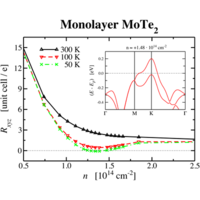
First-principles theory of field-effect doping in transition-metal dichalcogenides: Structural properties, electronic structure, Hall coefficient, and electrical conductivity

Thomas Brumme, Matteo Calandra, and Francesco Mauri

Phys. Rev. B 91, 155436 (2015) - Published 30 April, 2015

Electrochemical doping in 2D transition-metal dichalcogenides (TDMs) aimed at creating field effect transistor (FET) conditions can allow one to explore interesting transport phenomena in reduced dimensionality. In this timely work, the authors thoroughly investigate from first principles how field-effect doping affects the structural properties, electronic structure, and Hall coefficient of mono- and few-layers TDMs. They show that (i) the models, typically, used to estimate the doping charge in FET devices cannot be applied to 2D TMDs and, (ii) given the multivalley nature of both the conduction and valence bands, small differences in the band structure can manifest in transport behavior that is very different from that predicted based on a single parabolic band.

Topology of density matrices

Jan Carl Budich and Sebastian Diehl

Phys. Rev. B 91, 165140 (2015) - Published 30 April, 2015

Can topologically non-trivial states, such as those in topological insulators and superconductors, arise in the mixed states of open quantum systems? By imposing special constraints on the gauge structure of the density matrices which describe open quantum systems, the authors find non-trivial topological invariants showing that topological phenomena can be generalized to mixed states. The method is illustrated with an analysis of Chern insulators at finite temperature.

Anisotropic magnetocapacitance in ferromagnetic-plate capacitors

J. A. Haigh, C. Ciccarelli, A. C. Betz, A. Irvine, V. Novák, T. Jungwirth, and J. Wunderlich

Phys. Rev. B 91, 140409(R) (2015) - Published 29 April, 2015

The paper reports the observation of an anisotropic capacitance in a parallel plate p-n junction capacitor where one plate is a ferromagnetic semiconductor, GaMnAs, and the other is nonmagnetic n-doped GaAs. The capacitance depends on the angle of the magnetization of the ferromagnetic plate and is analogous to the tunneling anisotropic magnetoresistance, which originates from the spin-orbit interaction. This can be an important effect in magnetic sensor applications.

Broken SU(4) symmetry in a Kondo-correlated carbon nanotube

Daniel R. Schmid, Sergey Smirnov, Magdalena Margańska, Alois Dirnaichner, Peter L. Stiller, Milena Grifoni, Andreas K. Hüttel, and Christoph Strunk

Phys. Rev. B 91, 155435 (2015) - Published 29 April, 2015

This paper reports on the experimental and theoretical investigation of nonequilibrium Kondo effect in carbon nanotube quantum dots. At low temperature and in the absence of magnetic field, the authors observe two symmetric satellite features on either side of the zero bias peak due to the splitting of single-particle states by the spin-orbit coupling and valley mixing. Further experimental results are discussed based on the underlying symmetries of the carbon nanotube energy spectrum.

Quantum revivals and many-body localization

R. Vasseur, S. A. Parameswaran, and J. E. Moore

Phys. Rev. B 91, 140202(R) (2015) - Published 27 April, 2015

The authors consider the phenomena of quantum revivals in a system exhibiting many-body localization. To this end the authors study a qubit attached to a disordered insulator. Without interactions, the qubit undergoes revivals at a rate that approaches a constant as time goes to infinity. If interactions are added to the insulator, this rate sees instead a logarithmic suppression in time. This logarithmic behavior is related to the same mechanism that underpins the logarithmic growth in entanglement entropy after a quantum quench in a many-body localized system.

Atomic resolution imaging using electron energy-loss phonon spectroscopy

N. R. Lugg, B. D. Forbes, S. D. Findlay, and L. J. Allen

Phys. Rev. B 91, 144108 (2015) - Published 20 April, 2015

Inelastic scattering of electrons on crystals can excite lattice vibrations known as phonons. An energy resolution of 10 meV in the scattered electron energy loss has recently been demonstrated in scanning transmission electron microscopy (STEM), permitting experimenters to distinguish between elastic and inelastic scattering events. In this paper the authors present simulations showing that, with the recent improvement in energy resolution, atomic resolution phonon spectroscopy and imaging of crystals using STEM should now be feasible.

Dependence of superconductivity in CuxBi2Se3 on quenching conditions

J. A. Schneeloch, R. D. Zhong, Z. J. Xu, G. D. Gu, and J. M. Tranquada

Phys. Rev. B 91, 144506 (2015) - Published 20 April, 2015

CuxBi2Se3 is a material of significant recent interest and controversy, as it might be a topological superconductor. However, it is now apparent that different preparation routes yield crystals with different properties. This group offers the first systematic study of the preparation-dependence of superconductivity in this material.

Sign In to Your Journals Account

Filter

Section

Filter

Article Lookup

Enter a citation