Highlights

Imprint of topological degeneracy in quasi-one-dimensional fractional quantum Hall states

Eran Sagi, Yuval Oreg, Ady Stern, and Bertrand I. Halperin

Phys. Rev. B 91, 245144 (2015) - Published 19 June, 2015

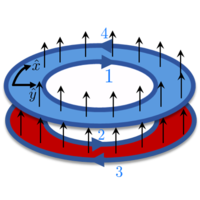
Experimental measurement of topological degeneracy of fractional quantum Hall states is obstructed by the requirement of a torus geometry. The authors propose an alternative scheme which relies on the realization of ground state degeneracy in an effective torus geometry. It is achieved by gluing the edges of a bilayer annulus, where the layers are occupied by electron and hole fractional quantum Hall states or by a topological insulator.

Using weak measurements to extract the Z2 index of a topological insulator

Zohar Ringel

Phys. Rev. B 91, 241109(R) (2015) - Published 18 June, 2015

In quantum mechanics, weak measurement allows one to measure off diagonal matrix elements of operators. In this work, the author designs a weak value protocol which can be harnessed to measure the topological invariant of a quantum spin Hall insulator.

Multiferroicity in spin ice: Towards magnetic crystallography of Tb2Ti2O7 in a field

L. D. C. Jaubert and R. Moessner

Phys. Rev. B 91, 214422 (2015) - Published 17 June, 2015

Recently D. I. Khomskii proposed that the elementary excitations in spin ice materials, the magnetic monopoles, also possess electric dipole moments. In this manuscript the properties of such magneto-electric monopoles are explored within a model of spin ice materials that includes nearest-neighbour coupling, Zeeman energy, electric and magnetic dipolar interactions, with a particular emphasis on a prototype spin-liquid pyrochlore Tb2Ti2O7.

Interface-enhanced high-temperature superconductivity in single-unit-cell FeTe1−xSex films on SrTiO3

Fangsen Li, Hao Ding, Chenjia Tang, Junping Peng, Qinghua Zhang, Wenhao Zhang, Guanyu Zhou, Ding Zhang, Can-Li Song, Ke He, Shuaihua Ji, Xi Chen, Lin Gu, Lili Wang, Xu-Cun Ma, and Qi-Kun Xue

Phys. Rev. B 91, 220503(R) (2015) - Published 17 June, 2015

A single unit cell FeTe1-xSex film consisting of a flat square Fe layer sandwiched between two Se/Te monolayers shows a fully gapped tunneling spectrum with superconducting gaps up to ~16.5 meV, nearly ten times the gap value of an optimally doped bulk single crystal. Compared with the Tc~14.5 K of bulk FeTe0.6Se0.4, a gap of ~16.5 meV could correspond to a transition temperature higher than the boiling temperature of liquid-nitrogen (77 K). Initial ex situ transport measurements reveal an onset superconducting transition temperature above 40 K, nearly two times higher than that of the optimally doped bulk single crystal FeTe0.6Se0.4.

Multiplet features and magnetic properties of Fe on Cu(111): From single atoms to small clusters

Giulia E. Pacchioni, Luca Gragnaniello, Fabio Donati, Marina Pivetta, Gabriel Autès, Oleg V. Yazyev, Stefano Rusponi, and Harald Brune

Phys. Rev. B 91, 235426 (2015) - Published 16 June, 2015

Fe atoms adsorbed on Cu(111) have been used as an atomic-scale model system for performing spin-based logic operations and to build the smallest stable magnet. In pursuit of understanding the strength of the adatom/substrate hybridization in this system, small Fe clusters down to single atoms adsorbed on a Cu(111) surface were studied using X-ray Absorption Spectroscopy and X-ray Magnetic Circular Dichroism experiments. The spin and orbital moments as well as the magnetic anisotropy energies were extracted experimentally and compared with density functional theory and multiplet calculations. The results show an unexpectedly sharp atomic-like multiplet feature for single Fe atoms which disappears with increasing coverage and cluster size. This indicates a surprisingly weak hybridization of the Fe 3d states to the electronic states of the Cu(111) substrate.

Counting statistics and dephasing transition in an electronic Mach-Zehnder interferometer

A. Helzel, L. V. Litvin, I. P. Levkivskyi, E. V. Sukhorukov, W. Wegscheider, and C. Strunk

Phys. Rev. B 91, 245419 (2015) - Published 16 June, 2015

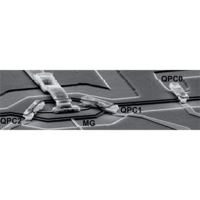
In this paper the authors study the dependence of the visibility of the Aharonov-Bohm oscillations of an electronic Mach-Zehnder interferometer upon the transmission properties of an additional quantum point contact placed in front of the interferometer’s input. According to a theory by I. P. Levkivskyi and E. V. Sukhorukov ( Phys. Rev. Lett. 103, 036801 (2009)), a non-equilibrium noise-induced phase transition is meant to occur when the transmission of the point contact equals 1/2. The authors present experimental evidence for the existence of this critical point.

Hybrid waves localized at hyperbolic metasurfaces

O. Y. Yermakov, A. I. Ovcharenko, M. Song, A. A. Bogdanov, I. V. Iorsh, and Yu. S. Kivshar

Phys. Rev. B 91, 235423 (2015) - Published 15 June, 2015

The authors show theoretically that hyperbolic metasurfaces support simultaneous propagation of both quasi-TE and quasi-TM plasmon surface modes of “hybrid’” polarization at the same frequency — a two-dimensional analog of D’yakonov surface waves. The shape of their equal-frequency contours depends drastically on the frequency and changes from elliptical to hyperbolic, and so a topological transition takes place.

Fermi surface instabilities in CeRh2Si2 at high magnetic field and pressure

A. Palacio Morales, A. Pourret, G. Seyfarth, M.-T. Suzuki, D. Braithwaite, G. Knebel, D. Aoki, and J. Flouquet

Phys. Rev. B 91, 245129 (2015) - Published 15 June, 2015

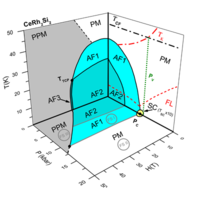
Measurements of thermoelectric power are used to show that the heavy fermion compound CeRh2Si2 has very different Fermi surfaces in different portions of the pressure-temperature phase diagram.

Electronic structure, spin-orbit coupling, and interlayer interaction in bulk MoS2 and WS2

Drew W. Latzke, Wentao Zhang, Aslihan Suslu, Tay-Rong Chang, Hsin Lin, Horng-Tay Jeng, Sefaattin Tongay, Junqiao Wu, Arun Bansil, and Alessandra Lanzara

Phys. Rev. B 91, 235202 (2015) - Published 11 June, 2015

Angle-resolved photoemission spectroscopy experiments reveal that the valence band splitting at K point in transition metal dichalcogenides is primarily due to the spin-orbit coupling rather than inter-layer interactions. The authors have achieved convincing agreement between experimental results and theoretical calculations over a wide energy range.

Majorana entanglement bridge

Stephan Plugge, Alex Zazunov, Pasquale Sodano, and Reinhold Egger

Phys. Rev. B 91, 214507 (2015) - Published 10 June, 2015

In this paper, the authors study the entanglement between two quantum dots mediated by a superconducting island hosting a pair of Majorana bound states. They show that, within several parameter regions, it is possible to obtain long-ranged entanglement between the dots and study the degree of this entanglement after a quench of tunnel couplings to the dots.

Entanglement entropy near Kondo-destruction quantum critical points

J. H. Pixley, Tathagata Chowdhury, M. T. Miecnikowski, Jaimie Stephens, Christopher Wagner, and Kevin Ingersent

Phys. Rev. B 91, 245122 (2015) - Published 10 June, 2015

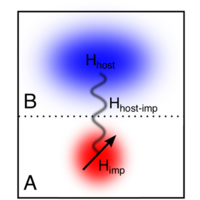
Entanglement entropy in several quantum impurity models is computed around the quantum critical point between the ordered and disordered phases and is found to be non-universal.

Manipulating the magnetic state of a carbon nanotube Josephson junction using the superconducting phase

R. Delagrange, D. J. Luitz, R. Weil, A. Kasumov, V. Meden, H. Bouchiat, and R. Deblock

Phys. Rev. B 91, 241401(R) (2015) - Published 9 June, 2015

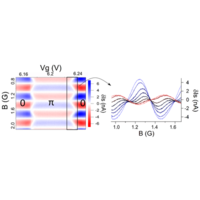
Using a cleverly designed device contacting superconducting leads to a carbon nanotube quantum dot, the authors investigate the magnetic state of a quantum dot attached to superconducting leads in a regime where the Kondo energy competes with the superconducting correlations. In this regime, the magnetic state of the system depends on the difference of superconducting phase between the two electrodes. This paper reports the first experimental observation of this effect.

Anderson localization and the topology of classifying spaces

Takahiro Morimoto, Akira Furusaki, and Christopher Mudry

Phys. Rev. B 91, 235111 (2015) - Published 8 June, 2015

In this work the authors generate the ten-fold classification of the periodic table of topological insulators by studying random Dirac Hamiltonians supporting a Dirac mass. They use homotopy groups to establish the phase diagram that encodes Anderson localization and provide an alternative explanation for the even-odd effect in the one-dimensional chiral classes.

Assembling Fibonacci anyons from a Z3 parafermion lattice model

E. M. Stoudenmire, David J. Clarke, Roger S. K. Mong, and Jason Alicea

Phys. Rev. B 91, 235112 (2015) - Published 8 June, 2015

Coupling arrays of extrinsic defects provides a promising avenue towards realizing exotic phases of matter. By varying the coupling between parafermionic zero modes and moving from triangular lattice to square lattice authors explore the ground states of the model and describe a method to assemble Fibonacci anyons.

Interlayer resonant Raman modes in few-layer MoS2

Nils Scheuschner, Roland Gillen, Matthias Staiger, and Janina Maultzsch

Phys. Rev. B 91, 235409 (2015) - Published 8 June, 2015

Two new first-order Raman-active modes are experimentally observed in few-layer MoS2 samples. The authors of this paper show that these modes should appear in virtually all few-layer systems. Since these new modes are symmetry-forbidden in single-layer structures, the results are going to be useful for metrology of layered thin films.

Spin texture of generic helical edge states

Alexia Rod, Thomas L. Schmidt, and Stephan Rachel

Phys. Rev. B 91, 245112 (2015) - Published 8 June, 2015

While many of the effects in two-dimensional topological insulators do not depend on the precise edge state structure because of their topological nature, more detailed experimental probes can extract non-topological information. In this paper the authors present comprehensive study of helical edge states of generic quantum spin Hall insulators whose quantization axis rotates as a function of the edge carrier momentum. This analysis reveals the information that can aid the spectroscopic detection of the spin texture of helical edge states.

Electrostriction enhancement in metamaterials

M. J. A. Smith, B. T. Kuhlmey, C. Martijn de Sterke, C. Wolff, M. Lapine, and C. G. Poulton

Phys. Rev. B 91, 214102 (2015) - Published 4 June, 2015

In this proof-of-concept analytical study (supported by numerical examples) the authors are able to achieve controllable enhancement of the electrostriction in a metamaterial medium consisting of an array of spheres in a host medium. Accounting for material dispersion and losses for a few test cases, they show a sizable enhancement (or suppression) and tunability of the electrostrictive properties. We anticipate that this study will open interesting directions previously unexplored in metamaterials research.

Real-time observation of collective excitations in photoemission

C. Lemell, S. Neppl, G. Wachter, K. Tőkési, R. Ernstorfer, P. Feulner, R. Kienberger, and J. Burgdörfer

Phys. Rev. B 91, 241101(R) (2015) - Published 3 June, 2015

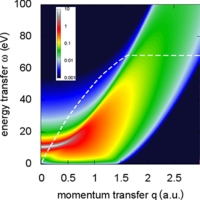
A method is proposed to solve a longstanding problem in photoelectron spectroscopy: the determination of the branching ratio between intrinsic and extrinsic plasmon generation. Attosecond metrology in combination with model simulations allow for a disentanglement of these excitation channels providing novel insight into the many-electron response of metals.

Complex magnetostructural order in the frustrated spinel LiInCr4O8

Gøran. J. Nilsen, Yoshihiko Okamoto, Takatsugu Masuda, Juan Rodriguez-Carvajal, Hannu Mutka, Thomas Hansen, and Zenji Hiroi

Phys. Rev. B 91, 174435 (2015) - Published 27 May, 2015

A magnetic insulator, LiInCr4O8 realizes a so-called “breathing” pyrochlore lattice of S=3/2 spins on corner-sharing tetrahedra that alternate in size. In this manuscript, a collaboration of researchers from Institut Laue-Langevin in Grenoble and Institute for Solid State Physics in Tokyo present a detailed neutron scattering study that elucidates the sequence of structural and magnetic phase transitions that occur at low temperatures in this material.

Comparative study of ab initio nonradiative recombination rate calculations under different formalisms

Lin Shi, Ke Xu, and Lin-Wang Wang

Phys. Rev. B 91, 205315 (2015) - Published 27 May, 2015
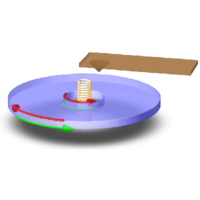
Nonradiative deep level carrier trapping, also known as the Shockley-Read-Hall effect, is an old and important problem in semiconductor physics. Five different possible formalisms, which have given very different results for calculations of the capture coefficients, are compared here with each other and with extant experimental results for two complex defect structures: GaP:ZnGa-OP and GaN:ZnGa-VN. The static coupling theory is shown to be in the best agreement with experiment and arguments are provided for why it should be used in calculations of nonradiative carrier recombination.

Sign In to Your Journals Account

Filter

Section

Filter

Article Lookup

Enter a citation