Highlights

Effective field theory for a p-wave superconductor in the subgap regime

T. H. Hansson, T. Kvorning, V. P. Nair, and G. J. Sreejith

Phys. Rev. B 91, 075116 (2015) - Published 19 February, 2015

An important theoretical approach to topologically ordered phases is based on topological field theories. These directly incorporate such important features as the absence of bulk excitations, ground state degeneracy on topologically nontrivial manifolds, and dynamical edge states. The authors construct an effective field theory for a two-dimensional spinless p-wave superconductor that describes the topological properties of the bulk state, and also provides a model for the subgap states at vortex cores and edges.

Multiferroicity in orthorhombic RMnO3 (R=Dy,Tb, and Gd) under high pressure

Takuya Aoyama, Ayato Iyama, Katsuya Shimizu, and Tsuyoshi Kimura

Phys. Rev. B 91, 081107(R) (2015) - Published 18 February, 2015

In type-II multiferroics ferroelectricity is driven by magnetism, and the coupling between the two orders is generally larger than in conventional multiferroic materials. However, a critical problem that needs to be overcome for type-II multiferroics is that their polarization is far too low to be useful for applications. In this Rapid Communication, a group of researchers from Osaka University, Japan, demonstrate that in three prototypical manganites (TbMnO3, DyMnO3, and GdMnO3) magnetic field can induce giant changes in polarization under high pressure. In the gadolinium compound, the change they have observed reaches the record high value of 1.3 μC/cm2 among the spin-driven multiferroics.

Ultrafast carrier relaxation through Auger recombination in the topological insulator Bi1.5Sb0.5Te1.7Se1.3

Yoshito Onishi, Zhi Ren, Kouji Segawa, Wawrzyniec Kaszub, Maciej Lorenc, Yoichi Ando, and Koichiro Tanaka

Phys. Rev. B 91, 085306 (2015) - Published 17 February, 2015

Using pump-probe spectroscopy a Japanese research team studies the physical properties of an intrinsic topological insulator material. Monitoring initial non-equilibrium photo-excitation they find that Auger recombination is an essential relaxation mechanism, in addition to thermalization, cooling, and population relaxation and dominates for higher carrier densities.

Strain field of a buried oxide aperture

F. Kießling, T. Niermann, M. Lehmann, J.-H. Schulze, A. Strittmatter, A. Schliwa, and U. W. Pohl

Phys. Rev. B 91, 075306 (2015) - Published 12 February, 2015

Site-controlled and scalable growth of quantum dots in semiconductors is an active area of research important for a number of applications. In one approach the position of the quantum dots is determined by artificially engineered local strain fields in the growth surface. A more complete and accurate understanding of the growth process depends on the ability to accurately the strain, and this is what the authors pursue in this article using high-precision dark-field electron holography.

Many-body localization edge in the random-field Heisenberg chain

David J. Luitz, Nicolas Laflorencie, and Fabien Alet

Phys. Rev. B 91, 081103(R) (2015) - Published 9 February, 2015

The authors study the phenomena of many-body localization in a random field Heisenberg chain. In this paper the authors use a shift-inverse exact diagonalization approach that allows them to study the mid-spectrum spectral properties of the model for system sizes of up to N=22. This has allow the authors to identify the many-body localization edge.

Phase diagram of the antiferromagnetic XXZ model on the triangular lattice

Daniel Sellmann, Xue-Feng Zhang (张学锋), and Sebastian Eggert

Phys. Rev. B 91, 081104(R) (2015) - Published 9 February, 2015

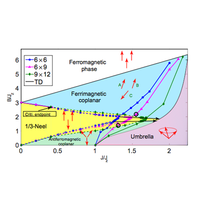
This paper studies studies the spin-1/2 XXZ antiferromagnet on a triangular lattice using a density matrix renormalization group. The authors study the phase diagram of this model as a function of magnetic field and spin anisotropy.

Ultrafast dynamic conductivity and scattering rate saturation of photoexcited charge carriers in silicon investigated with a midinfrared continuum probe

Fanqi Meng, Mark D. Thomson, Bo E. Sernelius, Michael Jörger, and Hartmut G. Roskos

Phys. Rev. B 91, 075201 (2015) - Published 4 February, 2015

The optical response of photoinduced charge-carrier plasmas in silicon are measured over a wide range of excitation densities in a pump-probe experiment. By using not just traditional terahertz probe pulses but also terahertz-midinfrared, a better estimate of the charge carrier scattering time is found. A detailed analysis of the early time dynamics in their experiment is also presented.

Enhanced performance of joint cooling and energy production

O. Entin-Wohlman, Y. Imry, and A. Aharony

Phys. Rev. B 91, 054302 (2015) - Published 3 February, 2015

A three-terminal thermoelectric junction is studied theoretically and a counterintuitive result is obtained. The cooling efficiency is increased for configurations when not only one terminal is cooled but also electric power is generated.

Nonequilibrium plasmons with gain in graphene

A. Freddie Page, Fouad Ballout, Ortwin Hess, and Joachim M. Hamm

Phys. Rev. B 91, 075404 (2015) - Published 3 February, 2015

A theoretical evaluation of the dynamic polarizability of graphene in a photoexcited carrier inversion state shows that graphene can support nonequilibrium plasmons with gain. The authors predict that the experimental observation of plasmon amplification in graphene is possible under realistic conditions. This would help overcome the barriers to using graphene in plasmonics due to plasmon losses.

Controlled suppression of superconductivity by the generation of polarized Cooper pairs in spin-valve structures

M. G. Flokstra, T. C. Cunningham, J. Kim, N. Satchell, G. Burnell, P. J. Curran, S. J. Bending, C. J. Kinane, J. F. K. Cooper, S. Langridge, A. Isidori, N. Pugach, M. Eschrig, and S. L. Lee

Phys. Rev. B 91, 060501(R) (2015) - Published 2 February, 2015

The authors create an unconventional superconducting state in the vicinity of noncollinear ferromagnetic interfaces. In particular, they use Co spin-valve structures to modify the superconducting state of Nb, a conventional superconductor, by the controlled generation of equal spin superconducting triplets from the singlet ground state.

Flux cutting in high-Tc superconductors

V. Vlasko-Vlasov, A. Koshelev, A. Glatz, C. Phillips, U. Welp, and W. Kwok

Phys. Rev. B 91, 014516 (2015) - Published 30 January, 2015

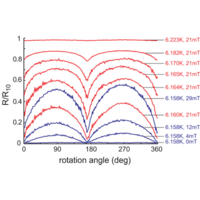
A magneto-optical study of flux distributions in superconducting YBCO under various applied crossed-field orientations elucidates the complex nature of magnetic flux cutting, and reveals unusual vortex patterns induced by the interplay between flux-cutting and vortex pinning.

Unconventional superconductivity in quasi-one-dimensional Rb2Cr3As3

Zhang-Tu Tang, Jin-Ke Bao, Yi Liu, Yun-Lei Sun, Abduweli Ablimit, Hui-Fei Zhai, Hao Jiang, Chun-Mu Feng, Zhu-An Xu, and Guang-Han Cao

Phys. Rev. B 91, 020506(R) (2015) - Published 30 January, 2015

Following the authors’ own discovery of superconductivity in quasi-one-dimensional K2Cr3As3, the analogous compound Rb2Cr3As3 is synthesized for the first time in polycrystalline form. Bulk superconductivity emerges at 4.8 K. Further work is needed to verify the nature of the superconducting state.

Anisotropic Hc2, thermodynamic and transport measurements, and pressure dependence of Tc in K2Cr3As3 single crystals

Tai Kong, Sergey L. Bud'ko, and Paul C. Canfield

Phys. Rev. B 91, 020507(R) (2015) - Published 30 January, 2015

K2Cr3As3 is a newly discovered compound that has a superconducting transition temperature of 6.1 K. Special interest in it stems from the fact that it crystallizes in a hexagonal lattice containing a quasi-one-dimensional chain structure made of (Cr3As3)2-. With careful measurements on single crystals this research team from Iowa State University demonstrates that although the material can be considered to be close to quasi-one-dimensional in a crystallographic sense, the data support a three-dimensional nature with Fermi-liquid-like properties.

Two distinct kinetic regimes for the relaxation of light-induced superconductivity in La1.675Eu0.2Sr0.125CuO4

C. R. Hunt, D. Nicoletti, S. Kaiser, T. Takayama, H. Takagi, and A. Cavalleri

Phys. Rev. B 91, 020505(R) (2015) - Published 29 January, 2015

Using femtosecond laser excitation to melt stripe order in La1.675Eu0.2Sr0.125CuO4, the authors reintroduce c-axis coherent coupling and observe the formation and subsequent relaxation of a competing state, which can be induced up to 80 K. In addition, they also find two distinct kinetic regimes above and below the spin-order transition at TSO~25 K.

Theory of lasing action in plasmonic crystals

J. Cuerda, F. Rüting, F. J. García-Vidal, and J. Bravo-Abad

Phys. Rev. B 91, 041118(R) (2015) - Published 26 January, 2015

In the context of plasmonic nanolasers, it has been previously recognized that systems with physically extended modes (as opposed to isolated cavity modes) can support lasing, and plasmonic crystals are a platform for such effects. In the present paper the authors present a general study that explores, from a unified perspective, the lasing properties of plasmonic crystals incorporating optically pumped four-level gain media.

High-Q optical cavities in hyperuniform disordered materials

Timothy Amoah and Marian Florescu

Phys. Rev. B 91, 020201(R) (2015) - Published 20 January, 2015

Hyperuniform disordered materials are a class of photonic solids with a constrained randomness that have short-range order and long-range statistical isotropy. In these materials, calculations suggest a new type of high-Q localization mechanism in optical cavities, that has no analogue in periodic or quasi-periodic photonic crystals.

Layer-dependent electronic structure of an atomically heavy two-dimensional dichalcogenide

Po-Chun Yeh, Wencan Jin, Nader Zaki, Datong Zhang, Jonathan T. Liou, Jerzy T. Sadowski, Abdullah Al-Mahboob, Jerry I. Dadap, Irving P. Herman, Peter Sutter, and Richard M. Osgood, Jr.

Phys. Rev. B 91, 041407(R) (2015) - Published 20 January, 2015

The first direct measurements are reported of the evolution of the thickness-dependent electronic band structure of monolayers of a material of much current interest. Angle-resolved photoemission is performed on the few-layer single-crystal dichalcogenide WSe2, which is in a class of graphene-like semiconductors with a desirable band gap in the visible frequency range. These results strongly support the presence of a predicted transition from an indirect (bulk or bilayer) to direct (one monolayer) band gap. Values are obtained for the effective mass and spin-orbit splitting of few-layer WSe2, parameters which are very important for transport studies and device applications.

Nonlinear terahertz field-induced carrier dynamics in photoexcited epitaxial monolayer graphene

Hassan A. Hafez, Ibraheem Al-Naib, Marc M. Dignam, Yoshiaki Sekine, Katsuya Oguri, François Blanchard, David G. Cooke, Satoru Tanaka, Fumio Komori, Hiroki Hibino, and Tsuneyuki Ozaki

Phys. Rev. B 91, 035422 (2015) - Published 16 January, 2015

Optical measurements on highly doped single-layer epitaxial graphene reveal that the photoexcitation of charge carriers leads to an enhancement of the THz transmission. In this paper, the results are explained in terms of the change in the carrier scattering rate due to the optical pump fluence and the THz electric field.

Infinite density matrix renormalization group for multicomponent quantum Hall systems

Michael P. Zaletel, Roger S. K. Mong, Frank Pollmann, and Edward H. Rezayi

Phys. Rev. B 91, 045115 (2015) - Published 14 January, 2015

Quantum Hall systems are expected to host a variety of exotic phases. In particular 5/2 filling fraction is believed to contain non-Abelian anyons. However, the exact nature of the ground state is sensitive to many factors and is hard to access. In this paper the authors develop a method to take into account scattering between Landau levels and show that, at 5/2 filling, it leads to the stabilization of the so called anti-Pfaffian state.

Competing superconducting and magnetic order parameters and field-induced magnetism in electron-doped Ba(Fe1−xCox)2As2

J. Larsen, B. Mencia Uranga, G. Stieper, S. L. Holm, C. Bernhard, T. Wolf, K. Lefmann, B. M. Andersen, and C. Niedermayer

Phys. Rev. B 91, 024504 (2015) - Published 13 January, 2015

This paper presents a systematic study of the magnetic and superconducting properties of Ba(Fe0.95Co0.05)2As2 as a function of temperature and external magnetic field using neutron scattering and muon spin rotation. Calculations based on the five-band Hubbard Hamiltonian reproduce the physical properties of the coexistence region of Ba(Fe1-xCox)2As2. Below the superconducting transition temperature the magnetic and superconducting order parameters coexist and compete. An external magnetic field significantly enhances the magnetic order parameter within the superconducting state. This behavior can be caused by the vortices, which in the superconducting state can slow down and locally freeze spin fluctuations.

Sign In to Your Journals Account

Filter

Section

Filter

Article Lookup

Enter a citation