Highlights

Magnetic structure and magnetocalorics of GdPO4

E. Palacios, J. A. Rodríguez-Velamazán, M. Evangelisti, G. J. McIntyre, G. Lorusso, D. Visser, L. J. de Jongh, and L. A. Boatner

Phys. Rev. B 90, 214423 (2014) - Published 12 December, 2014

Low-temperature neutron diffraction and field-dependent heat capacity measurements for the monazite GdPO4 compound shows some very interesting properties. In particular it displays a large magnetocaloric effect and it shows promise in applications for cooling at very low temperatures.

Skew scattering in dilute ferromagnetic alloys

Bernd Zimmermann, Kristina Chadova, Diemo Ködderitzsch, Stefan Blügel, Hubert Ebert, Dmitry V. Fedorov, Nguyen H. Long, Phivos Mavropoulos, Ingrid Mertig, Yuriy Mokrousov, and Martin Gradhand

Phys. Rev. B 90, 220403(R) (2014) - Published 8 December, 2014

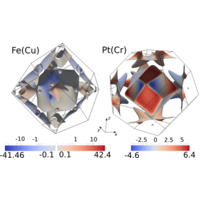
A detailed material-dependent analysis of the skew scattering mechanism in dilute alloys is presented for the first time for the anomalous Hall effect. In addition, the authors examine the spin Hall effect in ferromagnets from a first-principles perspective shedding light on its magnitude and on its relation to the anomalous Hall effect. Also, three up-to-date numerical methods are compared to each other demonstrating the subtlety of the effects under investigation. Small changes in the theoretical analysis or the experimental methods can, under certain conditions, influence the results drastically. The authors provide guidelines to both theoreticians and experimentalists as to where special attention has to be paid.

Energy density of variational states

Leon Balents

Phys. Rev. B 90, 245116 (2014) - Published 8 December, 2014

For a given many-body Hamiltonian, can a wavefunction in the wrong phase yield an arbitrarily good variational approximation to the true ground state energy density? The author discusses systems for which the answer is positive and outlines other cases where the Hamiltonian is expected to be variationally robust.

Threshold of magnetic field response of the superconducting proximity effect for ultrathin Pb/Ag metallic films

M. Caminale, A. A. Leon Vanegas, A. Stępniak, H. Oka, D. Sander, and J. Kirschner

Phys. Rev. B 90, 220507(R) (2014) - Published 5 December, 2014

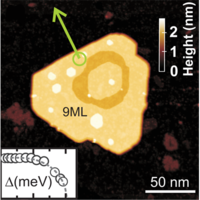
By exploiting the high spatial resolution of scanning tunneling microscopy/spectroscopy at sub-Kelvin temperatures, the authors investigate superconductivity in the prototypical Pb/Ag/Si(111) system. In this paper they present the first experimental consideration of the effect of an external magnetic field on the spatially-dependent extension of superconductivity across a nanostructure superconductor-metal boundary. This study reveals the first quantitative data on the interplay between induced superconductivity in a normal metal and magnetic field with nanometer spatial resolution.

Determination of Fermi contour and spin polarization of ν=32 composite fermions via ballistic commensurability measurements

D. Kamburov, M. A. Mueed, I. Jo, Yang Liu, M. Shayegan, L. N. Pfeiffer, K. W. West, K. W. Baldwin, J. J. D. Lee, and R. Winkler

Phys. Rev. B 90, 235108 (2014) - Published 2 December, 2014

In the composite fermions (CF) framework, at filling factor ν = 3/2 each carrier pairs up with two flux quanta to form quasi particles. The flux attachment cancels the external field, leaving the CFs as if they are at zero field — they occupy a Fermi sea with a well-defined Fermi contour. To examine this contour and its anisotropy induced by in-plane magnetic field, the authors apply the method of periodic grating of Hall bar samples, previously used by them in studies of CF near the filling factor 1/2. It is found that CF spin polarization increases with increasing quantum well width and electron density, and that in-plane magnetic field induces a larger CF Fermi contour anisotropy near filling factor 3/2 than near 1/2.

Transport characteristics of a single C60-molecule junction revealed by multiple Andreev reflections

Ryoichi Hiraoka, Ryuichi Arafune, Noriyuki Tsukahara, Maki Kawai, and Noriaki Takagi

Phys. Rev. B 90, 241405(R) (2014) - Published 2 December, 2014

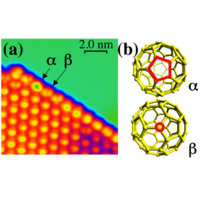
The I-V characteristics for atomic junction between two superconductors exhibit steps at voltages 2Δ/n (with n=1, 2, 3, …) associated with multiple Andreev reflections (MAR). These features have been used in the past to determine the fundamental transport characteristics of atomic junctions. In this work, the authors present a development of the MAR technique by utilizing a superconducting Nb STM tip as one of the leads to study the transport properties of C60 fullerene molecule. By analyzing the tunneling spectra and high-resolution molecular imaging, they were able to determine the number of conduction channels for C60 as well as the origin and the dependence of the transmission coefficients on the contact geometry.

Quantum Hall ice

Gia-Wei Chern, Armin Rahmani, Ivar Martin, and Cristian D. Batista

Phys. Rev. B 90, 241102(R) (2014) - Published 1 December, 2014

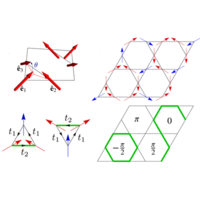
The authors study a model in which non-interacting itinerant electrons are coupled to Ising spins in kagome spin ice. They demonstrate that spin disorder leads to localization of itinerant electron states and to plateaus in the Hall conductance as a function of electron density.

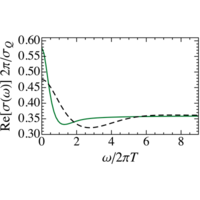
Conformal field theories at nonzero temperature: Operator product expansions, Monte Carlo, and holography

Emanuel Katz, Subir Sachdev, Erik S. Sørensen, and William Witczak-Krempa

Phys. Rev. B 90, 245109 (2014) - Published 1 December, 2014

Strongly correlated quantum critical points with conformal symmetry in two spatial dimensions describe many phase transitions in condensed matter systems, as for example that from superfluid to insulator. Combining field theory methods, Monte Carlo simulations, and the holographic duality from string theory, the authors use an operator product expansion to derive non-perturbative results for these systems, including the leading terms in the frequency dependence of the nonzero temperature conductivity and sum rules obeyed by the conductivity. These methods and results are applicable to a wide class of conformal field theories for condensed matter systems.

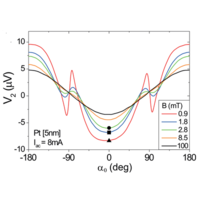
Simultaneous detection of the spin-Hall magnetoresistance and the spin-Seebeck effect in platinum and tantalum on yttrium iron garnet

N. Vlietstra, J. Shan, B. J. van Wees, M. Isasa, F. Casanova, and J. Ben Youssef

Phys. Rev. B 90, 174436 (2014) - Published 26 November, 2014

This is a simultaneous, but separate, detection of the spin Hall magnetoresistance and the spin Seebeck effect in Pt and Ta on YIG, by using a lock-in detection technique. In this way, the authors observe the dynamic behavior of the magnetization of the YIG, when applying low magnetic fields and high ac currents, i.e., in the regime where the system can be influenced by spin-transfer torques. They identify a new type of signal, present for small values of magnetic field, and demonstrate that this is due to changes in the spin Hall magnetoresistance signal caused by the Oersted-field-induced motion of the magnetic material.

Coherent feedback control in quantum transport

Clive Emary and John Gough

Phys. Rev. B 90, 205436 (2014) - Published 26 November, 2014

This paper adapts control theory to the study of quantum transport in mesoscopic systems. In particular the authors study coherent control where the system as well as the controller are quantum coherent.

Spin Hall torque magnetometry of Dzyaloshinskii domain walls

Satoru Emori, Eduardo Martinez, Kyung-Jin Lee, Hyun-Woo Lee, Uwe Bauer, Sung-Min Ahn, Parnika Agrawal, David C. Bono, and Geoffrey S. D. Beach

Phys. Rev. B 90, 184427 (2014) - Published 25 November, 2014

Spin-orbit coupling at a heavy-metal/ferromagnet interface can generate current-induced torques of several possible symmetries while simultaneously affecting the internal structure of domain walls driven by these torques. Disentangling these effects quantitatively is challenging but essential in order to understand the underlying physics of domain wall dynamics in ultrathin ferromagnets. By using in-plane magnetic fields one can isolate these effects based on symmetry. The authors show that in-plane fields, as well as current-induced torques, cause domain walls to rotate in the plane by up to 90 degrees. This new behavior also presents an important technological paradox: strong DMI is essential to achieve fast current-driven domain wall motion, but it simultaneously distorts domain walls dramatically, limiting their utility in applications. The authors propose a solution to this problem based on tuning spin Hall and Rashba torques at interfaces, whose feasibility is justified by recent measurements of these torques. They also show that in Pt/CoFe/MgO the DMI is surprisingly strong, close to the critical strength required for spontaneous skyrmion formation.

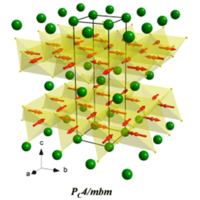
Symmetry of reentrant tetragonal phase in Ba1−xNaxFe2As2: Magnetic versus orbital ordering mechanism

D. D. Khalyavin, S. W. Lovesey, P. Manuel, F. Krüger, S. Rosenkranz, J. M. Allred, O. Chmaissem, and R. Osborn

Phys. Rev. B 90, 174511 (2014) - Published 24 November, 2014

Symmetry-allowed space groups are analyzed as a means to distinguish between magnetic and orbital order scenarios for the reentrant tetragonal phase in Ba1-xNaxFe2As2

Experimental realization of a Coulomb blockade refrigerator

A. V. Feshchenko, J. V. Koski, and J. P. Pekola

Phys. Rev. B 90, 201407(R) (2014) - Published 24 November, 2014

The authors present the first proof-of-concept experimental realization of a Coulomb blockade refrigerator using a single electron transistor. They argue that this device offers the ability to cool to temperatures well below 100 mK.

Ultrastrong coupling in the near field of complementary split-ring resonators

Curdin Maissen, Giacomo Scalari, Federico Valmorra, Mattias Beck, Jérôme Faist, Sara Cibella, Roberto Leoni, Christian Reichl, Christophe Charpentier, and Werner Wegscheider

Phys. Rev. B 90, 205309 (2014) - Published 24 November, 2014

Ultrastrong coupling of split ring resonators to the cyclotron transition in two-dimensional electron gases is studied in the terahertz regime, clarifying the importance of the resonator geometry. The use of the complementary type of resonator allows removal of the signal from the uncoupled areas. The experimental results are of spectacular quality and quantity. A record high light-matter coupling ratio (normalized vacuum Rabi frequency) of 0.87 is achieved.

Ballistic- and quantum-conductor carbon nanotubes: A reference experiment put to the test

M. Kobylko, M. Kociak, Y. Sato, K. Urita, A. M. Bonnot, A. Kasumov, Y. Kasumov, K. Suenaga, and C. Colliex

Phys. Rev. B 90, 195431 (2014) - Published 20 November, 2014

Using the liquid metal contact method for in-situ electron transport measurements in TEM, this paper revisits the question of whether carbon nanotubes (CNTs) are diffusive or ballistic conductors. It challenges previous conclusions of many ex-situ measurements that CNTs support ballistic transport and quantum conductance. It also suggests three reasons that possibly led to false positive results in the previous measurements.

Inverted singlet-triplet qubit coded on a two-electron double quantum dot

Sebastian Mehl and David P. DiVincenzo

Phys. Rev. B 90, 195424 (2014) - Published 19 November, 2014

Coherent control of quantum operations has previously been demonstrated in singlet-triplet qubits which store information in the relative spin of two electrons occupying two same size quantum dots positioned side by side. Here the authors propose to use two quantum dots differing both in size and out-of-plane magnetic field. This is called an inverted singlet-triplet qubit because the existence of a singlet-triplet inversion differs from other qubits. A comparative advantage is that the strongly confined quantum dot can be used for qubit initialization and readout while the weakly confined one is preferable for qubit manipulations. The authors show that full control could be implemented with electrostatic operations even in the presence of realistic noise.

Femtosecond intrapulse evolution of the magneto-optic Kerr effect in magnetoplasmonic crystals

M. R. Shcherbakov, P. P. Vabishchevich, A. Yu. Frolov, T. V. Dolgova, and A. A. Fedyanin

Phys. Rev. B 90, 201405(R) (2014) - Published 19 November, 2014

A time-resolved study of the transverse magneto-optic Kerr effect at femtosecond timescales. When 45-fs laser pulses are reflected from an iron grating under an external magnetic field, surface-plasmon polaritons with magnetization-dependent dispersion are excited; and as these decay in time, they affect the reflected pulse profile. This work opens the possibility of manipulating femtosecond laser pulses with external magnetic fields.

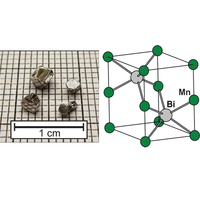
Symmetry-lowering lattice distortion at the spin reorientation in MnBi single crystals

Michael A. McGuire, Huibo Cao, Bryan C. Chakoumakos, and Brian C. Sales

Phys. Rev. B 90, 174425 (2014) - Published 18 November, 2014

Large single crystals of MnBi were created for the first time and examined with x-ray and neutron diffraction and thermal, electrical, and magnetization measurements. All of the data is consistent with a spin reorientation transition at around 90K associated with magneto-elastic coupling. Above that temperature, the Bi atomic displacement parameters continue to increase with temperature, which appears related to the increasing anisotropic thermal expansion and magnetocrystalline anisotropy. This study advances the potential of MnBi for applications as a robust rare-earth free permanent magnetic material.

Time-resolved imaging of domain pattern destruction and recovery via nonequilibrium magnetization states

Philipp Wessels, Johannes Ewald, Marek Wieland, Thomas Nisius, Andreas Vogel, Jens Viefhaus, Guido Meier, Thomas Wilhein, and Markus Drescher

Phys. Rev. B 90, 184417 (2014) - Published 17 November, 2014

The authors have built an X-ray microscope capable of taking snapshots of the domain formation process with a high spatial resolution down to a few ten nanometers. By exposing the sample to intense magnetic field pulses, they destroy the stable domain pattern and probe the rapid time-evolution of the sample magnetization stroboscopically with soft X-ray flashes created by the storage ring PETRA III at DESY in Hamburg. These flashes enable resolving very fast changes in the domain configuration occurring at a few hundred picoseconds and thus a video of the domain destruction and relaxation dynamics can be recorded in slow motion. Visualizing the process of domain formation and reorganization in real time helps developing future magnetic storage devices where digital information is contained in the alignment of nanometer sized domains.

Towards understanding the hydrogen molecule in ZnO

S. G. Koch, E. V. Lavrov, and J. Weber

Phys. Rev. B 90, 205212 (2014) - Published 17 November, 2014
Using Raman scattering, molecular hydrogen defects are shown to exist in ZnO, the first II-VI semiconductor in which this has been observed. The rotational-vibrational properties of the defects are shown to depend on the history of the sample and an ortho-para conversion between the nuclear spin states is observed.

Sign In to Your Journals Account

Filter

Section

Filter

Article Lookup

Enter a citation