Highlights

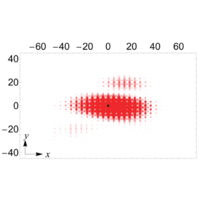
Direct observation of bulk charge modulations in optimally doped Bi1.5Pb0.6Sr1.54CaCu2O8+δ

M. Hashimoto, G. Ghiringhelli, W.-S. Lee, G. Dellea, A. Amorese, C. Mazzoli, K. Kummer, N. B. Brookes, B. Moritz, Y. Yoshida, H. Eisaki, Z. Hussain, T. P. Devereaux, Z.-X. Shen, and L. Braicovich

Phys. Rev. B 89, 220511(R) (2014) - Published 30 June, 2014

Using resonant inelastic soft x-ray scattering, the authors observe charge collective modes in Pb-Bi2212 at optimal doping that compete with superconductivity. Together with prior observations in the underdoped region, these results suggest that the modes are a universal feature in the pseudogap regime.

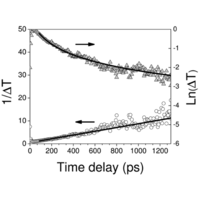
Memory effects, two color percolation, and the temperature dependence of Mott variable-range hopping

Oded Agam and Igor L. Aleiner

Phys. Rev. B 89, 224204 (2014) - Published 30 June, 2014

This paper presents a new advance in the theory of hopping conductivity by taking into account charge correlations generated due to memory effects.

Dynamical many-body corrections to the residual resistivity of metals

V. U. Nazarov, G. Vignale, and Y.-C. Chang

Phys. Rev. B 89, 241108(R) (2014) - Published 30 June, 2014

The authors study dynamical corrections to the residual resistivity of metals at zero temperature using a new form of the time-dependent many-body exchange-correlation potential derived from the time-dependent current density functional theory. Unexpectedly, they find significant dynamical corrections even in simple metals, and a surprising role played by the nondissipative electronic shear modulus in shaping the electric resistivity.

Pairing symmetry and dominant band in Sr2RuO4

Thomas Scaffidi, Jesper C. Romers, and Steven H. Simon

Phys. Rev. B 89, 220510(R) (2014) - Published 27 June, 2014

Multiple high-temperature transitions driven by dynamical structures in NaI

M. E. Manley, J. R. Jeffries, H. Lee, N. P. Butch, A. Zabalegui, and D. L. Abernathy

Phys. Rev. B 89, 224106 (2014) - Published 27 June, 2014

Using inelastic neutron scattering, x-ray diffraction, and heat capacity measurements, the authors study intrinsic localized modes in NaI. Their results suggest that, as the temperature is varied, NaI undergoes several unconventional phase transitions that are due to anharmonicity of the lattice vibrations.

Layer-controlled band gap and anisotropic excitons in few-layer black phosphorus

Vy Tran, Ryan Soklaski, Yufeng Liang, and Li Yang

Phys. Rev. B 89, 235319 (2014) - Published 26 June, 2014

The authors report that the band structure of few-layer black phosphorous is anisotropic and the band gap increases with the decrease in number of staking layers. The optical absorption and excitonic effects are also anisotropic.

Photon assisted tunneling in pairs of silicon donors

K. L. Litvinenko, S. G. Pavlov, H.-W. Hübers, N. V. Abrosimov, C. R. Pidgeon, and B. N. Murdin

Phys. Rev. B 89, 235204 (2014) - Published 19 June, 2014

The authors provide an experimental demonstration that an electron can tunnel between shallow phosphorus and antimony donors in Si at zero fields upon selective excitation of one of the centers by a THz pulse. These results show that the spin-to-charge conversion is practical with photon assisted tunnelling, as required for Kane-type quantum computing schemes

Magnetic-field-induced phases in anisotropic triangular antiferromagnets: Application to CuCrO2

Shi-Zeng Lin, Kipton Barros, Eundeok Mun, Jae-Wook Kim, Matthias Frontzek, S. Barilo, S. V. Shiryaev, Vivien S. Zapf, and Cristian D. Batista

Phys. Rev. B 89, 220405(R) (2014) - Published 18 June, 2014

Triangular lattice antiferromagnet CuCrO2 is an intriguing multiferroic where ferroelectricity is induced by chiral magnetic order. The detailed sequence of magnetic transitions in this compound, as a function of magnetic field and temperature, is an actively investigated subject. The authors of this Rapid Communication extend the earlier experiments in high-magnetic field (see e.g. E. Mun et al, Phys. Rev. B, 89 054411 (2011)) to 92 Tesla and propose a minimal model that reproduces the main features of the observed phase diagram.

Pressure-induced polar phases in multiferroic delafossite CuFeO2

Noriki Terada, Dmitry D. Khalyavin, Pascal Manuel, Toyotaka Osakabe, Paolo G. Radaelli, and Hideaki Kitazawa

Phys. Rev. B 89, 220403(R) (2014) - Published 13 June, 2014

Using a unique experimental setup allowing neutron diffraction measurements at pressures up to 10 GPa, the collaboration of authors from Japan and UK investigate pressure-induced magnetic phase transitions in CuFeO2 – a triangular lattice antiferromagnet that exhibits multiferroic behavior.

Time-reversal-invariant topological superconductivity induced by repulsive interactions in quantum wires

Arbel Haim, Anna Keselman, Erez Berg, and Yuval Oreg

Phys. Rev. B 89, 220504(R) (2014) - Published 13 June, 2014

The authors show that repulsive interactions in a Rashba wire coupled to a conventional superconductor can lead to time-reversal invariant topological superconductivity. Such state supports Majorana bound states in the absence of magnetic field.

Effect of nonmagnetic dilution in the honeycomb-lattice iridates Na2IrO3 and Li2IrO3

S. Manni, Y. Tokiwa, and P. Gegenwart

Phys. Rev. B 89, 241102(R) (2014) - Published 12 June, 2014

The authors have synthesized single crystals of magnetically depleted iridates by substituting Ir in Na2IrO3 and Li2IrO3 with non-magnetic Ti, and have studied the effects of the depletion through measurements of the magnetic susceptibility, specific heat, and magnetocaloric effect.

Theory of nonlinear phononics for coherent light control of solids

Alaska Subedi, Andrea Cavalleri, and Antoine Georges

Phys. Rev. B 89, 220301(R) (2014) - Published 11 June, 2014

A microscopic theory for ultrafast control of solids with tera-hertz optical pulses account for a light-induced insulator-to-metal transition.

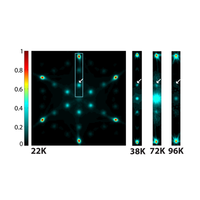
Visualizing the charge density wave transition in 2H-NbSe2 in real space

C. J. Arguello, S. P. Chockalingam, E. P. Rosenthal, L. Zhao, C. Gutiérrez, J. H. Kang, W. C. Chung, R. M. Fernandes, S. Jia, A. J. Millis, R. J. Cava, and A. N. Pasupathy

Phys. Rev. B 89, 235115 (2014) - Published 11 June, 2014

Scanning tunneling microscopy measurements suggest that strong electron-lattice interactions, not Fermi surface physics, are the dominant cause for charge density wave formation in NbSe2

Effect of isoelectronic doping on the honeycomb-lattice iridate A2IrO3

S. Manni, Sungkyun Choi, I. I. Mazin, R. Coldea, Michaela Altmeyer, Harald O. Jeschke, Roser Valentí, and P. Gegenwart

Phys. Rev. B 89, 245113 (2014) - Published 11 June, 2014

This thorough experimental and theoretical investigation of (Na1-x Lix)2IrO3 clearly reveals that there is phase segregation for x larger than 0.25, extending the previoulsy proposed quantum critical region.

Resonant electron tunneling in a tip-controlled potential landscape

Nikola Pascher, Flavia Timpu, Clemens Rössler, Thomas Ihn, Klaus Ensslin, Christian Reichl, and Werner Wegscheider

Phys. Rev. B 89, 245408 (2014) - Published 9 June, 2014

The authors use the biased tip of a cryogenic atomic force microscope at a specific position above a semiconductor surface to locally shape the electrostatic potential landscape. This new experimental approach offers enormous tunability and allows to extract relevant length scales of electron transport in quantum Hall edge channels.

Superconductivity and correlated Fermi liquid behavior in noncentrosymmetric Ca3Ir4Ge4

Fabian von Rohr, Huixia Luo, Ni Ni, Michael Wörle, and Robert J. Cava

Phys. Rev. B 89, 224504 (2014) - Published 6 June, 2014

The authors synthesized Ca3Ir4Ge4, another member of the growing family of noncentrosymmetric superconductors. A detailed analysis of its properties indicates that substantial electron correlations may exist in this compound.

Suppression of dephasing and phase lapses in the fractional quantum Hall regime

Yehuda Dinaii, Yuval Gefen, and Bernd Rosenow

Phys. Rev. B 89, 241402(R) (2014) - Published 4 June, 2014

The authors study the interference degradation of a Mach-Zehnder interferometer capacitively coupled to a quantum dot. The authors explore dephasing in the interferometer when the quantum dot is tunnel-coupled to a chiral Luttinger liquid.

Bulk superconductivity in undoped T′-La1.9Y0.1CuO4 probed by muon spin rotation

K. M. Kojima, Y. Krockenberger, I. Yamauchi, M. Miyazaki, M. Hiraishi, A. Koda, R. Kadono, R. Kumai, H. Yamamoto, A. Ikeda, and M. Naito

Phys. Rev. B 89, 180508(R) (2014) - Published 30 May, 2014

The authors use muon-spin rotation techniques to show that a thin film of La1.9Y0.1CuO4 exhibits superconductivity. Their surprising conclusion is that the parent compound of an n-doped high-temperature superconductor is metallic, rather than a Mott insulator, with apical oxygens viewed as impurities.

Understanding the μSR spectra of MnSi without magnetic polarons

A. Amato, P. Dalmas de Réotier, D. Andreica, A. Yaouanc, A. Suter, G. Lapertot, I. M. Pop, E. Morenzoni, P. Bonfà, F. Bernardini, and R. De Renzi

Phys. Rev. B 89, 184425 (2014) - Published 30 May, 2014

A detailed μSR study of MnSi is used to rule out an exotic magnetic polaron bound state.

Identifying non-Abelian topological ordered state and transition by momentum polarization

Yi Zhang and Xiao-Liang Qi

Phys. Rev. B 89, 195144 (2014) - Published 30 May, 2014

Using momentum polarisation calculations to obtain the spin and central charge of the wave function, the authors are able to distinguish SU(2)2 2 Chern-Simons theories with and without coupling to fermions. This is a remarkable result since the two theories cannot be discriminated with conventional approaches.

Sign In to Your Journals Account

Filter

Section

Filter

Article Lookup

Enter a citation