Highlights

Role of metastable charge states in a quantum-dot spin-qubit readout

J. D. Mason, S. A. Studenikin, A. Kam, Z. R. Wasilewski, A. S. Sachrajda, and J. B. Kycia

Phys. Rev. B 92, 125434 (2015) - Published 25 September, 2015

The authors present an experimental mechanism for converting the state of a spin qubit in a quantum dot device into different charge states. This mechanism depends on metastable charge states present when the device has very asymmetric couplings to the external leads. This approach is used to observe Landau-Zener-Stuckelberg oscillations of the (S-T+) qubit.

Auxiliary master equation approach within matrix product states: Spectral properties of the nonequilibrium Anderson impurity model

Antonius Dorda, Martin Ganahl, Hans Gerd Evertz, Wolfgang von der Linden, and Enrico Arrigoni

Phys. Rev. B 92, 125145 (2015) - Published 24 September, 2015

The non-equilibrium Anderson impurity model is solved to an unprecedented accuracy to obtain its spectral properties in the steady state using a recently developed approach.

Polarization analysis of excitons in monolayer and bilayer transition-metal dichalcogenides

Hanan Dery and Yang Song

Phys. Rev. B 92, 125431 (2015) - Published 23 September, 2015

The authors theoretically study optical transitions in transition-metal dichalcogenides. In particular, they explain the difference between the excitonic properties of monolayer MoSe2 and WSe2. Excitons in WSe2 are thought to be bound to impurities. An alternative theory presented in this paper suggests that these excitons correspond to low-energy optical transitions. The authors also put forward an alternative explanation as to why the excitons in MoSe2 have vanishing polarization. They attribute this phenomenon to polaron-induced Rabi oscillations between dark and bright excitons.

Controlling transmission eigenchannels in random media by edge reflection

Liyi Zhao, Chushun Tian, Yury P. Bliokh, and Valentin Freilikher

Phys. Rev. B 92, 094203 (2015) - Published 21 September, 2015

When a wave is incident on an open random medium it is decomposed into a number of “partial waves” that propagate independently along natural channels, the so-called transmission eigenchannels, and are superposed again when they leave the medium. Here, the authors propose the use of asymmetric edge reflection (the asymmetry in the reflections of the sample edges) to control the perfectly transmitting eigenchannel in a quasi-one-dimensional diffusive medium.

Hyperspherical theory of the quantum Hall effect: The role of exceptional degeneracy

K. M. Daily, R. E. Wooten, and Chris H. Greene

Phys. Rev. B 92, 125427 (2015) - Published 21 September, 2015

The fractional quantum Hall effect is traditionally viewed as a distinctive attribute of strongly-interacting electron systems. This paper develops an alternative picture which suggests that the low energy quantum states corresponding to an experimentally observable filling fractions can be identified by simply having an exceptionally high degeneracy in the noninteracting limit.

Scattering particles in quantum spin chains

Laurens Vanderstraeten, Frank Verstraete, and Jutho Haegeman

Phys. Rev. B 92, 125136 (2015) - Published 18 September, 2015

Using a variational ansatz based on matrix product states, the authors present a methodology for determine the elementary excitations and their low energy scattering matrices of general quasi-one-dimensional spin systems. From these scattering matrices, the authors map the system unto an effective integrable model and then employ the thermodynamic Bethe ansatz so as to determine thermodynamic properties of the spin system. As a demonstration of the method, the authors apply it to a Heisenberg spin ladder.

Dynamics of fractionalization in quantum spin liquids

J. Knolle, D. L. Kovrizhin, J. T. Chalker, and R. Moessner

Phys. Rev. B 92, 115127 (2015) - Published 14 September, 2015

Quantum spin liquids are elusive states of matter, which have been predicted more than four decades ago but have not so far been conclusively sighted in nature. In this paper the authors study the so called ‘extended Kitaev model’, which has a number of different quantum spin-liquid phases including one with non-Abelian excitations. They present a solution of a long standing problem for this model, namely, the problem of obtaining the dynamical response function. Using a rarely available exact calculation, they find that there are indeed clear signatures in the spin structure factor betraying the presence of spin-liquids and their fractionalized quasi-particles, including those with non-Abelian statistics.

Area law and its violation: A microscopic inspection into the structure of entanglement and fluctuations

Irénée Frérot and Tommaso Roscilde

Phys. Rev. B 92, 115129 (2015) - Published 14 September, 2015

Entanglement in quantum many-body systems is one of the most challenging and fascinating recent trends in the study of complex quantum systems. A physical interpretation of the concept of “entanglement contour” is given using quantum many-body constructs and is generalized to the case of both fermionic and bosonic Hamiltonians within a unified framework. The relationship to number fluctuations and entropy is explored in a variety of free (quadratic) many-body systems.

Relativistic interaction Hamiltonian coupling the angular momentum of light and the electron spin

Ritwik Mondal, Marco Berritta, Charles Paillard, Surendra Singh, Brahim Dkhil, Peter M. Oppeneer, and L. Bellaiche

Phys. Rev. B 92, 100402(R) (2015) - Published 11 September, 2015

The coupling of the electric and magnetic degrees of freedom in condensed matter systems has long been an area of basic and applied research. In a 2013 PRL (PRL 110, 137205), a coupling energy term between the electromagnetic angular momentum density and the magnetization of a material was proposed. In this PRB, the authors provide a direct link between the proposed coupling term and the Dirac equation. They demonstrate that the Dirac equation leads to an interaction Hamiltonian (which they refer to as “angular magnetoelectric”, or AME, coupling Hamiltonian) that couples linearly the electron spin and the electromagnetic field’s angular momentum. They show that the AME coupling Hamiltonian has an expectation value that for some materials (e.g., ferromagnets) is equal to the recently proposed energy coupling, and that it contributes to the Inverse Faraday Effect. The AME coupling Hamiltonian may lead to the prediction and understanding of novel magnetoelectric and magneto-optical phenomena.

Spin polarization enhanced by spin-triplet pairing in Sr2RuO4 probed by NMR

K. Ishida, M. Manago, T. Yamanaka, H. Fukazawa, Z. Q. Mao, Y. Maeno, and K. Miyake

Phys. Rev. B 92, 100502(R) (2015) - Published 11 September, 2015

The spin susceptibility in strontium ruthenate is shown to undergo an increase when the material goes superconducting, a result in variance with most superconductors that we know. This behavior, once predicted for 3He too, is the surest sign that strontium ruthenate is a spin-triplet superconductor.

Two-dimensional Fourier transform spectroscopy of exciton-polaritons and their interactions

N. Takemura, S. Trebaol, M. D. Anderson, V. Kohnle, Y. Léger, D. Y. Oberli, M. T. Portella-Oberli, and B. Deveaud

Phys. Rev. B 92, 125415 (2015) - Published 11 September, 2015

Two-dimensional Fourier transform (2DFT) spectroscopy is a cutting-edge technique to investigate nonlinear many-body physics in semiconductor nanostructures. This paper reports an experimental and theoretical study of 2DFT on a high-quality GaAs-based semiconductor microcavity to gain an understanding of polariton self-interactions and polariton cross-interactions and their effects on the 2D spectra.

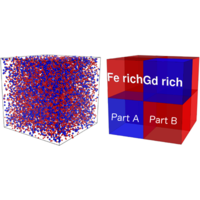
All-thermal switching of amorphous Gd-Fe alloys: Analysis of structural properties and magnetization dynamics

Raghuveer Chimata, Leyla Isaeva, Krisztina Kádas, Anders Bergman, Biplab Sanyal, Johan H. Mentink, Mikhail I. Katsnelson, Theo Rasing, Andrei Kirilyuk, Alexey Kimel, Olle Eriksson, and Manuel Pereiro

Phys. Rev. B 92, 094411 (2015) - Published 9 September, 2015

Ultrafast magnetization switching in ferrimagnets by an external laser pulse have been an active area of research in the last several years. Experimentally, the most intensively studied materials in which this phenomenon occurs are ferrimagnetic amorphous alloys, while the theoretical effort has been mostly concentrated on periodic crystalline structures. Understanding how and to what extent the inhomogeneity of the materials affects the magnetization switching is the focal point of this manuscript. By combining the first principles calculations with an atomistic model of the magnetization dynamics the authors construct a multi-scale theory that reproduces the experimentally observed magnetization dynamics in Gd-Fe alloys.

Exact CNOT gates with a single nonlocal rotation for quantum-dot qubits

Arijeet Pal, Emmanuel I. Rashba, and Bertrand I. Halperin

Phys. Rev. B 92, 125409 (2015) - Published 9 September, 2015

This theoretical study provides an exact implementation of the CNOT two-qubit gate operation between capacitively coupled exchange-only qubits defined by three electrons in triple quantum dots. The authors show that the CNOT gate can be implemented by tuning three parameters: the two single-qubit exchange splittings, and the duration of the pulse.

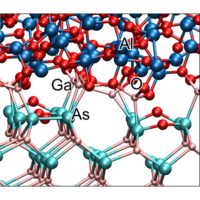
Fermi-level pinning through defects at GaAs/oxide interfaces: A density functional study

Davide Colleoni, Giacomo Miceli, and Alfredo Pasquarello

Phys. Rev. B 92, 125304 (2015) - Published 8 September, 2015

GaAs is the prototype material considered as a replacement for silicon in CMOS technology owing to its high electron mobility. However, the high density of interfacial defect states found at GaAs/oxide interfaces, which prevents the proper operation of GaAs-based devices through Fermi-level pinning, hinders the development of GaAs-based technology. In this thorough first-principles study of defects at the GaAs/Al2O3 interface, the authors deliver results that are very significant for the identification of the origins of Fermi-level pinning at these interfaces.

Shear viscosity of strongly interacting fermionic quantum fluids

Nandan Pakhira and Ross H. McKenzie

Phys. Rev. B 92, 125103 (2015) - Published 1 September, 2015

Shear viscosity for a fermionic fluid described by a single band Hubbard model is computed using dynamical mean field theory and found to violate the quantum limit.

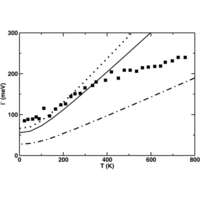
Wannier interpolation of the electron-phonon matrix elements in polar semiconductors: Polar-optical coupling in GaAs

J. Sjakste, N. Vast, M. Calandra, and F. Mauri

Phys. Rev. B 92, 054307 (2015) - Published 31 August, 2015

A new computational method is introduced that allows interpolation of the electron-phonon matrix elements in the space of localized Wannier functions, extending a previous method for study of polar semiconductors. The amount of broadening of the bands in GaAs due to electron-phonon scattering is presented, showing good agreement with experimental results. The method is shown to perform better than an empirical pseudopotential.

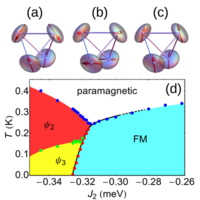
Spin dynamics in the presence of competing ferromagnetic and antiferromagnetic correlations in Yb2Ti2O7

J. Robert, E. Lhotel, G. Remenyi, S. Sahling, I. Mirebeau, C. Decorse, B. Canals, and S. Petit

Phys. Rev. B 92, 064425 (2015) - Published 31 August, 2015

The authors study the competing ferromagnetic (FM) and antiferromagnetic (AFM) interactions in the quantum spin ice candidate Yb2Ti2O7 using various probes and techniques. They show that it produces a continuum of broad excitations, where the coexistence of different magnetic characteristics indicates the compound lies at the FM and AFM phase boundary for the material. This suggests that the competition of states produces an unconventional ground state through quantum fluctuations.

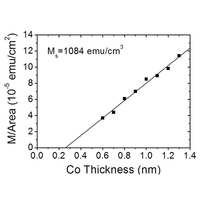
Dependence of the efficiency of spin Hall torque on the transparency of Pt/ferromagnetic layer interfaces

Chi-Feng Pai, Yongxi Ou, Luis Henrique Vilela-Leão, D. C. Ralph, and R. A. Buhrman

Phys. Rev. B 92, 064426 (2015) - Published 31 August, 2015

A systematic study of both the harmonic response and spin torque ferromagnetic resonance demonstrates that the spin Hall torque efficiency in a Pt-ferromagnetic (FM) structure is strongly dependent on the interface properties and the choice of the ferromagnetic materials, a key point that has until now not been made in spin Hall studies.

(InxGa1−x)2O3 alloys for transparent electronics

Hartwin Peelaers, Daniel Steiauf, Joel B. Varley, Anderson Janotti, and Chris G. Van de Walle

Phys. Rev. B 92, 085206 (2015) - Published 31 August, 2015

In2O3 and Ga2O3 are both transparent conducting oxides with advantageous properties, but differing crystal structures. Alloying the two together could permit the tuning of materials properties such as band gaps, but raises the question of what the stable crystal structure would be. Using state of the art first principles calculations, the authors predict alloy properties as a function of composition, finding the structure with the lowest formation barrier. They also report natural band alignments which can aid in the design of heterostructures.

Random Coulomb antiferromagnets: From diluted spin liquids to Euclidean random matrices

J. Rehn, Arnab Sen, A. Andreanov, Kedar Damle, R. Moessner, and A. Scardicchio

Phys. Rev. B 92, 085144 (2015) - Published 25 August, 2015

The authors study classical Heisenberg antiferromagnets with long-range interactions in two and three dimensions. These antiferromagnets can arise as effective models of diluted Coulomb spin liquids in the zero-temperature limit. The authors develop a phase diagram of these models as a function of the strength of the effective interaction strength.

Sign In to Your Journals Account

Filter

Section

Filter

Article Lookup

Enter a citation