Highlights

Particle-hole symmetry and the composite Fermi liquid

Maissam Barkeshli, Michael Mulligan, and Matthew P. A. Fisher

Phys. Rev. B 92, 165125 (2015) - Published 23 October, 2015

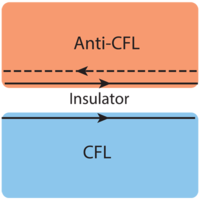
Exploiting the analogy between Pfaffian and anti-Pfaffian states the authors construct a particle-hole conjugate of the composite Fermi liquid state. They suggest that a transition between composite Fermi liquid and anti-composite Fermi liquid states may occur at half-filling and discuss the relevance of such transition to recent magnetoresistance oscillation experiments.

Electronic nematic correlations in the stress-free tetragonal state of BaFe2−xNixAs2

Haoran Man, Xingye Lu, Justin S. Chen, Rui Zhang, Wenliang Zhang, Huiqian Luo, J. Kulda, A. Ivanov, T. Keller, Emilia Morosan, Qimiao Si, and Pengcheng Dai

Phys. Rev. B 92, 134521 (2015) - Published 22 October, 2015

At low temperatures, the study of iron arsenide superconductors is hindered by the appearance of twin domains that strongly affect superconducting and magnetic properties of the system. To detwin the crystal, a uniaxial pressure is usually applied, which may itself affect the magnetic and electronic properties of the system. In this manuscript, a collaboration of authors from USA, China, France, and Germany develop a technique to obtain de-twinned strain-free samples and use transport measurements and neutron scattering to study electronic nematic phase in electron-doped BaFe2-xNixAs2. Their results indicate that the in-plane resistivity anisotropy found earlier in uniaxially strained paramagnetic tetragonal phase of iron pnictides is also present in the stress-free samples, but is due to magnetoelastic coupling.

Full counting statistics of information content in the presence of Coulomb interaction

Yasuhiro Utsumi

Phys. Rev. B 92, 165312 (2015) - Published 22 October, 2015

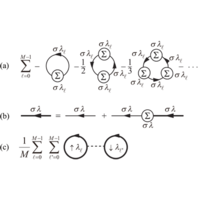
The Renyi entropies for an interacting quantum dot are computed under a multi-contour Keldysh formalism. With this in hand, the self-information generating function is determined and the probability distribution of self-information is computed, including the effects of Coulomb interactions in the Hartree approximation. The author argues through these computations that fluctuations in the self-information and the Renyi entropies are tied together intimately and that these fluctuations thus offer a way to give the Renyi entropies physical meaning.

Complexes of silicon, vacancy, and hydrogen in diamond: A density functional study

Gergő Thiering and Adam Gali

Phys. Rev. B 92, 165203 (2015) - Published 20 October, 2015

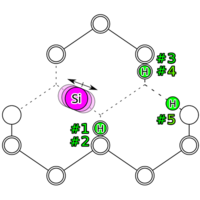
The chemical vapor deposition of diamond is known to introduce complexes of silicon, vacancy, and hydrogen. Here the authors theoretically examine several such complexes, some of which have already been observed, others which could potentially form. Using hybrid density functional theory for the treatment of highly correlated orbitals, many measurable quantities are calculated. The SiV2H(-) negatively charged defect is found to be a promising candidate for a long lived solid state quantum memory.

NMR evidence for inhomogeneous glassy behavior driven by nematic fluctuations in iron arsenide superconductors

A. P. Dioguardi, M. M. Lawson, B. T. Bush, J. Crocker, K. R. Shirer, D. M. Nisson, T. Kissikov, S. Ran, S. L. Bud'ko, P. C. Canfield, S. Yuan, P. L. Kuhns, A. P. Reyes, H.-J. Grafe, and N. J. Curro

Phys. Rev. B 92, 165116 (2015) - Published 16 October, 2015

This paper reports NMR spin-lattice and spin-spin relaxation rate data for iron arsenide superconductors involving multiple crystals with different dopants, doping levels, and magnetic fields. The results present evidence for glassy nematic fluctuations throughout an extensive region of phase space in these materials. The authors propose that the inhomogeneous relaxation dynamics that dominates the NMR response arises because the dopants introduce quenched random fields which couple to the nematic order. This disorder-induced frustration plays a significant role in suppressing antiferromagnetism and in the emergence of superconductivity.

Ab initio perspective on the Mollwo-Ivey relation for F centers in alkali halides

Paul Tiwald, Ferenc Karsai, Robert Laskowski, Stefanie Gräfe, Peter Blaha, Joachim Burgdörfer, and Ludger Wirtz

Phys. Rev. B 92, 144107 (2015) - Published 14 October, 2015

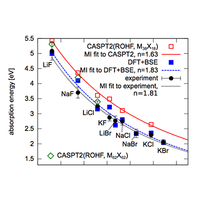
The authors revisited the Mollwo–Ivey relation of F centers in alkali halide crystals, a prototypical color center, based on post-density-functional-theory and post-Hartree-Fock methods. In contrast to earlier interpretations, which stress the importance of the Madelung potential, they find ion-size effects to be the predominant mechanism. These determine the shape of the defect-electron wave function and are responsible for the fractional Mollwo–Ivey exponent of 1.8.

Order and excitations in large−S kagome-lattice antiferromagnets

A. L. Chernyshev and M. E. Zhitomirsky

Phys. Rev. B 92, 144415 (2015) - Published 13 October, 2015

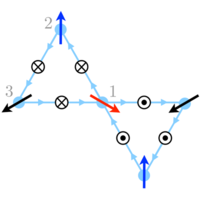
The authors apply non-linear spin wave theory to the problem of anisotropic spin-S Heisenberg models on the Kagome lattice. They argue that the non-linear terms of the analysis lead to two unusual effects: 1) the presence of a quantum phase transition as a function of the anisotropy parameter between q=0 and 3×3 order (whereas thermal fluctuations favor the 3×3 order regardless of the strength of the anisotropy) and 2) strong quantum effects in the spectral features that are not suppressed with 1/S as is typical.

Single-vortex pinning and penetration depth in superconducting NdFeAsO1−xFx

Jessie T. Zhang, Jeehoon Kim, Magdalena Huefner, Cun Ye, Stella Kim, Paul C. Canfield, Ruslan Prozorov, Ophir M. Auslaender, and Jennifer E. Hoffman

Phys. Rev. B 92, 134509 (2015) - Published 12 October, 2015

Magnetic force measurements are used to measure the penetration depth and pinning forces for vortices in the superconductor NdFeAsO1-xFx.

Terahertz time-domain spectroscopy of transient metallic and superconducting states

J. Orenstein and J. S. Dodge

Phys. Rev. B 92, 134507 (2015) - Published 9 October, 2015

The use of terahertz time-resolved studies in conducting and superconducting systems is gaining considerable interest, especially in the light of recent studies demonstrating induction of superconductivity in various materials with optical impulsive excitation. The authors carry out a theoretical analysis of the response functions typically measured by terahertz time-domain spectroscopy (THz-TDS) in metallic and superconducting samples. Within the Drude model, the authors found that THz-TDS does not simply measure the instantaneous conductivity change, in agreement with previous reports. They identify limits wherein the time-resolved THz-TDS spectrum does and does not approach the instantaneous conductivity change. They further show that the difference between the THz-TDS response and the instantaneous conductivity is largest when the photo-induced state changes from a normal metal to a superconductor.

Classical nature of nuclear spin noise near clock transitions of Bi donors in silicon

Wen-Long Ma, Gary Wolfowicz, Shu-Shen Li, John J. L. Morton, and Ren-Bao Liu

Phys. Rev. B 92, 161403(R) (2015) - Published 8 October, 2015

A fundamental question for understanding the decoherence of quantum spin qubits interacting with a bath of spins in the environment is the nature of the noise affecting the qubit - can it be modeled as classical noise or are quantum effects important? Here the authors experimentally demonstrate that in the favorable case of bismuth electron spin donors in silicon near values of a magnetic field known as clock transitions, the nuclear spin noise can be approximated as classical Gaussian noise. This finding is expected to influence efforts to optimize the control of qubits in silicon based quantum computation.

Anisotropic spin relaxation in n-GaAs from strong inhomogeneous hyperfine fields produced by the dynamical polarization of nuclei

N. J. Harmon, T. A. Peterson, C. C. Geppert, S. J. Patel, C. J. Palmstrøm, P. A. Crowell, and M. E. Flatté

Phys. Rev. B 92, 140201(R) (2015) - Published 7 October, 2015

Previous studies have shown that the nuclear spin polarization in GaAs is spatially inhomogeneous. The authors of this paper argue that the hyperfine interaction between the electron spins and inhomogeneous nuclear field is of Dyakonov-Perel type. They show that the inclusion of corresponding anisotropic spin relaxation mechanism produces a better fit of the experimentally measured Hanle effect.

Spin-flip scattering of critical quasiparticles and the phase diagram of YbRh2Si2

Peter Wölfle and Elihu Abrahams

Phys. Rev. B 92, 155111 (2015) - Published 7 October, 2015

Anomalies in transport and thermodynamic quantities near a quantum critical point in the heavy fermion compound YbRh2Si2 are shown to be caused by the onset of spin-flip scattering above a certain crossover line in the T-H phase diagram.

Ultrafast carrier dynamics in the large-magnetoresistance material WTe2

Y. M. Dai, J. Bowlan, H. Li, H. Miao, S. F. Wu, W. D. Kong, P. Richard, Y. G. Shi, S. A. Trugman, J.-X. Zhu, H. Ding, A. J. Taylor, D. A. Yarotski, and R. P. Prasankumar

Phys. Rev. B 92, 161104(R) (2015) - Published 7 October, 2015

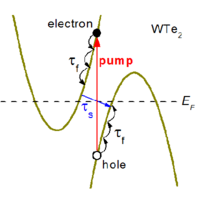
WTe2 has recently been reported to exhibit extremely large magnetoresistance, which may find potential applications in devices such as highly sensitive magnetic sensors and hard drives. In this paper, using ultrafast optical spectroscopy, the authors track the relaxation of photoexcited carriers in the time domain as they return to equilibrium in WTe2. Their experimental results not only resolve the time scales that ultimately limit potential applications of this material in electronic devices, e.g., high-speed hard drives, but also shed new light on the mechanisms governing the extremely large magnetoresistance.

Domain wall magneto-Seebeck effect

Patryk Krzysteczko, Xiukun Hu, Niklas Liebing, Sibylle Sievers, and Hans W. Schumacher

Phys. Rev. B 92, 140405(R) (2015) - Published 6 October, 2015

The authors investigate the magnetothermoelectrical properties of an individual magnetic domain wall in a permalloy nanowire. They show that the thermopower contribution of a domain wall in a magnetic nanowire provides a underlying coupling of the magnetic structure and overall thermoelectric fingerprint. The observation of a domain wall magneto-Seebeck effect is further explained through a magnetization-dependent Seebeck coefficient of permalloy in combination with the local spin configuration of the domain wall.

Validity of the local self-energy approximation: Application to coupled quantum impurities

Andrew K. Mitchell and Ralf Bulla

Phys. Rev. B 92, 155101 (2015) - Published 1 October, 2015

The authors investigate the application of an “impurity” or inhomogeneous dynamical mean-field theory (DMFT) to two magnetic impurities on the surface of a 3D cubic lattice and coupled quantum dots. This work also compares the combination of a local self-energy with self consistency, which produces dramatically nontrivial results, with the exact solutions provided by the numerical renormalization group (NRG). Furthermore, the authors provide the limits where the local self-energy fails.

Dynamics of many-body localization in a translation-invariant quantum glass model

Merlijn van Horssen, Emanuele Levi, and Juan P. Garrahan

Phys. Rev. B 92, 100305(R) (2015) - Published 28 September, 2015

The authors present evidence of many-body localization in a translationally invariant model Hamiltonian. The model, Ising-like, arises in the study of quantum glasses. The authors show that this model exhibits two regimes: one of fast relaxation and one of slow relaxation with dynamical features typically associated with many-body localized phases.

Discretized Abelian Chern-Simons gauge theory on arbitrary graphs

Kai Sun, Krishna Kumar, and Eduardo Fradkin

Phys. Rev. B 92, 115148 (2015) - Published 28 September, 2015

Motivated by a deeper understanding of strongly interacting topological phases and fractional Chern insulators the authors propose a formulation of a discretized Chern-Simon theory on random lattices and graphs.

Measurement of exciton correlations using electrostatic lattices

M. Remeika, J. R. Leonard, C. J. Dorow, M. M. Fogler, L. V. Butov, M. Hanson, and A. C. Gossard

Phys. Rev. B 92, 115311 (2015) - Published 28 September, 2015

The authors demonstrate a means to determine the strength of excitonic correlations (as measured by the photoluminescence energy shift) of indirect excitons in semiconductor quantum wells. Because this energy shift is determined by how the excitons respond to an external potential, the authors apply an electrostatic periodic potential to the excitonic gas. By measuring the corresponding excitonic response due to this applied potential, they, using a complementary theory, are able to deduce the strength of correlations.

Monte Carlo studies of the self-correcting properties of the Majorana quantum error correction code under braiding

Fabio L. Pedrocchi, N. E. Bonesteel, and David P. DiVincenzo

Phys. Rev. B 92, 115441 (2015) - Published 25 September, 2015

It is generally expected that Majorana qubits are immune to decoherence at the hardware level for topological reasons. The authors investigate this question in detail and show that this is not true in a specific, widely studied, quantum computing architecture.

Low-loss electron energy loss spectroscopy: An atomic-resolution complement to optical spectroscopies and application to graphene

Myron D. Kapetanakis, Wu Zhou, Mark P. Oxley, Jaekwang Lee, Micah P. Prange, Stephen J. Pennycook, Juan Carlos Idrobo, and Sokrates T. Pantelides

Phys. Rev. B 92, 125147 (2015) - Published 25 September, 2015

This paper reports on successful application of electron energy loss spectroscopy (EELS) for probing low-energy electronic excitations at all values of momentum transfer with atomic-scale spatial resolution. In this regard EELS appears to be complementary to optical spectroscopy which probes only direct excitations with limited spatial resolution. The authors suggest that EELS can be used to study atomic-scale structural, electronic, magnetic and vibrational properties of systems having defects and impurities as well.

Sign In to Your Journals Account

Filter

Section

Filter

Article Lookup

Enter a citation