Highlights

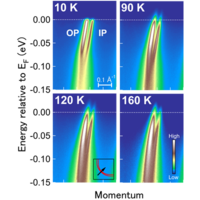
Temperature evolution of correlation strength in the superconducting state of high-Tc cuprates

S. Kudo, T. Yoshida, S. Ideta, K. Takashima, H. Anzai, T. Fujita, Y. Nakashima, A. Ino, M. Arita, H. Namatame, M. Taniguchi, K. M. Kojima, S. Uchida, and A. Fujimori

Phys. Rev. B 92, 195135 (2015) - Published 18 November, 2015

Using angle-resolved photoemission spectroscopy (ARPES), a collaboration of authors from Tokyo and Hiroshima, Japan study the evolution of the nodal d-wave quasiparticles in the trilayer Bi2223 cuprate superconductor across the phase transition into the normal state.

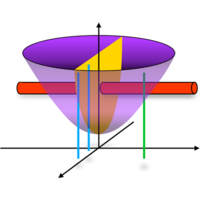
Linear magnetoresistance in metals: Guiding center diffusion in a smooth random potential

Justin C. W. Song, Gil Refael, and Patrick A. Lee

Phys. Rev. B 92, 180204(R) (2015) - Published 16 November, 2015

The puzzle of the observed nonsaturating and linear magnetoresistance in 3D Dirac materials is addressed by a new mechanism of magnetoresistance in metals that derives from the dynamics of ”squeezed” electrons.

Tuning the electronic structure of monolayer graphene/MoS2 van der Waals heterostructures via interlayer twist

Wencan Jin, Po-Chun Yeh, Nader Zaki, Daniel Chenet, Ghidewon Arefe, Yufeng Hao, Alessandro Sala, Tevfik Onur Mentes, Jerry I. Dadap, Andrea Locatelli, James Hone, and Richard M. Osgood, Jr.

Phys. Rev. B 92, 201409(R) (2015) - Published 16 November, 2015

Heterostructures of two-dimensional materials have shown unusual properties and rich physical phenomena. This paper reports on micrometer-scale angle-resolved photoemission spectroscopy of van der Waals heterostructures of graphene and MoS2 monolayers. The authors directly measured the electronic structure of monolayer stacking and its tunability due to the twist-angle between the layers. They show that the electronic states of graphene and MoS2 are not hybridized, and the band gap of MoS2 can be engineered by changing the orientation of the two layers.

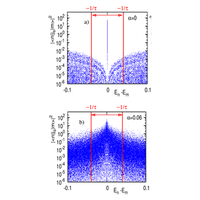
Approximate conservation laws in perturbed integrable lattice models

Marcin Mierzejewski, Tomaž Prosen, and Peter Prelovšek

Phys. Rev. B 92, 195121 (2015) - Published 11 November, 2015

The authors develop an algorithm to identify approximately conserved quantities in models perturbed away from integrability. The authors show that these quantities are able to determine the long time behavior of local correlation functions via Mazur’s inequality. They apply the model to a XXZ Heisenberg perturbed by a next-nearest-neighbor interaction.

Two-dimensional topological phases and electronic spectrum of Bi2Se3 thin films from GW calculations

Tobias Förster, Peter Krüger, and Michael Rohlfing

Phys. Rev. B 92, 201404(R) (2015) - Published 9 November, 2015

High-quality GW calculations of the quasiparticle band structure in thin films of topological insulator Bi2Se3 show that the topological nature of the surface states is not the spin-polarized quantum spin Hall state, but the less interesting trivial topology. This is in strong contrast to the expected topology of the surface states of bulk Bi2Se3 and the predictions of density functional theory and parametrized calculations for Bi2Se3 thin films, which produce fundamentally less accurate predictions of the band gap than the GW approach.

Long distance coupling of resonant exchange qubits

Maximilian Russ and Guido Burkard

Phys. Rev. B 92, 205412 (2015) - Published 9 November, 2015

The authors explore the possibility of long range coupling between two RX qubits, qubits formed out of sets of triple quantum dots. The coupling is electromagnetic in nature and is facilitated by a superconducting strip line. The authors demonstrate that within this setup, they can implement the quantum iSWAP gate with high fidelity.

Incommensurateness in nanotwinning models of modulated martensites

Barbora Benešová, Miroslav Frost, Malte Kampschulte, Christof Melcher, Petr Sedlák, and Hanuš Seiner

Phys. Rev. B 92, 180101(R) (2015) - Published 6 November, 2015

Martensites, which are the product of diffusionless phase transitions, can form phases with small periodic modulations of crystalline atomic lattice positions. Experiments have shown both that the modulation function is smooth and that when more than one modulation is present they can be incommensurate. These observations have appeared to be inconsistent with nanotwinning models. Here the authors show theoretically that in the case of the ferromagnetic shape memory alloy NiMnGa, the presence of two competing mechanisms favoring different commensurate periodic structures, a result of the interaction between different minima in the energy landscape, can lead to effective smooth incommensurate modulations consistent with nanotwinning models.

Superconducting dome in doped quasi-two-dimensional organic Mott insulators: A paradigm for strongly correlated superconductivity

Charles-David Hébert, Patrick Sémon, and A.-M. S. Tremblay

Phys. Rev. B 92, 195112 (2015) - Published 6 November, 2015

Cellular dynamical mean-field theory combined with continuous Monte Carlo techniques is used to account for the most important features of the doped quasi-two-dimensional organic Mott insulators.

Transversal magnetoresistance in Weyl semimetals

J. Klier, I. V. Gornyi, and A. D. Mirlin

Phys. Rev. B 92, 205113 (2015) - Published 6 November, 2015

The transport properties of three-dimensional Weyl and Dirac semimetals are studied under a transverse magnetic field. The analysis is based on the continuum Dirac/Weyl model in the presence of potential disorder. The results are successfully compared to recent transport experiments in CdAs.

Quantum phase transitions and decoupling of magnetic sublattices in the quasi-two-dimensional Ising magnet Co3V2O8 in a transverse magnetic field

K. Fritsch, G. Ehlers, K. C. Rule, K. Habicht, M. Ramazanoglu, H. A. Dabkowska, and B. D. Gaulin

Phys. Rev. B 92, 180404(R) (2015) - Published 5 November, 2015

The authors present the first example of a quasi-2D experimental realization of a transverse field Ising model, which is one of the canonical examples of a quantum phase transition driven by quantum mechanical fluctuations induced by a magnetic field applied perpendicular to the preferred direction of the magnetic moments. Experimental realizations of this model are rare, and include the prominently discussed quasi-1D Ising chain system CoNb2O6, and the 3D dipolar-coupled Ising ferromagnet LiHoF4, but the experimental realization of a quasi-2D system has been lacking until now.

Ab initio tight-binding Hamiltonian for transition metal dichalcogenides

Shiang Fang, Rodrick Kuate Defo, Sharmila N. Shirodkar, Simon Lieu, Georgios A. Tritsaris, and Efthimios Kaxiras

Phys. Rev. B 92, 205108 (2015) - Published 5 November, 2015

The modeling of the electronic structure is the key to understanding layered transition-metal dichalcogenides (TMDCs) heterostructures. The authors present a full-range tight-binding hamiltonian for TMDCs by Wannier transformation of density functional theory results, which preserves both the orbital character and phase information. The tight-binding hamiltonians is expected to form the basis for further theoretical investigations of many-body physics and simulations for potential applications under external electric or magnetic fields in finite-size nanostructures, in either monolayer or heterostructure forms.

Reflection thermal diffuse x-ray scattering for quantitative determination of phonon dispersion relations

A. B. Mei, O. Hellman, C. M. Schlepütz, A. Rockett, T.-C. Chiang, L. Hultman, I. Petrov, and J. E. Greene

Phys. Rev. B 92, 174301 (2015) - Published 3 November, 2015

The ability to spectrally resolve phonon energies and dispersion relations is central to the understanding and controlling of structural properties and thermal transport of crystalline solids. However, many of the existing probing techniques are limited by the requirement of large sample sizes. In this work, the authors have demonstrated a new method for determining phonon dispersion relations of solids based upon synchrotron reflection x-ray thermal diffuse scattering measurements. The application of this method was demonstrated in the model system of MgO thin films. Such techniques may become valuable for determining vibrational properties of heteroepitaxial thin films since x-ray penetration depths can be selectively tuned through the use of grazing incidence.

Fractional Chern insulators in bands with zero Berry curvature

Steven H. Simon, Fenner Harper, and N. Read

Phys. Rev. B 92, 195104 (2015) - Published 3 November, 2015

It is commonly believed that fractional Chern insulators can only occur in Bloch bands with non-zero Chern numbers. The authors of this paper outline a number of ways in which specifically crafted interactions can be used to create a fractional topological insulator from a noninteracting system with zero Berry curvature.

Towards the understanding of the origin of charge-current-induced spin voltage signals in the topological insulator Bi2Se3

E. K. de Vries, A. M. Kamerbeek, N. Koirala, M. Brahlek, M. Salehi, S. Oh, B. J. van Wees, and T. Banerjee

Phys. Rev. B 92, 201102(R) (2015) - Published 3 November, 2015

Previous electrical transport experiments on thin films of the topological insulator Bi2Se3 using ferromagnetic contacts have claimed to see spin-momentum locking based on changes in the measured voltage at the contacts. A careful new transport experiment using a unique device configuration reveals that such a voltage arises from fringe magnetic fields. The findings emphasize the necessity of performing detailed experiments so as to exclude effects such as local Hall fields on the measured signal.

Metallic quantum critical points with finite BCS couplings

S. Raghu, Gonzalo Torroba, and Huajia Wang

Phys. Rev. B 92, 205104 (2015) - Published 3 November, 2015

There are many instances where superconductivity seems to emerge from the condensation of a non-Fermi liquid metal in the vicinity of a quantum critical point. The authors of this paper address this problem by studying a Fermi surface coupled to a critical bosonic order parameter within a large-N approach. The ensuing competition between the tendency for pairing and the destruction of Landau quasiparticles is found to result in a novel non-Fermi liquid fixed point with a finite scale invariant BCS coupling.

Critical phenomena in hyperbolic space

Karim Mnasri, Bhilahari Jeevanesan, and Jörg Schmalian

Phys. Rev. B 92, 134423 (2015) - Published 30 October, 2015

How does the presence of a finite length scale in a negatively curved spatial geometry, namely the spatial curvature, modify statistical physics properties of many-particle systems such as critical exponents or the texture of ordered states? Here the authors show that phenomena such as unusual magnetization textures and a strong curvature fixed point can emerge, and that this is a promising theoretical approach for investigating uniform frustration and nontrivial critical behavior.

Quantum critical response function in quasi-two-dimensional itinerant antiferromagnets

C. M. Varma, Lijun Zhu, and Almut Schröder

Phys. Rev. B 92, 155150 (2015) - Published 30 October, 2015

Neutron scattering data show that the magnetic response function in the quantum critical region for two different materials, an iron-based superconductor and a heavy fermion compound, compare well to a universal theory.

Nonlocal transport and the hydrodynamic shear viscosity in graphene

Iacopo Torre, Andrea Tomadin, Andre K. Geim, and Marco Polini

Phys. Rev. B 92, 165433 (2015) - Published 30 October, 2015

Due to the absence of a strong electron-acoustic phonon interaction, a system made up of graphene sheets encapsulated between thin hexagonal boron nitride slabs is ideal for investigating the hydrodynamic behavior of an electron liquid. Using a fully analytical theoretical approach, the authors demonstrate that nonlocal dc transport measurements can be used to extract the hydrodynamic shear viscosity of 2D electrons in graphene far from the neutrality point. They also suggest that the currently available scanning probe techniques should be able to spatially resolve viscosity-dominated electron flow regions.

Thermalization and dynamics in the single-impurity Anderson model

Ireneusz Weymann, Jan von Delft, and Andreas Weichselbaum

Phys. Rev. B 92, 155435 (2015) - Published 29 October, 2015

A thorough test of the eigenstate thermalization hypothesis (ETH) for the single-impurity Anderson model, performed with the aid of the numerical renormalization group (NRG) method, finds good support for ETH. The mechanism responsible for effective thermalization within the NRG can be identified as Anderson orthogonality: the more charge that needs to flow to or from infinity after applying a local excitation within the Wilson chain, the more the system looks thermal afterwards at an increased temperature. For the same reason, however, thermalization fails if charge rearrangement after the excitation remains mostly local. In these cases, the different statistical ensembles lead to different results, and their behavior needs to be understood as a microscopic quantum quench only. This analysis provides new and important insight into the process of thermalization and dynamics of systems exhibiting strong, nontrivial correlations.

Nanosized helical magnetic domains in strongly frustrated Fe3PO4O3

K. A. Ross, M. M. Bordelon, G. Terho, and J. R. Neilson

Phys. Rev. B 92, 134419 (2015) - Published 26 October, 2015

The authors have investigated the magnetic and structural properties of Fe3PO4O3 using various methods including thermodynamic probes, synchrotron X-ray diffraction, and neutron powder diffraction. In this context, the authors demonstrate the formation of an incommensurate helical antiferromagnetic structure with highly anisotropic domains, which may be produced through magnetoelastic strain that blocks long-range magnetic order. The overall helical nature of the magnetic domains may be of interest to those studying antiferromagnetic Skyrmions and other topological spin textures.

Sign In to Your Journals Account

Filter

Section

Filter

Article Lookup

Enter a citation