Highlights

Experimental doping dependence of the lattice parameter in n-type Ge: Identifying the correct theoretical framework by comparison with Si

Chi Xu, C. L. Senaratne, J. Kouvetakis, and J. Menéndez

Phys. Rev. B 93, 041201(R) (2016) - Published 8 January, 2016

Doping a semiconductor induces a change in its lattice parameter. This change is caused not only by the different sizes of the impurity and host atoms, but also by the strain developed when the occupation of electronic energy bands is modified. While these ideas are conceptually simple, experimentalists and theorists alike have struggled for decades to separate the size and electronic effects. Following up on the most significant earlier developments, which focused on doped Si, the authors present data for n-type Ge doped with novel precursors and suggest that trends as a function of the donor species in both Ge and Si hold the key to resolving the doping dependence of the lattice parameter into its two fundamental physical components.

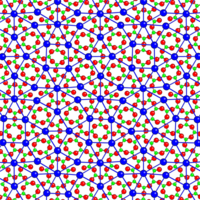
Structure of periodic crystals and quasicrystals in ultrathin films of Ba-Ti-O

Eric Cockayne, Marek Mihalkovič, and Christopher L. Henley

Phys. Rev. B 93, 020101(R) (2016) - Published 7 January, 2016

Through a combination of modeling and density functional theory calculations, the authors solve the structure of the only known quasicrystalline oxide, Ba-Ti-O, and introduce a new crystal-chemistry motif that explains all previously unsolved ultrathin Ba-Ti-O structures.

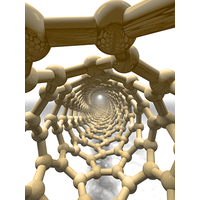
Gate-voltage induced trions in suspended carbon nanotubes

M. Yoshida, A. Popert, and Y. K. Kato

Phys. Rev. B 93, 041402(R) (2016) - Published 5 January, 2016

This paper reports on a photophysics study of gate-doped single-wall carbon nanotubes suspended over trenches. The authors experimentally demonstrate trion emissions from electrostatically doped nanotubes. They observe that the trion binding energies can be manipulated by varying the nanotube diameter.

Engineering closed optical transitions in rare-earth ion crystals

John G. Bartholomew, Rose L. Ahlefeldt, and Matthew J. Sellars

Phys. Rev. B 93, 014401 (2016) - Published 4 January, 2016

Previously, closed optical transitions were only possible in crystals where the rare-earth ion site had perfect axial symmetry. The possibility of creating closed hyperfine transitions for all site symmetries by applying an appropriate oriented magnetic field is explored. The new technique should allow studies that are currently impossible for rare-earth-ion crystals both in the single ion and ensemble regimes.

Dirac cones beyond the honeycomb lattice: A symmetry-based approach

Guido van Miert and Cristiane Morais Smith

Phys. Rev. B 93, 035401 (2016) - Published 4 January, 2016

Dirac cones are at the heart of all the quasirelativistic phenomena oberved or predicted to occur in graphene. For a long time, it was believed that their existence is tightly bound to the honeycomb geometry of the graphene lattice. However, recent studies show that Dirac cones can be found in a variety of two-dimensional materials, with square or more complicated lattices. Here, the authors present a complete classification of these different systems, and show how Dirac cones emerge as a consequence of the symmetries of the underlying crystal. These results also provide guidelines to engineer novel materials that go beyond graphene.

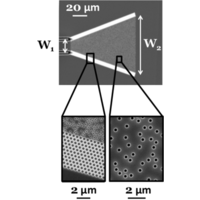
Control of mesoscopic transport by modifying transmission channels in opaque media

Raktim Sarma, Alexey Yamilov, Seng Fatt Liew, Mikhael Guy, and Hui Cao

Phys. Rev. B 92, 214206 (2015) - Published 31 December, 2015

Based on experiments and simulations, the authors use waveguides of nonuniform cross-sectional width to tailor the spatial distribution of the energy density of transmission channels and to realize conversion between evanescent and propagating channels. For particular geometries, perfect reflection channels are created, and their large penetration depth into the medium as well as the complete return of probe light to the input end should greatly benefit sensing and imaging applications.

Minimum reflection channel in amplifying random media

Seng Fatt Liew and Hui Cao

Phys. Rev. B 92, 224202 (2015) - Published 29 December, 2015

Enhancing light transmission through scattering media is of much interest in many fields. Here, numerical simulations are performed to study the impact of gain on the value of reflection of the minimum reflection channel in a random medium. Surprisingly, in some random configurations, the reflection falls when gain is added even through the intensity inside the medium presumably increases once gain is introduced. This unexpected behavior is explained based on a decomposition of quasinormal modes.

Pressure-induced quantum phase transitions in a YbB6 single crystal

Yazhou Zhou, Dae-Jeong Kim, Priscila Ferrari Silveira Rosa, Qi Wu, Jing Guo, Shan Zhang, Zhe Wang, Defen Kang, Wei Yi, Yanchun Li, Xiaodong Li, Jing Liu, Peiquan Duan, Ming Zi, Xiangjun Wei, Zheng Jiang, Yuying Huang, Yi-feng Yang, Zachary Fisk, Liling Sun, and Zhongxian Zhao

Phys. Rev. B 92, 241118(R) (2015) - Published 29 December, 2015

The first observation of two pressure-induced quantum phase transitions in a YbB6 single crystal is reported. This material is currently of much interest as there is conflicting experimental support for it belonging to a new class of topological insulators. Based on the results here the authors conclude that while at ambient-pressure YbB6 is topologically trivial, a newly found high-pressure gapped phase could be topologically nontrivial, although a partially gapped semimetal state has also been suggested. This interesting phase deserves further investigation.

Electrical phase diagram of bulk BiFeO3

Massimiliano Stengel and Jorge Íñiguez

Phys. Rev. B 92, 235148 (2015) - Published 28 December, 2015

BiFeO3 is one of the few known materials in which ferroelectricity and magnetism coexist at room temperature. Apart from possible practical applications, this multiferroic material has been attracting significant interest because of the interactions between its complex magnetic structure and different structural modes. The authors of this state-of-the-art first-principles study explore the electrical phase diagram of bulk BiFeO3 and reveal important aspects of the competition between ferroelectric and antiferroelectric phases.

Efficient formation of excitons in a dense electron-hole plasma at room temperature

Andreas Hangleiter, Zuanming Jin, Marina Gerhard, Dimitry Kalincev, Torsten Langer, Heiko Bremers, Uwe Rossow, Martin Koch, Mischa Bonn, and Dmitry Turchinovich

Phys. Rev. B 92, 241305(R) (2015) - Published 28 December, 2015

Room-temperature electronic properties of semiconductors, especially in the case of higher charge densities, are commonly discussed in terms of single-particle excitations – free electrons and holes. Many-particle effects, such as the formation of excitons (Coulomb-bound electron-hole pairs), are usually seen as low-temperature and low-density phenomena. In this paper, using ultrafast terahertz and photoluminescence measurements, the authors find that under certain conditions typical for wide-band-gap semiconductors, the radiative excitons can be efficiently formed at high charge density and at room temperature. This effect is believed to contribute to the extraordinarily high quantum efficiency of group III nitride light emitters.

A new kind of topological quantum order: A dimensional hierarchy of quasiparticles built from stationary excitations

Sagar Vijay, Jeongwan Haah, and Liang Fu

Phys. Rev. B 92, 235136 (2015) - Published 21 December, 2015

Exactly solvable models often provide valuable insights in theoretical studies of topological phases. Here the authors introduce exactly solvable models of interacting Majorana fermions each with extensive topological ground-state degeneracy and a hierarchy of pointlike, topological excitations that are only free to move within submanifolds of the full lattice. These very different models make up a new kind of topological quantum order.

Atomic clouds as spectrally selective and tunable delay lines for single photons from quantum dots

Johannes S. Wildmann, Rinaldo Trotta, Javier Martín-Sánchez, Eugenio Zallo, Mark O'Steen, Oliver G. Schmidt, and Armando Rastelli

Phys. Rev. B 92, 235306 (2015) - Published 21 December, 2015

For the first time, it is experimentally shown that a cloud of cesium (Cs) atoms can be used as a spectrally selective and tunable delay line for single photons emitted by semiconductor quantum dots. This delay line – significant slowing down of photons separated in frequency by only a few gigahertz – may represent the missing ingredient for the demonstration of a time-reordering scheme for entangled photon generation, and it could play a key role in future quantum networks and quantum communication.

Magnetic soliton confinement and discretization effects arising from macroscopic coherence in a chiral spin soliton lattice

Y. Togawa, T. Koyama, Y. Nishimori, Y. Matsumoto, S. McVitie, D. McGrouther, R. L. Stamps, Y. Kousaka, J. Akimitsu, S. Nishihara, K. Inoue, I. G. Bostrem, Vl. E. Sinitsyn, A. S. Ovchinnikov, and J. Kishine

Phys. Rev. B 92, 220412(R) (2015) - Published 17 December, 2015

Understanding the conditions determining the appearance of stable chiral spin topological excitations is a central problem in condensed matter physics and related fields. This work provides the first unambiguous demonstration of discretization due to the macroscopic phase coherence and metastability for chiral topological excitations, and evidence of the mechanisms underlying its appearance. This was achieved through the use of an advanced Lorentz electron microscope with the highest possible resolution imaging of spin textures. The results provide new insights into dynamics in the phase transition of the chiral system, and will raise new questions concerning the mechanisms governing loss of chiral ordering.

Excitons in van der Waals heterostructures: The important role of dielectric screening

S. Latini, T. Olsen, and K. S. Thygesen

Phys. Rev. B 92, 245123 (2015) - Published 17 December, 2015

van der Waals heterostructures, created by stacking two-dimensional materials, represent a novel and largely unexplored class of materials with very interesting optoelectronic properties. Excitons, strongly bound electron-hole pairs, play a crucial role in determining these properties, especially in 2D materials where the electron-hole binding is strong. However, a complete understanding of excitonic effects in 2D layered materials, i.e., when the electronic system transitions from a 2D geometry to a 3D one, is still missing. Here, the authors present a first-principles based multiscale method that attempts to fill this gap. With the help of their framework, one can predict the optoelectronics properties of van der Waals heterostructures and make a closer connection between the available theoretical models and experimental measurements in these materials.

Quantum Monte Carlo study of mass-imbalanced Hubbard models

Ye-Hua Liu and Lei Wang

Phys. Rev. B 92, 235129 (2015) - Published 16 December, 2015

Building on recent advances by several groups to solve the fermion-sign problem in continuous-time quantum Monte Carlo calculations, the authors present two new algorithms and simulate the magnetic properties and phase transitions of the mass-imbalanced Hubbard model for square and honeycomb lattices. These theoretical calculations provide unbiased predictions that are relevant for experiments on ultracold atoms.

Chiral magnetic effect and natural optical activity in metals with or without Weyl points

Jing Ma and D. A. Pesin

Phys. Rev. B 92, 235205 (2015) - Published 16 December, 2015

A recent experimental identification of mono-pnictides (TaAs, TaP, NbP, and others) as Weyl semimetals has triggered an enormous effort to understand the unconventional physical phenomena in these materials. The chiral magnetic effect (CME), i.e., the occurrence of electrical current along the direction of an applied magnetic field, has been a particularly controversial subject, with a number of claims and counter-claims published in the literature. In this work Jing Ma and D. A. Pesin from the University of Utah provide a systematic theory of the CME and the related natural optical activity in these materials. They show that the natural optical activity of metals can be distinguished from well known phenomena in insulators by its singular frequency dependence in the terahertz range.

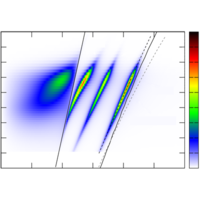
Landau-Zener interference at bichromatic driving

Florian Forster, Max Mühlbacher, Ralf Blattmann, Dieter Schuh, Werner Wegscheider, Stefan Ludwig, and Sigmund Kohler

Phys. Rev. B 92, 245422 (2015) - Published 15 December, 2015

The current through a driven two-level system, here realized in a double quantum dot, is determined by the phases acquired between avoided crossings. As a function of the detuning and the driving amplitude, it exhibits a characteristic interference pattern both in real space and in Fourier space. The authors demonstrate theoretically and experimentally the case of bichromatic driving creating fundamental relations between commensurability and symmetry properties.

Continuous dynamical decoupling of a single diamond nitrogen-vacancy center spin with a mechanical resonator

E. R. MacQuarrie, T. A. Gosavi, S. A. Bhave, and G. D. Fuchs

Phys. Rev. B 92, 224419 (2015) - Published 14 December, 2015

In an experimental and theoretical study, the authors find that the ac stress by a diamond mechanical resonator leads to a dressed spin basis whereby an NV center spin qubit is protected against magnetic fluctuations but remains sensitive to other environmental perturbations such as strain and temperature. By analyzing how the qubit protection scales with mechanical resonator amplitude, they demonstrate this technique’s value for precision thermometry, strain sensing, and quantum information.

Beam engineering for selective and enhanced coupling to multipolar resonances

Tanya Das, Prasad P. Iyer, Ryan A. DeCrescent, and Jon A. Schuller

Phys. Rev. B 92, 241110(R) (2015) - Published 14 December, 2015

The ability to control multipolar light-matter interactions in metamaterials and other photonic systems has traditionally relied on engineering the physical properties of the resonators. In this paper, the authors follow the reverse approach. By tailoring the optical beam that illuminates a spherical nanoparticle, they demonstrate selective and enhanced coupling to the optical modes excited on the nanoparticle.

Enhanced light emission from top-emitting organic light-emitting diodes by optimizing surface plasmon polariton losses

Cornelius Fuchs, Paul-Anton Will, Martin Wieczorek, Malte C. Gather, Simone Hofmann, Sebastian Reineke, Karl Leo, and Reinhard Scholz

Phys. Rev. B 92, 245306 (2015) - Published 11 December, 2015

Increasing the external quantum efficiency is currently an important goal in organic light-emitting diodes (OLED) research. Utilizing an altered optical design that involves a low refractive index hole transport layer in a monochrome green top-emitting OLED, the authors have managed to shift the surface plasmon polariton dispersion relation, which in turn decreases the power dissipated into lost evanescent excitations, thus enhancing the external quantum efficiency.

Sign In to Your Journals Account

Filter

Section

Filter

Article Lookup

Enter a citation