Highlights

Coexistence of low-moment magnetism and superconductivity in tetragonal FeS and suppression of Tc under pressure

S. Holenstein, U. Pachmayr, Z. Guguchia, S. Kamusella, R. Khasanov, A. Amato, C. Baines, H.-H. Klauss, E. Morenzoni, D. Johrendt, and H. Luetkens

Phys. Rev. B 93, 140506(R) (2016) - Published 25 April, 2016

The family of iron-based superconductors has recently acquired a new member material, FeS. Theoretically, this compound has been shown to have electronic structure similar to that of the superconducting FeSe. However, contradictory ground states have been predicted for FeS. In this work, a collaboration of authors from Switzerland and Germany use muon spin rotation and relaxation to show that weak-moment magnetism microscopically coexists with bulk superconductivity. Additionally, in contrast with some earlier studies, the results suggest a fully gapped superconducting state of FeS.

Origin of static and dynamic steps in exact Kohn-Sham potentials

M. J. P. Hodgson, J. D. Ramsden, and R. W. Godby

Phys. Rev. B 93, 155146 (2016) - Published 25 April, 2016

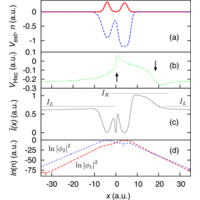
The need for a reliable quantum description of the motion of interacting electrons in nanostructures is of ever-growing significance. The usual approximations for the exchange-correlation (xc) potential of density functional theory can prove inadequate, especially in the time-dependent regime and when correlation is strong. Spatial steps (and related features) in the xc potential, in particular, are known to be frequently crucial for the accurate description of electron densities, but present challenges for the common xc approximations. Using a variety of model systems, the authors exhibit the nature of these steps, and describe the principles that determine their properties, to inform the development of improved functionals.

Electron and chemical reservoir corrections for point-defect formation energies

Christoph Freysoldt, Björn Lange, Jörg Neugebauer, Qimin Yan, John L. Lyons, Anderson Janotti, and Chris G. Van de Walle

Phys. Rev. B 93, 165206 (2016) - Published 22 April, 2016

The formation energies of semiconductor point defects are nowadays predicted much more accurately by density functional theory than a decade ago, thanks to the use of modern hybrid functionals. The drawback is the high computational effort compared to the traditional local density approximation (LDA) or generalized gradient approximation (GGA). In this work, the authors trace back the main variations between the functionals to differences in the position of the bulk valence-band maximum, as well as in the reference energies for the chemical potential obtained with each functional. For point defects relevant for p-type GaN, these differences are accounted for by corrections, reducing the maximum disagreement between the different functionals from more than 2 eV to below 0.2 eV. The correction scheme should be useful for performing high-throughput calculations in cases where full hybrid functional calculations are prohibitively expensive.

Detailed magnetic and structural analysis mapping a robust magnetic C4 dome in Sr1−xNaxFe2As2

K. M. Taddei, J. M. Allred, D. E. Bugaris, S. Lapidus, M. J. Krogstad, R. Stadel, H. Claus, D. Y. Chung, M. G. Kanatzidis, S. Rosenkranz, R. Osborn, and O. Chmaissem

Phys. Rev. B 93, 134510 (2016) - Published 20 April, 2016

The authors present a careful phase diagram determination of the hole-doped Sr1-xNaxFe2As2 iron-based superconductors, with special attention paid to the region around x=0.36, where they recently found the existence of a magnetic C4 phase. This phase has already proven instrumental in settling longstanding questions in these materials. In contrast to the two previous hole-doped Ba-based materials exhibiting this phase, here they find the C4 phase to be more robust, existing over a larger range of compositions. This should prove useful for future studies.

Ultrafast spin-polarization control of Dirac fermions in topological insulators

J. Sánchez-Barriga, E. Golias, A. Varykhalov, J. Braun, L. V. Yashina, R. Schumann, J. Minár, H. Ebert, O. Kornilov, and O. Rader

Phys. Rev. B 93, 155426 (2016) - Published 20 April, 2016

Topological insulators are promising materials for future spintronic applications due to the unique properties of their spin-polarized surface states. Using time-, spin-, and angle-resolved photoemission spectroscopy, the authors establish the utilization of photoexcited topological surface states as unique channels in which to drive fully controllable spin-polarized electrical currents on ultrafast time scales. Using circularly polarized femtosecond laser pulses of infrared light, the authors show that the dynamics of the generated currents exhibits two distinct timescales for the spin and charge degrees of freedom on the surface, and identify the underlying mechanisms giving rise to this behavior. Moreover, they find that the generated currents are completely reversible with the helicity of the circular-light polarization, paving the way for novel applications of topological insulators in spintronics at ultimate speeds.

Direct observation of nonequivalent Fermi-arc states of opposite surfaces in the noncentrosymmetric Weyl semimetal NbP

S. Souma, Zhiwei Wang, H. Kotaka, T. Sato, K. Nakayama, Y. Tanaka, H. Kimizuka, T. Takahashi, K. Yamauchi, T. Oguchi, Kouji Segawa, and Yoichi Ando

Phys. Rev. B 93, 161112(R) (2016) - Published 20 April, 2016

Weyl semimetals (WSMs) provide a platform to realize long-sought massless Weyl fermions, which can host a variety of exotic quantum phenomena such as chiral anomalies and anomalous Hall conductivity. The most intriguing nature of WSMs is the emergence of an unconventional surface state called a Fermi arc, which is distinct from the well-known Fermi surface of ordinary metals. The authors have used angle-resolved photoemission spectroscopy on NbP and succeeded in observing the electronic states for two differently terminated surfaces of this noncentrosymmetric crystal. Corroborated by first-principles calculations, it is unambiguously demonstrated that NbP is a Weyl semimetal with reduced spin-orbit coupling, exhibiting a drastic difference in the Fermi-surface topology between the P- and Nb-terminated surfaces. Through a direct comparison of Fermi-arc surface states between the two surfaces, the momentum location of Weyl nodes has been elucidated. The present results provides a pathway for exploring new quantum phenomena utilizing Fermi-arc properties of WSMs.

Ohmic two-state system from the perspective of the interacting resonant level model: Thermodynamics and transient dynamics

H. T. M. Nghiem, D. M. Kennes, C. Klöckner, V. Meden, and T. A. Costi

Phys. Rev. B 93, 165130 (2016) - Published 20 April, 2016

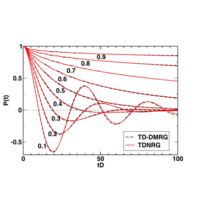
This paper provides a detailed analysis of the thermodynamic properties of the Ohmic two-state system as well as its transient dynamics following a quantum quench. The authors also quantify the accuracy of time-dependent NRG and compare it to a variety of techniques used to study time-dependent dynamics.

Stable phase separation and heterogeneity away from the coexistence curve

T. R. Kirkpatrick and D. Belitz

Phys. Rev. B 93, 144203 (2016) - Published 19 April, 2016

Numerous experiments on solids in the vicinity of first-order phase transitions indicate that the two phases can coexist in equilibrium even away from coexistence curve, which seems to defy basic notions of thermodynamics. Examples include the magnetic quantum phase transition in the helical magnet MnSi, and the Mott transition in the rare-earth nickelates. Muon spin rotation experiments show that the volume fraction of the magnetic phase is less than 100% in a region away from the coexistence curve of the first-order phase transition. The authors provide an explanation for these puzzling observations: imperfections in the solid material can lead to small regions in space that locally favor one phase over the other. As a result, the material will not be homogeneous, but rather contain droplets of one phase within the other. These droplets are stable, and last indefinitely. The system thus never attains the equilibrium state one would naively expect, in which all of the volume would be taken up by one of the phases.

Confinement of superconducting fluctuations due to emergent electronic inhomogeneities

C. Carbillet, S. Caprara, M. Grilli, C. Brun, T. Cren, F. Debontridder, B. Vignolle, W. Tabis, D. Demaille, L. Largeau, K. Ilin, M. Siegel, D. Roditchev, and B. Leridon

Phys. Rev. B 93, 144509 (2016) - Published 15 April, 2016

How a disordered superconductor evolves into an insulator is still a matter of intense debate. Disorder and reduced screening of Coulomb repulsion may simply break the pairs or, alternatively, the Cooper pairs themselves may localize. Thin disordered NbN films fall between these two extremes and display intermediate scale inhomogeneity with anomalous properties, which are studied by the authors using Scanning Tunneling Spectroscopy and transport measurements. While STS exhibits inhomogeneity at distances much larger the typical size of the nanocrystals constituting the NbN films, the conductivity fluctuations near the superconductor-insulator transition have effectively a zero-dimensional character similar to the one previously found only in granular systems.

Differentiation between ferroelectricity and thermally stimulated current in pyrocurrent measurements of multiferroic MMn7O12 (M=Ca, Sr, Cd, Pb)

Noriki Terada, Yana S. Glazkova, and Alexei A. Belik

Phys. Rev. B 93, 155127 (2016) - Published 15 April, 2016

Multiferroics present a dynamic crossover between magnetic and electronic order parameters. Using both the conventional pyroelectric current (PC) and the bias electric field (BE) methods, the authors investigate the electric polarization of multiferroic MMn7O12 (M= Ca, Sr, Cd, Pb). While the pyrocurrent measurements show intense peaks below the magnetic ordering temperature, the peaks are not observed in the biased electric field method, which indicates the peaks are produced by thermal stimulation, not ferroelectricity. In CaMn7O12, the electric polarizations polarization produced is quite small, which suggests that the large polarizations reported in previously are not associated with intrinsic ferroelectricity.

Quantitative determination of bond order and lattice distortions in nickel oxide heterostructures by resonant x-ray scattering

Y. Lu, A. Frano, M. Bluschke, M. Hepting, S. Macke, J. Strempfer, P. Wochner, G. Cristiani, G. Logvenov, H.-U. Habermeier, M. W. Haverkort, B. Keimer, and E. Benckiser

Phys. Rev. B 93, 165121 (2016) - Published 15 April, 2016

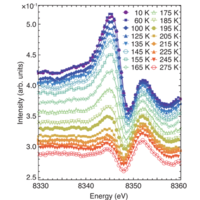
Resonant x-ray scattering is used to definitively show that a pure spin density wave state is the ground state in ultrathin LaNiO3 layers sandwiched between LAAlO3 layers. This result is also shown to be in agreement with first-principles calculations.

Current control of magnetic anisotropy via stress in a ferromagnetic metal waveguide

Kyongmo An, Xin Ma, Chi-Feng Pai, Jusang Yang, Kevin S. Olsson, James L. Erskine, Daniel C. Ralph, Robert A. Buhrman, and Xiaoqin Li

Phys. Rev. B 93, 140404(R) (2016) - Published 11 April, 2016

Current control of magnetism, especially in multilayer thin films, hold great promise for applications in spintronics. Efficient control can be achieved using spin-orbit torques originating from either the spin Hall effect or the Rashba effect. In the context of spin waves, direct current pass through a heavy metal/ferromagnetic bilayer may be used to reduce/amplify damping or shift the resonant field. The effective field or damping introduced by the spin Hall or the Rashba effects depends on the current linearly, reversing the sign with a direct current in the opposite direction. The authors of this study report unexpected symmetric magnetic resonance shifts for spin waves passing through a CoFeB/Ta waveguide. This second-order effect arises from the dc modified magnetic anisotropy via anisotropic stress introduced between the substrate and the bilayer. Similar current-induced magnetoelastic effects may be relevant in many ferromagnetic heterostructures subject to large direct current.

Strain coupling, microstructure dynamics, and acoustic mode softening in germanium telluride

D. Yang, T. Chatterji, J. A. Schiemer, and M. A. Carpenter

Phys. Rev. B 93, 144109 (2016) - Published 11 April, 2016

The authors have used resonant ultrasound spectroscopy to characterize variations in the elastic and anelastic properties of GeTe associated with the ferroelectric/ferroelastic phase transition at ~625 K. These arise as a consequence of strong coupling between strain and driving order parameter, and their magnitudes are permissive of a significant order/disorder component to the transition. Remarkably, precursor softening due to dynamical disorder and Debye freezing of twin walls at low temperatures appear both to be controlled by the same thermally activated mechanism associated with small displacements of Ge within GeTe6 octahedra. This mechanism must also be important in constraining the stability and dynamics with respect to ferroelectric switching.

Spin liquid nature in the Heisenberg J1−J2 triangular antiferromagnet

Yasir Iqbal, Wen-Jun Hu, Ronny Thomale, Didier Poilblanc, and Federico Becca

Phys. Rev. B 93, 144411 (2016) - Published 11 April, 2016

The search for unconventional phases of matter, such as quantum spin liquids (QSL), is one of the fundamental and most debated issues in condensed matter physics. While gapped spin liquids have been widely studied and are now accepted to exist in nature, the existence and stability of gapless spin liquids is more controversial. The authors present their analysis of the frustrated antiferromagnetic spin model on a triangular lattice, which has been suggested very recently as a platform to host QSLs. They use a combination of several numerical techniques to show that a gapless spin liquid, which can be described via emergent interacting Dirac fermions, proves to be an excellent candidate ground state to describe the frustrated regime for the spin model.

Determination of spin torque efficiencies in heterostructures with perpendicular magnetic anisotropy

Chi-Feng Pai, Maxwell Mann, Aik Jun Tan, and Geoffrey S. D. Beach

Phys. Rev. B 93, 144409 (2016) - Published 8 April, 2016

Current-induced spin-orbit torque (SOT) in magnetic heterostructures with perpendicular magnetic anisotropy is an efficient mechanism to control the magnetic moments therein. The authors present a Hall-voltage-based technique that allows them to simultaneously determine two key physical quantities describing SOT in magnetic heterostructures: the SOT efficiency and the magnitude of effective Dzyaloshinskii-Moriya interaction field. With the help of this new technique, the authors find that the spin-orbit torque, apart from the conventional spin-Hall-induced contribution, includes another geometrical component that depends on the shape of the ferromagnetic layer of the heterostructure. This opens a possibility for engineering SOT switching without any aid of external magnetic field, with possible applications for magnetic random access memory applications.

Ferrimagnetic ordering and spin entropy of field-dependent intermediate spins in Na0.82CoO2

G. J. Shu and F. C. Chou

Phys. Rev. B 93, 140402(R) (2016) - Published 5 April, 2016

The authors continue efforts to understand the origin of the peculiar phenomenon revealed in the electronic and magnetic properties of NaxCoO2. From ac and dc spin susceptibility measurements, they confirm the key role of the Co3+ intermediate spin state. This research should also have bearing on other layered transition metal oxides.

Ferroelectricity in corundum derivatives

Meng Ye and David Vanderbilt

Phys. Rev. B 93, 134303 (2016) - Published 4 April, 2016

Perovskite and double perovskite oxides are perhaps the most studied ferroelectric and multiferroic materials. The authors present in this manuscript an extensive analysis of another promising family of ferroelectrics, the corundum derivatives ABO3 and A2BB′O6. Despite a superficial similarity of the chemical formulas to single and double perovskites, the corundum derivatives have an entirely different structure and the mechanism for the polarization reversal. The authors perform a detailed first-principles study and arrive at empirical rules for evaluating the ferroelectric properties of materials in this class.

Asymmetric structure of 90∘ domain walls and interactions with defects in PbTiO3

Anand Chandrasekaran, Xian-Kui Wei, Ludwig Feigl, Dragan Damjanovic, Nava Setter, and Nicola Marzari

Phys. Rev. B 93, 144102 (2016) - Published 4 April, 2016

Using a combination of first-principles calculation and high-resolution scanning TEM, the authors report novel structural characteristics of the ferreoelastic 90∘ domain wall in PbTiO3. They highlight the discovery of a sharp discontinuity in the variation of the lattice parameters across the domain wall. The first-principles calculations show that oxygen vacancies prefer to cluster in the plane adjacent to the asymmetric domain walls. Understanding interaction of oxygen vacancies with domain walls is important because such defects are used to tailor properties of ferroelectric materials

Simultaneous evidence for Pauli paramagnetic effects and multiband superconductivity in KFe2As2 by small-angle neutron scattering studies of the vortex lattice

S. J. Kuhn, H. Kawano-Furukawa, E. Jellyman, R. Riyat, E. M. Forgan, M. Ono, K. Kihou, C. H. Lee, F. Hardy, P. Adelmann, Th. Wolf, C. Meingast, J. Gavilano, and M. R. Eskildsen

Phys. Rev. B 93, 104527 (2016) - Published 28 March, 2016

Iron-based superconductors, where the Cooper pairing is theorized to arise from magnetic interactions, have emerged as very good model systems for studies of the interplay between superconductivity and magnetism. Superconducting vortices, introduced by an applied magnetic field, can serve as a sensitive probe of the superconducting state in the host material. The authors have used small-angle neutron scattering to study the vortex lattice in KFe2As2, and perform a comprehensive characterization of the effects of multiband superconductivity and Pauli paramagnetism in this material. In particular, they have succeeded in separating orbital and paramagnetic contributions to the vortex lattice field modulation, and obtain a quantitative measure of the Pauli paramagnetic effects deep within the superconducting phase.

Point defects, impurities, and small hole polarons in GdTiO3

L. Bjaalie, A. Janotti, K. Krishnaswamy, and C. G. Van de Walle

Phys. Rev. B 93, 115316 (2016) - Published 28 March, 2016

GdTiO3 is representative of the rare-earth titanates, which are prototypical Mott insulators with a Ti 3d1 electron configuration. GdTiO3 has recently attracted a lot of attention due to the formation of a high-density two-dimensional electron gas when interfaced with SrTiO3, opening the way for new electronic devices. The authors present a comprehensive DFT study of native point defects and impurities in GdTiO3, finding that these introduce small hole polarons into the material and thus explaining the experimental observation of p-type hopping conductivity in a nominally undoped material. They also discuss how the defect-induced polarons impact optical properties and can act as traps in devices.

Sign In to Your Journals Account

Filter

Section

Filter

Article Lookup

Enter a citation