Highlights

Precise effective masses from density functional perturbation theory

J. Laflamme Janssen, Y. Gillet, S. Poncé, A. Martin, M. Torrent, and X. Gonze

Phys. Rev. B 93, 205147 (2016) - Published 25 May, 2016

Effective mass calculations are currently based on finite-difference estimations of electronic band curvature (or Hessians). This requires an extra convergence study that can easily reach problematic levels if not carefully monitored. While these issues could be considered hindrances in traditional first-principles calculations, they become more fundamental limitations within the quickly expanding field of high-throughput material design. To eliminate these issues, a new method is developed based on density functional perturbation theory (DFPT) that directly computes the Hessian of DFT bands. The new method includes a generalized k.p formalism within which it is possible to define effective masses at degenerate band extrema. The result is a simulation method of effective masses that is general, robust, and simple to use, which should open new routes in high-throughput material design.

Plasmonics without negative dielectrics

Cristian Della Giovampaola and Nader Engheta

Phys. Rev. B 93, 195152 (2016) - Published 24 May, 2016

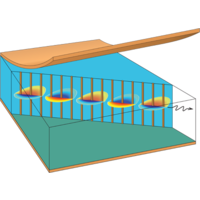
Some of the plasmonic phenomena can be imitated by exploiting the structural dispersion of parallel-plate waveguides filled with positive dielectrics. This synthetic platform, as a test bed for exploring plasmonic features, is more suitable for longer-wavelength regimes and may exhibit lower loss, since positive dielectric materials are utilized.

Bridging coupled wires and lattice Hamiltonian for two-component bosonic quantum Hall states

Yohei Fuji, Yin-Chen He, Subhro Bhattacharjee, and Frank Pollmann

Phys. Rev. B 93, 195143 (2016) - Published 20 May, 2016

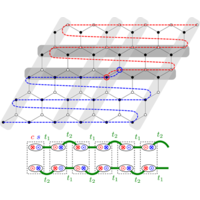
Identifying topological phases in strongly interacting many-body systems is a very challenging task, especially beyond fine-tuned exactly solvable models. The construction of topological phases from coupled quantum wires provides a controllable and systematic theoretical handle to those interactions. The authors show an explicit connection between the coupled wire construction and a lattice Hamiltonian of interacting bosons, which host a U(1) symmetry-protected topological phase (also referred to as the bosonic integer quantum Hall state).

Gigantic directional asymmetry of luminescence in multiferroic CuB2O4

S. Toyoda, N. Abe, and T. Arima

Phys. Rev. B 93, 201109(R) (2016) - Published 20 May, 2016

Multiferroic materials that simultaneously show electricity and magnetism provide an interesting playground for novel optical phenomena. One example is nonreciprocity, a change in optical properties with the reversal of the propagation direction of light. In this paper, the authors report that the luminescence intensity in multiferroic CuB2O4 changes by 70% between the opposite directions of the emitted light. The observed asymmetry is about 100 times larger than the previously reported value. They demonstrate that the gigantic directional asymmetry of luminescence provides a tool to visualize the antiferromagnetic domain structure, which is impossible using the conventional linear optical Faraday or Kerr effects.

Local density of states and its mesoscopic fluctuations near the transition to a superconducting state in disordered systems

I. S. Burmistrov, I. V. Gornyi, and A. D. Mirlin

Phys. Rev. B 93, 205432 (2016) - Published 20 May, 2016

Disordered superconductors show remarkable physics governed by the interplay of superconductivity and Anderson localization. The competition between these phenomena leads to a quantum phase transition: the superconductor-insulator transition (SIT). In this paper, the authors develop a theory of local density of states (LDOS) – including its average and mesoscopic fluctuations – as measured in tunneling experiments near the SIT. They use the nonlinear sigma-model renormalization-group framework (“fermionic approach”) and treat systems with short-range and Coulomb interactions on equal footing. The average LDOS obtained shows a pronounced depletion around the Fermi energy, both in the metallic phase (i.e., above the superconducting critical temperature) and in the insulating phase near the SIT. The LDOS fluctuations are found to be particularly strong for the case of short-range interactions. The findings compare well with experimental observations of depletion of LDOS and of its large point-to-point fluctuations in the metallic and insulating phases near the SIT in TiN, InO, and NbN films. The observed effects are thus intrinsic properties of a macroscopically homogeneous system and do not require any additional assumptions, such as granularity.

Weak (anti)localization in tubular semiconductor nanowires with spin-orbit coupling

Michael Kammermeier, Paul Wenk, John Schliemann, Sebastian Heedt, and Thomas Schäpers

Phys. Rev. B 93, 205306 (2016) - Published 19 May, 2016

Electrons in semiconductor nanowires can be radially confined to form a thin tubular conductive channel a few nanometers below the surface. The peculiar potential landscape, which can be either a result of Fermi level pinning due to surface reconstruction or band mismatch at the heterointerface in core/shell nanowires, gives rise to both Rashba and Dresselhaus spin-orbit coupling (SOC). By utilizing k⋅p theory, the authors have developed models for the SOC in nanowires with zinc-blende crystal structure for various nanowire growth directions. Taking advantage of these models, the weak (anti)localization correction Δσ to the static Drude conductivity is derived. Finally, the theory is fitted to experimental data of an undoped <111> InAs nanowire device, which exhibits a gate-controlled crossover from positive to negative magnetoconductivity. Thereby, the authors extract transport parameters and quantify the distinct types of SOC individually. The close agreement of theory and experiment suggests that the model provides reliable information and underlines the relevance of Dresselhaus SOC, which was previously often considered absent.

Many-body localization and thermalization: Insights from the entanglement spectrum

Scott D. Geraedts, Rahul Nandkishore, and Nicolas Regnault

Phys. Rev. B 93, 174202 (2016) - Published 18 May, 2016

The statistical physics of well isolated nonequilibrium quantum systems has been drawing intense interest recently, providing new paradigms for understanding equilibration and ergodicity (and failure thereof). Tools from the field of quantum information, such as quantum entanglement, have been instrumental in this development. Past investigations of the entanglement structure in localized and thermalizing phases have focused on diagnostics, such as entanglement entropy, which provide a useful but only partial characterization of the pattern of entanglement. In this work, inspired by random matrix theory, the authors examine localization and thermalization through the lens of the entanglement spectrum. This approach provides a complete characterization of the pattern of entanglement and yields new insights into many-body localization, thermalization, and nonequilibrium statistical mechanics.

SU(2)1 chiral edge modes of a critical spin liquid

Didier Poilblanc, Norbert Schuch, and Ian Affleck

Phys. Rev. B 93, 174414 (2016) - Published 18 May, 2016

Protected chiral edge modes are a well-known signature of topologically ordered phases, such as the fractional quantum Hall states (FQHS). Using the framework of projected entangled pair states (PEPS) on the square lattice, the authors construct a family of chiral spin-12 quantum spin liquids with Z2 gauge symmetry and analyze in full detail the properties of the edge modes. Surprisingly, the results show that the latter can be well described by a chiral conformal field theory of free bosons (SU(2)1), as is the case for the ν=12 (bosonic) gapped Laughlin state, despite the fact that the numerical data here suggest a critical bulk. The authors thus propose that our family of PEPS physically describes a boundary between a chiral topological phase and a trivial phase and might be closely connected to an (unknown) analogous FQHS.

Electric polarization observed in single crystals of multiferroic Lu2MnCoO6

S. Chikara, J. Singleton, J. Bowlan, D. A. Yarotski, N. Lee, H. Y. Choi, Y. J. Choi, and V. S. Zapf

Phys. Rev. B 93, 180405(R) (2016) - Published 17 May, 2016

Lu2MnCoO6 is a rare example of a double-perovskite material exhibiting multiferroic behavior – coupling of magnetic and electric order – and a rare example of hysteretic coupling in a bulk material. Here, the authors lay to rest questions about whether it occurs in single crystals and verify that it is an intrinsic effect. The Mn and Co spins are arranged in a frustrated up-up-down-down ordering along the c axis. Data from single crystals show that exchange striction produces electric polarization, albeit with a twist. Unlike other ‘up up down down’ multiferroics, the ferroelectricity emerges orthogonal to the magnetic ordering easy axis. This may be explained by a model taking into account the oxygen bond distortion in Lu2MnCoO6. Consequently, the system has a rich phase diagram: a dielectric response emerges below the magnetic ordering temperature, whereas a hysteretic polarization emerges in the region of magnetic hysteresis, as shown in this paper.

Ca3P2 and other topological semimetals with line nodes and drumhead surface states

Y.-H. Chan, Ching-Kai Chiu, M. Y. Chou, and Andreas P. Schnyder

Phys. Rev. B 93, 205132 (2016) - Published 17 May, 2016

Topological nodal line semimetals exhibit protected one-dimensional Fermi lines, which arise due to an intricate interplay between the symmetry and topology of the electronic wave functions. In this paper, the authors derive the Z invariants that guarantee the stability of the line nodes in the bulk under reflection symmetry and show that a quantized Berry phase (i.e, a Z2 invariant) leads to the appearance of protected surfaces states, which take the shape of a drumhead. Most importantly, a relation between the Z invariant, which characterizes the bulk, and the quantized Berry phase is derived. This relation is generally applicable to any topological nodal line semimetal with or without spin-orbit coupling. Moreover, it is shown that the Berry phase invariant can be simply obtained by computing the reflection parity eigenvalues. As a representative example of a topological nodal line semimetal, the authors examine Ca3P2, which has been identified as an ideal system with the line nodes at the Fermi energy. Using numerical calculations, they show that the drumhead surface state of Ca3P2 has a rather weak dispersion, which implies that correlation effects are enhanced at the surface.

Nonequilibrium optical properties in semiconductors from first principles: A combined theoretical and experimental study of bulk silicon

Davide Sangalli, Stefano Dal Conte, Cristian Manzoni, Giulio Cerullo, and Andrea Marini

Phys. Rev. B 93, 195205 (2016) - Published 13 May, 2016

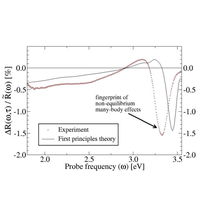
The study of optical properties in semiconductors after excitation with an ultrashort laser pulse represents a unique method to investigate many-body physics out of equilibrium. Indeed, the presence of a nonequilibrium carrier population alters the quasiparticle band structure and the excitonic binding energy. These peculiar effects can be captured only by computing exchange and correlation effects out of equilibrium. This paper provides an accurate and quantitative description of the nonequilibrium response of silicon by solving the Green’s function theory equation within a first-principles scheme. The method is shown to reproduce well the experimental transient reflectivity spectrum of bulk silicon.

Non-Abelian topological spin liquids from arrays of quantum wires or spin chains

Po-Hao Huang, Jyong-Hao Chen, Pedro R. S. Gomes, Titus Neupert, Claudio Chamon, and Christopher Mudry

Phys. Rev. B 93, 205123 (2016) - Published 13 May, 2016

In this paper, a family of non-Abelian topologically ordered states are built from arrays of quantum wires with fine-tuned electron-electron interactions. With the help of non-Abelian bosonization, the decoupled wires are described by conformal field theories. Electron-electron interactions are chosen to gap all conformal field theories except the one that describes the edge state. Hence, the construction makes it easy to engineer different topological ordered states. The authors prescribe, in particular, how to arrive at all the edge states described by the unitary conformal field theory minimal models using the spin degrees of freedom of the quantum wires alone. The construction provides a bridge between the field theory descriptions and the microscopic models of topological ordered states.

Dielectric function and plasmons in graphene: A self-consistent-field calculation within a Markovian master equation formalism

F. Karimi, A. H. Davoody, and I. Knezevic

Phys. Rev. B 93, 205421 (2016) - Published 12 May, 2016

The challenge of understanding the optical response and plasmon behavior in nanostructured materials, such as graphene and its nanoribbons, lies in describing screening in the presence of several concurrent electron scattering mechanisms. In this paper, the authors present a technique for calculating the dielectric function of nanostructures with an arbitrary band dispersion and Bloch wave functions. To calculate the linear response of a dissipative electronic system to an external electromagnetic field, the authors derive a quantum master equation within a self-consistent-field approach and solve it along with full-wave electromagnetic equations. This technique accurately captures interband electron-hole pair generation, as well as both interband and intraband electron scattering with phonons and impurities. The technique is employed to calculate the dielectric function, complex conductivity, as well as plasmon dispersion and propagation length for supported graphene. Plasmon propagation lengths are comparable on polar and nonpolar substrates and are on the order of tens of nanometers, considerably shorter than previously reported. They improve with fewer impurities, at lower temperatures, and at higher carrier densities.

Observation of topological nodal fermion semimetal phase in ZrSiS

Madhab Neupane, Ilya Belopolski, M. Mofazzel Hosen, Daniel S. Sanchez, Raman Sankar, Maria Szlawska, Su-Yang Xu, Klauss Dimitri, Nagendra Dhakal, Pablo Maldonado, Peter M. Oppeneer, Dariusz Kaczorowski, Fangcheng Chou, M. Zahid Hasan, and Tomasz Durakiewicz

Phys. Rev. B 93, 201104(R) (2016) - Published 11 May, 2016

The search for new topological phases of matter is a major new direction in condensed matter physics. Recent experimental realizations of Dirac and Weyl semimetal phases pave the way to look for other exotic phases of matter in real materials. In this paper, the authors present a systematic angle-resolved photoemission spectroscopy study of ZrSiS, a potential topological nodal semimetal candidate. Their systematic measurements establish the spinless nodal fermion semimetal phase in ZrSiS, which is supported by their first-principles calculations. This work puts forward the ZrSiS-type material family as a new platform to explore exotic states of quantum matter.

Exploiting spatiotemporal degrees of freedom for far-field subwavelength focusing using time reversal in fractals

Matthieu Dupré, Fabrice Lemoult, Mathias Fink, and Geoffroy Lerosey

Phys. Rev. B 93, 180201(R) (2016) - Published 5 May, 2016

Subwavelength focusing (and hence imaging) of waves is a topic of major interest for many applications. Several approaches have been proposed so far, mostly relying on metamaterials, but they suffer from drawbacks of being inherently narrowband and from dissipation into the material. The authors here suggest an innovative approach to overcome these issues by using an extended fractal resonator alongside time reversal. By coupling the fractal resonator with a reverberating cavity that transforms a single source of waves into multiple ones, they demonstrate experimentally that very wide bandwidth subwavelength focusing of microwaves is possible from the far field anywhere on the fractal.

Ising superconductivity and Majorana fermions in transition-metal dichalcogenides

Benjamin T. Zhou, Noah F. Q. Yuan, Hong-Liang Jiang, and K. T. Law

Phys. Rev. B 93, 180501(R) (2016) - Published 4 May, 2016

Due to its noncentrosymmetric lattice structure, a monolayer of transition metal dichalcogenides (TMD) possesses a very special type of spin-orbit coupling (SOC) called Ising SOC. Unlike Rashba SOC, Ising SOC pins electron spins to the out-of-plane rather than the in-plane direction. In TMD materials, the Ising SOC is quite strong and substantially enhances the in-plane upper critical field of their superconducting state. Despite this, the authors show here that the Ising SOC can in fact lead to spin-triplet Cooper pairing with electrons spins pointing in the in-plane direction. Such pairing induces a topological superconducting state in spin-polarized proximity coupled wires and generates Majorana end states. So-formed Majorana states can be more accessible experimentally due to the strong Ising SOC and a wider topologically nontrivial regime.

Effective action and electromagnetic response of topological superconductors and Majorana-mass Weyl fermions

Michael Stone and Pedro L. e S. Lopes

Phys. Rev. B 93, 174501 (2016) - Published 3 May, 2016

This paper discusses what happens when Weyl fermions acquire a Majorana mass through coupling to a charged condensate. Such a mass makes the system become a topological superconductor. Chiral vortices in this superconductor bind one-dimensional Majorana-Weyl modes in their core. The Majorana-Weyl modes are electrically neutral, and are also chiral in that particles occupying them propagate in only one direction. Previous work had suggested that these modes would possess their own axial anomaly, where charge appears on the vortex as a result of a radial inflow from outside. This charge accumulation seems paradoxical as the core modes are neutral.Stimulated by this paradox, the authors reexamine the derivation of the low-energy effective action functional that describes the system’s response to external fields. They find that both the original and another paradox that arise in the process are resolved by an interplay between the universal topological terms in the action functional that are determined entirely by anomaly effects and the nonuniversal nontopological terms that depend on the details of the band structure.

Characterizing the three-orbital Hubbard model with determinant quantum Monte Carlo

Y. F. Kung, C.-C. Chen, Yao Wang, E. W. Huang, E. A. Nowadnick, B. Moritz, R. T. Scalettar, S. Johnston, and T. P. Devereaux

Phys. Rev. B 93, 155166 (2016) - Published 29 April, 2016

The authors systematically characterize the three-orbital Hubbard model using state-of-the-art determinant quantum Monte Carlo (DQMC) simulations with parameters relevant to the cuprate high-temperature superconductors. The DQMC results agree well with those from cuprate experiments, such as photoemission, and enable the identification of orbital content in the bands. A comparison of DQMC results to those from exact diagonalization and cluster perturbation theory elucidates how these different numerical techniques complement one another to produce a more complete understanding of the model and the cuprates.

Scanning Josephson spectroscopy on the atomic scale

Mallika T. Randeria, Benjamin E. Feldman, Ilya K. Drozdov, and Ali Yazdani

Phys. Rev. B 93, 161115(R) (2016) - Published 28 April, 2016

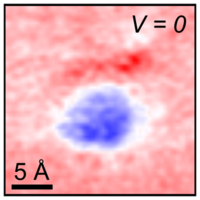
Unconventional superconductors, with order parameters that are predicted to have short range spatial modulations, have held long standing interest in the field. The Josephson effect, which directly probes the strength of the pairing potential is an ideal technique to study these materials, in contrast to a majority of probes which rely on deductions made from quasiparticle measurements. The authors combine the Josephson effect with the high spatial resolution afforded by scanning tunneling microscopy to study atomic scale variations of the order parameter in a model system consisting of magnetic adatoms on a BCS superconductor. The atomic resolution achieved establishes scanning Josephson spectroscopy as a promising tool for the study of novel superconducting materials.

Temperature-dependent excitonic effects in the optical properties of single-layer MoS2

Alejandro Molina-Sánchez, Maurizia Palummo, Andrea Marini, and Ludger Wirtz

Phys. Rev. B 93, 155435 (2016) - Published 26 April, 2016
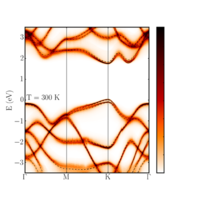
The electron-phonon interaction alters substantially the conventional picture of the band structure. It also changes the properties of excitonic states, which are very pronounced in many 2D materials. Using many-body perturbation theory, the authors describe how the inclusion of temperature modifies the electronic bands of single-layer MoS2. Different bands and different regions in the Brillouin zone are affected in different ways by electron-phonon coupling. Using the temperature-broadened bands as input for the Bethe-Salpeter equation, the authors explain why, for the bound A and B excitons, the electron-phonon coupling changes mainly the position, and for the C exciton, only the width is affected by temperature, while the energy is rather constant.

Sign In to Your Journals Account

Filter

Section

Filter

Article Lookup

Enter a citation