Highlights

T/B scaling without quasiparticle mass divergence: YbCo2Ge4

Akito Sakai, Kentaro Kitagawa, Kazuyuki Matsubayashi, Makoto Iwatani, and Philipp Gegenwart

Phys. Rev. B 94, 041106(R) (2016) - Published 8 July, 2016

“Strange metal phases”, displaying strong deviations from Fermi liquid theory, are discussed in the context of cuprates, itinerant magnets, or heavy-fermion metals. Several Yb-based materials, e.g., β-YbAlB4 or the Au-Al-Yb quasicrystal, display T/B scaling of magnetic and thermodynamic properties. This has been taken as evidence for zero-field quantum criticality without requirement to fine-tune composition and pressure. However, it appears unlikely that materials are accidentally located at such a special point in multidimensional phase space. In this paper, the authors demonstrate by a thermodynamic study on the new Kondo lattice compound YbCo2Ge4 that T/B scaling and a divergence of the magnetic Grüneisen parameter can arise without a quasiparticle mass divergence and in the absence of zero-field quantum criticality. They discuss alternative scenarios for such strange metal behavior.

Analogue of Rashba pseudo-spin-orbit coupling in photonic lattices by gauge field engineering

Y. Plotnik, M. A. Bandres, S. Stützer, Y. Lumer, M. C. Rechtsman, A. Szameit, and M. Segev

Phys. Rev. B 94, 020301(R) (2016) - Published 7 July, 2016

Engineering the gauge field of a physical system is a crucial step in the effort to control the behavior of waves. In the past few years, scientists have demonstrated the ability to design and implement artificial gauge fields in a variety of physical systems, which have played a major role in demonstrating various fascinating phenomena in both photonic and cold-atoms settings. In this Rapid Communication, the authors explore, theoretically and experimentally, a method to create artificial gauge fields. They implement this method for demonstrating the Rashba effect – the photonic equivalent of the spin-orbit coupling known from electronic systems.

Octahedral rotation patterns in strained EuFeO3 and other Pbnm perovskite films: Implications for hybrid improper ferroelectricity

A. K. Choquette, C. R. Smith, R. J. Sichel-Tissot, E. J. Moon, M. D. Scafetta, E. Di Gennaro, F. Miletto Granozio, E. Karapetrova, and S. J. May

Phys. Rev. B 94, 024105 (2016) - Published 7 July, 2016

The control of octahedral rotations in perovskite heterostructures is an emerging strategy for inducing new functionality as evidenced by recent predictions of improper ferroelectricity, polar metals, and multiferroics. Many of these predictions are predicated on the presence of a specific rotation pattern (a-a-c+) in superlattices that exhibit the orthorhombic (Pbnm) perovskite structural variant. The authors use synchrotron diffraction to measure the octahedral rotation patterns in strained ferrite, manganite, and gallate perovskite films finding that compressive strain strongly favors a+a-c- rotation patterns and tensile strain weakly favors a-a-c+ structures. In contrast, films grown on orthorhombic substrates exhibit the same rotation pattern orientation as the substrate, even for epitaxial conditions where strain would favor the opposite structural orientation. The results indicate that substrate imprinting is a more robust method than strain for controlling the rotation pattern in Pbnm-type perovskite films, a finding that should enable more efficient experimental pursuits of rotation-driven ferroic states in oxide heterostructures.

Superconductivity in the ferromagnetic semiconductor samarium nitride

E.-M. Anton, S. Granville, A. Engel, S. V. Chong, M. Governale, U. Zülicke, A. G. Moghaddam, H. J. Trodahl, F. Natali, S. Vézian, and B. J. Ruck

Phys. Rev. B 94, 024106 (2016) - Published 7 July, 2016

Ferromagnetism and superconductivity are two generally incompatible states of matter. Their coexistence has been observed only under very unusual circumstances and so far only in metals. In contrast, most semiconductors are not naturally magnetic or superconducting, but introducing magnetism or superconductivity into semiconductors is seen as an important step towards radical improvement of our electronics capabilities and therefore a hotly pursued goal. Here, the authors report the discovery of superconductivity coexisting with ferromagnetism in the semiconducting material samarium nitride (SmN). The large intrinsic exchange splitting of the conduction band in SmN requires the superconducting order to be of unconventional (likely p-wave) type. Superconductivity is observed to be even further enhanced in superlattices where layers of SmN alternate with layers made of the strongly ferromagnetic but non-superconducting material gadolinium nitride. These features render SmN an interesting laboratory for understanding more about the fundamentals of ferromagnetism and superconductivity in semiconductors and exploring opportunities for integrating superconducting spintronics into the design of semiconductor-based electronic devices.

Superconductivity from a confinement transition out of a fractionalized Fermi liquid with Z2 topological and Ising-nematic orders

Shubhayu Chatterjee, Yang Qi, Subir Sachdev, and Julia Steinberg

Phys. Rev. B 94, 024502 (2016) - Published 5 July, 2016

A Z2 fractionalized Fermi liquid (FL*) is a novel state of strongly correlated quantum matter. Although it is metallic, it violates Luttinger’s theorem on the volume enclosed by the Fermi surface obeyed by conventional metals; this is possible due to the presence of emergent gauge excitations. The authors study here the superconducting states that can arise out of instabilities of such a topological metal. In particular, they focus on a FL* topological metal that has favorable energetics on the square lattice with nematic order, relevant to the cuprate superconductors. They find that a Higgs transition out of this FL* results in confinement of the anyonic degrees of freedom, and the resulting state is a superconductor with broken translation symmetry or time-reversal invariance. In the process, they also establish a complete mapping between bosonic and fermionic descriptions of time-reversal invariant gapped insulating Z2 spin liquid states on the rectangular lattice, which, on doping with charge carriers, can give rise to FL* phases. They also note a possible connection to the recent observation of pair density waves in the superconducting state of the underdoped cuprates.

Spin-wave excitation modes in thick vortex-state circular ferromagnetic nanodots

R. V. Verba, A. Hierro-Rodriguez, D. Navas, J. Ding, X. M. Liu, A. O. Adeyeye, K. Y. Guslienko, and G. N. Kakazei

Phys. Rev. B 93, 214437 (2016) - Published 28 June, 2016

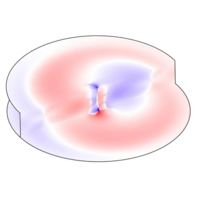
Magnetic vortex is one of the simplest nontrivial topological structure that can exist in magnetic nanodots. Due to nonzero topological charge, vortices exhibit complex and interesting dynamic under external excitation, which includes excitation of translational (gyrotropic) and spin-wave modes. Here, the authors study the vortex dynamic in thick magnetic nanodots, when the vortex becomes essentially three dimensional. The third dimension is shown to lead to the appearance of additional spin-wave modes with characteristic curled structure (“curled” modes), which becomes the lowest ones in frequency among spin-wave modes for a sufficiently thick nanodot. Besides an uncommon profile, the curled modes also show uncommon hybridization with gyrotropic modes: modes propagating in opposite directions (clockwise and counterclockwise) that can be hybridized with different order gyrotropic modes.

Size dependence of nanosecond-scale spin-torque switching in perpendicularly magnetized tunnel junctions

T. Devolder, A. Le Goff, and V. Nikitin

Phys. Rev. B 93, 224432 (2016) - Published 28 June, 2016

Magnetic tunnel junctions are under active consideration owing to their applications including the potential next generations of spin transfer torque memories. In view of the high symmetry of the magnetic properties and of the high frequency of the system eigenexcitations, out-of-plane magnetized systems are thought to enable a faster and simpler spin-torque-induced switching process than the formerly used in-plane magnetized systems. Unfortunately, the lack of high frequency and low current switching experiments have precluded, so far, the assessment of the speed potential of perpendicular anisotropy systems at low junction dimensions. By time resolving the switching and evidencing its stochastic aspects at the nanosecond-scale, the authors here demonstrate that a complex dynamics happens and persists down to small sized elements with always a very strong asymmetry between the two switching directions. The reversal is explained by the complex interplay between the spatial profile of the stray field emanating from the fixed system of the tunnel junction and the constraint that the switching is preferably initiated from the device edge.

Challenges in design of Kitaev materials: Magnetic interactions from competing energy scales

Stephen M. Winter, Ying Li, Harald O. Jeschke, and Roser Valentí

Phys. Rev. B 93, 214431 (2016) - Published 27 June, 2016

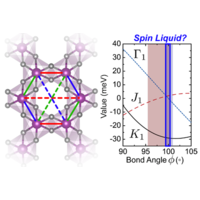
Much interest has emerged in the realization of materials with quantum spin liquid ground states, which would provide fertile ground for realizing exotic excitations. Three “Kitaev” spin liquid candidate materials have been proposed – Na2IrO3, α-RuCl3, and α-Li2IrO3 – and there has been many diverging proposals for the most relevant interactions. Here, the authors re-evaluate carefully the magnetic interactions in these materials, using nonperturbative exact diagonalization methods. The results clarify misconceptions in the literature and help estimate the potential for realizing the spin liquid state in real materials.

Spin-orbit coupling controlled ground state in Sr2ScOsO6

A. E. Taylor, R. Morrow, R. S. Fishman, S. Calder, A. I. Kolesnikov, M. D. Lumsden, P. M. Woodward, and A. D. Christianson

Phys. Rev. B 93, 220408(R) (2016) - Published 27 June, 2016

The role of spin-orbit coupling (SOC) in 4d and 5d transition metal oxides is relatively poorly understood outside of the LS or JJ coupling limits. In this work, the importance of the intermediate regime is demonstrated through the identification of SOC as an essential feature of the collective properties in nominally orbitally quenched 5d3 systems. The authors probe the magnetic excitations in model system Sr2ScOsO6 via inelastic neutron scattering and model the results including the effects of SOC-induced anisotropy. Experimentally determining the strengths of nearest and next-nearest neighbor interactions leads to the important discovery that the magnetic ground state is controlled by anisotropy, which would not be possible in the LS coupling limit. This indicates that SOC plays a key role in relieving frustration and promoting heightened transition temperatures in 5d3 double perovskites.

Nature of composite fermions and the role of particle-hole symmetry: A microscopic account

Ajit C. Balram and J. K. Jain

Phys. Rev. B 93, 235152 (2016) - Published 27 June, 2016

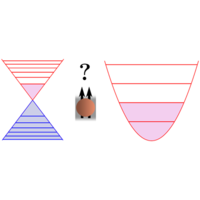
Motivated by the particle-hole symmetry at the half-filled lowest Landau level, many articles have taken the point of view, following D. T. Son, that composite fermions are Dirac particles and their Fermi sea is akin to that occurring at the surface of a three dimensional topological insulator. This presents a paradox, because the microscopic theory of composite fermions, which treats composite fermions as non-relativistic particles, has been confirmed in great detail. The authors discuss what features of the Dirac-composite fermion view can be reconciled with the microscopic theory. They also show how particle-hole symmetry can emerge in the Chern-Simons formulation of composite fermions.

Phase structure of one-dimensional interacting Floquet systems. I. Abelian symmetry-protected topological phases

C. W. von Keyserlingk and S. L. Sondhi

Phys. Rev. B 93, 245145 (2016) - Published 27 June, 2016

Phases of matter are traditionally seen as families of static systems exhibiting the same long-distance and low-energy correlations. In this work, the authors propose and classify a new family of phases of matter. They are novel insofar as they are intrinsically driven and out of equilibrium — they can only be realized in systems with time-dependent Hamiltonians. The phases we consider arise in 1D periodically driven systems, in the presence of strong disorder and interactions, and are similar to but qualitatively distinct from the symmetry-protected topological phases now well known in the equilibrium setting. In a companion paper, the authors examine similar intrinsically driven families of states with long-range order, and an order parameter that oscillates at a frequency that is robustly an integer multiple of the underlying drive frequency.

Particle-vortex duality of two-dimensional Dirac fermion from electric-magnetic duality of three-dimensional topological insulators

Max A. Metlitski and Ashvin Vishwanath

Phys. Rev. B 93, 245151 (2016) - Published 27 June, 2016

Duality is a powerful theoretical tool whereby the strongly interacting and intractable regime of a theory can be accessed in terms of weakly interacting “dual” variables. In condensed matter, this is familiar from the Kramers-Wannier duality of the Ising model, and boson-vortex duality. Here, a duality for another fundamental problem – Dirac fermions in two spatial dimensions – is obtained, which provides a new window to the physics of strongly interacting electrons. This leads to unexpected connections between topological insulators in three dimensions and the physics of the half-filled Landau level, including composite fermions and Pfaffian quantum Hall states.

Low-energy excitations and ground-state selection in the quantum breathing pyrochlore antiferromagnet Ba3Yb2Zn5O11

T. Haku, K. Kimura, Y. Matsumoto, M. Soda, M. Sera, D. Yu, R. A. Mole, T. Takeuchi, S. Nakatsuji, Y. Kono, T. Sakakibara, L.-J. Chang, and T. Masuda

Phys. Rev. B 93, 220407(R) (2016) - Published 24 June, 2016

This study is motivated by a challenge to the third law of the thermodynamics: how does the degenerated ground state in a textbook example behave in a real compound? At very low temperatures, nature tries to preserve the basic law using small perturbations and a novel quantum state should appear. The authors here study the classic frustrated magnet Ba3Yb2Zn5O11, a spin tetrahedron having two-fold degeneracy realized in a breathing pyrochlore lattice. They measure by inelastic neutron scattering the low-energy excitations in order to identify the effective spin Hamiltonian and macroscopic properties at very low temperatures. They demonstrate how the degeneracy of the ground state is lifted and a unique quantum state is selected.

Self-organized charge puddles in a three-dimensional topological material

N. Borgwardt, J. Lux, I. Vergara, Zhiwei Wang, A. A. Taskin, Kouji Segawa, P. H. M. van Loosdrecht, Yoichi Ando, A. Rosch, and M. Grüninger

Phys. Rev. B 93, 245149 (2016) - Published 24 June, 2016

Unraveling the peculiar properties of topological materials often requires tuning of the bulk chemical potential, which has been addressed by compensation of acceptors and donors. Compensation necessarily creates Coulomb disorder which, however, impedes chemical potential tuning and gives rise to self-organized charge puddles. In the topological insulator BiSbTeSe2, optical data and Monte Carlo simulations presented here reveal the existence of puddles at low temperatures as well as their surprising “evaporation” on a temperature scale of about 40 K. The highly nonlinear screening effect of thermal excitations is also important for Dirac matter or Weyl semimetals. Understanding and controlling the puddles will be a key to realizing novel phenomena in 3D topological materials, as was the case with 2D materials such as graphene.

History dependence of the magnetic properties of single-crystal Fe1−xCoxSi

A. Bauer, M. Garst, and C. Pfleiderer

Phys. Rev. B 93, 235144 (2016) - Published 21 June, 2016

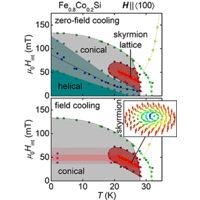
Cubic chiral magnets crystallizing in space group P213 give rise to a spin structure of nontrivial topology, the so-called skyrmion lattice. The strongly doped semiconductor Fe1-xCoxSi is a fascinating member of this material class of compounds as it exhibits helimagnetism over a wide compositional range. The authors study the magnetic properties of this itinerant magnet for different values of x, combine their results with previous reports, and infer the magnetic phase diagrams. The latter are rather isotropic but depend on the field and temperature history. In particular, when cooled in an applied magnetic field, the skyrmion lattice may persist down to lowest temperatures. This history dependence, in combination with the variation of temperature, field, and length scale of the magnetic order by means of compositional tuning, makes Fe1-xCoxSi an excellent material for future experiments studying skyrmions.

Charged quantum dot micropillar system for deterministic light-matter interactions

P. Androvitsaneas, A. B. Young, C. Schneider, S. Maier, M. Kamp, S. Höfling, S. Knauer, E. Harbord, C. Y. Hu, J. G. Rarity, and R. Oulton

Phys. Rev. B 93, 241409(R) (2016) - Published 21 June, 2016

Quantum dots have long been considered systems that could deliver a significant advantage for practical quantum information applications. Their atomic dipolelike transitions and their compatibility to be integrated into a variety of photonic structures has highlighted this fact. Here, the authors measure an unexpectedly high single-photon level phase shift (~6∘), induced upon reflection from a singly negatively charged quantum dot incorporated in a low-Q-factor cavity (Q~290). This measurement provides the first evidence for a system with unit fidelity and a high efficiency in its interactions. The result opens a new road to realistic spin-photon entanglement devices, in a simple and easy to fabricate photonic structure.

Highly anisotropic exchange interactions of jeff=12 iridium moments on the fcc lattice in La2BIrO6 (B=Mg,Zn)

A. A. Aczel, A. M. Cook, T. J. Williams, S. Calder, A. D. Christianson, G.-X. Cao, D. Mandrus, Yong-Baek Kim, and A. Paramekanti

Phys. Rev. B 93, 214426 (2016) - Published 20 June, 2016

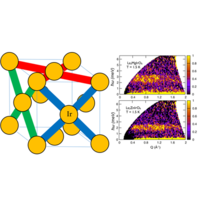
A special type of anisotropic spin exchange called the “Kitaev interaction” provides rare exactly-soluble models of gapless quantum spin liquids in 2d and 3d. The main goals of this work were to identify other lattice geometries that support the elusive Kitaev interactions and understand the magnetic properties of such materials. By performing inelastic neutron scattering on La2MgIrO6 and La2ZnIrO6, the authors find that these magnets, which possess long-range antiferromagnetic order, yield clear signatures of gapped and nearly-dispersionless magnon excitations. They also show that spin-wave models with a dominant Kitaev interaction can naturally account for the magnetic ordering pattern as well as the inelastic neutron scattering data.

Spectral functions of the uniform electron gas via coupled-cluster theory and comparison to the GW and related approximations

James McClain, Johannes Lischner, Thomas Watson, Devin A. Matthews, Enrico Ronca, Steven G. Louie, Timothy C. Berkelbach, and Garnet Kin-Lic Chan

Phys. Rev. B 93, 235139 (2016) - Published 20 June, 2016

Coupled-cluster theory is a “gold standard” of molecular quantum chemistry, but has only recently been extended to condensed-phase systems. In this work, excited-state coupled-cluster techniques are brought to bear on the spectral function of the uniform electron gas. The diagrammatic content of coupled-cluster theory goes beyond that of the GW approximation, which has become a canonical approach in first-principles condensed-matter physics. Benchmark calculations demonstrate that the coupled-cluster results are more accurate than those of GW-based approaches, insensitive to the mean-field reference, and systematically improvable towards the exact result. Calculations on large systems approaching the thermodynamic limit reveal an accurate quasiparticle bandwidth as well as plasmonic satellite structure in the core-hole spectral function.

Conductance of a proximitized nanowire in the Coulomb blockade regime

B. van Heck, R. M. Lutchyn, and L. I. Glazman

Phys. Rev. B 93, 235431 (2016) - Published 20 June, 2016

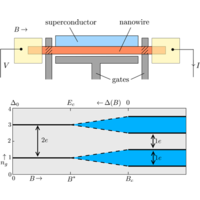
The search for Majorana bound states, motivated by the prospect of discovering non-Abelian exchange statistics and developing topological quantum computing, is an ongoing challenge in condensed matter physics. Crafting a wire hosting Majorana states is not a trivial task, requiring great care in the choice of materials and in the device design. Experimentalists rely on the electron transport measurements to characterize the devices. It is therefore important to have a detailed theory for interpreting the experimental data and reliably detecting the nontrivial (topological) superconductivity needed for the appearance of Majorana states. Here, the authors have developed such a theory for short small-capacitance wires. In such wires, the apperance of Majorana states coexists with the effects of single-electron charging. The theory here provides quantitative results for the electric conduction of wires in these conditions and provides guidance for those in the field seeking understanding of important recent experiments, as well as those designing the future ones.

Origin of dissipative Fermi arc transport in Weyl semimetals

E. V. Gorbar, V. A. Miransky, I. A. Shovkovy, and P. O. Sukhachov

Phys. Rev. B 93, 235127 (2016) - Published 15 June, 2016

The existence of the surface Fermi arc states is a signature property of the Weyl semimetals. In view of their one-dimensional chiral nature, one might naively expect that the corresponding surface transport is nondissipative. In a drastic contrast to such an expectation, the authors show here that the dynamics of the chiral surface states is dissipative in semimetals. In the presence of impurities, the origin of the dissipation is the scattering of surface Fermi arc states into the bulk of the semimetal. The gapless spectrum of the bulk states in semimetals is the key feature that allows such processes to happen. By taking into account all scattering processes, the authors perform a model calculation of the electric conductivity of the surface Fermi arc states.

Sign In to Your Journals Account

Filter

Section

Filter

Article Lookup

Enter a citation