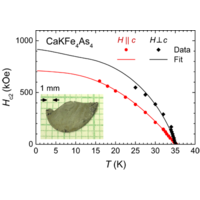
Single-crystalline, single-phase has been grown out of a high-temperature, quaternary melt. Temperature-dependent measurements of x-ray diffraction, anisotropic electrical resistivity, elastoresistivity, thermoelectric power, Hall effect, magnetization, and specific heat, combined with field-dependent measurements of electrical resistivity and field and pressure-dependent measurements of magnetization indicate that is an ordered, stoichiometric, Fe-based superconductor with a superconducting critical temperature, K. Other than superconductivity, there is no indication of any other phase transition for K. All of these thermodynamic and transport data reveal striking similarities to those found for optimally or slightly overdoped , suggesting that stoichiometric is intrinsically close to what is referred to as “optimal-doped” on a generalized, Fe-based superconductor, phase diagram. The anisotropic superconducting upper critical field, , of was determined up to 630 kOe. The anisotropy parameter , for applied perpendicular and parallel to the axis, decreases from at to at 25 K, which can be explained by interplay of paramagnetic pair breaking and orbital effects. The slopes of kOe/K and kOe/K at yield an electron mass anisotropy of and short Ginzburg-Landau coherence lengths and . The value of can be extrapolated to kOe, well above the BCS paramagnetic limit.