Highlights

Mott physics and spin fluctuations: A functional viewpoint

Thomas Ayral and Olivier Parcollet

Phys. Rev. B 93, 235124 (2016) - Published 14 June, 2016

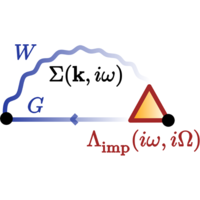
Two important scenarios have been put forth to explain high-temperature superconductivity. One scenario emphasizes, following Philip W. Anderson, that for many high-Tc superconductors their undoped parent compounds are Mott insulators, with local physics playing a major role. Another scenario stresses instead the importance of spin fluctuations near a quantum critical point. In this work, the authors reconcile both viewpoints by constructing a functional of the Green’s function of the electron (G), of the fluctuations (W) and of the vertex that couples the two (Λ). In the approach presented by the authors, Mott physics as well as the charge and spin fluctuations are taken into account in the description of correlations. This is done at a computational cost comparable to that of the dynamical mean field theory, making the method suitable for multiorbital extensions.

Electron doping evolution of the magnetic excitations in NaFe1−xCoxAs

Scott V. Carr, Chenglin Zhang, Yu Song, Guotai Tan, Yu Li, D. L. Abernathy, M. B. Stone, G. E. Granroth, T. G. Perring, and Pengcheng Dai

Phys. Rev. B 93, 214506 (2016) - Published 13 June, 2016

Because of the unconventional nature of high-temperature superconductors, it has been proposed that magnons, rather than phonons, play an important role in Cooper pair formation. It is therefore of great importance to understand how magnetic excitations behave and evolve between superconducting and nonsuperconducting compounds. In this work, the authors present a comprehensive study of the magnetic excitations in electron-doped NaFe1-xCoxAs in several samples across the phase diagram, including both superconducting and nonsuperconducting compounds. They find a strong suppression of low-energy magnetic scattering connected with the onset of superconductivity but no effect on either high-energy scattering intensity or bandwidth. Additionally, through comparison with the related but structurally distinct compound BaFe2-xNixAs2, they find a comparable total moment despite a smaller ordered moment, narrower scattering bandwidth, and Tc. These features all point to magnetism as an agent in the formation of superconductivity.

Magnetic diffuse scattering in artificial kagome spin ice

Oles Sendetskyi, Luca Anghinolfi, Valerio Scagnoli, Gunnar Möller, Naëmi Leo, Aurora Alberca, Joachim Kohlbrecher, Jan Lüning, Urs Staub, and Laura Jane Heyderman

Phys. Rev. B 93, 224413 (2016) - Published 13 June, 2016

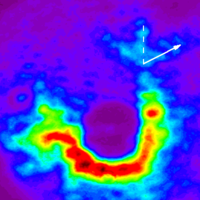
Magnetic phases and phase transitions in artificial spin ice, constructed from tailor-made arrays of nanomagnets, are currently subjects of great interest. The authors present measurements of the diffuse soft x-ray resonant magnetic scattering in artificial spin ice, where the moments of the magnets, arranged on the sites of the kagome lattice, are highly dynamic. Comparing experimental scattering patterns with the patterns calculated from Monte Carlo simulations based on a needle-dipole model, they show the emergence of quasi-pinch-points in the kagome ice I phase, and explain their relation to the pinch-point singularities in spin ice pyrochlores. As in the bulk pyrochlore spin ices, measurement of diffuse scattering from artificial kagome spin ice provides unique information on the magnetic correlations and can be applied to a number of other problems concerning nanomagnetic systems.

Measurement of spin coherence using Raman scattering

Z. Sun, A. Delteil, S. Faelt, and A. Imamoğlu

Phys. Rev. B 93, 241302(R) (2016) - Published 13 June, 2016

Measuring spin coherence time is essential in general characterization of a qubit. Here, a novel method to determine the coherence time of a spin qubit is implemented, based on the coherence properties of inelastic Raman scattering obtained with an unbalanced Mach-Zehnder interferometer. The authors demonstrate this method on both a single electron spin and a hole spin confined in a self-assembled quantum dot. The visibility of the first-order coherence of Raman scattered photon in the weak excitation regime exhibits a Gaussian decay as a function of the time delay, allowing a direct extraction of T2*, which is immune to the limitations that influence standard Ramsey interference with self-assembled quantum dots.

Tunable scattering cancellation cloak with plasmonic ellipsoids in the visible

Martin Fruhnert, Alessio Monti, Ivan Fernandez-Corbaton, Andrea Alù, Alessandro Toscano, Filiberto Bilotti, and Carsten Rockstuhl

Phys. Rev. B 93, 245127 (2016) - Published 13 June, 2016

Rendering arbitrary objects invisible is currently of great interest in photonics. While there are some optical tricks to hide macroscopic objects, such as camouflaging and mimetics, true invisibility remains out of reach. However, for sufficiently small objects one can use advanced techniques to prevent their detection at least at discrete wavelengths. The scattered light is suppressed, as envisioned using the recently developed scattering cancellation technique. At optical frequencies, metallic nanoparticles that mantle a small object do the desired job. However, tuning the operational frequency of such a mantle cloak remained a challenge. The authors here solve this problem by using silver ellipsoids instead of spheres. Depending on the axis ratio, the cloaking frequency is tunable throughout the entire visible spectrum. The cloak performance has been rigorously analyzed using the T-matrix method. It is envisioned that the optimized structure opens the door to many applications where the scattering signal will be suppressed at a predefined wavelength, e.g., to suppress the cross-talk between adjacent optical nanoantennas or the spurious signal from a tip in a near-field optical microscope.

Ising tricriticality in the extended Hubbard model with bond dimerization

Satoshi Ejima, Fabian H. L. Essler, Florian Lange, and Holger Fehske

Phys. Rev. B 93, 235118 (2016) - Published 10 June, 2016

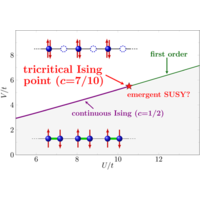
The tricritical Ising universality class emerges at the end point of a line of continuous Ising phase transitions, above which the transition is first order. In 1+1 dimensions, it is described by the second minimal model of conformal field theory (CFT) with central charge c=7/10. Recently, there has been a revival of interest in the tricritical Ising model due to its emergent space-time supersymmetry. Combining numerical (infinite density-matrix renormalization group) and field theoretical (bosonization and CFT) techniques, there authors demonstrate here that Ising tricriticality occurs in a paradigmatic extended one dimensional Hubbard model with explicit bond dimerization. The low-energy sector can be described by a triple sine-Gordon model, which, in the transition region, reduces to the tricritical Ising CFT. The theoretically predicted decay of various two-point correlation functions is found to be in excellent agreement with the density-matrix renormalization group data.

In situ hard x-ray photoemission spectroscopy of barrier-height control at metal/PMN-PT interfaces

E. Kröger, A. Petraru, A. Quer, R. Soni, M. Kalläne, N. A. Pertsev, H. Kohlstedt, and K. Rossnagel

Phys. Rev. B 93, 235415 (2016) - Published 10 June, 2016

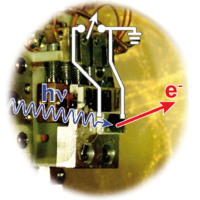
Ferroelectrics exhibit switchable spontaneous polarization, a functionality that can be harnessed in nonvolatile memory devices. The main characteristics of these devices are governed by the electronic band alignment at the interfaces, particularly at the metallic contacts. Here, the authors study such an interface using state-of-the-art high-energy x-ray photoelectron spectroscopy, with in situ polarization reversal achieved by applying poling voltage. They confirm a result central to the physics of ferroelectric devices: an electrode-dependent potential drop at the interface that is linear in the spontaneous polarization. They also reveal a novel effect: electric-field-dependent increase of the energy offset due to the field-induced strain in the ferroelectric material.

Evidencing the need for high spatial resolution in angle-resolved photoemission experiments

Frédéric Joucken, Nicolas Reckinger, Stéphane Lorcy, José Avila, Chaoyu Chen, Jérôme Lagoute, Jean-François Colomer, Jacques Ghijsen, Maria Carmen Asensio, and Robert Sporken

Phys. Rev. B 93, 241101(R) (2016) - Published 9 June, 2016

Angle-resolved photoemission spectroscopy (ARPES) provides direct access to the electronic band structure of materials. Very recently, the spatial resolution of ARPES setups has dramatically increased, with a spot size at the sample shrinking from 50×50 μm2, typical of most synchrotron-based setups, down to 100×100 nm2 or less. In this work, the authors demonstrate the impact of increased spatial resolution by evidencing faint spatial inhomogeneity in the ARPES signal of a graphene sample that would go undetected in ARPES setups possessing lower spatial resolution.

Superconductivity and ferromagnetism in hole-doped RbEuFe4As4

Yi Liu, Ya-Bin Liu, Zhang-Tu Tang, Hao Jiang, Zhi-Cheng Wang, Abduweli Ablimit, Wen-He Jiao, Qian Tao, Chun-Mu Feng, Zhu-An Xu, and Guang-Han Cao

Phys. Rev. B 93, 214503 (2016) - Published 8 June, 2016

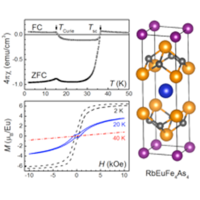
Superconductivity (SC) and local-moment ferromagnetism (FM) are mutually antagonistic collective phenomena, and their genuine coexistence is rarely seen in nature. Although recent years have witnessed the possible coexistence of SC and Eu-spin FM in some doped EuFe2As2 systems, evidence of simultaneous bulk SC and obvious FM is still absent. Here, the authors report a robust coexistence of SC and FM in the iron pnictide RbEuFe4As4. The newly synthesized material is virtually an intergrowth of RbFe2As2 and EuFe2As2, making it hole doped by itself. With decreasing temperature, SC emerges at 36.5 K, followed by a Eu-spin ferromagnetic ordering at 15 K. Bulk SC is unambiguously confirmed by a large specific heat jump ΔC=7.5 J mol-1 K-1 at 36 K, while the Eu-spin FM is demonstrated by a coersive field of 360 Oe as well as a saturation magnetization of 6.5 μB/Eu at 2 K. Additional interesting issues include a rarely observed third-order ferromagnetic transition and a possible Fulde-Ferrell-Larkin-Ovchinnikov (FFLO) state below 5 K. The findings not only provide an excellent playground to investigate the long-standing issue of how SC coexists with long-range local-moment FM, but also give hints for the mechanism of iron-based SC by answering why SC and FM are compatible in this particular system.

Spin state ordering of strongly correlating LaCoO3 induced at ultrahigh magnetic fields

Akihiko Ikeda, Toshihiro Nomura, Yasuhiro H. Matsuda, Akira Matsuo, Koichi Kindo, and Keisuke Sato

Phys. Rev. B 93, 220401(R) (2016) - Published 6 June, 2016

An additional degree of freedom in cobalt oxides that makes them fascinating is the spin state of the Co3+ ions, which possess six d-shall electrons and can form configurations with spins S=0, 1, or 2. In the prototypical member of the family, LaCoO3, the ground state is believed to be insulating with the spin state S=0. However, there has been a great deal of controversy over the last decades about the nature of the excited states and the phases observed at higher temperatures. The authors here approach this long-standing problem by applying ultrahigh magnetic fields reaching 133 Tesla at temperatures ranging from 2 to 120 K. Surprisingly, at magnetic fields above 100 T, they find two novel magnetic phases that are identified as spin-state crystalline states, possibly with some orbital ordering.

Measurement of Chern numbers through center-of-mass responses

H. M. Price, O. Zilberberg, T. Ozawa, I. Carusotto, and N. Goldman

Phys. Rev. B 93, 245113 (2016) - Published 6 June, 2016

The remarkable quantization of the Hall conductivity is routinely observed in two-dimensional electron gases subject to strong magnetic fields. Such quantum transport experiments are performed by measuring the current that flows in 2D systems in response to an applied electric field, and result in a quantized conductance proportional to a topological index, known as the Chern number. Recently, a similar effect was proposed and observed in gases of ultracold atoms, when these are loaded into Bloch bands with a nonzero Chern number. In this context, the center of mass of the atomic gas performs a measurable differential drift, in direct analogy with the electronic Hall effect, from which the corresponding Chern number can be obtained. Such detection relies on the assumption that the center-of-mass drift of the atomic cloud is directly related to the current density, which itself depends on the Chern number of the band. Here, the authors carefully revisit and analyze the center-of-mass detection scheme. Interestingly, we find that the center-of-mass motion also depends on the particle density, which in the presence of magnetic perturbations, can be explicitly related to the topology of the band. Whereas this additional dependence offers a correction to existing experimental results, it opens up a rich variety of new possible quantized responses and detection schemes in 2D and 4D engineered systems, such as cold atoms and photonic lattices.

Unified ab initio formulation of flexoelectricity and strain-gradient elasticity

Massimiliano Stengel

Phys. Rev. B 93, 245107 (2016) - Published 3 June, 2016

Flexoelectricity has become a hot topic, and recent substantial advances in theoretical modeling have been key to this success. Establishing a strong synergy between continuum and first-principles approaches appears crucial for future progress. This manuscript presents a powerful innovative approach to achieve this goal. Moreover, it unravels unsuspected and deep connections between flexoelectricity and strain-gradient elasticity. The latter is an important field of its own, where a formal ab initio theory was still missing. This manuscript unifies two fields, provides a fundamental advance in both, pushing them into unexplored directions.

Electronic vortex structure of Fe-based superconductors: Application to LiFeAs

B. Mencia Uranga, Maria N. Gastiasoro, and Brian M. Andersen

Phys. Rev. B 93, 224503 (2016) - Published 2 June, 2016

The understanding of the microscopic origin of electron pairing in strongly correlated electron systems remains an ultimate goal in the field of unconventional superconductivity. Detailed tunneling spectroscopy of vortex core states can provide important insight to the momentum structure of the superconducting order parameter, which is closely related to the nature of the electron pairing. The authors performed a fully self-consistent real-space BdG study of vortex core states in five-orbital models relevant to Fe-based superconductors. The superconducting order was stabilized by spin fluctuation-derived pairing vertices generating an s±-wave gap structure. By application to LiFeAs, they find striking agreement with STS measurements by Hanaguri et al. on this compound. In particular, the details of the energy dependence and the spatial structure seems in almost quantitative agreement without any tuning parameters. From this fact they conclude that their model provides a reasonable description of LiFeAs, without the necessity to invoke more exotic paring states of this material.

Magnetoelectric and structural properties of Y2CoMnO6: The role of antisite defects

J. Blasco, J. García, G. Subías, J. Stankiewicz, J. A. Rodríguez-Velamazán, C. Ritter, J. L. García-Muñoz, and F. Fauth

Phys. Rev. B 93, 214401 (2016) - Published 1 June, 2016

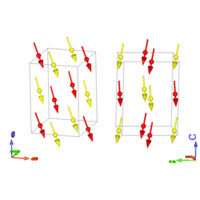
The finding of new multiferroic materials, where electric and magnetic orders coexist, is a challenging task currently. The double perovskite Y2CoMnO6 shows spontaneous magnetization and electrical polarization at low temperature. Previous investigations of this compound did not reach agreement about the type of magnetic structure present. This study demonstrates that this compound exhibits a collinear ferromagnetic ordering of Co2+ and Mn4+ moments in the ac plane with a small antiferromagnetic canting along the b axis. A thorough characterization of the dielectric properties reveals the absence of any related anomaly in the dielectric permittivity and the lack of spontaneous electrical polarization (P) in the P(E, electric field) loops. The pyroelectric current is strongly dependent on the number of antisite defects in the Co/Mn arrangement, the heating rate, and the poling field. Thus, the observed electric polarization is due to thermally stimulated depolarization currents ascribed to defect dipoles mainly placed at the antiphase boundaries. No ferroelectric transition occurs in this material, disproving the existence of intrinsic magnetoelectric multiferroicity.

Experimental realization of a polariton beam amplifier

Dominik Niemietz, Johannes Schmutzler, Przemyslaw Lewandowski, Karol Winkler, Marc Aßmann, Stefan Schumacher, Sebastian Brodbeck, Martin Kamp, Christian Schneider, Sven Höfling, and Manfred Bayer

Phys. Rev. B 93, 235301 (2016) - Published 1 June, 2016

For polariton condensates, nonresonant excitation creates carriers that act both as a repulsive potential and a gain medium for the condensate. The repulsive potential allows for direct imprinting of functional optical elements and simple circuits based on flowing polaritons just by shaping the excitation beam. However, extended geometries will also require amplification of the polariton beam. Another nonresonant pump beam may act as an amplifier, but will necessarily also result in an undesired deflection of the traveling polariton beam. The authors show that a deflectionless amplifier can be realized by embedding the amplification beam in a photonic trap that cancels the repulsive potential created by the amplification beam. This work emphasizes the potential of polariton condensates as a platform for reconfigurable optical circuits.

Parquet decomposition calculations of the electronic self-energy

O. Gunnarsson, T. Schäfer, J. P. F. LeBlanc, J. Merino, G. Sangiovanni, G. Rohringer, and A. Toschi

Phys. Rev. B 93, 245102 (2016) - Published 1 June, 2016

Photoemission spectroscopy is one of the most direct routes to investigate electronic systems. However, if electron correlations are strong, the identification of the predominant scattering processes through the analysis of the photoelectron spectra becomes a formidable challenge. The authors introduce here a decomposition of the electronic self-energy (see image), based on the so-called parquet equations, which, as suggested by their name, take into account all scattering channels and their interconnections. The application of this new parquet decomposition to self-energies computed in the case of local Coulomb interaction in two-dimensions (2D Hubbard model) yields several new results. Future investigations based on parquet decompositions and/or the fluctuation diagnostics of the self-energy could shed further light on the microscopic processes controlling the spectral functions in correlated electron models.

Quantum nonergodicity and fermion localization in a system with a single-particle mobility edge

Xiaopeng Li, J. H. Pixley, Dong-Ling Deng, Sriram Ganeshan, and S. Das Sarma

Phys. Rev. B 93, 184204 (2016) - Published 31 May, 2016

Quantum thermalization of isolated systems undergoing unitary time evolution is a fundamental problem in quantum statistical mechanics. Its study has been revived recently in the context of many-body Anderson localization. Previous works have focused on localization of many-body systems with all the single-particle states being localized. As a significant step forward, this work studies localization aspects of noninteracting many-particle systems in the presence of a single-particle mobility edge. By systemically investigating entanglement entropy scaling and nonthermal fluctuations in various lattice models, the authors establish a nonergodic extended phase as a generic intermediate phase (between purely ergodic extended and nonergodic localized phases) for the many-body localization transition of noninteracting fermions. This work also sheds light on the interacting transition scenario as well.

Phonon analog of topological nodal semimetals

Hoi Chun Po, Yasaman Bahri, and Ashvin Vishwanath

Phys. Rev. B 93, 205158 (2016) - Published 31 May, 2016

Topological band structures are ubiquitous in both fermionic and bosonic problems, but conventional wisdom holds that the topological features in a noninteracting bosonic system are only visible to finite-frequency probes. Utilizing a recently proposed boson-to-fermion mapping, the authors demonstrate that topological gapless phonon modes can in fact be brought all the way down to zero frequency. In particular, they construct spring-mass models that are analogs of two-dimensional Dirac semimetals, and hence feature topological zero-frequency phonon modes. These zero modes are physically distinct from the familiar Goldstone phonons, and are in fact present even in pinned disordered systems due to topological protection.

Nonlinear optical effects and third-harmonic generation in superconductors: Cooper pairs versus Higgs mode contribution

T. Cea, C. Castellani, and L. Benfatto

Phys. Rev. B 93, 180507(R) (2016) - Published 25 May, 2016

In conventional superconductors, the energy gap lies in the frequency range of few tenths of terahertz (THz), making THz spectroscopy the best tool to access its fundamental excitations. Recently it has been shown by R. Matsunaga et al. that the use of intense, coherent multicycle THz pulses allows one to measure, in a NbN film, a component of the transmitted pulse oscillating three times faster than the incident light. It is found that this effect, named third-harmonic generation, has its maximum intensity at the temperature below Tc, where the light frequency ω matches the superconducting gap value Δ(T), pointing to a resonant process involving excitations specific of the superconducting state. What is the nature of this resonance? While previous work attributed this resonance to the Higgs mode, i.e., to amplitude fluctuations of the superconducting order parameter, the present paper comes to a different conclusion. By providing a detailed microscopic derivation of the nonlinear optical response, the authors show that the 3ω current response is controlled by the lattice-modulated density fluctuations. As a consequence, the third-harmonic generation turns out to be largely dominated by Cooper-pair excitations, which pile up at 2Δ. At the same time, in analogy with the standard Raman response, the Higgs signal is suppressed by the extremely small coupling to the probing field. The authors discuss also the polarization dependence of the nonlinear 3ω response, which opens the route to a Raman-like symmetry-selective probe of the superconducting excitations. This result offers challenging perspectives for THz spectroscopy of several systems, including cuprate superconductors.

Role of excited states in Shockley-Read-Hall recombination in wide-band-gap semiconductors

Audrius Alkauskas, Cyrus E. Dreyer, John L. Lyons, and Chris G. Van de Walle

Phys. Rev. B 93, 201304(R) (2016) - Published 25 May, 2016
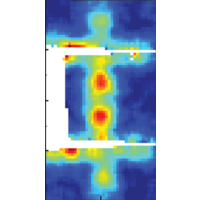
Defect-assisted nonradiative Shockley-Read-Hall recombination is an important process in wide-band-gap semiconductors. However, nonradiative capture rates decrease exponentially with the energy of the transition, and therefore the mechanisms by which such recombination can take place are unclear. The authors show here that excited states of defects play a key role in turning specific defects into efficient nonradiative centers. The wider the band gap of the material, the greater a role these excited states are likely to play. Specifically, the authors can explain why certain gallium vacancy complexes are efficient nonradiative centers in group-III nitrides, the key materials for solid-state lighting.

Sign In to Your Journals Account

Filter

Section

Filter

Article Lookup

Enter a citation