Highlights

Helicity-dependent photocurrent in a Bi2Se3 thin film probed by terahertz emission spectroscopy

Sun Young Hamh, Soon-Hee Park, Sahng-Kyoon Jerng, Jae Ho Jeon, Seung-Hyun Chun, and Jong Seok Lee

Phys. Rev. B 94, 161405(R) (2016) - Published 20 October, 2016

Topological insulators have been attracting much attention as potential candidates for spintronic applications. Spin-momentum-locked surface states can lead to spin current naturally accompanied by electric charge current. As a way to control the current, circularly polarized photon injection has been widely used as the photon can excite spin-polarized carriers selectively depending on the photon’s helicity. Here, the authors investigate the helicity-dependent photocarrier dynamics in an unbiased Bi2Se3 thin film by monitoring the terahertz pulse emitted from the sample after illumination by femtosecond laser pulses. Although all the measurements were performed on an unbiased sample with no electrical contacts, the authors observe three-fold periodic helicity-dependent terahertz emission, and attribute such circular anisotropy in the photocurrent to the circular photon drag effect, namely linear and angular momentum transfer from photons to photocarriers.

Coupled wire model of symmetric Majorana surfaces of topological superconductors

Sharmistha Sahoo, Zhao Zhang, and Jeffrey C. Y. Teo

Phys. Rev. B 94, 165142 (2016) - Published 19 October, 2016

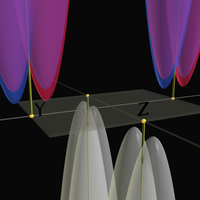
Classification of symmetry-protected topological phases such as the topological superconductor (TSC) is well known in the free fermion picture. Recently, it was observed that including many-body interactions that preserves symmetry gives rise to novel surface phases and breaks down the classification scheme. A complete understanding of the microscopic theory for such phases is missing. This paper is an attempt to understand the interaction that gives rise to these phases in the case of the three-dimensional TSC. The authors build a coupled wire model Hamiltonian for the gapless surface and show that the addition of a time-reversal symmetric two-body interaction, constructed in this paper, opens an energy gap in the spectrum. They also show this gapped surface phase is topologically nontrivial and is classified differently compared to the noninteracting case.

Quasiparticle interference from different impurities on the surface of pyrochlore iridates: Signatures of the Weyl phase

F. Lambert, A. P. Schnyder, R. Moessner, and I. Eremin

Phys. Rev. B 94, 165146 (2016) - Published 19 October, 2016

Weyl semimetals make up a novel three-dimensional topological phase of matter. Among their most fascinating properties is the existence of a very peculiar type of surface bound state. Contrary to common topological materials, the surface Fermi surface of a Weyl system consists of disconnected arcs – the so-called Fermi arcs – instead of a closed surface. These Fermi arcs connect the projected position of band crossings in their bulk band structure. The Weyl phase typically arises from a symmetry-protected topological insulator upon spontaneously breaking one of the protecting symmetries. In the case of the pyrochlores, the magnetic momenta inside the constituting Ir tetrahedra break time-reversal symmetry, so the pyrochlores are considered magnetic Weyl semimetals. Here, the authors show theoretically that the nontrivial spin polarization of the surface Fermi arcs of a magnetic Weyl semimetal provide characteristic feature observable via spin-resolved scanning tunneling microscopy (STM). They analyze the Fourier transform (FT) of Friedel oscillations in the local density of states occurring due to scattering by localized magnetic and nonmagnetic impurities. They note that the FT features inherit traces of the disconnected nature of the Fermi surface and the spin rotation happening on the Fermi arcs.

Effect of disorder on a pressure-induced z=1 magnetic quantum phase transition

A. Mannig, J. S. Möller, M. Thede, D. Hüvonen, T. Lancaster, F. Xiao, R. C. Williams, Z. Guguchia, R. Khasanov, E. Morenzoni, and A. Zheludev

Phys. Rev. B 94, 144418 (2016) - Published 14 October, 2016

Magnetic insulators are widely used as prototypes for the study of quantum criticality. Among the more exotic experimental realizations is the z=1 Heisenberg quantum critical point (QCP). It hosts asymptotic freedom of quasiparticles, unconventional scaling properties, and excitations analogous to the Higgs boson in high-energy physics. An interesting question is how this quantum phase transition is affected by disorder. Theory predicts a destruction of the quantum critical point and the emergence of a quantum Griffiths phase. In the present work, this issue is addressed experimentally by studying one of the precious few materials that host a pressure-induced Heisenberg QCP, namely the organometallic quantum magnet piperazine hexachlorodicuprate (PHCC). Disorder is introduced by chemical substitution of bromine for chlorine on a nonmagnetic site. Magnetic ordering at low temperatures is then studied as a function of applied hydrostatic pressure for a range of impurity concentrations. The tool of choice is the highly sensitive muon-spin rotation technique. The authors uncover a dramatic effect of disorder on the magnetic phase diagram. In agreement with theoretical expectations, they detect strong magnetic inhomogeneities already for small impurity concentrations, followed by the destruction of pressure-induced magnetic order at high concentrations of impurities.

Gradient methods for variational optimization of projected entangled-pair states

Laurens Vanderstraeten, Jutho Haegeman, Philippe Corboz, and Frank Verstraete

Phys. Rev. B 94, 155123 (2016) - Published 14 October, 2016

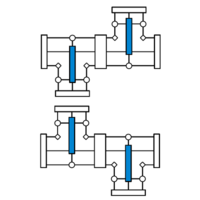
The authors present a new method for variationally optimizing projected entangled-pair states (PEPS) in the thermodynamic limit based on the global energy functional and novel tensor contraction strategies. It is successfully benchmarked using Ising and Heisenberg Hamiltonians. The method is completely independent from previous PEPS implementations and improves on the variational energies and order parameters as compared to other state-of-the-art PEPS simulations. The algorithm presented here should prove valuable in simulating ground-state properties of strongly correlated quantum spin systems, can be used with other variational ansatzes, and can be applied to tensor network states in general.

Electrons, holes, and spin in the IV-VI monolayer four-six-enes

Ian Appelbaum and Pengke Li (李鹏科)

Phys. Rev. B 94, 155124 (2016) - Published 14 October, 2016

The electronic structure of crystalline materials reflects the influence of underlying discrete symmetries of the atomic lattice. When these symmetries are broken, associated degeneracies in the spectrum of states often split, with important consequences for potential electronic and spintronic applications. The mathematical language of group theory can be used to capture the effect of these symmetries and provide insight into the origins of spectrum features obtained from essentially empirical ab initio numerical calculations such as density functional theory. A salient example comes from the unusual electronic structure of atomically thin two-dimensional “four-six-ene” semiconductors such as tin sulfide, germanium telluride, etc. (related to group-V phosphorene but formed from group IV and VI). In this case, group theoretic methods provide a straightforward framework for understanding the consequences of inversion symmetry breaking due to inequivalent sublattice atomic identity. In particular, the quantum states at the edge of the fundamental band gap – relevant to all transport, optoelectronic, and spintronic properties – are shown to directly inherit their character from nearby points of high symmetry in the reciprocal lattice, where the form of allowable energetic interactions is constrained.

Spin excitations in an all-organic double quantum dot molecule

Max Koole, Jan C. Hummelen, and Herre S. J. van der Zant

Phys. Rev. B 94, 165414 (2016) - Published 14 October, 2016

Double quantum dots play an important role in the field of semiconductor and carbon nanotube quantum dots. They have resulted in, for example, correlated electron physics beyond the single spin-1/2 Kondo system and the realization of qubits for quantum computation. Using organic molecules to create a double quantum dot can be beneficial due to the larger energy scales present as compared to its more extended counterparts. Furthermore, they open up the possibility to investigate interactions between spins and perform coherent experiments on electrons in organic molecules. In this article, the authors experimentally investigate charge transport through a three-terminal single-molecule junction. The data shows features in transport that arise from the broken conjugation in dihydro-anthracene, which localizes π electrons and creates a set of nearly degenerate orbitals. The ferromagnetic and antiferromagnetic interactions are of the same order of magnitude, so that the singlet and triplet states are close in energy. These findings thus demonstrate a double quantum dot programmed in a single molecule due to its broken conjugation. This research is a starting point for further experiments, whereby with chemical means the interaction between the two dots can be lowered to observe Pauli spin-blockade and investigate spin coherent effects in single molecules.

Photoexcitation of electron wave packets in quantum spin Hall edge states: Effects of chiral anomaly from a localized electric pulse

Fabrizio Dolcini, Rita Claudia Iotti, Arianna Montorsi, and Fausto Rossi

Phys. Rev. B 94, 165412 (2016) - Published 13 October, 2016

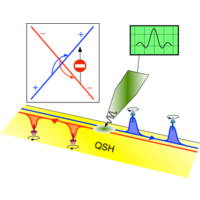
In the helical edge states of a quantum spin Hall (QSH) bar, the phenomenon of electron photoexcitation is quite different from systems commonly used in optoelectronics. The vertical electric dipole transitions typically occurring between valence and conduction bands of conventional semiconductor-based devices are forbidden in QSH edge states due to a selection rule. Also, electrons in QSH edge states are described by a massless Dirac fermion theory rather than the conventional Schrödinger-like parabolic band, so their response to an electromagnetic field is intrinsically affected by a peculiar effect known as the chiral anomaly. Here, the authors analyze this problem in the mesoscopic regime. They show that, when a spatially localized electric pulse is applied at the edge of a QSH system, helical electron wave packets can be photoexcited by purely intrabranch electrical transitions, without invoking the magnetic Zeeman coupling or transitions to bulk states. At the end of the pulse, the wave packets counter propagate with opposite spin orientations, keeping their space profile unaltered. Notably, the authors find that the space profile of the photoexcited electron wave packets is independent of the temperature and chemical potential of the initial equilibrium state. Instead, the profile depends purely on the applied electric pulse, in a linear manner, as a signature of the chiral anomaly. Then authors discuss how the wave packet profile can be tailored by the electric pulse parameters, for both low and finite frequencies.

Determining the spin-orbit coupling via spin-polarized spectroscopy of magnetic impurities

V. Kaladzhyan, P. Simon, and C. Bena

Phys. Rev. B 94, 134511 (2016) - Published 12 October, 2016

The well known spin-orbit coupling is a peculiar type of interaction that links the direction of electron motion to its intrinsic magnetic moment, called spin. The role of the spin orbit is believed to be particularly important in giving rise to exotic states of matter, such as topological insulators and topological superconductors, that could host, for example, Majorana fermions. Despite several methods of measuring the spin-orbit constant having already been developed, given the rapid progress in the discovery and possible applications of new materials with strong spin-orbit coupling, it is important to provide experimentalists with novel and general approaches to unequivocally measure the value of this coupling. Here, the authors show theoretically that the spin-orbit coupling in two-dimensional and one-dimensional systems, both superconducting and metallic, can be read off directly and unambiguously via spin-resolved scanning tunneling microscopy (STM). The authors analyze the Friedel oscillations in the local density of state occurring due to scattering by localized magnetic impurities. In particular, they focus on the Fourier transform (FT) of the Friedel oscillations and note that the FT features observed in non-spin-polarized measurements split when using spin-polarized STM, and the splitting is exactly equal to twice the inverse spin-orbit length. Moreover, the superconducting systems exhibit extra high-intensity FT features with respect to the metallic systems, at a wavevector given by twice the inverse spin-orbit length. Such features provide a direct measure of the spin-orbit coupling in these materials.

Polarization memory in the nonpolar magnetic ground state of multiferroic CuFeO2

J. Beilsten-Edmands, S. J. Magorrian, F. R. Foronda, D. Prabhakaran, P. G. Radaelli, and R. D. Johnson

Phys. Rev. B 94, 144411 (2016) - Published 12 October, 2016

Type-II multiferroics –- materials where magnetic order induces ferroelectricty -– offer great potential for novel electronic devices due to the strong intrinsic coupling between order parameters. Such coupling is found in CuFeO2, where ferroelectricity is driven by proper-screw “helical” magnetic ordering for applied magnetic fields between 7.5 and 13 T at low temperatures. Here, the authors report a polarization memory effect in CuFeO2, whereby the nonpolar antiferromagnetic ground state retains a strong memory of the high-magnetic-field ferroelectric phase. The dependence of the polarization on the magnetothermal history is investigated, and it is found that the direction and almost the full polarization magnitude is “remembered” after cycling through the zero-field nonpolar phase. This polarization memory persists in samples in which multiple crystallographic domains are suppressed by applied stress, ruling out crystallographic boundaries as the cause of the observed memory. Instead, the authors propose that the memory is carried by Bloch-type antiferromagnetic domain walls with definite helicity. As similar memory effects have been also been reported for other multiferroics, such as MnWO4 and CuO, the proposed mechanism could be a general feature of phase transitions between collinear-antiferromagnetic and incommensurate magnetic phases.

Temperature dependence of the NMR spin-lattice relaxation rate for spin-12 chains

E. Coira, P. Barmettler, T. Giamarchi, and C. Kollath

Phys. Rev. B 94, 144408 (2016) - Published 11 October, 2016

Recent developments in density matrix renormalization group/matrix product state techniques allow today for a quantitative computation of dynamical correlations at finite temperature in low-dimensional quantum spin systems. By combining numerical results and field theoretical asymptotic methods, e.g., bosonization, it is now possible to give a full description of the dynamical quantity one is interested in for the range of temperatures experimentally accessible. This enhances of course the possibility of one-to-one comparisons with experiments without having to resort to uncontrolled approximations. Here, the authors focus on the temperature dependence of the NMR spin-lattice relaxation rate 1/T1 in spin-12 chain systems. This quantity is directly related to local, dynamical spin-spin correlation functions. The results agree in the low-temperature regime with bosonization predictions, and show interesting deviations from this behavior at intermediate temperatures.

Temperature dependence of the NMR relaxation rate 1/T1 for quantum spin chains

Maxime Dupont, Sylvain Capponi, and Nicolas Laflorencie

Phys. Rev. B 94, 144409 (2016) - Published 11 October, 2016

Quasi-one-dimensional (1D) antiferromagnets are good candidates to realize a Tomonaga-Luttinger liquid (TLL), describing 1D interacting quantum systems, provided 3D coupling remains small as compared to temperature. In systems such as NiCl2-4SC(NH2)2 (DTN), made of weakly coupled spin S=1 chains, interchain coupling plays an important role at low temperature as it leads to antiferromagnetic long-range order below 1 K, corresponding to a Bose-Einstein condensate of magnons. Using time-dependent numerical simulations at finite temperature, the authors compute here the nuclear magnetic resonance (NMR) relaxation rate 1/T1, a key experimental quantity, and address the question of the low-temperature crossover between TLL predictions and the higher-temperature regime in purely 1D quantum spins chains. They also comment on the experimental observation of the TLL regime, possibly masked by 3D long-range order in materials such as DTN.

Spin resonance in the superconducting state of Li1−xFexODFe1−ySe observed by neutron spectroscopy

N. R. Davies, M. C. Rahn, H. C. Walker, R. A. Ewings, D. N. Woodruff, S. J. Clarke, and A. T. Boothroyd

Phys. Rev. B 94, 144503 (2016) - Published 10 October, 2016

Layered molecular-intercalated iron selenides (FeSe) show great promise as a class of high-Tc unconventional superconductors, with a Tc as high as 45 K reported so far. The FeSe layers in these materials also show structural and electronic similarities to monolayer FeSe on SrTiO3, where Tc values up to 65 K have been observed. Information on the superconducting properties of these materials may provide vital insight into the unconventional mechanism of high-temperature superconductivity in iron-based compounds. One property of particular interest is the symmetry of the superconducting gap function on the Fermi surface, which is a key prediction for any theory of superconductivity. However, a precise experimental determination of this has proven elusive in the iron-based superconductors. In this paper, the authors study the LiOD-intercalated FeSe derivative Li1-xFexODFe1-ySe via inelastic neutron scattering, detecting a spin resonance which appears in the superconducting state below the pair breaking energy 2Δ. This shows that superconductivity in this compound is unconventional and, in conjunction with previous ARPES and STS results, strongly constrains the possible superconducting gap symmetries in this material.

Spin-orbit semimetals in the layer groups

Benjamin J. Wieder and C. L. Kane

Phys. Rev. B 94, 155108 (2016) - Published 6 October, 2016

Since the discovery of graphene, there has been great interest in finding other nodal semimetals in two and three dimensions. Over the past few years, numerous examples of these materials have been proposed or observed. However, the explanations for the symmetry and topology mechanisms protecting nodal features in these materials have generally been provided on a case-by-case basis. In this paper, we use a mathematical consideration of crystal lattices on flat manifolds like Mquotobius strips and Klein bottles, most recently revived by Watanabe, Po, Vishwanath, and Zaletel, to develop a framework for discussing all possible two-dimensional and quasi-two-dimensional semimetals in systems with strong spin-orbit interactions. Using this framework, we draw connections to known nodal features in two- and three-dimensional semimetals like SrIrO3, and we predict new ones, including an exotic “Cat’s Cradle” Weyl fermion feature.

Magnetic ratchet effect in bilayer graphene

Narjes Kheirabadi, Edward McCann, and Vladimir I. Fal'ko

Phys. Rev. B 94, 165404 (2016) - Published 6 October, 2016

The magnetic ratchet effect is optical rectification in two-dimensional systems – such as bilayer graphene – whereby a steady in-plane magnetic field and the alternating electric field of a laser produce a dc electric current. It occurs in systems with broken inversion symmetry due, say, to an inhomogeneous distribution of impurities, leading to increased electronic scattering on the upper layer of the bilayer. For a given direction of electric field, electrons are driven downwards by the Lorentz force towards the lower layer where scattering is low whereas, when the electric field switches direction, electrons are driven towards the upper layer where scattering is high. Such asymmetry in scattering leads to a nonzero dc current. By deriving linear-in-magnetic-field terms in the low-energy electronic Hamiltonian, the authors predict a very large ratchet effect in bilayer graphene. They compare symmetry breaking due to impurities with interlayer asymmetry due to an external gate, the latter allowing for a tuneable magnetic ratchet.

Wide-band nanoscale magnetic resonance spectroscopy using quantum relaxation of a single spin in diamond

James D. A. Wood, David A. Broadway, Liam T. Hall, Alastair Stacey, David A. Simpson, Jean-Philippe Tetienne, and Lloyd C. L. Hollenberg

Phys. Rev. B 94, 155402 (2016) - Published 5 October, 2016

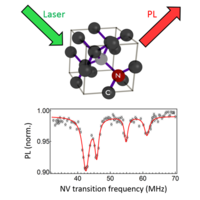
Magnetic resonance spectroscopy is one of the most important tools used across the physical and life sciences, but typically requires macroscopic samples. A key challenge is therefore to develop methods suitable for the nanometric regime. This paper investigates a new approach whereby quantum relaxation of a single nitrogen-vacancy center spin in diamond is monitored to construct a spectrum of the surrounding electron and nuclear spin environment within a nanometric volume. In contrast to existing decoherence-based techniques, the technique is all optical, requiring no complex quantum control, and intrinsically broadband, which means it can probe both electron and nuclear spin resonances. As an illustration, the authors report broadband nanoscale magnetic resonance spectroscopy of nitrogen impurities located within the diamond. This work provides a new route towards magnetic resonance spectroscopy of electrons and nuclear spins at the single molecule level.

Cubic scaling GW: Towards fast quasiparticle calculations

Peitao Liu, Merzuk Kaltak, Jiří Klimeš, and Georg Kresse

Phys. Rev. B 94, 165109 (2016) - Published 5 October, 2016

The GW method is the standard method for predicting quasiparticle energies as measured in experimental photoemission spectroscopy. Until recently, routine GW calculations have been restricted to fairly small systems and few k points for sampling the Brillouin zone, since the computational demand usually scales quartic with the number of atoms and quadratic with the number of k points. The original work of Lars Hedin suggests that one can do better by calculating the self-energy as Σ(1,2)=iG(1,2)W(1,2) – the equation that coined the phrase ”GW”. Here, G is the one-particle Green’s function and W the screened interaction between the electrons. Using this relation directly in computations brings the scaling down to linear in the number of k points and cubic in the number of atoms. Although this approach has been used in the past by others, in this work its full potential is unveiled by implementing it in a massively parallel code and adopting it to the projector augmented wave method. This makes GW calculations as convenient as calculations based on local density functionals and allows for calculations for hundred atoms in few hours.

Functional renormalization group approach to electronic structure calculations for systems without translational symmetry

Christian Seiler and Ferdinand Evers

Phys. Rev. B 94, 155102 (2016) - Published 3 October, 2016

Good progress has been made in electronic structure calculations for real materials as well as for model Hamiltonians. However with an eye on ab initio calculations, it is still very challenging to accurately calculate, e.g., the dynamical response of small molecules or atom clusters. At present the method of choice is the GW-BSE method. Its notorious drawback is that solving a computationally demanding self-consistency equation is required. Thus motivated, the author explore an alternative idea replacing the self-consistency problem by the functional renormalization group (FRG). The traditional FRG was formulated for systems with translational symmetry. We investigate an alternative (εFRG) that is also applicable to inhomogeneous matter, such as disordered metals or molecules. It accounts for Fermi-liquid corrections to quasiparticle energies and particle-hole excitations. In principle it can go beyond the state of the art approximation, GW-BSE, by solving the Bethe-Salpeter equation (BSE) self-consistently We present an efficient implementation of εFRG together with performance tests on the spinless disordered Hubbard model.

Direct determination of the spin structure of Nd2Ir2O7 by means of neutron diffraction

H. Guo, C. Ritter, and A. C. Komarek

Phys. Rev. B 94, 161102(R) (2016) - Published 3 October, 2016

Among others, pyrochlore iridates with strong spin-orbit coupling have received attention recently due to the prediction of Weyl semimetal states in these materials. Despite tremendous efforts, there exists no direct measurement of the spin structure at the iridium site by means of neutron diffraction. This might be caused by the small ordered Ir moment and also by the neutron absorbing properties of the Ir ions. Up to now, only basic indirect evidence for the spin structure at the iridium site exists. From the observation here of the full magnetic structure of Nd2Ir2O7 via neutron diffraction experiments, the authors obtain direct insight into unknown aspects of the physics of the iridium ions in pyrochlore iridates.

Automated construction of maximally localized Wannier functions for bands with nontrivial topology

Jamal I. Mustafa, Sinisa Coh, Marvin L. Cohen, and Steven G. Louie

Phys. Rev. B 94, 125151 (2016) - Published 30 September, 2016

Wannier functions provide a useful description of the electronic states in a crystal, providing a chemical picture for the bonding structure of a material, in addition to applications in computational materials science. Topological insulators are an interesting class of materials with spin-polarized conducting surface states alongside an insulating bulk. To date, constructing Wannier functions for topological insulators has proven difficult, relying on an educated guess for the trial orbitals or requiring the system to be parameterized in order to tune between the normal and topological phase. The authors have developed an automated approach within the optimized projection functions method for constructing localized Wannier functions for topologically nontrivial bands. They demonstrate the method on a two-dimensional tight-binding model, a strong three-dimensional topological insulator, and finally, the prototypical topological insulating material Bi2Se3. They find that the Wannier functions contain large imaginary components and are more extended than those in the topologically trivial phase.

Sign In to Your Journals Account

Filter

Section

Filter

Article Lookup

Enter a citation