Highlights

Hyperfine-controlled domain-wall motion observed in real space and time

John N. Moore, Junichiro Hayakawa, Takaaki Mano, Takeshi Noda, and Go Yusa

Phys. Rev. B 94, 201408(R) (2016) - Published 15 November, 2016

Recently, a number of experimental methods have been found by which magnetic domains can be controlled and made to propagate through a host material. Theoretical schemes have also been devised to cleverly manipulate magnetic domains in space in order to enable new logic and memory devices with improved performance. Efforts to better understand the physics of domain motion have revealed that the interactions involved in driving this phenomenon are rich and numerous. The magnetic domains studied in this work form in a GaAs quantum well 2D electron system in a nonequilibrium regime of a correlated state of matter called a fractional quantum Hall liquid. In this exotic medium, ferromagnetic and nonmagnetic domains can be created and made to propagate when the system is excited by a current. This propagation is imaged here in real time using photoluminescence microscopy. The speed of the domains is measured and found to depend on several factors, including the strength of nuclear polarization in the system, as probed by nuclear magnetic resonance. This finding reveals the surprisingly significant impact of the hyperfine interaction on magnetic domain dynamics in a semiconductor, in which noticeable hyperfine effects are uncommon.

Odd-parity superconductors with two-component order parameters: Nematic and chiral, full gap, and Majorana node

Jörn W. F. Venderbos, Vladyslav Kozii, and Liang Fu

Phys. Rev. B 94, 180504(R) (2016) - Published 10 November, 2016

Recently, there is widespread interest in odd-parity (e.g., p-wave) superconductivity in strongly spin-orbit-coupled materials, such as doped topological insulators. CuxBi2Se3 is a prime example. A series of recent experiments, including NMR, specific heat, magnetoresistance, and torque magnetometry, has provided mounting evidence of odd-parity spin-triplet superconductivity in CuxBi2Se3 as well as SrxBi2Se3 and NbxBi2Se3. Here, the authors construct a general theory of such degenerate superconducting components and the competition between chiral and nematic states. They derive a general criterion to establish which state is energetically favored, which highlights the crucial role of spin-orbit coupling. In particular, when applied to the specific case of CuxBi2Se3, the theory is consistent with three key experimental findings: a full pairing gap, triplet pairing, and spontaneous rotational symmetry breaking. Remarkably, both nematic and chiral superconductors with odd-parity pairing symmetry are topological superconductors, belonging respectively to time-reversal-invariant (class DIII) and time-reversal-breaking (class D) categories of the topological classification. The authors show that due to the nonunitary nature of chiral pairing in spin-orbit coupled materials, spin nondegenerate point nodes realize Majorana fermion quasiparticles in three dimensions.

Negativity spectrum of one-dimensional conformal field theories

Paola Ruggiero, Vincenzo Alba, and Pasquale Calabrese

Phys. Rev. B 94, 195121 (2016) - Published 10 November, 2016

Logarithmic negativity is a proper measure of quantum entanglement in mixed states. Originally proposed in the context of quantum information, in recent years it is attracting interest in quantum field theory, condensed matter physics, and statistical physics. The key object to construct the negativity is the partial transpose of the reduced density matrix. Here, focusing on two adjacent intervals, the authors provide a complete study of the distribution of the eigenvalues of the partial transpose (negativity spectrum) for gapless one-dimensional systems described by a conformal field theory (CFT). Similar to the entanglement spectrum, the distribution of the negativity spectrum is universal, and it depends only on the central charge of the underlying CFT. The precise form of the spectrum depends on whether the two intervals are in a pure or mixed state, and in both cases, a dependence on the sign of the eigenvalues is found. This dependence is weak for bulk eigenvalues, whereas it is strong at the spectrum edges. The authors also investigate the scaling of the smallest (negative) and largest (positive) eigenvalues of the partial transpose. The analytical results are thoroughly checked against numerical DMRG simulations as well as in exactly solvable models.

When strong correlations become weak: Consistent merging of GW and DMFT

L. Boehnke, F. Nilsson, F. Aryasetiawan, and P. Werner

Phys. Rev. B 94, 201106(R) (2016) - Published 10 November, 2016

The spectral functions of strongly correlated metals, with the cubic perovskite SrVO3 as a prototype, are characterized by the presence of satellite structures below and above the main quasiparticle peak. These satellites have been explained as Hubbard bands, whose energy separation is determined by the Hubbard U. Here, the authors show that this commonly accepted interpretation, based largely on LDA+DMFT calculations, has to be reconsidered. An important ingredient missing in these calculations is the nonlocal screening and the nonlocal self-energy. Using a truly first-principles and fully self-consistent GW+extended dynamical mean-field theory calculation, the authors find that the screening from nonlocal Coulomb interactions substantially reduces the effective local Coulomb repulsion, while vertex corrections beyond GW provided by DMFT lead to strong plasmonic effects and a reduction in the plasmon energy. The resulting effective local interactions are too weak to produce pronounced Hubbard bands. Instead, prominent plasmon satellites appear at energies corresponding to the experimentally observed sidebands. The new results demonstrate the important role of nonlocal interactions and dynamical screening in determining the effective interaction strength of correlated compounds and point to the need of revising the current view on the electronic structure of strongly correlated metals.

Creating arbitrary quantum vibrational states in a carbon nanotube

Heng Wang and Guido Burkard

Phys. Rev. B 94, 205413 (2016) - Published 10 November, 2016

Due to their small mass and large mechanical stiffness, free-standing carbon nanotubes turn out to be superb high-frequency mechanical resonators that could find applications in mass and force sensing. With resonance frequencies up to the gigahertz regime, one can envision cooling the mechanical motion of such nanotubes to its quantum mechanical ground state at cryogenic temperatures. This opens the possibility to generate highly nonclassical states of the mechanical motion, similar to those created several years ago with electromagnetic radiation in superconducting microwave resonators. Such states are interesting from a fundamental physics point of view, but potentially also for quantum information and sensing applications. While classical activation of a harmonic oscillator will always produce “quasiclassical” coherent states, a necessary ingredient for the production of nonclassical states such as Fock states is a nonlinear element, e.g., superconducting qubits in the case of microwaves. This work predicts that for mechanical oscillations, the spin-orbit coupling of the mechanical motion to a single localized electron spin can do the trick by acting as a nonlinear element for phonons.

Otto refrigerator based on a superconducting qubit: Classical and quantum performance

B. Karimi and J. P. Pekola

Phys. Rev. B 94, 184503 (2016) - Published 9 November, 2016

Experimental demonstration of a truly quantum mechanical solid-state heat engine or refrigerator remains elusive up to now. Here, a four-stroke quantum refrigerator that can be realized using a superconducting qubit coupled alternately to two resonators with embedded reservoirs is analyzed theoretically. Besides being a practically feasible thermal machine, this concept presents a number of fundamentally interesting features. At high frequencies, the system exhibits nearly coherent dynamics, leading to quantum oscillations in cooling power versus operation frequency. At intermediate frequencies, an ideal Otto cycle can be realized. In the nearly adiabatic regime, the cooling power is quadratic in frequency and can be separated to classical and quantum contributions. Interestingly, it is shown here that quantum coherence leads always to performance that is inferior as compared to that arising from purely classical dynamics. Furthermore, in the nearly adiabatic regime the efficiency of the refrigerator exceeds clearly that of the standard Otto cycle.

Spin mapping of surface and bulk Rashba states in ferroelectric α-GeTe(111) films

H. J. Elmers, R. Wallauer, M. Liebmann, J. Kellner, M. Morgenstern, R. N. Wang, J. E. Boschker, R. Calarco, J. Sánchez-Barriga, O. Rader, D. Kutnyakhov, S. V. Chernov, K. Medjanik, C. Tusche, M. Ellguth, H. Volfova, St. Borek, J. Braun, J. Minár, H. Ebert, and G. Schönhense

Phys. Rev. B 94, 201403(R) (2016) - Published 9 November, 2016

In regular semiconductors each electronic state is occupied by spin-up and spin-down electrons. It is well known that inversion symmetry breaking at a surface may lift this degeneracy by spin-orbit coupling (the Rashba effect). As already proposed by Rashba, bulk inversion symmetry breaking may cause a similar degeneracy lifting of bulk states. Ferroelectric materials provide such an inversion symmetry breaking. Thin ferroelectric α-GeTe(111) films grown on Si(111) show a stable ferroelectric polarization with a polarization vector perpendicular to the surface that can be switched by an electric field into a metastable state with opposite polarization. Spin-resolved time-of-flight momentum microscopy reveals a Rashba-type spin splitting of the valence band caused by the inner electric field. Due to orbital polarization, the outer Rashba branch has a larger polarization than the inner branch. The corresponding net spin polarization provides new functionalities in spintronic devices, e.g. it may strongly affect the conversion process of spin into current via the spin-galvanic effect.

Time-dependent correlations in quantum magnets at finite temperature

B. Fauseweh, F. Groitl, T. Keller, K. Rolfs, D. A. Tennant, K. Habicht, and G. S. Uhrig

Phys. Rev. B 94, 180404(R) (2016) - Published 8 November, 2016

Complex interactions in quantum magnets lead to a variety of phases with manifold correlations, which are measurable at temperatures very low compared to the energy scale of the system. The common expectation is that quantum effects are just suppressed upon increasing temperature due to the additional thermal fluctuations. However, recent inelastic neutron scattering investigations in one- and three-dimensional compounds indicate that interplay between quantum and thermal effects is much more complicated. By combining high-resolution neutron resonance spin-echo measurements with diagrammatic perturbation theory, the authors show that anomalous decoherence effects can also be observed in the time domain, the natural domain for decaying correlations. This offers a complementary view on this phenomenon, allowing for a direct comparison between experimental data and theoretical prediction without the need for intensive data analysis. The specific form of the echo amplitude, in combination with the temperature dependence of the spectral weight, provides a smoking gun signature for nontrivial scattering processes of hard-core bosonic excitations.

Structural evolution and electronic properties of (Sr1−xCax)2−yIrO4+z spin-orbit-assisted insulators

Xiang Chen and Stephen D. Wilson

Phys. Rev. B 94, 195115 (2016) - Published 8 November, 2016

Due to their unique balance of energy scales, correlated iridates have proven a fruitful materials platform for both the prediction and discovery of numerous novel electronic phases and ground states. The comparable strengths of spin-orbit coupling, on-site Coulomb interactions, and local crystal-field splitting inherent to the iridium cations hosted within various lattice geometries has led to the realization of a novel form of spin-orbit assisted Mott insulating ground state, where the iridium’s spin and orbital angular momenta become entangled into a Jeff=1/2 wave function. In this paper, the stability of this state with respect to chemical pressure is explored in the prototypical spin-orbit assisted Mott insulator Sr2IrO4. This study reveals that isovalent substitution of smaller Ca2+ onto Sr2+ sites in this system drives the lattice to evolve through three distinct structural phases with increasing Ca2+ content: evolving from the parent quasi-two-dimensional n=1 Ruddlesden-Popper structure, to a novel three dimensional corner sharing IrO6 octahedral network to a quasi-one dimensional IrO6 edge-sharing chain structure. All three phases remain insulators reliant on the inherently strong spin-orbit coupling of Ir. However, their magnetic properties evolve dramatically across the phase diagram. The work here provides a global view of the evolution of the structural and electronic properties of Sr2IrO4 as its lattice is destabilized via chemical pressure.

Magnetic effects in the paraxial regime of elastic electron scattering

Alexander Edström, Axel Lubk, and Ján Rusz

Phys. Rev. B 94, 174414 (2016) - Published 7 November, 2016

The transmission electron microscope (TEM) is a powerful tool for structural or chemical characterization of materials with atomic, or even subatomic, spatial resolution. Recent developments in producing electron vortex beams carrying orbital angular momentum, spin polarization technology, and aberration correction technology have opened up new doors to image magnetism with high resolution in the TEM. The development of such methods requires a thorough understanding of the effects of magnetic interactions in electron scattering processes. The authors of this paper use a full-fledged description of elastic electron scattering, including magnetic effects, to computationally identify possible magnetic signals from an electron beam scattered through a magnetic solid. Three types of magnetic fingerprints, namely one originating from the orbital angular momentum of electron vortex beams, one from spin polarized beams, and one from the nontrivial phase distributions of aberrated electron beams, are found. The possibility of atomic resolution mapping of magnetism by scanning TEM is investigated and deemed in principle possible, but experimentally challenging, while nanometer resolution magnetic imaging using electron vortex beams is proposed as a realistic goal for future experimental work.

Classical origin of conductance oscillations in an integrable cavity

Christina Pöltl, Aleksey Kozikov, Klaus Ensslin, Thomas Ihn, Rodolfo A. Jalabert, Christian Reichl, Werner Wegscheider, and Dietmar Weinmann

Phys. Rev. B 94, 195304 (2016) - Published 7 November, 2016

Quantum transport of electrons through ultraclean two-dimensional cavities depends sensitively on the geometry. In scanning gate microscopy, the charged tip is a valuable tool to tune the shape of a cavity while measuring its conductance, and thus to address questions of quantum chaos, such as the relevance of the underlying classical electron dynamics. For the tip placed in the center of an integrable cavity of circular shape, a remarkable nonmonotonic variation of the conductance is measured as a function of the voltage applied to the tip. Numerical simulations yield conductance oscillations with tip strength that agree well with the experimental findings. A semiclassical analysis of the conductance, based on the classical trajectories transmitted through the cavity, reproduces the conductance oscillations, proving that the effect is of classical origin. Remarkably, only particular classes of short trajectories are responsible for the effect within this semiclassical analysis. When the strength of the tip-induced potential is increased, the character of the dominant trajectories alternates between transmitted and reflected ones, thereby providing an unusually simple explanation for the observed phenomenon.

Momentum-resolved hot electron dynamics at the 2H−MoS2 surface

P. Hein, A. Stange, K. Hanff, L. X. Yang, G. Rohde, K. Rossnagel, and M. Bauer

Phys. Rev. B 94, 205406 (2016) - Published 7 November, 2016

The layered transition-metal dichalcogenide MoS2 as well as related compounds, such as WS2 and WSe2, undergo a transition from an indirect to a direct band-gap semiconductor when thinned down to a single layer. This unexpected observation, which goes along with substantial changes in electronic and optical properties, has stimulated numerous recent studies on this compound class, including pump-probe time-domain studies addressing fundamental aspects of hot carrier relaxation. So far, mainly all-optical methods have been applied to probe the ultrafast dynamics in a rather comprehensive manner. Due to intermixing of different processes and a lack of momentum-resolution, the interpretation of such data is, however, not necessarily straightforward. In order to complement these studies, the authors present here results of a time- and angle-resolved photoemission (trARPES) experiment on bulk MoS2, a technique that provides the most direct view onto hot electron dynamics in energy and momentum space. Surprisingly, the new data agree well with past results of monolayer MoS2 as opposed to bulk MoS2. The authors interpret this finding in terms of the high density of surface defects in MoS2 samples, which substantially affect hot carrier relaxation due to trapping. In contrast to all optical studies, trARPES is very efficient in probing such processes owing to the extreme surface sensitivity of photoemission.

Role of electron and phonon temperatures in the helicity-independent all-optical switching of GdFeCo

J. Gorchon, R. B. Wilson, Y. Yang, A. Pattabi, J. Y. Chen, L. He, J. P. Wang, M. Li, and J. Bokor

Phys. Rev. B 94, 184406 (2016) - Published 4 November, 2016

GdFeCo ferrimagnetic films have the unique property of responding with a full reversal of the magnetization following irradiation of a single femtosecond laser pulse. The switching of the magnetization happens within a picosecond. Referred to as “all-optical switching,” the mechanism has been attributed to the rapid heating of electrons to extremely high peak temperatures and to the existence of two different magnetic sublattices. In this work, the authors demonstrate that all-optical switching is possible for pulses up to 15 ps in duration, where the electron peak temperatures are much more modest, barely reaching the Curie temperature. This result was obtained by using static and time-resolved experiments to access the critical switching fluences and the magnetization dynamics for various pulse durations and initial temperatures.

Superconducting quantum criticality of topological surface states at three loops

Nikolai Zerf, Chien-Hung Lin, and Joseph Maciejko

Phys. Rev. B 94, 205106 (2016) - Published 3 November, 2016

First proposed in the context of elementary particle physics, supersymmetry is an exotic symmetry that relates bosons and fermions but has not yet been observed in nature. While the traditional expectation is that supersymmetry would be first observed in a high-energy physics experiment, an alternative possibility stressed recently is that supersymmetry could be realized as an emergent symmetry at long wavelengths and low energies in interacting many-particle systems. More specifically, it was suggested that supersymmetry emerges at the quantum phase transition between the gapless Dirac semimetal and a gapped superconductor on the surface of a 3D topological insulator. The authors of this paper provide additional support for the conjecture by performing a three-loop renormalization group calculation and showing that the supersymmetric fixed point in 2+1 dimensions remains stable to that order in perturbation theory.

Dilatometric study of the metamagnetic and ferromagnetic phases in the triple-layered Sr4Ru3O10 system

W. Schottenhamel, M. Abdel-Hafiez, R. Fittipaldi, V. Granata, A. Vecchione, M. Hücker, A. U. B. Wolter, and B. Büchner

Phys. Rev. B 94, 155154 (2016) - Published 31 October, 2016

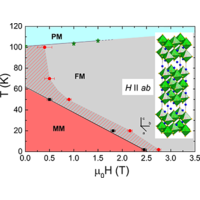
The Ruddlesden Popper series Srn+1RunO3+n+1 contains highly interesting physical phenomena depending on the number of RuO2 layers in the unit cell, spanning from unconventional superconductivity for the n=1 member Sr2RuO4 to itinerant ferromagnetism in the infinite-layer system SrRuO3. Obviously, the unique interplay between electronic, spin, and lattice degrees of freedom in this group of correlated itinerant electron systems leads to a tremendous change of the physical properties. This is also demonstrated by anisotropic and orbital-dependent magnetism and a strong spin-phonon coupling found in many members within the series. This paper focusses on triple-layer Sr4Ru3O10, which becomes ferromagnetic at Tc∼105 K and shows a metamagnetic transition below T*∼50 K for a magnetic field along the ab plane. The authors investigate the magnetoelastic properties of this compound as a function of temperature and magnetic field. The high-resolution thermal expansion and magnetostriction measurements indicate a highly anisotropic response with a specific rearrangement of the crystal lattice in fields parallel and perpendicular to the c axis. Finally, they reconstruct the T-H phase diagram, which shows a new feature suggestive of the multiple-orbital character of Sr4Ru3O10, where both the ferromagnetic (dxy) and the metamagnetic orbitals (dxz;yz) coexist and interact.

Laser angle-resolved photoemission as a probe of initial state kz dispersion, final-state band gaps, and spin texture of Dirac states in the Bi2Te3 topological insulator

Minna Ärrälä, Hasnain Hafiz, Daixiang Mou, Yun Wu, Rui Jiang, Trevor Riedemann, Thomas A. Lograsso, Bernardo Barbiellini, Adam Kaminski, Arun Bansil, and Matti Lindroos

Phys. Rev. B 94, 155144 (2016) - Published 27 October, 2016

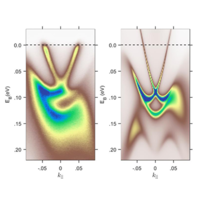
Angle-resolved photoemission spectroscopy (ARPES) is widely used to investigate topological states and their spin textures in topological materials. Here, the authors examine the role of the ARPES matrix element in laser-ARPES spectra, and delineate how imprints of the Dirac states and their spin textures are encoded in these spectra in terms of the character and symmetry of the underlying initial and final states. For this purpose, they collect laser-ARPES spectra from the exemplar topological insulator material Bi2Te3 over a wide range of momenta in the kx-ky plane at energies ranging from 5.57–6.70 eV for two different linear polarizations of the incident light. The experimental results are analyzed via first-principles fully relativistic calculations of ARPES intensities within the framework of the one-step model of photoemission. These include effects of the ARPES matrix element from a semi-infinite solid surface. The authors obtain new insight into the nature of the laser-ARPES spectra from topological materials, and show how these spectra contain fingerprints of the initial state kz dispersions and spin textures of the Dirac-cone states, and how laser-ARPES could open a previously unrecognized window on the presence of delicate gaps in the final-state spectra.

Theoretical study of stimulated and spontaneous Hawking effects from an acoustic black hole in a hydrodynamically flowing fluid of light

Pjotrs Grišins, Hai Son Nguyen, Jacqueline Bloch, Alberto Amo, and Iacopo Carusotto

Phys. Rev. B 94, 144518 (2016) - Published 26 October, 2016

Given the extreme faintness of Hawking radiation from astrophysical black holes, researchers are actively pursuing the experimental quest of its analogs in condensed-matter and optical systems. This work reports a detailed theoretical study of different aspects of analog Hawking physics in a flowing fluid of exciton-polaritons in a semiconductor microcavity. Previous experimental work has demonstrated the relative ease to generate a black-hole horizon for collective sound waves in this system. Here, the authors propose realistic schemes to experimentally observe stimulated and spontaneous Hawking radiation effects, and they characterize their efficiency in view of forthcoming experiments. In particular, the study illustrates how complex shapes of the effective analog metric are naturally realized in this system and how this results in peculiar new features in the Hawking emission. The study also pinpoints the potential of quantum fluids of light for future studies and highlights the novelties and the experimental advantages of using driven-dissipative systems over conservative ultracold atomic gases.

Revealing the role of electrons and phonons in the ultrafast recovery of charge density wave correlations in 1T−TiSe2

C. Monney, M. Puppin, C. W. Nicholson, M. Hoesch, R. T. Chapman, E. Springate, H. Berger, A. Magrez, C. Cacho, R. Ernstorfer, and M. Wolf

Phys. Rev. B 94, 165165 (2016) - Published 25 October, 2016

Electrons in low-dimensional materials sometimes reorganize themselves with a new translational symmetry, which gives rise to an energetically more favorable ground state. This phenomenon, called a charge density wave (CDW) phase, is often the result of the coupling of electrons to phonons. In the quasi-two-dimensional material TiSe2, the CDW occurring at low temperature is unusual, since it appears to be driven by strong electron-hole correlations, which in turn couple to phonons. In this work, the authors use time- and angle-resolved photoemission spectroscopy to investigate the peculiar nature of the CDW phase in TiSe2.Depending on the temperature at which measurements are performed, they observe that the response of the material is either strongly coupled to the lattice or dominated by its electronic degrees of freedom. This selective response is enhanced by tuning the pump pulse wavelength to specific optical resonances. They conclude that their measurements do indeed confirm a combined scenario, for which both the electron-hole correlations and the coupling to phonons are essential to the origin of the CDW phase in TiSe2.

Weak coupling of pseudoacoustic phonons and magnon dynamics in the incommensurate spin-ladder compound Sr14Cu24O41

Xi Chen, Dipanshu Bansal, Sean Sullivan, Douglas L. Abernathy, Adam A. Aczel, Jianshi Zhou, Olivier Delaire, and Li Shi

Phys. Rev. B 94, 134309 (2016) - Published 21 October, 2016

Incommensurate compounds consist of two or more interpenetrating sublattices with lattice periods incommensurate along one or more crystal axes. Intriguing lattice dynamics have been predicted for these compounds and are relevant to not only the thermal properties but also electronic, optical, and magnetic properties via coupling between different energy excitations. Here, the authors report inelastic neutron scattering measurements of phonon and magnon dispersions in Sr14Cu24O41, which contains incommensurate chain and ladder substructures. Two distinct acoustic phononlike modes, corresponding to the sliding motion of one sublattice against the other, are observed for atomic motions polarized along the incommensurate axis. In the long-wavelength limit, it is found that the sliding mode shows a remarkably small energy gap, indicating very weak interactions between the two incommensurate sublattices. The measurements also reveal an appreciable contribution from gapped magnons to the low-temperature specific heat, as well as a gapped and steep linear magnon dispersion of the ladders. The high group velocity of this magnon branch and weak coupling with acoustic phonons can explain the large magnon thermal conductivity in Sr14Cu24O41 crystals. These findings offer new insights into the phonon and magnon dynamics and thermal transport properties of incommensurate magnetic crystals that contain low-dimensional substructures.

Finding and proving the exact ground state of a generalized Ising model by convex optimization and MAX-SAT

Wenxuan Huang, Daniil A. Kitchaev, Stephen T. Dacek, Ziqin Rong, Alexander Urban, Shan Cao, Chuan Luo, and Gerbrand Ceder

Phys. Rev. B 94, 134424 (2016) - Published 21 October, 2016

Lattice models are widely used to represent the statistical mechanics of condensed phases for the study of alloy thermodynamics, phase transitions, magnetic properties, fluid mechanics, and other applications. A longstanding problem has been the identification of the true global ground states of a lattice model, which is challenging for general models, and only a limited number of solutions for highly simplified systems are known. Here, a practical and general algorithm is presented that allows to determine provable periodically constrained ground states of complex lattice models up to a given unit cell size and in most cases is able to prove global optimality over all possible choices of unit cells. This universal algorithm is developed by reformulating the ground-state problem in terms of maximum satisfiability (MAX-SAT) and convex optimization, which results in both provable accuracy and sufficient numerical efficiency to handle systems of physically relevant complexity. Considering that lattice-model ground states are conventionally solved using simulated annealing or genetic algorithms, techniques that are often unable to find the true global minimum and provide no handle to prove the optimality of their results, this work promises to resolve the longstanding uncertainties in lattice models of important physical phenomena.

Sign In to Your Journals Account

Filter

Section

Filter

Article Lookup

Enter a citation