Highlights

Computational investigation of half-Heusler compounds for spintronics applications

Jianhua Ma, Vinay I. Hegde, Kamaram Munira, Yunkun Xie, Sahar Keshavarz, David T. Mildebrath, C. Wolverton, Avik W. Ghosh, and W. H. Butler

Phys. Rev. B 95, 024411 (2017) - Published 11 January, 2017

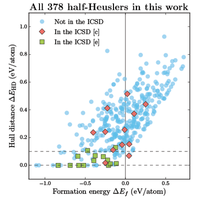
The authors investigate the properties of 378 half-Heusler compounds using density functional theory with the goal of identifying promising candidates for spintronic applications, e.g. half-metals. Although DFT has often been applied to the search for half-metals, this study may be the most comprehensive attempt to identify which of the compounds predicted by DFT to be half-metals are likely to be fabricated. The calculated formation energy of each of the 378 potential half Heuslers was compared to that of all competing phases and combination of phases in the Open Quantum Materials Database. Those semiconductors, half-metals, and near half-metals within an empirically determined 0.1 eV/atom hull distance margin for neglected effects were deemed of interest for further experimental investigation.

Domain walls and ferroelectric reversal in corundum derivatives

Meng Ye and David Vanderbilt

Phys. Rev. B 95, 014105 (2017) - Published 10 January, 2017

Materials physicists are increasingly coming to understand that domain walls in complex materials often have a life of their own. Far from being unwanted “defects”, they may have rich and interesting physics not available in the bulk material. Here, the authors use first-principles theoretical methods to consider ferroelectric domain walls in a promising family of corundum-derivative materials. Beyond studying issues of domain wall mobility and clarifying the factors that allow polarization reversal, the authors also identify an unusual set of domain-wall-specific couplings between polarization, magnetization, and chirality that they suggest may lead to new functionalities.

Resonant optical control of the spin of a single Cr atom in a quantum dot

A. Lafuente-Sampietro, H. Utsumi, H. Boukari, S. Kuroda, and L. Besombes

Phys. Rev. B 95, 035303 (2017) - Published 10 January, 2017

A Cr atom in a semiconductor host carries a localized spin with an intrinsic large spin to strain coupling particularly promising for the development of hybrid spin-mechanical systems. The authors demonstrate here that the spin of an individual Cr atom can be controlled optically. To optically access to the spin of an individual atom, they insert it in a cadmium telluride quantum dot. With a single Cr atom introduced in the quantum dot, the energy and polarization of the photon emitted or absorbed by the dot depends on the spin state of the magnetic atom. The authors first show that excitation with a laser beam tuned to the wavelength of one of these optical transitions can be used to initialize the state of the Cr spin and to probe its dynamics optically: the Cr behaves like an optically addressable spin-based memory. Under optical excitation exactly resonant with an absorption transition one can also enter the strong coupling regime where hybrid states of matter and light are created. The spin-dependent strong coupling with the laser field is exploited to optically tune the Cr atom’s energy levels.

Chiral charge pumping in graphene deposited on a magnetic insulator

Michael Evelt, Hector Ochoa, Oleksandr Dzyapko, Vladislav E. Demidov, Avgust Yurgens, Jie Sun, Yaroslav Tserkovnyak, Vladimir Bessonov, Anatoliy B. Rinkevich, and Sergej O. Demokritov

Phys. Rev. B 95, 024408 (2017) - Published 9 January, 2017

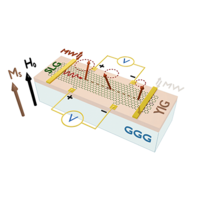
Yttrium iron garnet (YIG) holds a special place among all magnetic materials since it shows an unprecedentedly small magnetic damping, resulting in the narrowest known line in ferromagnetic resonance and enabling propagation of spin waves over long distances. Due to these unique characteristics, YIG films have been recently considered as a promising material for spintronic and magnonic applications. By combining YIG and a single layer of graphene in a bilayer, one obtains a unique model system for investigations of magnetic interfacial effects. Here, the authors demonstrate experimentally that the system shows a sizable chiral charge pumping, which could arise from an imbalance of screw dislocations. The effect, which cannot be attributed to the ordinary spin pumping, reveals itself in the creation of a dc electric field/voltage in graphene as a response to the dynamic magnetic excitations (spin waves) in an adjacent out-of-plane magnetized YIG film. The authors show that the induced voltage changes its sign when the orientation of the static magnetization is reversed, clearly indicating the broken mirror reflection symmetry about the planes normal to the graphene/YIG interface. The strength of effect shows a nonmonotonic dependence on the spin-wave frequency, in agreement with the proposed theoretical model.

Quantum oscillations without magnetic field

Tianyu Liu, D. I. Pikulin, and M. Franz

Phys. Rev. B 95, 041201(R) (2017) - Published 9 January, 2017

Quantum oscillations are the fundamental measurement made when studying metals and semimetals. They provide information about the Fermi surface by measuring interference of particles drifting around it in a magnetic field. So far it was only possible to measure them by applying an external magnetic field. Here, the authors argue that the deformation of the Dirac/Weyl semimetal can produce a strong enough pseudo-magnetic field to measure quantum oscillations in the strength of the strain. They argue that the effect of the strain is identical to the effect of the real magnetic field at energies close to the Dirac/Weyl points. They propose a setup in which the strain can be tuned continuously, and in which the quantum oscillations can be first observed in the complete absence of a magnetic field.

Critical behavior in the presence of an order-parameter pinning field

Francesco Parisen Toldin, Fakher F. Assaad, and Stefan Wessel

Phys. Rev. B 95, 014401 (2017) - Published 3 January, 2017

Can one investigate more efficiently quantum critical behavior by employing a local order-parameter pinning field, which explicitly breaks the symmetry of the model under investigation? To answer this question, the authors consider the two-dimensional square-lattice bilayer quantum Heisenberg model using a world-line quantum Monte Carlo method. The pinning-field approach is found to accurately locate the quantum critical point over a wide range of pinning-field strengths. However, the identification of the quantum critical scaling behavior is found to be complicated by the fact that the pinning field introduces strong corrections to scaling. A renormalization group analysis exhibits important analogies to surface critical phenomena, and a crossover effect to an infinite pinning-field fixed point, which the authors study in detail by simulations of an improved classical lattice model in the three-dimensional Ising universality class. At the infinite pinning-field fixed point, the short-distance expansion of the order-parameter profile exhibits a new universal critical exponent, which characterizes the experimentally relevant critical adsorption on a line defect. This result also implies the presence of slowly decaying scaling corrections, which are analyzed here in detail.

Nuclear magnetic resonance study of the magnetic-field-induced ordered phase in the NiCl2−4SC(NH2)2 compound

Rémi Blinder, Maxime Dupont, Sutirtha Mukhopadhyay, Mihael S. Grbić, Nicolas Laflorencie, Sylvain Capponi, Hadrien Mayaffre, Claude Berthier, Armando Paduan-Filho, and Mladen Horvatić

Phys. Rev. B 95, 020404(R) (2017) - Published 3 January, 2017

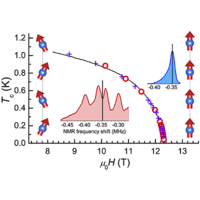
The NiCl2-4SC(NH2)2 spin-chain compound, also called “DTN”, is one of the most studied archetype materials that at low temperature presents the magnetic-field-induced ordered phase that is described as a Bose-Einstein condensate (BEC). The paper here presents an NMR study of the static properties of this phase, where, for the first time, the exact absolute value of the order parameter has been determined and compared to theoretical predictions. The precise phase boundary of the BEC phase close to its upper critical field is found to be in perfect agreement with theory, and used to define and discuss the range of validity of the Hartree-Fock-Popov approximation. DTN is a unique quasi-1D BEC-type material for which the sub-dominant 3D exchange couplings are known from independent measurements, so that theoretical descriptions are completely constrained. Therefore, precise state-of-the-art numerical methods could be used to critically discuss the applicability of approximate 1D-based descriptions (e.g., Tomonaga-Luttinger liquid + mean field) to the case when the quasi-1D character is of intermediate strength. The NMR results presented here and the corresponding theoretical descriptions can be considered as reference data and analysis for BEC-type compounds, which have been missing for a long time in this field of research.

Three-boson bound states in two dimensions

Tianhao Ren and Igor Aleiner

Phys. Rev. B 95, 045401 (2017) - Published 3 January, 2017

The presence of few-body bound states is an important issue in the study of interacting bosonic systems due to the instability it introduces into the condensation. The problem is more interesting in two dimensions because the system can host only a finite number of bound states, in contrast to the Efimov effect in three dimensions. The authors considered a two-component bosonic system in two dimensions, with repulsive intra- and attractive inter-species interactions. They found that there is only one three-particle bound state and the binding energies for various scattering lengths fall on an universal curve, where the microscopic details are of no relevance. Their conclusion is pertinent for various systems such as excitons in quantum well structures and bosonic dipoles in bilayer geometries. They developed an efficient renormalization group type method, capable of handling both short- and long- range physics and free of numerical instabilities. This method also makes use of the Hopf coordinates and running basis to reduce the proliferation of hyperspherical harmonics appearing in alternative approaches, yielding significant saving in numerical implementations.

Observation of Fermi arc and its connection with bulk states in the candidate type-II Weyl semimetal WTe2

Chenlu Wang et al.

Phys. Rev. B 94, 241119(R) (2016) - Published 30 December, 2016

WTe2 is well known for its manifestation of anomalously large magnetoresistance. It has recently attracted much attention because it is theoretically predicted to be the first material candidate that may realize the “type-II” Weyl state. This work reports combined experimental and theoretical investigations on the electronic structure of WTe2. Taking advantage of the latest-generation laser-based angle-resolved photoemission (ARPES) system with superior instrumental resolution, a complete picture of the electronic structure of WTe2 is revealed. The existence of a surface state that connects the bulk electron and hole pockets is identified. High-temperature ARPES measurements make it possible to reveal electronic states above the Fermi level where the Weyl points are predicted to be located. The observed connection of the surface state with the bulk bands, its momentum evolution, and its momentum and energy locations, are all in good agreement with the calculated band structures. These results provide key information to understand the anomalous transport properties of WTe2. They also provide electronic signatures that are consistent with the type-II Weyl state in WTe2 and lay a foundation for further investigations on its topological nature.

Cooling phonons with phonons: Acoustic reservoir engineering with silicon-vacancy centers in diamond

K. V. Kepesidis, M.-A. Lemonde, A. Norambuena, J. R. Maze, and P. Rabl

Phys. Rev. B 94, 214115 (2016) - Published 29 December, 2016

The authors propose a new method for realizing mechanical ground-state cooling that could generate quantum entanglement at convenient temperatures (1 K). They consider a diamond beam bending above a magnetic tip (the beam is clamped at one end and free to move at the other). Near the oscillating end, they insert a lattice defect, specifically a silicon-vacancy center. As the beam bends, the defect experiences a varying magnetic field which may flip its spin by absorbing mechanical energy from the low-frequency flexural motion of the beam. At the same time, the center is coupled to high-frequency compression modes, which locally distort the surrounding lattice and lead to a fast relaxation of the center’s electronic states. By stimulating the defect with microwave fields, these two coupling mechanisms can be connected and an energy flow from the bending motion into the high-frequency phonon reservoir is induced. According to predictions made here, the mechanical temperature of the beam – how much it bends – can then be tuned via optimizing these alternating absorption and reemission processes in the same way the temperature of atoms can be controlled with light.

Stoner versus Heisenberg: Ultrafast exchange reduction and magnon generation during laser-induced demagnetization

Emrah Turgut, Dmitriy Zusin, Dominik Legut, Karel Carva, Ronny Knut, Justin M. Shaw, Cong Chen, Zhensheng Tao, Hans T. Nembach, Thomas J. Silva, Stefan Mathias, Martin Aeschlimann, Peter M. Oppeneer, Henry C. Kapteyn, Margaret M. Murnane, and Patrik Grychtol

Phys. Rev. B 94, 220408(R) (2016) - Published 28 December, 2016

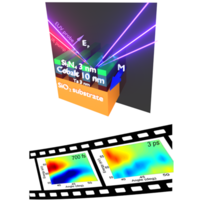
The excitation of a ferromagnetic film by a femtosecond laser pulse causes an unexpectedly fast quenching of the film’s magnetization on subpicosecond time scales. The microscopic physical mechanisms responsible for this remain a scientific puzzle. The authors employ femtosecond extreme ultraviolet pulses produced by high harmonic generation to follow how the magnetization of a thin cobalt film evolves after the excitation by a 40-fs laser pulse. By measuring the time-, energy-, and angle-resolved magneto-optical response of the Co films across the M2,3 absorption edge, they obtain a set of time-lapsed magnetic asymmetry spectra, which contain a wealth of information about the different mechanisms at work. When combined with advanced ab initio magneto-optical calculations, they identify two dominant contributions: first, a transient reduction of exchange splitting, and second, magnon excitation. This work thus distinguishes between two fundamental models of magnetism, the Stoner and Heisenberg models, which ascribe magnetization dynamics to an exchange splitting reduction and spin wave excitations, respectively.

Time-resolved studies of the spin-transfer reversal mechanism in perpendicularly magnetized magnetic tunnel junctions

Christian Hahn, Georg Wolf, Bartek Kardasz, Steve Watts, Mustafa Pinarbasi, and Andrew D. Kent

Phys. Rev. B 94, 214432 (2016) - Published 27 December, 2016

Miniaturized magnetic tunnel junctions enable single-shot time-resolved studies of magnetization reversal driven by spin currents that can test basic physical models, particularly as recent technological advances enable the study of sub-100 nm diameter junctions. The junctions consist of two magnetic layers with uniaxial magnetic anisotropy separated by a thin insulating layer that enables electron tunneling and thus transfer of spin-angular momentum in the tunneling process. One magnetic layer is free to reverse in response to the spin current while the other is fixed. Pulsed current measurements show the stochastic nature of the reversal process on nanosecond time scales and provide evidence for nonuniform magnetization reversal processes in junctions that are larger than 50 nm in diameter.

Coherent anti-Stokes Raman scattering under electric field stimulation

Erwan Capitaine, Nawel Ould Moussa, Christophe Louot, Claire Lefort, Dominique Pagnoux, Jean-René Duclère, Junya F. Kaneyasu, Hideaki Kano, Ludovic Duponchel, Vincent Couderc, and Philippe Leproux

Phys. Rev. B 94, 245136 (2016) - Published 27 December, 2016

The authors have developed a new method for exploring and controlling matter at the molecular scale. Their technique, called “electro-CARS” (for “Coherent anti-Stokes Raman scattering under electric field stimulation”), consists of exposing the sample to an electric field and laser radiation simultaneously. Under these conditions, the molecules in the sample organize themselves and start vibrating, while returning a tiny part of the received light energy. Although very weak, this reemitted light provides a lot of chemical information about the sample, with a better sensitivity and signal-to-noise ratio in comparison to existing spectroscopy tools. Electro-CARS could have a major impact in the field of electrochemotherapy, a promising method for cancer treatment. It could enable investigation of cell membrane modifications thoroughly and monitoring of anticancer drug delivery into cells without damaging them.

Anderson localization and ergodicity on random regular graphs

K. S. Tikhonov, A. D. Mirlin, and M. A. Skvortsov

Phys. Rev. B 94, 220203(R) (2016) - Published 22 December, 2016

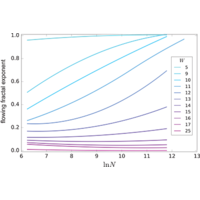
A disordered quantum system can be driven, e.g., by increasing disorder, through the Anderson transition between a delocalized and localized phase. Recently, Anderson localization on treelike graphs has attracted much attention in view of its connections with problems of many-body localization. One of the central questions in this context is that of ergodicity of eigenstates. The authors of this paper perform a numerical study of Anderson transition on random regular graphs (RRGs) with diagonal disorder. The problem can be described as a tight-binding model on a lattice with N sites that is locally a tree with constant connectivity. Focusing on the delocalized side of the transition, they show that the data can be interpreted in terms of the finite-size crossover from a small (N≪Nc) to a large (N≫Nc) system, where Nc is the correlation volume diverging exponentially at the transition. A distinct feature of this crossover is a nonmonotonicity of the spectral and wave-function statistics, which is related to properties of the critical phase in the studied model and renders the finite-size analysis highly nontrivial. The results support an analytical prediction that states in the delocalized phase (and at N≫Nc) are ergodic.

Hubbard band versus oxygen vacancy states in the correlated electron metal SrVO3

S. Backes, T. C. Rödel, F. Fortuna, E. Frantzeskakis, P. Le Fèvre, F. Bertran, M. Kobayashi, R. Yukawa, T. Mitsuhashi, M. Kitamura, K. Horiba, H. Kumigashira, R. Saint-Martin, A. Fouchet, B. Berini, Y. Dumont, A. J. Kim, F. Lechermann, H. O. Jeschke, M. J. Rozenberg, R. Valentí, and A. F. Santander-Syro

Phys. Rev. B 94, 241110(R) (2016) - Published 19 December, 2016

Strong electron correlations in solids are at the heart of fascinating phenomena such as high temperature superconductivity, whose understanding remains a prominent open problem in Physics. A central prediction of dynamical mean field theory (DMFT) is the breaking of Landau’s Fermi liquid, which describes extremely well simple metals like copper, into itinerant heavy quasiparticles and localized Mott-Hubbard states. To test it, electronic structure calculations based on DMFT are usually benchmarked against the photoemission spectra of SrVO3, a cubic perovskite with one d electron per unit cell that is considered the gold standard in this field. However, the present study shows that the UV synchrotron radiation used in the photoemission experiments creates oxygen vacancies, resulting in a strong peak of defect states essentially on top of the SrVO3 Hubbard band. As recent works found that the same peak of vacancy states occurs in noncorrelated wide-gap d0insulators, such as SrTiO3, an unavoidable worry emerges. What if the putative Hubbard bands observed in SrVO3 were just a mirage? What if this strongly correlated effect, a hallmark prediction of DMFT for the past 25 years was just not there? This study thoroughly explores those crucial issues both experimentally and theoretically.

Competing magnetic orders and spin liquids in two- and three-dimensional kagome systems: Pseudofermion functional renormalization group perspective

Finn Lasse Buessen and Simon Trebst

Phys. Rev. B 94, 235138 (2016) - Published 15 December, 2016

In quantum magnetism, the kagome antiferromagnet is one of the most widely studied spin-liquid candidate systems, in which geometric frustration inhibits the formation of conventional magnetic order. In this paper, the authors employ a recently developed pseudofermion functional renormalization group approach that reveals the competition of magnetic orders in the kagome system and a three-dimensional generalization, the hyperkagome lattice. Including couplings beyond the nearest-neighbor exchange, the authors identify a plethora of magnetically ordered states as well as extended spin-liquid regimes.

Finite field methods for the supercell modeling of charged insulator/electrolyte interfaces

Chao Zhang and Michiel Sprik

Phys. Rev. B 94, 245309 (2016) - Published 15 December, 2016

Interactions between aligned dipoles in periodic model systems are often considered spurious and removed by partitioning the supercell in isolated slabs separated by vacuum layers. One popular and efficient screening approach is the so-called dipole correction. In this work, the authors present an alternative finite-field based method which retains all electrostatic interactions and dispenses with vacuum layers. Adapting the constant-D approach developed by Stengel, Spaldin, and Vanderbilt for the study of ferroelectric nanocapacitors, the new scheme here is intended for molecular dynamics simulations of the interface between an insulator carrying a specifically absorbed surface charge and an ionic conductor (the electrolyte) at finite temperature. The authors show that the dipole correction scheme is equivalent to D=0 electric boundary conditions with or without vacuum layers. Thus, both global polarization P of the heterogeneous system and corresponding average macroscopic electric field E are finite. The authors then continue with the investigation of the variation of P with E or D and validate expressions based on P for computing the electric double-layer capacitance using atomistic simulations.

Structural origins of the boson peak in metals: From high-entropy alloys to metallic glasses

Tobias Brink, Leonie Koch, and Karsten Albe

Phys. Rev. B 94, 224203 (2016) - Published 14 December, 2016

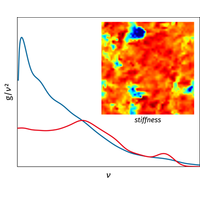
The boson peak is an excess in the vibrational spectrum of amorphous solids, which was recently conjectured to be simply related to features already inherent in the vibrations of the corresponding crystal. In this work, the authors reveal that this is not the case, at least for metallic systems. Using atomic-scale computer simulations of a four-component alloy in different structural states, either as a metallic glass or as a high-entropy alloy, they show that the boson peak does not occur in a defect-free lattice, independent of its density. This disproves, at least for the case of amorphous metals, the recent notion that the vibrational spectra of glasses are not distinct from that of crystals, but simply shifted because of the reduced density that always accompanies the amorphous state. Instead, additional modes arise in softened regions of the material, which are connected to structural defects. These defects can take the form of ”soft spots” in glasses or even a high concentration of lattice defects in crystals. The boson peak is therefore, in fact, a signature of structural disorder.

Extended pump-probe Faraday rotation spectroscopy of the submicrosecond electron spin dynamics in n-type GaAs

V. V. Belykh, E. Evers, D. R. Yakovlev, F. Fobbe, A. Greilich, and M. Bayer

Phys. Rev. B 94, 241202(R) (2016) - Published 14 December, 2016

Pump-probe Faraday/Kerr rotation spectroscopy is a powerful tool for exploring the coherent spin dynamics with picosecond temporal resolution. However, this has so far been possible only in time ranges up to a few nanoseconds. In this work, the technique is extended to address time ranges orders of magnitude longer by employing a tailored pump and probe pulse sequence, while maintaining picosecond time resolution. The submicrosecond electron spin dynamics in n-type GaAs with doping concentrations close to the metal-insulator transition can be directly accessed thereby with high precision, rendering the electron spin dephasing time T2* and the longitudinal spin relaxation time T1. Both approach 250 ns in weak magnetic fields. The Larmor spin precession in high magnetic fields applied in the Voigt geometry shows nonmonotonic dynamics deviating strongly from a mono-exponential decay and revealing g-factor variations on the level of 10-4, demonstrating the high precision of the method. The possibility of varying the pump pulse train composition from single to multiple pulses provides detailed insight into the synchronization of the spin precession in the electron gas when subject to periodic laser excitation.

Hyperfine fields in the BaFe2As2 family and their relation to the magnetic moment

Gerald Derondeau, Ján Minár, and Hubert Ebert

Phys. Rev. B 94, 214508 (2016) - Published 12 December, 2016

The hyperfine field Bhf and the magnetic properties of the BaFe2As2 family are studied using the fully relativistic Dirac formalism for different types of substitution. Relativistic contributions were found to have a significantly stronger impact for the iron pnictides when compared to bulk Fe. Based on the calculations here and the measured hyperfine field from 57Fe Mössbauer spectroscopy for undoped BaFe2As2, we can estimate a magnetic moment of roughly 0.7–1.0 μB, which is more consistent with neutron diffraction reporting 0.87 μB. This solves the longstanding puzzle of different reports for the magnetic moment of BaFe2As2 based on either 57Fe Mössbauer spectroscopy or neutron diffraction. However, for substituted iron pnictides, the behavior of Bhf with the concentration x is clearly unpredictable and might lead to wrong conclusions. Thus, relating the hyperfine fields Bhf of Fe obtained via 57Fe Mössbauer spectroscopy to the magnetic moments is not sensible for substituted iron pnictides.

Sign In to Your Journals Account

Filter

Section

Filter

Article Lookup

Enter a citation