Highlights

Magnetoresistance and quantum oscillations of an electrostatically tuned semimetal-to-metal transition in ultrathin WTe2

Valla Fatemi, Quinn D. Gibson, Kenji Watanabe, Takashi Taniguchi, Robert J. Cava, and Pablo Jarillo-Herrero

Phys. Rev. B 95, 041410(R) (2017) - Published 30 January, 2017

Here, the authors extend the study of semimetallic WTe2 to the 2D limit, utilizing new fabrication schemes that preserve sample quality to create high-mobility electronic transport devices from few-layer thick crystals, previously found to be electrically insulating. The large magnetoresistance persists in these samples and can be turned off by electrostatically tuning the system to a simple-metal (noncompensated) regime. Furthermore, the semimetallic magnetoresistance is found to follow a density-independent subquadratic power law, a topic for future study. Finally, quantum oscillations are also analyzed as a function of total carrier density, providing the first insights into the band structure of ultrathin WTe2.

Analytical solutions of the two-dimensional Dirac equation for a topological channel intersection

J. R. Anglin and A. Schulz

Phys. Rev. B 95, 045430 (2017) - Published 30 January, 2017

What happens to the edge states when two edges intersect? The authors answer this question for the case in which the topologically protected edge states are the quasi-one-dimensional bound states that propagate unidirectionally under the two-dimensional Dirac equation, if it includes an inhomogeneous potential term that changes sign across a zero line. These “zero line modes” are bound to the line along which the potential vanishes, and so if the potential has a “checkerboard” form, such that two zero lines cross, then the question becomes: what happens to the zero line modes at the intersection? By finding an exact integral representation for the two-dimensional Dirac energy eigenstates, the authors show that the eigenstates take surprisingly narrow “T-junction” forms, so that incoming wave packets split coherently at the intersection into two outgoing packets, while remaining tightly bound to the zero lines. The intersection thereby acts as a beam splitter for zero line modes.

Nonequilibrium effective field theory for absorbing state phase transitions in driven open quantum spin systems

Michael Buchhold, Benjamin Everest, Matteo Marcuzzi, Igor Lesanovsky, and Sebastian Diehl

Phys. Rev. B 95, 014308 (2017) - Published 27 January, 2017

Phase transitions to absorbing states are among the simplest examples of critical phenomena out of equilibrium. The characteristic feature of these models is the presence of a fluctuationless configuration that the dynamics cannot leave, which has proved a rather stringent requirement in experiments. Recently, a proposal to seek such transitions in highly tunable systems of cold atomic gases offers to probe this physics and, at the same time, to investigate the robustness of these transitions to quantum coherent effects. Here, the authors specifically focus on the interplay between classical and quantum fluctuations in a simple driven open quantum model which, in the classical limit, reproduces a contact process, which is known to undergo a continuous transition in the “directed percolation” universality class. The authors derive an effective long-wavelength field theory for the present class of open spin systems and show that, due to quantum fluctuations, the nature of the transition changes from second to first order, passing through a critical point which appears to belong instead to the “tricritical directed percolation” class.

Double vibronic process in the quantum spin ice candidate Tb2Ti2O7 revealed by terahertz spectroscopy

E. Constable, R. Ballou, J. Robert, C. Decorse, J.-B. Brubach, P. Roy, E. Lhotel, L. Del-Rey, V. Simonet, S. Petit, and S. deBrion

Phys. Rev. B 95, 020415(R) (2017) - Published 27 January, 2017

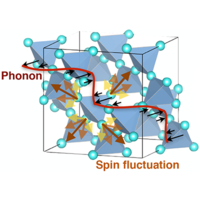
In the field of geometrically frustrated magnetism, the very nature of the ground state of Tb2Ti2O7 has remained a long-standing conundrum. In this pyrochlore material, no conventional spin-ice or long-range magnetic order is stabilized, even at very low temperatures. Quantum fluctuations are suspected of being at the origin of such an exotic quantum phase, yet so far there is no conclusive evidence. Here, high-resolution synchrotron-based terahertz spectroscopy probes the lowest energy excitations of Tb2Ti2O7. By exciting transitions within the crystal electric field and crystal lattice, it is revealed that a double hybridization of crystal-field phonon modes is present across a broad temperature range. This unique vibronic process triggers coupling between several degrees of freedom that provides a crucial path for quantum spin-flip fluctuations to inhibit the stabilization of conventional magnetic states. While providing evidence for the unique quantum phase in Tb2Ti2O7, the result also highlights the powerful and complementary nature of terahertz spectroscopy as a probe in the study of exotic magnetic and frustrated phases.

Symmetry breaking, slow relaxation dynamics, and topological defects at the field-induced helix reorientation in MnSi

A. Bauer, A. Chacon, M. Wagner, M. Halder, R. Georgii, A. Rosch, C. Pfleiderer, and M. Garst

Phys. Rev. B 95, 024429 (2017) - Published 25 January, 2017

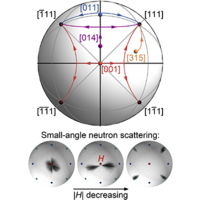
The Dzyaloshinskii-Moriya interaction in the cubic chiral magnet MnSi stabilizes a magnetic helix - a periodic one-dimensional modulation of the magnetization. The orientation of this helix is determined by weak magnetocrystalline anisotropies, but it can be reoriented by applying a magnetic field. Here, the authors have studied this reorientation process by means of small-angle neutron scattering and susceptibility measurements. Their results are in excellent agreement with predictions of an effective mean-field theory taking into account the precise symmetries of the crystal structure. Measurements of the magnetization and ac susceptibility provide evidence that the reorientation of helimagnetic domains is associated with large relaxation times exceeding seconds. In addition, hysteresis at the Ising transitions indicates, within the same theoretical framework, the formation of an abundance of plastic deformations of the helical spin order. These deformations comprise topologically nontrivial disclinations, reminiscent of the skyrmions discovered recently in the same class of materials.

Exactly soluble model of boundary degeneracy

Sriram Ganeshan, Alexey V. Gorshkov, Victor Gurarie, and Victor M. Galitski

Phys. Rev. B 95, 045309 (2017) - Published 25 January, 2017

Engineering topological degeneracy within an experimentally accessible platform has been an active area of research with applications towards the pursuit of universal topological quantum computation. In this work, the authors consider Abelian fractional quantum spin Hall states with multiply connected gapped boundaries. Such a system manifests topological degeneracy (also dubbed “boundary degeneracy”) and in principle can realize universal quantum computation with no superconducting proximity required. The authors construct an exactly soluble model manifesting this topological degeneracy and solve it within Hamiltonian formalism, which is a natural framework to quantify the Hilbert space structure associated with this degenerate subspace. Furthermore, this platform is accessible within experiments and can be created by applying a depletion gate to the quantum spin Hall material and using a spin-mixing process realized by generic magnetic impurities that gap out the edge modes.

Advances in quantitative Kerr microscopy

I. V. Soldatov and R. Schäfer

Phys. Rev. B 95, 014426 (2017) - Published 24 January, 2017

Measuring the magnetization vector field of magnetically ordered materials is the ultimate goal of magnetic imaging. The authors propose a technical realization of quantitative magneto-optical Kerr microscopy, which makes it possible to obtain the continuously changing vector field of complete magnetization processes on arbitrarily oriented surfaces. It is based on a pulsed light emitting diode (LED) light source that allows for a computer controlled, real-time contrast selection of all three magnetization components of the domain patterns. As parasitic Faraday contributions in the microscope optics are eliminated and by using monochrome LED light, the accuracy and signal-to-noise ratio of the analysis is significantly enhanced compared to preceding solutions. The approach to vector imaging thus exceeds previous limits of the experimental instrumentation for magneto-optical domain investigation. The potential of the technique was demonstrated by the quantitative analysis of a remagnetization cycle of a Permalloy film element, and by the vectorial analysis of a domain structure in a GaMnAs thin semiconducting film with extremely low Kerr response.

Excitations and magnetization density distribution in the dilute ferromagnetic semiconductor Yb14MnSb11

M. B. Stone, V. O. Garlea, B. Gillon, A. Cousson, A. D. Christianson, M. D. Lumsden, S. E. Nagler, D. Mandrus, and B. C. Sales

Phys. Rev. B 95, 020412(R) (2017) - Published 23 January, 2017

While it is mostly well-known for its excellent thermoelectric properties at high temperatures, Yb14MnSb11 has also come to be characterized as a ferromagnetic semiconductor. Such systems support ferromagnetic correlations similar to metallic compounds, although with semiconducting electronic configurations. As such, they are promising materials for use in spintronic devices. The authors here use neutron scattering techniques to examine the distribution of the magnetization density and the energy scale of the magnetic exchange interactions in the Yb14MnSb11 compound. They find that there is a large ferromagnetic moment localized to the Mn site in the crystal structure with a ‘Kondo cloud’ of negative moments distributed over the other atomic sites. The results provide long sought answers to questions regarding the valence, magnetization distribution, and energy scales of the magnetic interactions in this compound. The ferromagnetic spin-wave spectrum supports this premise and is well characterized by inclusion of nearest and next-nearest neighbor exchange interactions.

Quantum oscillations in a lead chalcogenide three-dimensional Dirac system

Filip Orbanić, Mario Novak, Mirko Baćani, and Ivan Kokanović

Phys. Rev. B 95, 035208 (2017) - Published 20 January, 2017

The three-dimensional (3D) Dirac materials represent a dimensional extension of the two-dimensional physics seen in graphene. Recently, two types of 3D Dirac materials have been proposed. The first type are the symmetry protected 3D Dirac materials with the Cd3As2 as the representative material. The second type are materials with accidental touching of the conduction and valence bands in a single point. In this paper, the authors are reporting bulk quantum oscillations in Pb1-xSnxSe, a latter type of material, which has also been recently identified as a topological crystalline insulator with a topological phase transition predicted to take place at x=0.17. The authors have used the quantum oscillations in resistivity and magnetization to identify the phase of the oscillation and prove that this material has the 3D Dirac linear dispersion for x=0.17. Combining the oscillations in the resistivity and magnetization, the authors provide the consistent indexing method for drawing the Landau level diagrams that are used in identifying the Berry phase.

Many-body localization in the presence of a small bath

Katharine Hyatt, James R. Garrison, Andrew C. Potter, and Bela Bauer

Phys. Rev. B 95, 035132 (2017) - Published 19 January, 2017

In the presence of strong disorder and weak interactions, closed quantum systems can enter a many-body localized phase wherein the system does not conduct heat or charge, does not equilibrate even for arbitrarily long times, and robustly violates quantum statistical mechanics. While this is well established in closed quantum systems, the interplay of such systems with delocalized degrees of freedom is much less understood. Here, the authors consider a model for which, in the noninteracting limit, some degrees of freedom are localized while others remain delocalized. Such a system can be viewed as a model for a many-body localized system brought into contact with a small bath of a comparable number of degrees of freedom. The authors numerically and analytically study the effect of interactions on this system and find that in certain parameter regimes, results are consistent with interaction-induced localization of the entire system.

Resonant optical spectroscopy and coherent control of Cr4+ spin ensembles in SiC and GaN

William F. Koehl, Berk Diler, Samuel J. Whiteley, Alexandre Bourassa, N. T. Son, Erik Janzén, and David D. Awschalom

Phys. Rev. B 95, 035207 (2017) - Published 19 January, 2017

The authors identify a new class of optically controllable, semiconductor-based defect spin that is formed from the d-orbital electrons of chromium ions in silicon carbide and gallium nitride. These ions possess a simple lambda optical structure that couples only weakly to phonons and lattice strain. Therefore, even though they probe an ensemble of many ions at once with varying strain environments, the optical transitions they observe are exceptionally narrow and possess a high radiative efficiency. These properties allow the authors to individually interrogate the magnetic sublevels of the ground-state spin using resonant optical excitation, enabling ensemble optical spin polarization as well as optically detected magnetic resonance in the time domain. Each ion species emits the majority of its luminescence within a near-infrared zero-phonon line, suggesting a capacity for efficient photonic integration. Additionally, as magnetically active d-orbital states, the spins of these ions possess a number of degrees of design freedom not available to other common defect spin species such as those based on vacancy complexes. The authors therefore expect that these studies will broaden the range of opportunities available to semiconductor-based quantum device engineering, and will motivate further explorations into the use of transition metal ions as optically active qubit states.

Intertube effects on one-dimensional correlated state of metallic single-wall carbon nanotubes probed by C13 NMR

Noboru Serita, Yusuke Nakai, Kazuyuki Matsuda, Kazuhiro Yanagi, Yasumitsu Miyata, Takeshi Saito, and Yutaka Maniwa

Phys. Rev. B 95, 035128 (2017) - Published 18 January, 2017

Due to the one-dimensional nature of single-wall carbon nanotubes (SWCNTs), electron-electron interactions are of great importance because the lack of screening enhances the effective Coulomb interactions between electrons, and individual SWCNTs have been considered as an ideal realization of a Tomonaga-Luttinger liquid (TLL). In an actual SWCNT sample, SWCNTs usually pack together closely and form a bundle structure, in which intertube effects may alter the TLL state significantly. Here, the authors study the TLL effect in bundles of metallic SWCNTs using 13C nuclear magnetic resonance techniques to understand how the intertube effects alter the electron-electron interaction in the bundle form. They find a modified charge Luttinger parameter for the bundled metallic SWCNTs. Their findings give direct evidence that bundling reduces the effective Coulomb interactions via intertube interactions within bundled metallic SWCNTs.

Anomalous Fraunhofer interference in epitaxial superconductor-semiconductor Josephson junctions

H. J. Suominen, J. Danon, M. Kjaergaard, K. Flensberg, J. Shabani, C. J. Palmstrøm, F. Nichele, and C. M. Marcus

Phys. Rev. B 95, 035307 (2017) - Published 18 January, 2017

Fraunhofer interference is a paradigmatic phenomena arising due to phase coherence in diverse systems from optics to superconducting junctions. In Josephson junctions, coupling two superconductors through a weak link, such patterns arise in the maximal dissipationless current the system can sustain, oscillating as function of a perpendicular applied magnetic field. By investigating this effect in a recently realized material system epitaxially coupling a thin superconductor to a semiconducting region, the authors here discover novel effects arising due to a combination of magnetic field screening, spin physics, and disorder. In an appropriately aligned in-plane magnetic field, they find that due to screening by the superconducting leads, a flux dipole develops in the semiconducting region leading to an effective confinement of the superconducting states to edges of the intervening semiconducting region. When the out-of-plane field is swept in the presence of an in-plane field, striking asymmetries in the Fraunhofer pattern are observed. By analyzing the underlying theoretical symmetries of the system, they demonstrate that such an effect arises as a result of an intricate interplay between disorder in the junction, splitting of the spin states in the applied field, and coupling between the momentum of the electrons and their spin.

Light-hole exciton in a nanowire quantum dot

Mathieu Jeannin, Alberto Artioli, Pamela Rueda-Fonseca, Edith Bellet-Amalric, Kuntheak Kheng, Régis André, Serge Tatarenko, Joël Cibert, David Ferrand, and Gilles Nogues

Phys. Rev. B 95, 035305 (2017) - Published 17 January, 2017

Quantum dots are promising building blocks for future optoelectronics or quantum information applications. Many of their properties derive from the quantum state of the hole trapped in the dot. “Light” and “heavy” hole states differ by the anisotropic character of their spin and of the electric dipole they form with a trapped electron. Light holes are of particular interest as they offer extended opportunities for optical manipulation of single carriers, or the electrical manipulation of magnetic objects. Here, the authors demonstrate that the hole ground state can be engineered through a proper design of the strain built in the dot when inserted inside a nanowire of a different lattice parameter. Two complementary techniques provide evidence of a light hole state: polarization-resolved Fourier imaging, which is sensitive to the nature of the electron-hole electric dipole, and magneto-optical spectroscopy, which probes the hole spin state through its coupling to magnetic atoms.

Many-body theory of trion absorption features in two-dimensional semiconductors

Dmitry K. Efimkin and Allan H. MacDonald

Phys. Rev. B 95, 035417 (2017) - Published 17 January, 2017

Monolayer two-dimensional transition metal dichalcogenide (TMDCs) exhibit exceptionally strong spin-orbit and electron-electron interaction effects and have provided a rich new playground for the exploration of exciton physics. Recent experiments have demonstrated that in the presence of excess charge carriers the prominent excitonic features in optical absorption split into two separate peaks. The appearance of the additional peak is usually attributed to the presence of trions, charged fermionic quasiparticles formed by binding two electrons to one hole or two holes to one electron. The authors here argue that in the density range for which amplitudes of two peaks are comparable three-particle physics is of importance, and the appropriate picture is one of excitons interacting with the Fermi sea formed by additional charge carriers. These interactions result in the dressing of excitons into exciton-polarons. The exciton spectrum splits into a lower energy attractive exciton-polaron branch, normally identified as a trion branch, and a higher energy repulsive exciton-polaron branch, normally identified as an exciton branch. The authors provide a complete theory of absorption, which incorporates both static and dynamic effects of Fermi sea, and analyze frequency and doping dependence of optical conductivity in detail. The calculated density dependence of peak splitting and their amplitudes and widths are in agreement with recent experiments.

Topological order, symmetry, and Hall response of two-dimensional spin-singlet superconductors

Sergej Moroz, Abhinav Prem, Victor Gurarie, and Leo Radzihovsky

Phys. Rev. B 95, 014508 (2017) - Published 13 January, 2017

The interplay between symmetry and topology is one of the most exciting avenues of modern condensed matter research. Here, the authors propose a new and unified approach for describing the low-energy physics of two-dimensional spin-singlet superconductors, placing them in a class of topologically ordered states akin to quantum Hall fluids and spin liquids. Starting from a microscopic model of two-dimensional paired fermions with a dynamical electromagnetism (that is also confined to two spatial dimensions), the authors derive Chern-Simons theories for all spin-singlet gapped superconductors, including s-wave and chiral states. The topological field theories constructed here thus pave the way towards understanding superconductors as symmetry-enriched topological phases of matter.

Mode decomposition based on crystallographic symmetry in the band-unfolding method

Yuji Ikeda, Abel Carreras, Atsuto Seko, Atsushi Togo, and Isao Tanaka

Phys. Rev. B 95, 024305 (2017) - Published 13 January, 2017

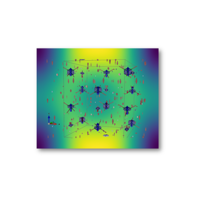
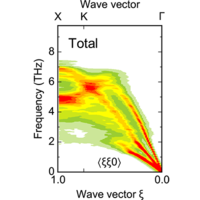
The band-unfolding method is now widely used to calculate the effective band structures of a disordered system from its supercell model. The unfolded band structures are obtained as if the disordered system really has the crystallographic symmetry of its underlying structure. However, it has still been difficult to decompose the unfolded band structures into the modes based on the crystallographic symmetry of the underlying structure. This has prohibited detailed analyses of, e.g., selection rules and avoided band crossings for the unfolded band structures. The authors here develop a procedure to decompose the unfolded band structures according to the small representations (SRs) of the little groups. The decomposition is performed using the projection operators for SRs derived from the group representation theory. Using this procedure, the authors investigate the phonon band structure of disordered face-centered-cubic Cu0.75Au0.25, which has large variations of atomic masses and force constants among the atomic sites due to the chemical disorder. In the unfolded phonon band structure, several peculiar behaviors such as discontinuous and split branches are found in the decomposed modes corresponding to specific SRs.

Photocurrents in Weyl semimetals

Ching-Kit Chan, Netanel H. Lindner, Gil Refael, and Patrick A. Lee

Phys. Rev. B 95, 041104(R) (2017) - Published 13 January, 2017

The discovery of topological matter should be an opportunity for revolutionizing electronic devices. Nevertheless, for all their unique properties, to date there are limited feasible devices or applications based on topological materials. The work here recognizes that topological Weyl semimetal materials, through their protected gap closing and spin-orbit locking, could be used to detect low-frequency infrared radiation. Detecting infrared light electrically beyond a ten-micron wavelength is rather difficult with few ready made commercial solutions. The authors find that Weyl semimetals could provide an ideal solution for detecting mid- and far-infrared light even at room temperature. In this work, they describe the conditions of the materials to be effective photodetectors (noncentrosymmetry, doping levels etc.) and provide a detailed analysis of this photovoltaic effect.

Ab initio study of doping effects in the 42214 compounds: A new family of layered iron-based superconductors

F. Bucci, A. Sanna, G. Profeta, A. Continenza, and E. K. U. Gross

Phys. Rev. B 95, 014415 (2017) - Published 12 January, 2017

The authors present a systematic density functional theory GGA characterization of the R4Fe2As2Te1-xO4-yFy family of compounds (called “42214”) as a function of a set of key tuning parameters: rare earth (R = Pr, Sm, and Gd), Te content, oxygen to fluorine substitutional doping, and external pressure. The analysis is based on an unfolding procedure that allows observation of the behavior of hole and electron pockets of the Fermi surface and of the nesting function. The present study includes characterization of a related hypothetical compound having Se substituting for Te. Results show that this peculiar compound family offers very good opportunities to properly harness material properties. Nesting, Fermi surface (topology and size), and magnetism can be easily modified by changing chemical composition: such tuning may lead to improved superconducting properties.

Direct three-dimensional ordering of quasi-one-dimensional quantum dimer system near critical fields

Taku Matsushita, Nobuyoshi Hori, Seiya Takata, Nobuo Wada, Naoki Amaya, and Yuko Hosokoshi

Phys. Rev. B 95, 020408(R) (2017) - Published 12 January, 2017

As the temperature lowers in the gapless region, quantum quasi-1D spin systems show one-dimensional (1D) short-range ordering (SRO) corresponding to a Tomonaga-Luttinger liquid (TLL) by the interaction within chains, and then at lower temperatures where the small interchain interaction cannot be ignored, they have a three-dimensional (3D) long- range ordered (LRO, BEC) phase. This generally accepted scenario for the dimensional crossover of quasi-1D spin ordering, however, is debatable around the critical field, because the 1D SRO (TLL) regime has a linear boundary on the H-T phase diagram, while the 3D LRO transition temperature has a convex shape. To this dimensionality paradox around the critical field, the authors have given the solution, experimentally by detailed analyses of the specific heat and ac susceptibility for bond-alternating antiferromagnetic chains in pentafluorophenyl nitronyl nitroxide (F5PNN). They reveal the existence of a definite field region near a critical field, where 3D LRO (BEC) directly occurs without passing through 1D SRO region at higher temperatures, even if the interchain interaction is sufficiently small compared to the intrachain one.

Sign In to Your Journals Account

Filter

Section

Filter

Article Lookup

Enter a citation