Highlights

Wing structure in the phase diagram of the Ising ferromagnet URhGe close to its tricritical point investigated by angle-resolved magnetization measurements

Shota Nakamura, Toshiro Sakakibara, Yusei Shimizu, Shunichiro Kittaka, Yohei Kono, Yoshinori Haga, Jiří Pospíšil, and Etsuji Yamamoto

Phys. Rev. B 96, 094411 (2017) - Published 11 September, 2017

The ferromagnetic quantum phase transition (FMQPT) in clean metals has attracted much interest since a first-order transition is commonly observed. The orthorhombic Ising ferromagnet URhGe provides an excellent opportunity to study the FMQPT, because its Curie temperature can be tuned to zero by applying a magnetic field H parallel to the b axis, perpendicular to the spontaneous moment that aligns along the c axis. Here, the authors perform high-precision angle-resolved magnetization measurements on URhGe to investigate the FMQPT with H applied near the b axis. They find a clear first-order transition below a tricritical point (TCP) located above 4 K, and determine the detailed profiles of the wing structure of the first-order transition in the T-Hb-Hc phase diagram. The obtained wing structure is consistent with the theoretical expectation that three second-order transition lines merge tangentially at TCP.

Origins of Willis coupling and acoustic bianisotropy in acoustic metamaterials through source-driven homogenization

Caleb F. Sieck, Andrea Alù, and Michael R. Haberman

Phys. Rev. B 96, 104303 (2017) - Published 11 September, 2017

In addition to conventional acoustic properties (mass density and compressibility), recent research has shown that inhomogeneous acoustic media may require coupling tensors between effective volume strain and momentum fields. These coupling tensors imply conversion between monopolar and dipolar motion in the effective material response. Intrinsic coupling between strain and momentum is known as Willis coupling in elastodynamics, and it is analogous to bianisotropy in electromagnetism. This paper investigates the microscale and mesoscale effects that lead to Willis coupling, studies the proper homogenization of acoustic metamaterials with non-negligible Willis coupling, and demonstrates the impact of Willis coupling on defining physically meaningful effective material parameters.

Anomalous Nernst and thermal Hall effects in tilted Weyl semimetals

Yago Ferreiros, A. A. Zyuzin, and Jens H. Bardarson

Phys. Rev. B 96, 115202 (2017) - Published 8 September, 2017

In the thermal Hall and Nernst effects, electric and heat currents, respectively, are induced perpendicular to an applied temperature gradient. Usually, such a response requires the application of a magnetic field. In contrast, here the authors establish that in Weyl semimetals – semimetals with a linear conical energy dispersion around a set of points called Weyl nodes – the Nernst effect can be realized without magnetic field, provided that the Weyl cones are tilted. This is the anomalous Nernst effect. It is significantly altered by the tilt of the Weyl cones, with Fermi surface contributions becoming important. Two experimental setups that would allow measuring both responses are discussed.

Lead palladium titanate: A room-temperature multiferroic

Elzbieta Gradauskaite, Jonathan Gardner, Rebecca M. Smith, Finlay D. Morrison, Stephen L. Lee, Ram S. Katiyar, and James F. Scott

Phys. Rev. B 96, 104104 (2017) - Published 7 September, 2017

The authors demonstrate room-temperature multiferroic (ferroelectric-ferromagnetic) behavior in lead titanate, in which about 30% of the titanium is substituted by palladium. Palladium is an unusual element with an instability to ferromagnetism under some special conditions. Typically, it has not been easy to incorporate it into perovskite oxides – the most common structure for ferroelectric device materials. Although palladium is expensive, commercial devices like ferroelectric memories often use very thin films, for which the added cost of palladium is negligible. Thus, the present study combines basic new physics of the first multiferroic palladium compounds with potential commercial devices.

Exactly solvable models for symmetry-enriched topological phases

Meng Cheng, Zheng-Cheng Gu, Shenghan Jiang, and Yang Qi

Phys. Rev. B 96, 115107 (2017) - Published 6 September, 2017

Symmetry-enriched topological phases (SET) exhibit both long-range entanglement and intricate interplay with global symmetries, such as anyon permutation symmetry or fractionalization of quantum numbers, going beyond the Landau paradigm of symmetry breaking. Here, the authors study two-dimensional SET phases based on the novel concept of symmetric local unitary transformations. Using the fixed-point structure of wave functions, they construct systematically exactly solvable models that can describe generic nonchiral SET phases. The technique applies to on-site as well as spatial symmetries and, furthermore, to anomalous symmetries that can only be realized on the surface of three-dimensional symmetry-protected phases.

TRILEX and GW+EDMFT approach to d-wave superconductivity in the Hubbard model

J. Vučičević, T. Ayral, and O. Parcollet

Phys. Rev. B 96, 104504 (2017) - Published 5 September, 2017

In high-temperature superconductors, the superconductivity appears on the verge of Mott localization and is mediated by collective electronic excitations. Here, the authors present a general theoretical framework (TRILEX) that combines the ideas of DMFT and spin-fluctuation theory, and is shown to capture both the d-wave superconductivity and the Mott insulating phase in the Hubbard model. The emphasis is laid on the local scattering between the electrons and the effective long-range bosonic degrees of freedom. The renormalized electron-boson vertex is obtained from a quantum Monte Carlo solution of a self-consistent single-impurity effective model. Therefore, the calculation is of significantly lighter weight compared to the minimal cluster DMFT required for the same purpose. Additionally, both the level and flavor of the approximation are variable, in a fully controlled manner.

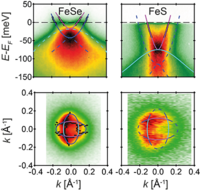
Suppression of electronic correlations by chemical pressure from FeSe to FeS

P. Reiss, M. D. Watson, T. K. Kim, A. A. Haghighirad, D. N. Woodruff, M. Bruma, S. J. Clarke, and A. I. Coldea

Phys. Rev. B 96, 121103(R) (2017) - Published 5 September, 2017

In iron-based superconductors, the interplay between nematicity, magnetism, and superconductivity is still not fully understood. Experimentally, the isoelectronic series FeSe1-xSx provides an ideal playground to tune different electronic ground states and to selectively investigate their mutual interplay. Here, the authors use high-resolution angle-resolved photoemission spectroscopy to compare the electronic structure of different single crystals in the tetragonal phase. They find that in the absence of nematicity and magnetism, the substantial reduction of electronic correlations correlates with the decrease of the superconducting transition temperature from FeSe to FeS.

Density functional perturbation theory for gated two-dimensional heterostructures: Theoretical developments and application to flexural phonons in graphene

Thibault Sohier, Matteo Calandra, and Francesco Mauri

Phys. Rev. B 96, 075448 (2017) - Published 31 August, 2017

In the search for exciting new physics and the design of next-generation devices, gated two-dimensional heterostructures are becoming omnipresent. As the fabrication and characterization techniques in this field improve, first-principles methods must follow suit. The authors present here an implementation of density functional perturbation theory, tailored to simulate the electronic and vibrational properties of two-dimensional heterostructures in the field-effect configuration. They apply the method to gated graphene and show that while the field effect activates the coupling between electrons and flexural phonons, this coupling is strongly screened by the electrons of doped graphene.

Pressure-induced superconductivity up to 13.1 K in the pyrite phase of palladium diselenide PdSe2

Moaz A. ElGhazali, Pavel G. Naumov, Hossein Mirhosseini, Vicky Süß, Lukas Müchler, Walter Schnelle, Claudia Felser, and Sergey A. Medvedev

Phys. Rev. B 96, 060509(R) (2017) - Published 30 August, 2017

The family of transition-metal dichalcogenides provides a rich platform for studying the interplay between the crystal structure and electronic properties in strongly correlated electron systems. Applying external pressure as a tuning parameter, the authors observed a striking correlation between the critical temperature Tc for superconductivity and the strength of the Se-Se bonds in the high-pressure pyrite phase of PdSe2. The bond length of the Se2 dimer was identified as the main parameter for controlling the superconductivity in the pyrite structure. Strong pressure-induced enhancement of Tc up to its maximum value of 13.1 K cannot, however, be explained solely by phonon softening, and this implies the relevance of additional factors influencing Tc. Indeed, electronic band calculations reveal the presence of topologically nontrivial states in the pyrite structure.

Resistance-area product and size dependence of spin-torque switching efficiency in CoFeB-MgO based magnetic tunnel junctions

J. Z. Sun

Phys. Rev. B 96, 064437 (2017) - Published 30 August, 2017

Magnetic tunnel junctions have seen active development for spin-transfer-torque based magnetic random access memory (STT-MRAM), a new technology attractive for low-power applications, especially when embedded in semiconductor logic processors. Such efforts open new frontiers for materials and device physics involving interface magnetic states and materials properties, such as an unexpected dependence of spin-torque switching efficiency on a tunnel junction’s resistance-area product. This paper examines the observation and some possible causes. An experiment-based understanding will improve device performance for wider adaptation, while at the same time deepening the knowledge about magnetic excitations and materials physics.

Classical spin spirals in frustrated magnets from free-fermion band topology

Jan Attig and Simon Trebst

Phys. Rev. B 96, 085145 (2017) - Published 30 August, 2017

In frustrated magnets, competing interactions give rise to many nearly degenerate low-energy states. For classical Heisenberg antiferromagnets the spin spiral ground states form a degenerate manifold in momentum space that, somewhat unexpectedly, looks like a Fermi surface. Here, the authors demonstrate an exact classical-to-quantum correspondence that allows one to map the spin spiral surfaces of classical spin systems to the Fermi surfaces of free-fermion models.

Magnetic hexadecapole order and magnetopiezoelectric metal state in Ba1−xKxMn2As2

Hikaru Watanabe and Youichi Yanase

Phys. Rev. B 96, 064432 (2017) - Published 28 August, 2017

Odd-parity magnetic multipole order, where time-reversal and space-inversion symmetries are spontaneously broken, may open a new paradigm in the fields of multipole physics, multiferroics, and spintronics. BaMn2As2 is a new candidate material. Here, the authors theoretically identify that the seemingly simple antiferromagnetic order in BaMn2As2 is actually magnetic hexadecapole order mixed with magnetic quadrupole order. Interestingly, doping hole carriers realize an itinerant odd-parity magnetic multipole order. Emergent electromagnetic responses, such as magnetoelectric effect, antiferromagnetic Edelstein effect, and electric current-induced nematicity, are clarified. In particular, the current-induced nematicity is a characteristic response of an itinerant magnetic hexadecapole state and indicates a novel phase, the “magnetopiezoelectric metal”.

Emergent particle-hole symmetry in spinful bosonic quantum Hall systems

S. D. Geraedts, C. Repellin, Chong Wang, Roger S. K. Mong, T. Senthil, and N. Regnault

Phys. Rev. B 96, 075148 (2017) - Published 23 August, 2017

Recently, a reevaluation of particle-hole symmetry in fermionic quantum Hall systems has led to a wealth of new insights about quantum Hall phases and connections between quantum Hall physics and other topological phases as well as high-energy physics. Similar progress may be possible in the bosonic case if such a symmetry exists, unlike the fermionic case such a symmetry is not exact. Here, the authors provide the first evidence for the existence of an emergent bosonic particle-hole symmetry.

Parity breaking in a double atomic chain system

J. Aulbach, S. C. Erwin, J. Kemmer, M. Bode, J. Schäfer, and R. Claessen

Phys. Rev. B 96, 081406(R) (2017) - Published 22 August, 2017

In one-dimensional electron systems, cooperative effects are expected to cause very specific electronic instabilities. Atomic nanowires, formed via self-organized growth on semiconductor surfaces, represent viable physical realizations for the study of such fascinating one-dimensional quantum states. The system in the focus of this work, Si(553)-Au, is created by Au adsorption on a stepped silicon substrate. It features two different chain types, interspersed with each other: Au chains on the terraces, and Si step edges that are subject to the formation of spin chains. By combining high-resolution scanning tunneling microscopy and local tunneling spectroscopy, the authors reveal the complex interplay between the two distinct wire architectures. The interaction is effectively “one-way” in that the Si step edges respond to the Au chains, but not vice versa. As a consequence, the symmetry of the system is lowered as the parity of the Si chains is broken. This fundamental effect creates two different configurations of chains with opposite directionality.

Griffiths singularities in the random quantum Ising antiferromagnet: A tree tensor network renormalization group study

Yu-Ping Lin, Ying-Jer Kao, Pochung Chen, and Yu-Cheng Lin

Phys. Rev. B 96, 064427 (2017) - Published 21 August, 2017

Rare events can have major effects on quantum matter. Extremely unlikely events cause certain physical properties to diverge to infinity near the quantum phase transition of the disordered Ising antiferromagnet in a transverse field, but destroy criticality of the clean system completely when a longitudinal component of the field is present. Using a tree tensor network renormalization group method combined with a novel matrix product operator representation, the authors detect signatures of rare events and determine the zero-temperature phase diagram of the disordered antiferromagnetic Ising chain in the presence of both longitudinal and transverse magnetic fields. The numerical technique used in this paper is generalizable to more complicated many-body systems and higher dimensions.

Optical and microwave control of germanium-vacancy center spins in diamond

Petr Siyushev, Mathias H. Metsch, Aroosa Ijaz, Jan M. Binder, Mihir K. Bhaskar, Denis D. Sukachev, Alp Sipahigil, Ruffin E. Evans, Christian T. Nguyen, Mikhail D. Lukin, Philip R. Hemmer, Yuri N. Palyanov, Igor N. Kupriyanov, Yuri M. Borzdov, Lachlan J. Rogers, and Fedor Jelezko

Phys. Rev. B 96, 081201(R) (2017) - Published 18 August, 2017

Novel solid-state qubits have a lot to offer for quantum information processing because of the potential simplicity of engineering quantum computational hardware similar to modern silicon-based electronics. This work presents optical and electron-spin properties of a novel germanium-vacancy defect in diamond. The defect center combines high brightness and exceptional spectral stability with microwave and optical access to electron spin. The combination of a spin-½ qubit and an optical interface makes possible of the germanium-vacancy defect in scalable quantum networks.

Spinon confinement in a quasi-one-dimensional anisotropic Heisenberg magnet

A. K. Bera, B. Lake, F. H. L. Essler, L. Vanderstraeten, C. Hubig, U. Schollwöck, A. T. M. N. Islam, A. Schneidewind, and D. L. Quintero-Castro

Phys. Rev. B 96, 054423 (2017) - Published 17 August, 2017

Confinement – the process by which particles with fractional quantum numbers bind to form quasiparticles with integer quantum numbers – is as important to condensed matter as to particle physics. By a combination of inelastic neutron scattering experiments and theoretical calculations, the authors establish the compound SrCo2V2O8 as a beautiful paradigm for spinon confinement in a quasi-one-dimensional quantum magnet. In particular, using state-of-the-art theoretical techniques, the authors provide a quantitative and macroscopic explanation for the existence of free spinons above the ordering temperature. They also explain how those spinons get confined into pairs with transverse and longitudinal polarizations by interchain interactions as well as how these bound pairs evolve with temperature.

Length scale of puddle formation in compensation-doped semiconductors and topological insulators

Thomas Bömerich, Jonathan Lux, Qingyufei Terenz Feng, and Achim Rosch

Phys. Rev. B 96, 075204 (2017) - Published 17 August, 2017

In most semiconductors and insulators the presence of a small density of charged impurities cannot be avoided, but their effect can be reduced by introducing defects of opposite charge. Screening in such a system leads to the formation of electron-hole puddles, which dominate bulk transport, as first recognized by Efros and Shklovskii. This paper investigates the typical length scale, which determines the distance between puddles and the suppression of puddle formation close to metallic surface states. The authors find that this length scale is much smaller than previously anticipated, with profound consequences for the sample quality of thin films of topological insulators.

Disorder-induced transitions in resonantly driven Floquet topological insulators

Paraj Titum, Netanel H. Lindner, and Gil Refael

Phys. Rev. B 96, 054207 (2017) - Published 16 August, 2017

Periodically driven system may provide a route for realizing novel phases of matter. Particularly, Floquet topological insulators could be induced by resonantly driving a transition in a spin-orbit coupled quantum well. In this work, disorder, dynamics, and topology are all considered on the same footing within the realm of such phases. First, it is found that Floquet topological phases are robust to disorder. Next, it is found that disorder actually induces a transition into a Floquet topological phase, when the pure driven system is trivial. The resulting driven, disordered, topological phase is a realization of the Floquet topological Anderson insulator.

Duality and universal transport in mixed-dimension electrodynamics

Wei-Han Hsiao and Dam Thanh Son

Phys. Rev. B 96, 075127 (2017) - Published 14 August, 2017

Using the recently conjectured fermion particle-vortex duality, the authors demonstrate that the theory of a single (2+1)-dimensional Dirac fermion coupled to an Abelian gauge field in a (3+1)-dimensional bulk exhibits a strong-weak duality. The duality is a manifestation of the electromagnetic S-duality in the bulk. At the self-dual point, they find several exact relations between transport coefficients, such as conductivity, Hall conductivity, and thermoelectric coefficients. Consequently, the duality provides new constraints on the physics of a strongly interacting system.

Sign In to Your Journals Account

Filter

Section

Filter

Article Lookup

Enter a citation