Highlights

Quantum oscillations in the anomalous spin density wave state of FeAs

Daniel J. Campbell, Chris Eckberg, Kefeng Wang, Limin Wang, Halyna Hodovanets, Dave Graf, David Parker, and Johnpierre Paglione

Phys. Rev. B 96, 075120 (2017) - Published 10 August, 2017

The authors succeeded in growing high-quality crystals of binary FeAs, a spin density wave antiferromagnet with similarities to two families of unconventional superconductors. Quantum oscillations were measured in magnetic torque at high fields, making it possible to compare experimental electronic structure to prior density functional theory calculations. The two agree on the multicarrier nature of FeAs in the magnetic state, but diverge in some aspects of the Fermi-surface geometry. The theoretical results have so far been unable to describe the magnetic structure, and the presented experimental data now indicate that that could be due to an incorrect Fermi surface picture. Oscillations analysis also shows enhanced effective masses compared to theory, indicating that electron correlations may have previously been underappreciated in this material.

Ab initio dynamical exchange interactions in frustrated antiferromagnets

Jacopo Simoni, Maria Stamenova, and Stefano Sanvito

Phys. Rev. B 96, 054411 (2017) - Published 9 August, 2017

The microscopic mechanism of the subpicosecond magnetization dynamics observed in transition metals irradiated by intense optical laser pulses is not yet completely understood. Here, the authors analyze this effect in the case of the frustrated antiferromagnet FeMn within the framework of time-dependent spin-density-functional theory. Detailed spatial and temporal analysis of the first-principles spin dynamics allows an effective fully dynamical nonlocal in space exchange interaction to be introduced and evaluated. The study shows that it is meaningful to distinguish between two types of excitations governing the early dynamics of the antiferromagnetic system. The first type can be described as Stoner-like excitations, while the second type is of a spin-wave nature and is directly related to the ultrafast modification of the effective exchange interaction.

Spin order and dynamics in the diamond-lattice Heisenberg antiferromagnets CuRh2O4 and CoRh2O4

L. Ge, J. Flynn, J. A. M. Paddison, M. B. Stone, S. Calder, M. A. Subramanian, A. P. Ramirez, and M. Mourigal

Phys. Rev. B 96, 064413 (2017) - Published 9 August, 2017

Quantum and frustrated magnets are a great platform to probe collective phenomena of fundamental and technological importance. Antiferromagnets on a diamond lattice have not been as extensively studied as other model magnetic materials due to the absence of obvious geometrical frustration. This is changing with the prediction — and in some cases observation — of several unique phenomena in magnetic A-site spinels like, e.g., degenerate spin spirals, spin-orbital entanglement and topological paramagnetism. In this work, the authors add two model materials to the growing family of diamond lattice antiferromagnets: CuRh2O4 and CoRh2O4. The authors deploy an arsenal of experimental and theoretical techniques to develop a detailed understanding of their results. Their work evidences that CoRh2O4 is a canonical diamond-lattice antiferromagnet while CuRh2O4 displays an unexpected spin-helix ground-state with a very strong influence from quantum fluctuations.

Chirality-mediated bistability and strong frequency downshifting of the gyrotropic resonance of a magnetic vortex due to dynamic destiffening

Manu Sushruth, Jasper P. Fried, Abdelmadjid Anane, Stephane Xavier, Cyrile Deranlot, Vincent Cros, and Peter J. Metaxas

Phys. Rev. B 96, 060405(R) (2017) - Published 7 August, 2017

The gyrotropic resonance frequency of a magnetic vortex, widely studied for applications in data storage and radio-frequency signal processing, increases with the vortex core’s stiffness. In traditional disk-shaped elements, this stiffness increases if the core is shifted towards the element’s edges. Here, the authors show that introducing a flat edge into a disk locally de-stiffens the core, resulting in the resonant frequency strongly decreasing when the core approaches the element’s flat edge. By controllably displacing the core within the disk one can thus both increase or decrease the core’s resonant frequency with respect to its value when unshifted. This has the effect of more than doubling the accessible range of resonant frequencies. However, more fundamentally, the above properties lead to a chirality-mediated bistability: for a given finite static in-plane magnetic field, one of two values of gyrotropic frequencies can be observed depending on the vortex chirality.

Diagrammatic approach to orbital quantum impurities interacting with a many-particle environment

G. Bighin and M. Lemeshko

Phys. Rev. B 96, 085410 (2017) - Published 7 August, 2017

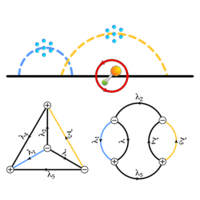
Feynman diagrams represent one of the most powerful techniques of modern many-particle theory. Applying such diagrammatic techniques to many-body processes involving angular momentum is, however, substantially challenging. Here, the authors introduce a diagrammatic approach to the angulon quasiparticle, which consists of an orbital quantum impurity – such as a molecule or electron – exchanging angular momentum with a bath of bosons (superfluid, lattice phonons). The new approach fuses the Feynman diagrams of solid-state physics with the angular momentum diagrams previously used in atomic and nuclear structure calculations.

Zeeman and spin-orbit effects in the Andreev spectra of nanowire junctions

B. van Heck, J. I. Väyrynen, and L. I. Glazman

Phys. Rev. B 96, 075404 (2017) - Published 4 August, 2017

Microwave spectroscopy of a Josephson junction is a useful tool to directly measure the properties of Andreev bound states. Recently, this method has been successfully applied to junctions defined in proximitized InAs/Al nanowires whose realization is aimed at the study and use of Majorana zero modes. In these nanowires, Andreev bound states are sensitive to the interplay of spin-orbit coupling and applied magnetic field. Our theory investigates the evolution of the Andreev levels and of the associated microwave spectrum upon application and increase of magnetic field. The authors find that a drastic change in the spectrum occurs once the magnetic field is strong enough to affect the ground-state parity, which can happen before the topological transition. Besides explaining existing experimental data, the presented theory provides guidance for future experiments, involving the spectroscopic observation of the effects associated with Majorana zero modes.

Simple way to apply nonlocal van der Waals functionals within all-electron methods

Fabien Tran, Julia Stelzl, David Koller, Thomas Ruh, and Peter Blaha

Phys. Rev. B 96, 054103 (2017) - Published 2 August, 2017

Solid-state simulations at the quantum mechanics level are mostly done by means of density functional theory (DFT). With the development of a new type of functionals about a decade ago, the accuracy of DFT for systems with relevant van der Waals interactions increased. These functionals, the so-called van der Waals functionals, have been used extensively by the pseudopotential solid-state community, but, for technical reasons, not by the community that uses all-electron methods. Here, the authors present a very simple way for the implementation of van der Waals functionals within the framework of all-electron methods. At that, the advantages of the algorithm, used in the pseudopotential methods, are preserved. The development should lead to a much more widespread use of the van der Waals functionals in the all-electron community.

Neutron study of in-plane skyrmions in MnSi thin films

S. A. Meynell, M. N. Wilson, K. L. Krycka, B. J. Kirby, H. Fritzsche, and T. L. Monchesky

Phys. Rev. B 96, 054402 (2017) - Published 1 August, 2017

Chiral magnetic thin films have been a recent source of interest due to their ability to stabilize topological magnetic states, known as skyrmions. However, there exists disagreement in the literature over their existence in epitaxial MnSi films, grown on Si(111) substrates. The authors have combined polarized neutron reflectometry and small-angle neutron reflectometry to uncover direct evidence for a unique skyrmion geometry in MnSi/Si(111) films where the core magnetization of the vortex-like magnetic textures points in the plane of the film.

Spin wave propagation in a uniformly biased curved magnonic waveguide

A. V. Sadovnikov, C. S. Davies, V. V. Kruglyak, D. V. Romanenko, S. V. Grishin, E. N. Beginin, Y. P. Sharaevskii, and S. A. Nikitov

Phys. Rev. B 96, 060401(R) (2017) - Published 1 August, 2017

Using a combination of experiment and simulation, the authors have investigated comprehensively how the spin-wave transmission across a curved magnonic waveguide is modified through rotation of an externally delivered uniform magnetic field. They reveal that, while the spin-wave transmission is reasonable when the bend is magnetized along an axis of symmetry, the transmission can be substantially improved (by a factor of 2) through just rotating the magnetic field by 15° in a particular direction. To explain their results, the authors study the landscape of the internal magnetic field spanning the structure, and discuss how it can be tuned in order to optimally distribute the flow of anisotropic spin waves across networks of magnonic waveguides.

Ab initio study of the BaTiO3/Ge interface

Mehmet Dogan and Sohrab Ismail-Beigi

Phys. Rev. B 96, 075301 (2017) - Published 1 August, 2017

Growing thin films of ferroelectric oxides in direct contact with semiconductors is a key research goal due to its technological promise. This work presents a comprehensive theoretical study of ultrathin films of BaTiO3 on Ge. For the experimentally stable interface stoichiometry, there are two distinct interfacial configurations with differing out-of-plane electrical polarizations. The two configurations can be made energetically degenerate by choosing an appropriate top electrode, thus enabling, in principle, an epitaxial ferroelectric thin film oxide. Surprisingly, in the intrinsic limit for Ge, switching the oxide polarization state modulates the band alignments to such a degree that the dominant charge carrier switches between electrons and holes.

Insight into the Dzyaloshinskii-Moriya interaction through first-principles study of chiral magnetic structures

L. M. Sandratskii

Phys. Rev. B 96, 024450 (2017) - Published 31 July, 2017

This work advances a physical picture of the Dzyaloshinskii-Moriya interaction (DMI), capable of addressing the apparently contradicting conclusions of recent studies about the location of the DMI energy in the real and reciprocal space as well as about the relation between the values of atomic moments and DMI strength. It is demonstrated on the example of a Co/Pt bilayer how DMI emerges from the chirality-dependent hybridization of the Co and Pt magnetic-spiral states under the influence of spin-orbit coupling and broken spatial inversion.

Coupling and braiding Majorana bound states in networks defined in two-dimensional electron gases with proximity-induced superconductivity

Michael Hell, Karsten Flensberg, and Martin Leijnse

Phys. Rev. B 96, 035444 (2017) - Published 31 July, 2017

A key challenge in realizing a Majorana-based topological quantum computer is to identify a scalable platform granting easy control over networks of Majorana bound states. A promising candidate is a two-dimensional electron gas with strong spin-orbit coupling and a superconducting layer on top. Here, the authors propose two different ways of defining Majorana networks in these structures and theoretically model the basic network elements. They show that Majoranas can be exchanged (braided) by controlling their coupling with electric gates.

Symmetric operation of the resonant exchange qubit

Filip K. Malinowski, Frederico Martins, Peter D. Nissen, Saeed Fallahi, Geoffrey C. Gardner, Michael J. Manfra, Charles M. Marcus, and Ferdinand Kuemmeth

Phys. Rev. B 96, 045443 (2017) - Published 31 July, 2017

Spin states of a three-electron system can encode one quantum bit in such a way that universal qubit control by voltage pulses becomes possible. In this work, a triple-dot qubit is operated in a highly symmetric charge configuration, using resonant radio-frequency voltage pulses applied to one gate electrode. The authors show that careful symmetrization reduces the susceptibility of the qubit frequency to voltage fluctuations by more than an order of magnitude, compared to conventional triple-dot spin qubits. Combining voltage control with symmetric operating regimes may lead to multiqubit processors based on semiconducting spin qubits that at the same time alleviate decoherence due to electrical noise.

Evidence of a fractional quantum Hall nematic phase in a microscopic model

N. Regnault, J. Maciejko, S. A. Kivelson, and S. L. Sondhi

Phys. Rev. B 96, 035150 (2017) - Published 27 July, 2017

The fractional quantum Hall (FQH) nematic state is a conjectured state of matter in which FQH topological order coexists with spontaneously broken rotation symmetry. Recent experiments on GaAs quantum wells suggest this state, as well as the concomitant isotropic-nematic phase transition, may be realized in a two-dimensional electron gas at certain rational filling factors. Although effective field theories of the FQH nematic state have been constructed, there has been so far no explicit realization of this state as the ground state of a microscopic model of interacting electrons. The authors show via a variational approach and numerical exact diagonalization that tuning Haldane pseudopotentials in a model of interacting electrons in the lowest Landau level induces a quantum phase transition out of the isotropic Laughlin FQH liquid and into the FQH nematic state.

Chirality blockade of Andreev reflection in a magnetic Weyl semimetal

N. Bovenzi, M. Breitkreiz, P. Baireuther, T. E. O'Brien, J. Tworzydło, İ. Adagideli, and C. W. J. Beenakker

Phys. Rev. B 96, 035437 (2017) - Published 26 July, 2017

Conduction electrons in Weyl semimetals move as massless relativistic particles with a definite chirality, meaning that the spin points parallel or antiparallel to the momentum. Such a spin-momentum locking allows for a mechanism to control Cooper-pair transfer at the interface between a magnetic Weyl semimetal and a superconductor. The authors demonstrate that Andreev reflection is fully suppressed when the internal magnetization lies in the plane of the interface. External magnetic field can activate Andreev reflection by relaxing the requirement of zero-spin transfer into the superconductor. The chiralityblockade that the team has discovered provides a phase-insensitive mechanism to control supercurrent. It is also the unique signature of a pseudoscalar superconducting pair potential.

Cheshire charge in (3+1)-dimensional topological phases

Dominic V. Else and Chetan Nayak

Phys. Rev. B 96, 045136 (2017) - Published 25 July, 2017

The authors examine the phenomenon of “Cheshire charge” in topological phases of matter in three spatial dimensions. A looplike excitation is said to carry Cheshire charge if the charge is not locally detectable, that is, it can only be observed by a nonlocal process such as shrinking the loop to a point. The authors show that “Cheshire charge” is a generic feature of three-dimensional topological phases. They relate it to other features of these phases, such as three-loop braiding, as well as to higher-category theory that is hypothesized to be the general mathematical framework describing three-dimensional topological phases.

Spectrum of the Wilson-Fisher conformal field theory on the torus

Seth Whitsitt, Michael Schuler, Louis-Paul Henry, Andreas M. Läuchli, and Subir Sachdev

Phys. Rev. B 96, 035142 (2017) - Published 24 July, 2017

The authors study the finite-size energy spectrum of the O(N) symmetric Wilson-Fisher conformal field theory (CFT) on the spatial torus. They first perform an analytic calculation of the spectrum using the ϵ expansion with a careful treatment of the zero-momentum modes. The authors also perform exact diagonalization on several lattice Hamiltonians whose critical points are known to be described by the Wilson-Fisher CFT. Comparison of the analytic and numerical data demonstrates that the energy spectrum is a useful diagnostic for determining the universality class of a critical point. These results have applications in determining the critical behavior of more complicated many-body systems.

Hall number across a van Hove singularity

Akash V. Maharaj, Ilya Esterlis, Yi Zhang, B. J. Ramshaw, and S. A. Kivelson

Phys. Rev. B 96, 045132 (2017) - Published 24 July, 2017

The high-field Hall number directly measures the carrier density in metals with closed Fermi surfaces. However, no general theorem is known to govern the behavior of the Hall number in systems with open Fermi surfaces or the critical behavior across a Lifshitz transition from a closed to open topology. Using Boltzmann transport theory, the authors derive analytic expressions for the behavior of the Hall number through such a transition, and recent experiments on hole doped cuprate superconductors that suggest a sudden drop of the Hall number below optimal doping are shown to be consistent with a nematicity-induced Lifshitz transition.

Effect of SU(2) symmetry on many-body localization and thermalization

Ivan V. Protopopov, Wen Wei Ho, and Dmitry A. Abanin

Phys. Rev. B 96, 041122(R) (2017) - Published 21 July, 2017

Many-body localization (MBL) enables new nonergodic dynamical phases of matter that avoid the fate of thermalization. Do other ergodicity-breaking phases beyond the MBL paradigm exist? Here, the authors introduce a method for constructing and probing the stability of candidate nonergodic phases. As an example, they consider disordered spin systems, in which a non-Abelian SU(2) symmetry precludes the conventional MBL phase that is characterized by quasilocal integrals of motion and area-law entanglement entropy of eigenstates. Instead, the authors construct a candidate nonergodic phase characterized by eigenstates having logarithmic scaling of entanglement entropy. They find that the phase is only marginally unstable and, therefore, nonthermal yet non-MBL dynamics can be observed in such disordered systems.

Three-dimensional dispersion of spin waves measured in NiO by resonant inelastic x-ray scattering

D. Betto, Y. Y. Peng, S. B. Porter, G. Berti, A. Calloni, G. Ghiringhelli, and N. B. Brookes

Phys. Rev. B 96, 020409(R) (2017) - Published 20 July, 2017

The authors have investigated the dispersion of magnetic excitations in thin films of antiferromagnetic NiO using resonant inelastic x-ray scattering (RIXS) at the L3 edge of nickel. They demonstrate here that, thanks to the recent improvements in energy resolution and scattering geometry, soft x-ray RIXS is a valid complement to inelastic neutron scattering in this field because it allows a clear identification of the spin-wave peaks not only in bulk crystals but also in thin films and heterostructures too small for neutron studies. Moreover, the spin-wave dispersion measured along three high-symmetry directions of the 3D fcc Brillouin zone allows an accurate determination of the main super-exchange integral J′ that establishes the antiferromagnetic structure of NiO. This report demonstrates definitively that RIXS is not confined to 2D materials such as cuprates and can be a useful tool for the study of magnetic interaction in a wide class of 3d transition metal systems.

Sign In to Your Journals Account

Filter

Section

Filter

Article Lookup

Enter a citation