Highlights

Theory of parametrically amplified electron-phonon superconductivity

Mehrtash Babadi, Michael Knap, Ivar Martin, Gil Refael, and Eugene Demler

Phys. Rev. B 96, 014512 (2017) - Published 19 July, 2017

In a periodically driven nonlinear lattice, small lattice deformations are parametrically amplified and the dynamic phonon response function is broadly enhanced. As a consequence, the phonon-mediated electron-electron attraction becomes stronger, allowing Cooper pairs to be formed at higher temperatures.

Nonequilibrium steady states and transient dynamics of conventional superconductors under phonon driving

Yuta Murakami, Naoto Tsuji, Martin Eckstein, and Philipp Werner

Phys. Rev. B 96, 045125 (2017) - Published 19 July, 2017

The optical manipulation of phonon degrees of freedom can change the effective interactions in solids and potentially enhance superconductivity. However, heating and nonthermal energy distributions need to be considered to understand the ultimate effects of such a driving on ordered states. Using nonequilibrium dynamical mean field theory in the Kadanoff-Baym and Floquet implementation, the authors systematically discuss the effects of parametric phonon driving on conventional superconductivity. Both the transient dynamics of isolated systems and the nonequilibrium steady states in driven-dissipative systems are considered. While the phonon-mediated attractive interaction can be enhanced in certain driving regimes because of Floquet phonon sidebands, the heating and nonthermal distribution effects dominate and generically result in a suppression of superconductivity.

Nearly massless Dirac fermions and strong Zeeman splitting in the nodal-line semimetal ZrSiS probed by de Haas–van Alphen quantum oscillations

Jin Hu, Zhijie Tang, Jinyu Liu, Yanglin Zhu, Jiang Wei, and Zhiqiang Mao

Phys. Rev. B 96, 045127 (2017) - Published 19 July, 2017

Topological semimetals harbor relativistic fermions featuring light effective mass, high mobility, and a nontrivial Berry phase. Quantum oscillations are an effective means to probe the properties of relativistic fermions. In the Dirac nodal-line semimetal ZrSiS, the extremely high Dirac fermion density gives rise to very strong de Haas–van Alphen quantum oscillations even at low magnetic fields, by which nearly massless Dirac fermions with surprisingly strong Zeeman effect are revealed.

Relativistic theory of magnetic inertia in ultrafast spin dynamics

Ritwik Mondal, Marco Berritta, Ashis K. Nandy, and Peter M. Oppeneer

Phys. Rev. B 96, 024425 (2017) - Published 18 July, 2017

In the field of ultrafast spin dynamics, magnetic inertia (spin nutation) is considered to hold great promise for achieving ultrafast magnetization switching. However, the fundamental origin of magnetic inertial dynamics is unknown. Here, the authors derive a complete theory of spin dynamics, including magnetic inertia, from fundamental Dirac theory. They show that magnetic inertia exists for any single Dirac particle and that it is a higher-order relativistic spin-orbit coupling effect compared to Gilbert damping. Magnetic inertia is therefore expected to play a role only on an ultrashort subpicosecond timescale.

Rich magnetoelectric phase diagrams of multiferroic single-crystal α−NaFeO2

Noriki Terada, Yuta Ikedo, Hirohiko Sato, Dmitry D. Khalyavin, Pascal Manuel, Atsushi Miyake, Akira Matsuo, Masashi Tokunaga, and Koichi Kindo

Phys. Rev. B 96, 035128 (2017) - Published 17 July, 2017

The authors have studied the multiferroic properties of a triangular lattice magnet with ferromagnetic nearest-neighbor (NN) interactions, using single-crystal α-NaFeO2 grown by hydrothermal synthesis. Despite the ferromagnetic NN interactions, this system exhibits very rich magnetoelectric phase diagrams induced by application of magnetic field. The relationship between complex magnetic ordering and ferroelectric polarization can be explained by the inverse Dzyaloshinskii-Moriya effect. Competition between antiferromagnetic second NN interactions in the triangular lattice plane and weak inter-plane interactions leads to a rich phase diagram for the crystal under study.

Role of commensurability of spin order for optical magnetoelectric effect with electromagnons in multiferroic YMn2O5

R. Masuda, Y. Kaneko, Y. Yamasaki, Y. Tokura, and Y. Takahashi

Phys. Rev. B 96, 041117(R) (2017) - Published 17 July, 2017

Multiferroic phases of materials like YM2O5 feature an optical magnetoelectric effect on the resonance of the electromagnon. The effect manifests itself in nonreciprocal directional dichroism. Here, the authors examine the role of the commensurability of noncollinear spin order for the optical magnetoelectric effect for two types of electromagnon. For the electromagnon driven by the exchange striction, the crucial role of the commensurability is indicated by the suppression of the directional dichroism by the magnetic phase transition. On the other hand, the gapped electromagnon due to the spin-current mechanism is identified by the directional dichroism, regardless of (in)commensurability. These results provide new insights into the light-matter interaction driven by dynamical magnetoelectric coupling.

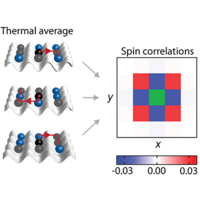
Quantum correlations at infinite temperature: The dynamical Nagaoka effect

Márton Kanász-Nagy, Izabella Lovas, Fabian Grusdt, Daniel Greif, Markus Greiner, and Eugene A. Demler

Phys. Rev. B 96, 014303 (2017) - Published 14 July, 2017

The interplay of quantum correlations and thermal decoherence is key to understanding the fundamental properties of many-body systems. Coherence is usually easily destroyed by interaction with the environment and local fluctuations inherent to thermal ensembles. Hence experimental demonstrations of many-body quantum correlations rely on cooling the system close to its ground state or pumping it into a well-defined quantum state. Here, the authors instead show how quantum correlations can arise in the opposite limit of an infinite temperature. Motivated by recent experiments with ultracold atoms in optical lattices, they study the dynamics of a hole created in a fermionic or bosonic Mott state in the atomic limit. They demonstrate that the propagating hole entangles the surrounding spins leading to sizable and lasting dynamical spin correlations. In the absence of interactions, these correlations arise solely due to quantum interference. Furthermore, they are both ferromagnetic and antiferromagnetic, in contrast to the equilibrium Nagaoka effect.

Multiple topological nontrivial phases in strained HgxCd1−xTe

Tomáš Rauch, Steven Achilles, Jürgen Henk, and Ingrid Mertig

Phys. Rev. B 96, 035124 (2017) - Published 14 July, 2017

Topological phases of multiple bands near the Fermi energy are investigated for strained HgxCd1-xTe, both from a bulk topological invariants and a surface states perspective. The main result of the paper is that nontrivial topology is induced solely by the spin-orbit coupling and not by the sp band inversion. It is obtained through the actual calculation of the topological invariants of individual bands throughout the topological phase diagram. Along with insulating topological phases, Weyl-semimetal phases have also been identified in this material.

Absorption and generation of femtosecond laser-pulse excited spin currents in noncollinear magnetic bilayers

M. L. M. Lalieu, P. L. J. Helgers, and B. Koopmans

Phys. Rev. B 96, 014417 (2017) - Published 13 July, 2017

It it has been found in recent years that a spin current can be generated when a ferromagnetic (FM) thin film is excited with a femtosecond laser pulse. Here, the authors use a noncollinear magnetic bilayer to investigate both the absorption and generation of these optical spin currents. It is demonstrated that the very local absorption of the spin current near the injection interface of a FM layer allows for terahertz spin wave excitation in such noncollinear magnetic bilayers, and advance of much relevance for the upcoming field of ultrafast magnonics.

Inversion of the exciton built-in dipole moment in In(Ga)As quantum dots via nonlinear piezoelectric effect

Johannes Aberl, Petr Klenovský, Johannes S. Wildmann, Javier Martín-Sánchez, Thomas Fromherz, Eugenio Zallo, Josef Humlíček, Armando Rastelli, and Rinaldo Trotta

Phys. Rev. B 96, 045414 (2017) - Published 13 July, 2017

Piezoelectric effects can strongly affect the position and shape of the electron and hole wave functions in compound semiconductors quantum dots (QDs). From the point of view of theoretical semiconductor physics, this is a well-documented notion. From an experimental point of view, however, the extreme sensitivity of the electronic properties of QDs to tiny variations of their shape, size, and composition makes it very challenging to single out the effect of piezoelectricity, which is often neglected in the analysis of experimental data. Here, the authors demonstrate that externally induced piezoelectric fields can be used for wave function engineering and to even force an inversion of the exciton built-in dipole moment in the very same QD. Detailed calculations based on k.p theory disclose that the inversion of the exciton dipole is driven by the nonlinear terms of the piezoelectric fields. These findings shine new light on the role and the possible exploitation of piezoelectric effects in semiconductor QDs.

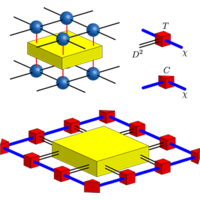
Quantum critical phase with infinite projected entangled paired states

Didier Poilblanc and Matthieu Mambrini

Phys. Rev. B 96, 014414 (2017) - Published 12 July, 2017

Whether two-dimensional tensor networks, such as the so-called projected entangled pair states (PEPS), have the potential to describe a genuine quantum critical point or quantum critical phases separating two ordered phases is of much interest for the understanding of frustrated magnets and strongly correlated systems. Here, the authors identify a specific family of SU(2)-invariant PEPS, which provides excellent variational energies for the J1-J2 frustrated Heisenberg model at large frustration. Using a full-update infinite-PEPS scheme directly in the thermodynamic limit, the authors provide evidence of diverging correlation lengths in both the singlet and triplet channels. It is argued that such PEPS give a qualitative description of the critical point or critical phase of the J1-J2 model.

Information propagation in isolated quantum systems

David J. Luitz and Yevgeny Bar Lev

Phys. Rev. B 96, 020406(R) (2017) - Published 12 July, 2017

How fast does quantum information spread in isolated quantum systems? The authors address this question using out-of-time order correlation functions and find that information spreads behind a power law front in disordered spin chains, with a characteristic exponent, which is related to the exponent of the power law growth of the entanglement entropy. The authors also observe that disorder inhibits information spreading and leads to unsaturated Lieb-Robinson bounds.

Interacting nodal-line semimetal: Proximity effect and spontaneous symmetry breaking

Bitan Roy

Phys. Rev. B 96, 041113(R) (2017) - Published 12 July, 2017

The nodal-line semimetal stands out as a paradigmatic representative of a gapless topological phase of matter that supports linearly dispersing quasiparticles around an isolated closed loop in the bulk and accommodates drumhead shaped surface states. The author demonstrates an intriguing possibility of realizing either charge or spin order on the surface of this system for arbitrarily weak Coulomb repulsion. When onsite Hubbard repulsion dominates, each surface becomes ferromagnetic with its moment pointing in opposite directions on complementary faces, which yields a global antiferromagnet. As shown numerically, surface ordering via proximity effect can in turn induce charge or spin order in the bulk at weak coupling, making the proposed scenario for spontaneous symmetry breaking relevant for materials, such as Ca3P2 and PbTaSe2, specifically in a thin-film geometry.

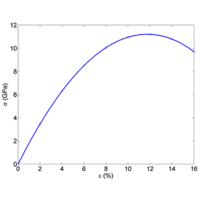
Ideal strength and ductility in metals from second- and third-order elastic constants

Maarten de Jong, Ian Winter, D. C. Chrzan, and Mark Asta

Phys. Rev. B 96, 014105 (2017) - Published 10 July, 2017

Idealstrength is a fundamental property describing the upper bound on a material’s strength in the absence of crystal defects. Similarly, the nature of the failure at the ideal strength can be related to the intrinsicductility of metals and alloys. In this work, analytical expressions are derived for the ideal strength and intrinsic ductility with knowledge of only the second-order and third-order elastic constants. This analytical approach greatly improves the fundamental understanding of mechanical behavior in advanced materials.

Tunable quasiparticle band gap in few-layer GaSe/graphene van der Waals heterostructures

Zeineb Ben Aziza, Debora Pierucci, Hugo Henck, Mathieu G. Silly, Christophe David, Mina Yoon, Fausto Sirotti, Kai Xiao, Mahmoud Eddrief, Jean-Christophe Girard, and Abdelkarim Ouerghi

Phys. Rev. B 96, 035407 (2017) - Published 7 July, 2017

Two-dimensional few-layered materials exhibit unique and exotic electronic properties when compared to their bulk counterparts. Here, the authors report the role of dimensionality on the electronic properties of a van der Waals GaSe/graphene heterostructure. The strong thickness dependence of the GaSe band gap is demonstrated experimentally using scanning tunneling spectroscopy. The GaSe band gap decreases as the number of layers increases due to quantum confinement effects. The particular GaSe ‘Mexican hat’ band structure is further explored by angle-resolved photoemission spectroscopy and by theoretical calculations. Interestingly, an electron transfer from graphene to GaSe has also been detected. It results in n-type doped thin GaSe films, opposite to the p-type character GaSe bulk.

Nonequilibrium spin transport in integrable spin chains: Persistent currents and emergence of magnetic domains

Andrea De Luca, Mario Collura, and Jacopo De Nardis

Phys. Rev. B 96, 020403(R) (2017) - Published 6 July, 2017

The nonequilibrium dynamics of isolated many-body quantum systems leads generically to the emergence of standard thermal ensembles. However, some models, denoted as integrable, can display nontrivial steady states with a large memory of the initial state. This is due to the presence of conserved quantities constraining the unitary dynamics. Here, the authors show that in interacting integrable spin chains there exist also conserved operators that are responsible for ballistic spin transport. Such conserved operators highly influence both the equilibrium and nonequilibrium physics: at equilibrium they are responsible for a nonvanishing spin Drude weight even at half filling, while in the nonequilibrium case they are responsible for out-of-equilibrium steady states characterized by persistent spin currents or dynamically expanding magnetic domains.

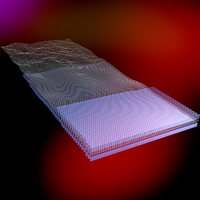
Suppression of intrinsic roughness in encapsulated graphene

Joachim Dahl Thomsen, Tue Gunst, Søren Schou Gregersen, Lene Gammelgaard, Bjarke Sørensen Jessen, David M. A. Mackenzie, Kenji Watanabe, Takashi Taniguchi, Peter Bøggild, and Timothy J. Booth

Phys. Rev. B 96, 014101 (2017) - Published 5 July, 2017

Carrier mobility in graphene can be degraded by roughness. Here, the authors have measured the roughness of a suspended graphene layer encapsulated with hexagonal boron nitride (hBN) by diffraction in the transmission electron microscope. The 12-pm roughness measured is close to that found for carbon atoms within graphite. The simulations here show that encapsulation localizes flexural phonons in the hBN layers, leading to a suppression of roughness in the graphene. These results could lead to new strategies for device fabrication in applications requiring ultimately high performance, and show that layer roughness in artificially fabricated van der Waals heterostructures approaches that in naturally occurring bulk crystals.

Disorder and superfluid density in overdoped cuprate superconductors

N. R. Lee-Hone, J. S. Dodge, and D. M. Broun

Phys. Rev. B 96, 024501 (2017) - Published 5 July, 2017

One of the hallmarks of clean, d-wave superconductivity is a linear temperature dependence of superfluid density in the low-temperature limit. Here, the authors show that weak scattering, combined with a realistic model of the cuprate Fermi surface, allows the linear behavior of superfluid density to persist in the presence of disorder even in the regime where the superfluid density and the transition temperature are strongly suppressed from their clean-limit values. This leads to a superfluid density that is both correlated with the transition temperature and linear in temperature, consistent with recent experiments on overdoped La2-xSrxCuO4.

Optical and magnetic measurements of gyroscopically stabilized graphene nanoplatelets levitated in an ion trap

Pavel Nagornykh, Joyce E. Coppock, Jacob P. J. Murphy, and B. E. Kane

Phys. Rev. B 96, 035402 (2017) - Published 5 July, 2017

The authors present magnetic moment measurements of a levitated graphene nanoplatelet, observing two mechanisms of interaction with a magnetic field, one diamagnetic and one due to the particle’s rotation. These observations are made possible by gyroscopically stabilizing the nanoplatelet using radio-frequency electric fields, achieving control of the rotation frequency up to 100 MHz while it is held in an electric field trap at high vacuum. Levitation avoids substrate effects and clamping losses entirely, while gyroscopic stabilization provides unparalleled torque sensitivity. The method is expected to be generalizable to other two-dimensional materials and nanoparticles and may be incorporated into optomechanics experiments.

Nontrivial Berry phase and type-II Dirac transport in the layered material PdTe2

Fucong Fei, Xiangyan Bo, Rui Wang, Bin Wu, Juan Jiang, Dongzhi Fu, Ming Gao, Hao Zheng, Yulin Chen, Xuefeng Wang, Haijun Bu, Fengqi Song, Xiangang Wan, Baigeng Wang, and Guanghou Wang

Phys. Rev. B 96, 041201(R) (2017) - Published 5 July, 2017

Recently, the picture of type-II energy dispersion with broken Lorentz invariance has been adapted from Weyl to Dirac fermions. It is demonstrated in PdTe2 in this paper by extensive evidence from electrical transport, de Haas–van Alphen oscillations, first-principles calculations, and angle-resolved photoemission spectroscopy. The type-II Dirac cone looks like a pinnacle in momentum space. It may be cut by the Fermi level with the result of a pair of Dirac pockets (of p/n type), whose sizes change dramatically with the Fermi level. The nontrivial Berry phase of the hole pocket is also displayed. This also means a nonvanishing density of states in the whole Dirac cones, which makes PdTe2 an improved platform for possible topological superconductors and Majorana fermions

Sign In to Your Journals Account

Filter

Section

Filter

Article Lookup

Enter a citation