Highlights

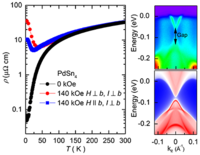
Extremely large magnetoresistance and Kohler's rule in PdSn4: A complete study of thermodynamic, transport, and band-structure properties

Na Hyun Jo, Yun Wu, Lin-Lin Wang, Peter P. Orth, Savannah S. Downing, Soham Manni, Dixiang Mou, Duane D. Johnson, Adam Kaminski, Sergey L. Bud'ko, and Paul C. Canfield

Phys. Rev. B 96, 165145 (2017) - Published 27 October, 2017

A new type of a topological quantum structure was identified recently in PtSn4 as a Dirac node arc feature on the surface. More importantly, PtSn4 shows extremely large magnetoresistance (XMR). PdSn4 is isostructural with PtSn4 and has the same electron count. By comparing these similar compounds, the authors address the problem about the origin of the XMR in them and establish that neither the carrier compensation nor the Dirac node arc surface state can be the primary reason for it. On the other hand, Kohler’s rule scaling is fulfilled over the entire range of temperatures and field strengths that are explored here.

Switching the chirality of a ferroelectric vortex in designed nanostructures by a homogeneous electric field

Le Van Lich, Takahiro Shimada, Jie Wang, Van-Hai Dinh, Tinh Quoc Bui, and Takayuki Kitamura

Phys. Rev. B 96, 134119 (2017) - Published 25 October, 2017

Nanometer-scale ferroelectric vortex that is characterized by a curling polarization around a core is regarded as a new state of matter. The control of vortex chirality by homogeneous electric field is a key to the utilization of vortices in technological applications, but remains elusive since the toroidal moment of a ferroelectric vortex is conjugate to a curled electric field rather than to a homogeneous one. Here, the authors design free-standing nanodots with rational nanostructures and demonstrate using phase-field modelling that the chirality of the polarization vortex in such designed nanodots is deterministically switched by a homogeneous electric field.

New class of flat-band models on tetragonal and hexagonal lattices: Gapped versus crossing flat bands

Tatsuhiro Misumi and Hideo Aoki

Phys. Rev. B 96, 155137 (2017) - Published 25 October, 2017

There is an increasing fascination centered on superconductivity and topological properties with bands that are flat due to quantum mechanical interference. An important question remains: can we actually control the energy of the flat band against the dispersive ones? Here, the authors have constructed classes of models in two (or higher) dimensions in a systematic extension of the known flat bands, where the controllability provides a flat band with a tunable gap, or a flat band that pierces right through the dispersive one. While the former may favor ferromagnetism, the latter is expected to favor high-Tc superconductivity through virtual pair hopping from dispersive to flat bands.

Entanglement renormalization for disordered systems

Andrew M. Goldsborough and Glen Evenbly

Phys. Rev. B 96, 155136 (2017) - Published 24 October, 2017

Tensor network states have proven to be powerful tools for investigating quantum many-body systems. Here, the authors propose a tensor network method, based on an adaptation of entanglement renormalization, for investigating strongly disordered systems. The method makes use of the strong disorder renormalization group to determine the order in which lattice sites are coarse grained, which sets the overall structure of the corresponding tensor network ansatz, before optimization using variational energy minimization. This approach leads to a new class of efficiently contractible tensor network ansatz for 1D systems, which may be understood as a generalization of the multiscale entanglement renormalization ansatz for disordered systems.

Symmetry-adapted order parameters and free energies for solids undergoing order-disorder phase transitions

Anirudh Raju Natarajan, John C. Thomas, Brian Puchala, and Anton Van der Ven

Phys. Rev. B 96, 134204 (2017) - Published 23 October, 2017

Order-disorder phase transitions are common in a wide range of materials and are exploited in many technological applications. A key challenge in developing predictive mesoscale models for these materials lies in constructing rigorous first-principles based thermodynamic descriptions. In this study, the authors develop a general formalism to generate order parameters for any crystal structure and alloy ordering. Furthermore, they describe a thermodynamic and statistical mechanics framework to determine the free energy as a function of order parameters. The methods described here are broadly applicable to any multicomponent crystalline solid and provide the first step in generating truly abinitio multiscale models.

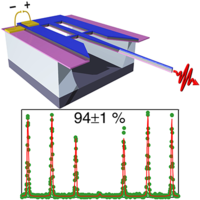
Indistinguishable and efficient single photons from a quantum dot in a planar nanobeam waveguide

Gabija Kiršanskė, Henri Thyrrestrup, Raphaël S. Daveau, Chris L. Dreeßen, Tommaso Pregnolato, Leonardo Midolo, Petru Tighineanu, Alisa Javadi, Søren Stobbe, Rüdiger Schott, Arne Ludwig, Andreas D. Wieck, Suk In Park, Jin D. Song, Andreas V. Kuhlmann, Immo Söllner, Matthias C. Löbl, Richard J. Warburton, and Peter Lodahl

Phys. Rev. B 96, 165306 (2017) - Published 19 October, 2017

Planar photonic technology provides a highly promising route of creating an on-chip and on-demand source of single photons, which can be scaled into photonic circuitry. While self-assembled quantum dots have been proven to be excellent coherent single-photon emitters in many microscale structures, in nanoscale devices the photon coherence can be compromised due to the nearby surfaces. Here, the authors achieve 94% indistinguishability of photons emitted from a nanoscale photonic waveguide under p-shell excitation.

Bulk Fermi surface of the Weyl type-II semimetallic candidate γ−MoTe2

D. Rhodes, R. Schönemann, N. Aryal, Q. Zhou, Q. R. Zhang, E. Kampert, Y.-C. Chiu, Y. Lai, Y. Shimura, G. T. McCandless, J. Y. Chan, D. W. Paley, J. Lee, A. D. Finke, J. P. C. Ruff, S. Das, E. Manousakis, and L. Balicas

Phys. Rev. B 96, 165134 (2017) - Published 17 October, 2017

The electronic structure of WTe2 and of orthorhombic γ-MoTe2 are theoretically claimed to contain pairs of Weyl type-II points associated with linearly touching electron and hole pockets. A series of recent angle-resolved photoemission spectroscopy (ARPES) experiments claims to observe general agreement with these predictions. Here, the authors report a de Haas–van Alphen study on γ-MoTe2 which, in contrast to ARPES and predictions, finds a simpler and more isotropic Fermi surface. Upon the guidance of ARPES, they show here that it is possible to explain the observed Fermi surface geometry by an independent displacement of the theoretical electron and hole bands relative to the Fermi level. However, this ad hoc procedure, previously used by a number of groups, suppresses the crossings between electron and hole bands and hence the predicted Weyl type-II points.

Fluctuations in a model ferromagnetic film driven by a slowly oscillating field with a constant bias

Gloria M. Buendía and Per Arne Rikvold

Phys. Rev. B 96, 134306 (2017) - Published 13 October, 2017

Ferromagnets perturbed by time-dependent fields are technologically important examples of nonequilibrium physics. Using kinetic Monte Carlo simulations and droplet theory of magnetization reversal, the authors explain recent experiments on ordered uniaxial ferromagnetic films driven by oscillating fields. The associated dynamic phase transition at a critical field period is known to be in the equilibrium Ising universality class. Consistent with experiments, the authors find that the response to a constant bias field in the supercritical period limit differs from an equilibrium ferromagnet above criticality in that, instead of a wide central susceptibility maximum, side bands are observed, which are shown to result from stochastic resonance.

Periodic table for Floquet topological insulators

Rahul Roy and Fenner Harper

Phys. Rev. B 96, 155118 (2017) - Published 13 October, 2017

Periodically driven systems have recently been shown to host topological phases that are inherently dynamical in character, opening up a new arena in which to explore topological physics. One important group of such phases, known as Floquet topological insulators, arise in systems of free fermions and exhibit protected topological edge modes analogous to the edge modes of static topological insulators. In this work, the authors use methods from K theory to provide a complete topological classification of Floquet topological phases of this kind. The main result is a periodic table for Floquet topological insulators, which may be viewed as a time-dependent extension of the periodic table of topological insulators and superconductors originally introduced by Alexei Kitaev.

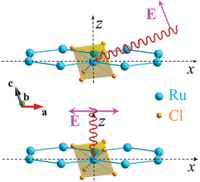
Electronically highly cubic conditions for Ru in α−RuCl3

S. Agrestini, C.-Y. Kuo, K.-T. Ko, Z. Hu, D. Kasinathan, H. B. Vasili, J. Herrero-Martin, S. M. Valvidares, E. Pellegrin, L.-Y. Jang, A. Henschel, M. Schmidt, A. Tanaka, and L. H. Tjeng

Phys. Rev. B 96, 161107(R) (2017) - Published 12 October, 2017

α-RuCl3 is the most promising candidate for the long-sought materialization of the Kitaev model, where compasslike exchange interactions lead to a gapless spin liquid with emergent Majorana fermion excitations. Prerequisite for these expectations is that the symmetry-imposed noncubic crystal field is smaller compared to the spin-orbit coupling and does not perturb significantly the description of the electronic ground state in terms of the Jeff = 1/2 state. Here, the authors combine polarization-dependent x-ray absorption spectroscopy, a technique that gives direct access to the crystal field of a material, and full multiplet calculations to determine the size and sign of the noncubic crystal-field splitting. The results demonstrate that the “electronically cubic conditions” and the Jeff = 1/2 ground state for Ru in α-RuCl3 are fulfilled.

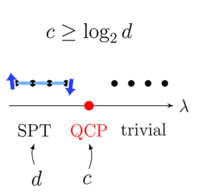
One-dimensional symmetry protected topological phases and their transitions

Ruben Verresen, Roderich Moessner, and Frank Pollmann

Phys. Rev. B 96, 165124 (2017) - Published 12 October, 2017

The authors present a unified perspective on a large class of one-dimensional symmetry-protected topological phases. Characterizing critical points between such phases leads to a conjecture of a topological lower bound on the central charge in terms of the phase-specific edge mode dimension.

Multiband k·p theory of monolayer XSe (X=In,Ga)

Ma Zhou, Rui Zhang, Jiangpeng Sun, Wen-Kai Lou, Dong Zhang, Wen Yang, and Kai Chang

Phys. Rev. B 96, 155430 (2017) - Published 11 October, 2017

Multiband k⋅p Hamiltonians near the high symmetric points in the Brillouin zones of two-dimensional (2D) materials are widely used to predict and understand the unique transport and optical properties of 2D materials. Based on the crystal symmetry of 2D materials, the authors develop a multiband k⋅p Hamiltonian for monolayer GaSe and InSe using the theory of invariants. The authors establish the relationship between the crystal lattice symmetry and the Hamiltonian matrix elements, accounting for spin-orbit interaction and strain. The work provides a systematic way to construct the relevant multiband k⋅p Hamiltonian for various monolayer and few-layer materials.

First-principles electron transport with phonon coupling: Large scale at low cost

Tue Gunst, Troels Markussen, Mattias L. N. Palsgaard, Kurt Stokbro, and Mads Brandbyge

Phys. Rev. B 96, 161404(R) (2017) - Published 11 October, 2017

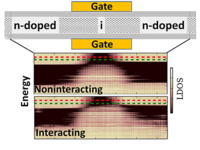
Phonon-assisted tunneling plays a crucial role in sub-10-nanometer gate-length devices. Here, the authors present a first-principles special thermal displacement method that bridges the models used independently in molecular electronics and in device simulations. The method is conceptually simple and much more efficient than any existing first-principles transport method, enabling modeling of realistic rectifiers and transistors with account of electron-phonon coupling. The results are in excellent agreement with both experiments and state-of-the-art perturbation theory calculations discussed in the paper, demonstrating that the method is an appealing design tool for next-generation devices and nanomaterials.

Photoemission study of the electronic structure of valence band convergent SnSe

C. W. Wang, Y. Y. Y. Xia, Z. Tian, J. Jiang, B. H. Li, S. T. Cui, H. F. Yang, A. J. Liang, X. Y. Zhan, G. H. Hong, S. Liu, C. Chen, M. X. Wang, L. X. Yang, Z. Liu, Q. X. Mi, G. Li, J. M. Xue, Z. K. Liu, and Y. L. Chen

Phys. Rev. B 96, 165118 (2017) - Published 10 October, 2017

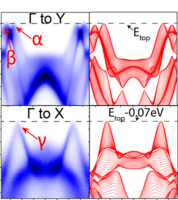
Monocrystalline SnSe, which is a binary semiconductor, has recently been demonstrated to be a high-performance thermoelectric material with a record-high figure of merit of 2.6 at high temperature (923 K). Using angle-resolved photoemission spectroscopy, the authors probed the full electronic structure of SnSe. They observed three convergent hole bands with small energy differences in their band tops and relatively small in-plane effective masses, in agreement with ab initio calculations. These bands are critical for the enhancement of the Seebeck coefficient, while preserving the high electrical conductivity of the material. Thus, they represent a key factor contributing to the high figure of merit in SnSe.

Dual gauge field theory of quantum liquid crystals in three dimensions

Aron J. Beekman, Jaakko Nissinen, Kai Wu, and Jan Zaanen

Phys. Rev. B 96, 165115 (2017) - Published 9 October, 2017

Quantum liquid crystals are strongly correlated quantum many-body systems with broken rotational symmetry but with partial or complete translational symmetry. Inspired by the classical theory for hexatic liquid crystals, which deals with the thermal unbinding of dislocations in 2D solids, the present work advances the idea that 3D solids can melt quantum mechanically via unbinding, or rather Bose-Einstein condensation, of dislocation worldsheets, resulting in quantum analogs of nematic, smectic, and columnar liquid crystals. In these phases, the phonons, as represented by two-form dual gauge fields, develop a mass gap reflecting the loss of shear rigidity.

Two mechanisms of disorder-induced localization in photonic-crystal waveguides

P. D. García, G. Kiršanskė, A. Javadi, S. Stobbe, and P. Lodahl

Phys. Rev. B 96, 144201 (2017) - Published 6 October, 2017

The development of nanoscale optical devices requires high-quality nanocavities to mediate the optical feedback. Any fabrication method will generate imperfections that may induce light loss, limiting the device performance. However, in some cases such disorder may enable new functionalities as, for example, in state-of-the art photonic-crystal waveguides where localization originates from the random multiple scattering of light. Understanding the different mechanisms leading to this type of localization is crucial to exploit disorder as a resource as well as to design structures which are more robust against disorder.

Crystalline Kitaev spin liquids

Masahiko G. Yamada, Vatsal Dwivedi, and Maria Hermanns

Phys. Rev. B 96, 155107 (2017) - Published 6 October, 2017

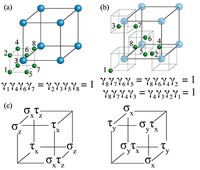
Three-dimensional Kitaev models – generalizations of the well known exactly solvable Kitaev honeycomb model – exhibit a rich variety of quantum spin liquid phases. Their fractionalized excitations are Majorana fermions that may form topological band structures. These can be enriched by lattice symmetries, as shown in the present work. In particular, the authors propose two new instances of Kitaev spin liquids that exhibit nodal chains and 3D Dirac nodes in the bulk. Such crystalline Kitaev spin liquids are direct generalizations of crystalline topological insulators, albeit in an interacting spin system. A potential material realization in metal-organic frameworks is also discussed.

Magnetic ground state of the Ising-like antiferromagnet DyScO3

L. S. Wu, S. E. Nikitin, M. Frontzek, A. I. Kolesnikov, G. Ehlers, M. D. Lumsden, K. A. Shaykhutdinov, E.-J. Guo, A. T. Savici, Z. Gai, A. S. Sefat, and A. Podlesnyak

Phys. Rev. B 96, 144407 (2017) - Published 5 October, 2017

Orthorhombic perovskites provide a perfect playground for investigations of novel magnetic phenomena, such as ferroelectricity, ultrafast spin reorientation, colossal magnetoresistance, and many others. Here, the authors combined magnetization and neutron scattering measurements with crystalline electrical field calculations to characterize the magnetic properties of a DyScO3 single crystal. They establish that Dy moments have a strong Ising-like single-ion anisotropy with a doublet ground state and an enormous value of effective moment. This results in a significant dipolar interaction, which strongly suppresses conventional transverse fluctuations and makes magnetic excitations invisible to neutron spectroscopy.

Effect of edge plasmons on the optical properties of MoS2 monolayer flakes

Tuomas P. Rossi, Kirsten T. Winther, Karsten W. Jacobsen, Risto M. Nieminen, Martti J. Puska, and Kristian S. Thygesen

Phys. Rev. B 96, 155407 (2017) - Published 5 October, 2017

The electronic edge states of MoS2 nanoparticles are important for the catalytic activity of the particles and could also have potential for photocatalysis. Here, the authors explore computationally optical properties of MoS2 monolayer nanoflakes. These nanostructures show a rich size-dependent optical response below the absorption onset of the infinite monolayer. The authors present a detailed analysis of the emerging optical absorption resonances revealing their edge-state origins. In particular, metallic edge states support localized edge plasmons, and overall, resonances are sensitive to changes in the edge-atom configuration.

Fractons from partons

Timothy H. Hsieh and Gábor B. Halász

Phys. Rev. B 96, 165105 (2017) - Published 5 October, 2017

Fracton phases are three dimensional topological phases in which quasiparticle excitations are restricted to move along planes, lines, or not to move at all. In this work, we show how such phases can be understood in terms of parton constructions, and in the process we find a new type-II model with fractal logical operators.

Sign In to Your Journals Account

Filter

Section

Filter

Article Lookup

Enter a citation