Highlights

Direct visualization of phase separation between superconducting and nematic domains in Co-doped CaFe2As2 close to a first-order phase transition

Antón Fente, Alexandre Correa-Orellana, Anna E. Böhmer, Andreas Kreyssig, S. Ran, Sergey L. Bud'ko, Paul C. Canfield, Federico J. Mompean, Mar García-Hernández, Carmen Munuera, Isabel Guillamón, and Hermann Suderow

Phys. Rev. B 97, 014505 (2018) - Published 9 January, 2018

Many structural phase transitions are of first order, and many superconducting transitions are of second order. Some iron-based materials have a first-order (magneto)structural phase transition and then cross over to a superconducting phase at low temperatures. Using nanoscale imaging, the authors show that this results in separated superconducting and normal regions, each showing a different crystalline structure. In systems having different crystalline phases, it can be energetically favorable to separate a superconductor into patches.

Quantum anomalous Hall state from spatially decaying interactions on the decorated honeycomb lattice

Mengsu Chen, Hoi-Yin Hui, Sumanta Tewari, and V. W. Scarola

Phys. Rev. B 97, 035114 (2018) - Published 9 January, 2018

The quantum anomalous Hall effect can, in principle, be driven entirely by interparticle interactions into a new phase of matter called the topological Mott insulator. Calculations to date have shown that this effect can arise in simple models only when the interaction strength between particles is not spatially decaying. Such interactions are typically unphysical. Here, the authors study particles in a decorated honeycomb lattice to find that spatially decaying interactions do in fact lead to a topological Mott insulator with a quantum anomalous Hall effect. The results set the stage for realizing interaction-driven topological effects in quantum matter.

Bethe-Boltzmann hydrodynamics and spin transport in the XXZ chain

Vir B. Bulchandani, Romain Vasseur, Christoph Karrasch, and Joel E. Moore

Phys. Rev. B 97, 045407 (2018) - Published 8 January, 2018

The anomalous nature of spin transport in the XXZ quantum spin chain has been a topic of theoretical interest for some time. Here, the integrability of the underlying dynamics leads to a ballistic component of the spin current, characterized by a spin Drude weight, which measures the degree of divergence of the zero-frequency spin conductivity. However, this quantity had previously proven to be beyond the reach of standard Bethe ansatz techniques. Here, the authors show that a recently developed hydrodynamic formalism for quantum integrable models may be used to compute the spin Drude weight. They also propose a numerical scheme to obtain hydrodynamic predictions for finite-time energy transport. This suggests that the hydrodynamic approach captures completely the ballistic component that dominates transport at long times and distances in the gapless regime of the XXZ model.

Direct evidence for cycloidal modulations in the thermal-fluctuation-stabilized spin spiral and skyrmion states of GaV4S8

J. S. White, Á. Butykai, R. Cubitt, D. Honecker, C. D. Dewhurst, L. F. Kiss, V. Tsurkan, and S. Bordács

Phys. Rev. B 97, 020401(R) (2018) - Published 5 January, 2018

It was recently proposed that multiferroic GaV4S8 hosts a new Néel-type of magnetic skyrmion lattice in its bulk, though direct microscopic experimental evidence of this type of skyrmion state has been absent up to now. By using polarized small-angle neutron scattering, the authors show unambiguously that the spins twist cycloidally in all modulated phases of GaV4S8, consistent with that expected for Néel-type skyrmions. In a further contrast to any other skyrmion host material, all of the spiral and skyrmion phases in GaV4S8 are shown to be stable only at finite temperature due to a delicate interplay between thermal agitation and a strong magnetic anisotropy.

Gauge field entanglement in Kitaev's honeycomb model

Balázs Dóra and Roderich Moessner

Phys. Rev. B 97, 035109 (2018) - Published 5 January, 2018

A spin fractionalizes into matter and gauge fermions in the Kitaev spin liquid on the honeycomb lattice, which is topologically ordered for certain parameters. To what extent does only one constituent of a fractionalized topological system signal the existence of topological order? To answer this, the authors focus on the reduced density matrix of the gauge sector on a cylinder after tracing out the matter degrees of freedom. The ensuing gauge entanglement Hamiltonian contains infinitely long-range correlations along the symmetry axis of the cylinder. Rather small correctly chosen gauge partitions can still account for the topological entanglement entropy in spite of long-range correlations in the gauge entanglement Hamiltonian.

Phase-driven collapse of the Cooper condensate in a nanosized superconductor

Alberto Ronzani, Sophie D'Ambrosio, Pauli Virtanen, Francesco Giazotto, and Carles Altimiras

Phys. Rev. B 96, 214517 (2017) - Published 29 December, 2017

The phase degree of freedom is a core property of the superconducting state, intimately linked to its coherent yet macroscopic nature. The authors directly observe evidence of a complete suppression of the superconducting energy gap in a nanosized aluminum wire upon subjecting the latter to an appropriate phase gradient by means of a micro-interferometer. They exploit the sharp magnetic response obtained with the design to realize ultrasensitive magnetic flux detectors.

Two-dimensional Dirac semimetal phase in undoped one-monolayer FeSe film

S. Kanayama, K. Nakayama, G. N. Phan, M. Kuno, K. Sugawara, T. Takahashi, and T. Sato

Phys. Rev. B 96, 220509(R) (2017) - Published 29 December, 2017

In the one-monolayer FeSe film on SrTiO3, which is a new member of high-temperature superconductor family, there exists two competing proposals on the nature of the ground state in the parent undoped film: strongly correlated insulator (as in copper-oxide superconductors) versus moderately correlated metal (as in iron-based superconductors). Here, the authors provide experimental evidence for the metallic nature by performing in situ angle-resolved photoemission spectroscopy on an undoped one-monolayer FeSe film prepared by careful post-growth annealing. The authors demonstrate the materialization of an ideal two-dimensional Dirac electron system, where only the Dirac-cone band crosses the Fermi level, unlike in the multilayer counterpart.

Superconductivity in three-dimensional spin-orbit coupled semimetals

Lucile Savary, Jonathan Ruhman, Jörn W. F. Venderbos, Liang Fu, and Patrick A. Lee

Phys. Rev. B 96, 214514 (2017) - Published 28 December, 2017

The discovery of superconductivity in the j=32 spin-orbit coupled half-Heusler semimetals has given the field of low-density superconductivity a new twist. Exotic pairings are likely, yet the favored superconducting instabilities remain to be determined. The authors provide a method to analyze superconductivity in systems with symmetry-protected band touchings. They apply it to j=32 systems to find that polar phonons play an important role in the superconducting mechanism of the half-Heusler compounds. They also explicitly show a number of new features associated with such band structures, such as the strong dependence on hole or electron doping in the determination of the leading odd-parity superconducting instability.

Spin-triplet supercurrent in Josephson junctions containing a synthetic antiferromagnet with perpendicular magnetic anisotropy

Joseph A. Glick, Samuel Edwards, Demet Korucu, Victor Aguilar, Bethany M. Niedzielski, Reza Loloee, W. P. Pratt, Jr., Norman O. Birge, P. G. Kotula, and N. Missert

Phys. Rev. B 96, 224515 (2017) - Published 28 December, 2017

Conversion of conventional spin-singlet Cooper pairs into spin-triplet pairs inside a Josephson junction enables supercurrent to propagate over long distances through ferromagnetic materials. Several groups have shown how to turn the spin-triplet supercurrent on or off by varying the relative orientations of the magnetizations in multiple ferromagnetic layers inside the junction. This paper introduces a new magnetic configuration involving a synthetic antiferromagnet (SAF) with perpendicular magnetic anisotropy (PMA) that can be patterned into nanomagnets with very low stray fields. The authors suggest that this configuration will enable the controlled manipulation of the ground-state phase shift across the spin-triplet Josephson junctions to be either 0 or π.

Exciton lifetime and emission polarization dispersion in strongly in-plane asymmetric nanostructures

M. Gawełczyk, M. Syperek, A. Maryński, P. Mrowiński, Ł. Dusanowski, K. Gawarecki, J. Misiewicz, A. Somers, J. P. Reithmaier, S. Höfling, and G. Sęk

Phys. Rev. B 96, 245425 (2017) - Published 27 December, 2017

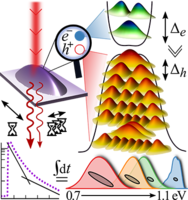
The authors investigate theoretically and experimentally epitaxial nanostructures offering a full range of confinement regimes for excitons due to controlled cross-sectional sizes and strong variation in the elongation of the nanosize objects - from strong through intermediate to weak confinement. It is demonstrated that the symmetry breaking leads to significantly slower recombination in one of the bright states of the excitonic fine structure. The respective components are detected in time-resolved decays of unpolarized photoluminescence,which allows a full characterization of the exciton states, including their intrinsic polarization properties.

Mesoscopic pairing without superconductivity

Johannes Hofmann

Phys. Rev. B 96, 220508(R) (2017) - Published 26 December, 2017

The author provides a full theoretical description of current transport in finite-size superconductors with variable attractive pairing interaction. The solution shows an intricate interplay between strong quantum fluctuations induced by the finite system size and the interaction strength, which tunes a BEC-BCS crossover. The results explain a recent experiment on mesoscopic superconducting semiconductor nanowires and point the way to a systematic understanding of mesoscopic fluctuations in superconductors. In particular, the study identifies the first experimental detection of a fundamental quantity in mesoscopic superconductivity, the parity parameter.

Revisiting Cu63 NMR evidence for charge order in superconducting La1.885Sr0.115CuO4

T. Imai, S. K. Takahashi, A. Arsenault, A. W. Acton, D. Lee, W. He, Y. S. Lee, and M. Fujita

Phys. Rev. B 96, 224508 (2017) - Published 26 December, 2017

Until recently, many authors remained skeptical about the presence of charge order in superconducting cuprates. As early as 1999, Hunt et al. [Phys. Rev. Lett. 82, 4300] demonstrated that superconducting La1.885Sr0.115CuO4 (Tc=30 K) shares nearly identical, peculiar NMR anomalies observed at the charge order transition of Nd codoped La1.48Nd0.4Sr0.12CuO4 (suppressed Tc=6 K). In particular, 63Cu NMR signals gradually disappear in the charge ordered state. Where did the wiped out 63Cu NMR signals go? The authors here take full advantage of advancements in the instrumental technologies of NMR over the last two decades, and finally solve this mystery.

Magnetic shape-memory effect in SrRuO3

S. Kunkemöller, D. Brüning, A. Stunault, A. A. Nugroho, T. Lorenz, and M. Braden

Phys. Rev. B 96, 220406(R) (2017) - Published 21 December, 2017

The magnetic shape-memory effect – magnetic-field-induced plastic deformations that return to the initial shape upon heating – is intensively studied in intermetallic Heusler materials. Here, the authors see this effect for the metallic oxide SrRuO3, which exhibits a structural phase transition at high temperature and ferromagnetic ordering at six times a lower temperature. Neutron diffraction and macroscopic analyses on SrRuO3 single crystals show that moderate magnetic fields induce strong structural deformations resulting from the rearrangement of structural domains. The shape-memory effect is observed by modest heating to the paramagnetic phase, where the initial arrangement of structural domains already recovers, although the temperature remains well below the structural phase transition.

Spin injection and detection via the anomalous spin Hall effect of a ferromagnetic metal

K. S. Das, W. Y. Schoemaker, B. J. van Wees, and I. J. Vera-Marun

Phys. Rev. B 96, 220408(R) (2017) - Published 21 December, 2017

Electrical injection of spin current via the spin Hall effect has a huge technological implication for spin transfer torque devices and in magnon spintronics. This effect generates a spin current perpendicular to a charge current but has so far relied on expensive heavy metals. This paper uncovers a new mechanism present in ferromagnets, the anomalous spin Hall effect, where the magnetization of the ferromagnet is used to tune the spin injection efficiency up to a level greater than that found in heavy metals. The authors demonstrate this anomalous mechanism via an experimental advance where nonlocal magnon transport in a ferrimagnetic insulator (YIG) was achieved using a ferromagnetic metal (permalloy) for efficient and tunable electrical injection and detection of magnons.

Quantum kinetic theory of the chiral anomaly

Akihiko Sekine, Dimitrie Culcer, and Allan H. MacDonald

Phys. Rev. B 96, 235134 (2017) - Published 21 December, 2017

The authors present here a general quantum kinetic equation for the Bloch-state density matrix of a crystal that accounts for disorder, and for electric and magnetic fields. The theory naturally incorporates momentum-space Berry phase effects that can have an especially important influence on transport in topological materials. As an illustration, they have considered the steady state of a Weyl semimetal that is driven by parallel electric and magnetic fields, showing explicitly how the chiral magnetotransport anomaly emerges when intervalley scattering is very weak.

Deterministic entanglement between a propagating photon and a singlet-triplet qubit in an optically active quantum dot molecule

Y. L. Delley, M. Kroner, S. Faelt, W. Wegscheider, and A. İmamoğlu

Phys. Rev. B 96, 241410(R) (2017) - Published 21 December, 2017

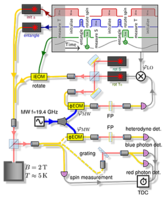
Generation of spin-photon entanglement lies at the heart of quantum repeater protocols. Here, the authors experimentally demonstrate quantum entanglement between a photon and a spin degree of freedom of a quantum dot molecule, by measuring a state overlap with a fully entangled state of about 70%. In contrast to earlier demonstrations of spin-photon entanglement, the system realized here, using single-triplet qubits in a quantum dot molecule, combines potentially long spin-coherence times with a very efficient photonic interface. The authors also develop a novel heterodyne technique that may have wide-ranging applications for characterizing photonic color qubits.

Multifractality of wave functions on a Cayley tree: From root to leaves

M. Sonner, K. S. Tikhonov, and A. D. Mirlin

Phys. Rev. B 96, 214204 (2017) - Published 20 December, 2017

Disordered quantum systems undergo Anderson localization-delocalization transitions, which exhibit very rich physics. A remarkable feature of these transitions is the multifractality of critical wave functions. The eigenfunction multifractality in a d-dimensional disordered system holds only at the transition point and is characterized by universal critical exponents. The authors explore the evolution of wave-function statistics on a finite Bethe lattice from the central site (“root”) to the boundary (“leaves”). They show that eigenfunction moments exhibit generally a multifractal scaling with the volume N. The multifractality spectrum τq depends on the disorder strength and on the parameter s characterizing the position of the observation point, s = r/R, where r is the distance to the root and R is the “radius” of the lattice.

Multifractal metal in a disordered Josephson junctions array

M. Pino, V. E. Kravtsov, B. L. Altshuler, and L. B. Ioffe

Phys. Rev. B 96, 214205 (2017) - Published 20 December, 2017

Superconducting circuits provide a very attractive platform to study the transition from chaotic ergodic to full localized behavior expected in closed quantum systems. The present work reports the emergence of a chaotic, yet nonergodic regime that preempts the transition into a fully localized state in Josephson junction chains. The lack of ergodicity is reflected in multifractal eigenstates in the many-body space. Furthermore, the multifractality in the phase space is accompanied by the fractal properties of the local energy spectrum that translates into anomalous power-law behavior of the physical correlators. The observation of a fractal structure in the local energy spectrum of Josephson junction arrays may provide a bridge between nonergodic dynamics of quantum systems and the hierarchical structure of the local minima in the theory of classical spin glasses.

Unconventional spin dynamics in the honeycomb-lattice material α−RuCl3: High-field electron spin resonance studies

A. N. Ponomaryov, E. Schulze, J. Wosnitza, P. Lampen-Kelley, A. Banerjee, J.-Q. Yan, C. A. Bridges, D. G. Mandrus, S. E. Nagler, A. K. Kolezhuk, and S. A. Zvyagin

Phys. Rev. B 96, 241107(R) (2017) - Published 19 December, 2017

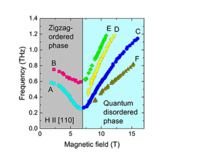
The honeycomb-lattice material α-RuCl3 is a prime candidate for exhibiting Kitaev spin-liquid physics. Here, the authors employ high-field electron spin resonance spectroscopy to probe its spin dynamics across different regions of the phase diagram. Apart from two modes of antiferromagnetic resonance in the zigzag-ordered phase, a rich excitation spectrum was observed in the field-induced quantum disordered state. The authors compare their observations with results of recent numerical calculations, revealing a complex multiparticle nature of magnetic excitations in the field-induced phase.

Enhanced ultrafast relaxation rate in the Weyl semimetal phase of MoTe2 measured by time- and angle-resolved photoelectron spectroscopy

A. Crepaldi, G. Autès, G. Gatti, S. Roth, A. Sterzi, G. Manzoni, M. Zacchigna, C. Cacho, R. T. Chapman, E. Springate, E. A. Seddon, Ph. Bugnon, A. Magrez, H. Berger, I. Vobornik, M. Kalläne, A. Quer, K. Rossnagel, F. Parmigiani, O. V. Yazyev, and M. Grioni

Phys. Rev. B 96, 241408(R) (2017) - Published 18 December, 2017

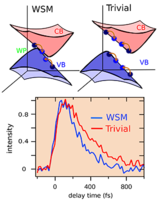
Type-II Weyl semimetals (WSM) are topological materials characterized by special Weyl points (WP) in momentum space where the valence and the conduction band touch. A WSM phase is predicted in MoTe2 below 250 K, but the WP located in the unoccupied part of the electronic structure has eluded direct observation. By means of time- and angle-resolved photoemission, the authors reveal the fingerprint of the WP in the ultrafast electron dynamics. Electrons that are optically excited into the conduction band relax faster in the WSM phase than in the high-temperature phase or in the topologically trivial sister compound WTe2.

Sign In to Your Journals Account

Filter

Section

Filter

Article Lookup

Enter a citation