Highlights

Valley-selective optical Stark effect probed by Kerr rotation

Trevor LaMountain, Hadallia Bergeron, Itamar Balla, Teodor K. Stanev, Mark C. Hersam, and Nathaniel P. Stern

Phys. Rev. B 97, 045307 (2018) - Published 25 January, 2018

The authors show here that Kerr rotation is a sensitive probe of valley-dependent energy splitting induced by the optical Stark effect in two-dimensional semiconductors. Kerr rotation rejects the polarization-independent background and probes a complementary dielectric response from established absorption-based techniques, allowing detection of shifts as small as 4 μeV - the lowest reported value so far. The authors apply this improved valley Stark spectroscopy to a wider range of materials by observing Stark shifts of two energetically distinct exciton species in MoS2, representing the first valley- and energy-selective Stark effect in a single material.

Integer quantum Hall transition in a fraction of a Landau level

Matteo Ippoliti, Scott D. Geraedts, and R. N. Bhatt

Phys. Rev. B 97, 014205 (2018) - Published 22 January, 2018

Electron localization is a crucial ingredient for the observation of the integer quantum Hall effect. However, using exact diagonalization to characterize the transition between consecutive Hall conductance plateaus is hard due to system size limitations. But what if one could remove most of the states in the Landau level, while still retaining the essential ingredients of the transition? The authors here propose a scheme to do this by binding a fraction of the electrons to point-like “impurity” potentials. The remaining states form a flat band, equivalent to a smaller Landau level, which undergoes a plateau transition of the same kind.

Multispin-assisted optical pumping of bulk C13 nuclear spin polarization in diamond

Daniela Pagliero, K. R. Koteswara Rao, Pablo R. Zangara, Siddharth Dhomkar, Henry H. Wong, Andrea Abril, Nabeel Aslam, Anna Parker, Jonathan King, Claudia E. Avalos, Ashok Ajoy, Joerg Wrachtrup, Alexander Pines, and Carlos A. Meriles

Phys. Rev. B 97, 024422 (2018) - Published 22 January, 2018

The nitrogen-vacancy (NV) center in diamond is known to spin-polarize under optical illumination, but how is this polarization transferred to carbon spins in the bulk of the crystal? Here, the authors use field-cycled nuclear magnetic resonance to study the formation of light-driven 13C spin polarization in NV-rich diamond at room temperature. By considering the system’s response to various magnetic fields, it is shown that 13C spins polarize via a cross-relaxation process involving the NV center and the electron and nuclear spins of the substitutional nitrogen impurities. Furthermore, it is shown that high levels of 13C spin polarization can be attained for almost any magnetic field orientation.

Trial wave functions for a composite Fermi liquid on a torus

M. Fremling, N. Moran, J. K. Slingerland, and S. H. Simon

Phys. Rev. B 97, 035149 (2018) - Published 22 January, 2018

Fractional quantum Hall effect fluids remain the prototype systems with topological order and strong interactions. They are usually well described as integer quantum Hall states of composite fermions, made of electrons and magnetic flux quanta. The authors investigate a two-dimensional electron gas in a magnetic field at half filling. This system should be described by a Fermi liquid of composite fermions in zero field and is uniquely suited to study the nature of composite fermions as, for instance, to determine if they are Dirac fermions. The composite Fermi liquid is indeed found to give an excellent approximation of the low-energy physics. It also shows unexpected features in the Berry curvature of the composite fermions.

Tunneling anisotropic magnetoresistance via molecular π orbitals of Pb dimers

Johannes Schöneberg, Paolo Ferriani, Stefan Heinze, Alexander Weismann, and Richard Berndt

Phys. Rev. B 97, 041114(R) (2018) - Published 22 January, 2018

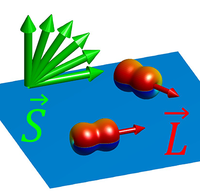
Spin-orbit coupling (SOC) links spin space and real space and leads to solids with intriguing spin topologies and transport properties, such as anisotropic magnetoresistance (AMR). The orientation of a real-space symmetry axis with respect to the spin direction determines the size of SOC-induced changes of the electronic structure. To show this effect at the single-molecule level, the authors arrange Pb dimers on a ferromagnetic Fe layer and observe that the AMR resulting from their molecular orbitals depends strongly on the dimer orientation.

Origin of the net magnetic moment in LaCoO3

G. M. Kaminsky, D. P. Belanger, F. Ye, J. A. Fernandez-Baca, J. Wang, M. Matsuda, and J.-Q. Yan

Phys. Rev. B 97, 024418 (2018) - Published 19 January, 2018

The authors here combine polarized neutron scattering experimental work with computational minimization of proposed Hamiltonians in an effort to understand the low-temperature magnetic behavior in small applied magnetic fields for LaCoO3. They provide an exceptionally comprehensive study of the phase diagrams generated by various Hamiltonians germane to a situation in which magnetic ordering occurs at twin boundaries due to antiferromagnetic chains crossing the boundary at an angle different than 90°.

Three-dimensional magnetic critical behavior in CrI3

Yu Liu (刘育) and C. Petrovic

Phys. Rev. B 97, 014420 (2018) - Published 18 January, 2018

Low-dimensional intrinsically ferromagnetic semiconductors are rare and crucial to develop the next-generation spintronics devices. CrI3 is a promising candidate since its ferromagnetism can be maintained upon exfoliating of bulk crystals down to single layer. However, the nature of magnetism in bulk CrI3 is still unclear. Here, the authors experimentally study the critical properties of bulk CrI3 around the paramagnetic to ferromagnetic phase transition, and idenify clearly three-dimensional long-range magnetic coupling with the exchange distance decaying as J(r) ≈ r−4.69 in bulk CrI3.

Snowflake phononic topological insulator at the nanoscale

Christian Brendel, Vittorio Peano, Oskar Painter, and Florian Marquardt

Phys. Rev. B 97, 020102(R) (2018) - Published 18 January, 2018

The authors propose here the first experimentally viable scheme of a topological insulator for sound waves at the nanoscale. This significantly advances the field of nanoscale phononics, adding helical waveguides to its toolbox. The proposed device could hardly be simpler as it relies purely on a geometrical design, based on the “snowflake” phononic crystal that has already been demonstrated experimentally.

Influence of the effective layer thickness on the ground-state and excitonic properties of transition-metal dichalcogenide systems

L. Meckbach, T. Stroucken, and S. W. Koch

Phys. Rev. B 97, 035425 (2018) - Published 18 January, 2018

The effective dimensionality of a semiconductor strongly influences its excitonic properties. Due to their unit-cell thickness, monolayer materials are the almost perfect realization of a two-dimensional system. However, the unit-cell dimensions can easily exceed the nominal value of the exciton Bohr radius. Employing a fully microscopic theory based on the equation-of-motion approach, it is shown that the effective finite-layer thickness in transition metal dichalcogenides (TMDCs) is responsible for the observed nonhydrogenic exciton series, not only in monolayers, but also in few-layer and bulk systems. The theoretical results identify the resonances in bulk TMDCs as due to quasi-two-dimensional intra- and interlayer excitons.

Environmentally sensitive theory of electronic and optical transitions in atomically thin semiconductors

Yeongsu Cho and Timothy C. Berkelbach

Phys. Rev. B 97, 041409(R) (2018) - Published 17 January, 2018

Due to their small size, atomically thin materials are expected to exhibit electronic properties that are highly sensitive to their environment. However, atomically thin semiconductors on a variety of substrates, as well as in their bulk layered phase, exhibit an absorption onset at roughly the same energy. The authors provide a semianalytic theory of the quasiparticle band gap in atomically thin semiconductors and show that environment-induced changes are almost exactly canceled by changes in the exciton binding energy, leaving the absorption onset nearly constant. The presented theory sets limits on the prospect of environmental engineering in atomically thin materials.

Theory of the magnetic skyrmion glass

Shintaro Hoshino and Naoto Nagaosa

Phys. Rev. B 97, 024413 (2018) - Published 16 January, 2018

Magnetic skyrmions discovered in chiral magnets show unique physical properties due to their nontrivial topology. While their basic properties have been well understood for pure systems, in real materials there is always disorder from, for example, crystal defects or impurities. This glassy nature substantially modifies the low-energy behavior, and hence the investigation of the skyrmion glass is crucial to understanding real materials. Here, the authors theoretically study disordered chiral magnets in terms of replica field theory, and provide a firm basis to explore the glassy state of magnetic skyrmions.

Quantum multicriticality in disordered Weyl semimetals

Xunlong Luo, Baolong Xu, Tomi Ohtsuki, and Ryuichi Shindou

Phys. Rev. B 97, 045129 (2018) - Published 16 January, 2018

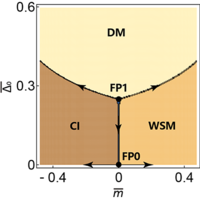
In the electronic band structure of materials, two-band touching points with linear dispersion always appear in pairs in momentum space. When the pair annihilates, the system undergoes a quantum phase transition from a Weyl semimetal (WSM) to a band insulator (BI), which is described by a new critical theory. This paper reveals that the critical theory hosts a novel disorder-driven quantum multicritical point (QMCP), which is encompassed by three quantum phases: WSM, BI, and diffusive metal (DM). The authors clarify scaling theories around the QMCP as well as all the phase boundaries among these three phases. The scaling theory is general and easily extended to other systems.

Bulk characterization of topological crystalline insulators: Stability under interactions and relations to symmetry enriched U(1) quantum spin liquids

Liujun Zou

Phys. Rev. B 97, 045130 (2018) - Published 16 January, 2018

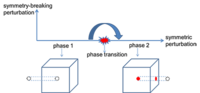
The notion of symmetry protected distinctions among quantum phases has been well appreciated in understanding many-body systems. As a prominent example, recent studies on topological crystalline insulators (TCIs) indicate that these insulators are nontrivial if and only if the relevant crystalline (and some other) symmetries are preserved. By bulk-boundary correspondence, the authors study the properties of the bulk magnetic monopoles of some TCIs that are conceptually interesting and/or experimentally feasible, and argue that this bulk characterization is a more direct and unified physical description of a TCI. In doing so, the authors prove the stability of these TCIs with respect to interactions.

Illumination-induced nonequilibrium charge states in self-assembled quantum dots

Sascha R. Valentin, Jonathan Schwinger, Pia Eickelmann, Patrick A. Labud, Andreas D. Wieck, Björn Sothmann, and Arne Ludwig

Phys. Rev. B 97, 045416 (2018) - Published 16 January, 2018

The detection via capacitance-voltage measurements of nonequilibrium electron states in semiconductor quantum dots are reported here for the first time. A nonequilibrium setting is generated by external illumination of the quantum dots. By carefully tuning the dot properties, it is possible to render the nonequilibrium states long-lived, allowing for their subsequent detection.

Effect of applied orthorhombic lattice distortion on the antiferromagnetic phase of CeAuSb2

Joonbum Park, Hideaki Sakai, Onur Erten, Andrew P. Mackenzie, and Clifford W. Hicks

Phys. Rev. B 97, 024411 (2018) - Published 11 January, 2018

Lattice symmetry is important for classifying ordered phases in solids, but can it have consequences for the energetics of phase formation? In the heavy-fermion antiferromagnet CeAuSb2, it does. The unstressed lattice is tetragonal, and an orthorhombic distortion can be created through in-plane uniaxial pressure. For small distortions, the Néel transition is hardly affected, since the tetragonal lattice symmetry provides an energetic stabilization of the magnetic order. When the applied orthorhombicity exceeds a threshold, however, the transition splits into two transitions, and the order changes qualitatively.

Gapped electronic structure of epitaxial stanene on InSb(111)

Cai-Zhi Xu, Yang-Hao Chan, Peng Chen, Xiaoxiong Wang, David Flötotto, Joseph Andrew Hlevyack, Guang Bian, Sung-Kwan Mo, Mei-Yin Chou, and Tai-Chang Chiang

Phys. Rev. B 97, 035122 (2018) - Published 11 January, 2018

Stanene, a single tin atomic layer akin to graphene, is a quantum spin Hall insulator. Its spin-polarized edge states within the gap would be well suited for spintronic applications, but this attractive property has not been realized because the substrate for supporting stanene in prior experiments leads to a metallic contact that fills the band gap and shorts out the quantum spin Hall channels. By judiciously selecting InSb(111) as the substrate, the resulting system shows a large gap of 0.44 eV well suited for room-temperature device operations. Stanene on InSb(111) is thus a strong contender for next-generation spintronic technology.

Semiclassical dynamics of spin density waves

Gia-Wei Chern, Kipton Barros, Zhentao Wang, Hidemaro Suwa, and Cristian D. Batista

Phys. Rev. B 97, 035120 (2018) - Published 10 January, 2018

Spin density waves (SDW) provide a canonical example of quantum states with spontaneously broken symmetries. The dynamics of SDWs in Mott insulators is described by the well-known Holstein-Primakoff Hamiltonian, which is equivalent to the semiclassical Landau-Lifshitz equation. Based on a real-space formulation of the time-dependent Hartree-Fock method, the authors demonstrate how to extend the semiclassical dynamics description to the case of itinerant magnets or Mott systems with a moderate charge gap. They further show that, within the adiabatic approximation, the SDW dynamics is governed by a generalized quantum Landau-Lifshitz equation.

Atlas for the properties of elemental two-dimensional metals

Janne Nevalaita and Pekka Koskinen

Phys. Rev. B 97, 035411 (2018) - Published 10 January, 2018

Two-dimensional materials research has recently advanced to free-standing, atomically thin metallic nanostructures. To facilitate further progress, the authors construct a periodic table for the properties of 2D elemental metals using density functional theory. The theoretical values for cohesive energies, bond lengths, and elastic moduli of 45 metals correlate linearly with the corresponding properties of the familiar bulk metals. The presentation of these correlations and their causes provides for profound insights into material research that would help design new 2D nanosize heterostructures with optical, catalytic, and nanoelectronic applications.

Renormalization of tensor networks using graph-independent local truncations

Markus Hauru, Clement Delcamp, and Sebastian Mizera

Phys. Rev. B 97, 045111 (2018) - Published 10 January, 2018

Implementing real-space renormalization using tensor networks has proven to be a useful approach for studying lattice systems. The key step in such methods is removing local correlations from a network. Here, the authors propose a way to do this that is fast, simple to implement, applicable to any network, and preserves geometry. This opens a new avenue for extending such methods to three-dimensional networks, as well as providing a competitive alternative to existing methods in two dimensions.

Universality of modular symmetries in two-dimensional magnetotransport

K. S. Olsen, H. S. Limseth, and C. A. Lütken

Phys. Rev. B 97, 045113 (2018) - Published 10 January, 2018

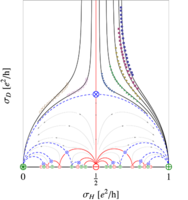
The quantum Hall effect has bagged several Nobel prizes and is a cornerstone of modern metrology, but after four decades it continues to strain our understanding of quantum physics. This comprehensive review of scaling experiments provides substantial support for the conjecture that the morass of Hall data conceals a new type of symmetry, known as modular symmetry [C. A. Lütken and G. G. Ross, Phys. Rev. B 45, 11837 (1992)]. These infinite discrete symmetries are central to many recent developments in mathematics and string theory, but have not previously been seen in nature.

Sign In to Your Journals Account

Filter

Section

Filter

Article Lookup

Enter a citation