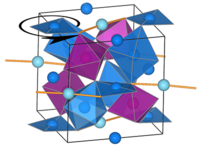
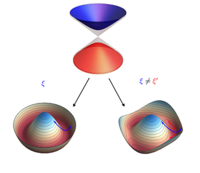
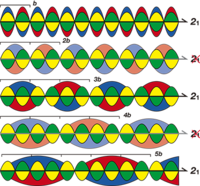
A common characteristic of quasi-one-dimensional (q1D) conductors = Li, Na, and Ag) is that the charge ordering (CO), the ground state (GS) at ambient pressure, and the superconducting (SC) phases, the GS under high pressure, are competing with each other. We have explored high-pressure properties of divalent -vanadium bronzes, = Ca, Sr, and Pb), which are -cation stoichiometry finely controlled single-crystal/powder samples, and found the absence of the SC phase. In these observations, however, we observed enormous and novel phase transitions, a kind of “devil's staircase”-type phase transitions in the charge ordering (CO) phases. The most surprising discovery in this devil's staircase, which was found mainly in , is that all the charge modulation vectors of many kinds of CO phases can be represented as a primitive lattice translation vector along the axis multiplied by several odd numbers. This discovery surely demonstrates interplay between the charge degree freedom and the crystallographic symmetry. We propose two possible mechanisms to explain this phenomenon: “self-charge transfer (carrier redistribution)” between the two subsystems in these compounds and “sequential symmetry reduction” that was discussed in Landau theory of phase transitions. In we also found a phase diagram similar in outlook but different in detail. The devil's staircase was also observed but it is an incomplete one. Furthermore, the charge modulation vectors in it are shorter than those in . In , which has no CO phase at ambient pressure, the pressure-induced antiferromagnetic ordering was observed at around 50 K above 0.5 GPa. Using these two kinds of mechanisms, we also explain the global high-pressure properties in all the stoichiometric divalent -vanadium bronzes, which were observed as a wide variety of electromagnetic states. In addition, we also discuss a possible key for the presence/absence of the SC phase under pressure.