Highlights

Localized interlayer complexes in heterobilayer transition metal dichalcogenides

M. Danovich, D. A. Ruiz-Tijerina, R. J. Hunt, M. Szyniszewski, N. D. Drummond, and V. I. Fal'ko

Phys. Rev. B 97, 195452 (2018) - Published 31 May, 2018

Here, a prediction is made that, in the presence of donor impurities, the optical properties of type-II transition-metal dichalcogenide (TMD) heterobilayers are dominated by interlayer excitonic complexes bound to the impurity centers. Quantum Monte Carlo calculations reveal the stability of many such complexes, including neutral-donor bound excitons and biexcitons. A theory is developed for radiative decay of such complexes, where the localized nature of these few-carrier states allows recombination even for a finite misalignment between the TMD layers. A multipeak photoluminescence spectrum is predicted, in the energy range where recent experiments have observed broad luminescence peaks. These results provide a new perspective for interpreting the experimental observations, which so far have been attributed only to delocalized interlayer excitons.

Anisotropy of the upper critical field and its thickness dependence in superconducting FeSe electric-double-layer transistors

Junichi Shiogai, Shojiro Kimura, Satoshi Awaji, Tsutomu Nojima, and Atsushi Tsukazaki

Phys. Rev. B 97, 174520 (2018) - Published 29 May, 2018

High-temperature superconductivity in FeSe thin films has attracted keen interest owing to the counterintuitive enhancement of the superconducting critical parameters in the monolayer-thin limit. Here, the authors apply an electrochemical etching technique to the FeSe-based electric-double-layer transistor (FeSe-EDLT) to investigate systematically the thickness and angular dependence of the upper critical magnetic field (Hc2) below 10 nm. Compared with the isotropic Hc2 in low-Tc bulk FeSe, the high-Tc FeSe-EDLT exhibits highly anisotropic and three-dimensional behavior, with a much smaller out-of-plane coherence length than the interlayer distance between FeSe sheets. The authors consider this to be the reason for the robust high-Tc superconductivity of monolayer FeSe.

Full dyon excitation spectrum in extended Levin-Wen models

Yuting Hu, Nathan Geer, and Yong-Shi Wu

Phys. Rev. B 97, 195154 (2018) - Published 29 May, 2018

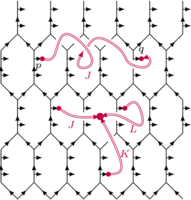
The Levin‐Wen models are discrete gauge models, leading to intrinsic two-dimensional topological order. To incorporate the charge degrees of freedom at vertices for excited states, the authors propose to extend the Levin-Wen model by adding on one of the edges of each vertex a tail, labeled by its string type. They show that the local operators associated with the dyonic excitations obey the so‐called tube algebra. When the input data is associated with a finite or quantum group, any dyon species is described by three quantum numbers: charge, fluxon type, and twist.

Strain engineering of the silicon-vacancy center in diamond

Srujan Meesala, Young-Ik Sohn, Benjamin Pingault, Linbo Shao, Haig A. Atikian, Jeffrey Holzgrafe, Mustafa Gündoğan, Camille Stavrakas, Alp Sipahigil, Cleaven Chia, Ruffin Evans, Michael J. Burek, Mian Zhang, Lue Wu, Jose L. Pacheco, John Abraham, Edward Bielejec, Mikhail D. Lukin, Mete Atatüre, and Marko Lončar

Phys. Rev. B 97, 205444 (2018) - Published 29 May, 2018

Here, the authors tune the color of light emitted by single-atom imperfections (silicon vacancy color centers) inside a diamond. Such tunable imperfections can be networked together to build a quantum internet, where information can be securely exchanged using the laws of quantum physics. One problem is that all the centers need to emit at precisely the same color or wavelength. The authors overcome this challenge by placing color centers inside a diamond nanostring. By adjusting the tension in the string, atoms are stretched inside the crystal and tune the center to emit photons of a desired wavelength. The tuning method involves bending the string with a force controlled handily with an electrical voltage. A symphony of such tunable diamond strings could serve as the backbone of a future quantum internet.

Tunable Majorana corner states in a two-dimensional second-order topological superconductor induced by magnetic fields

Xiaoyu Zhu

Phys. Rev. B 97, 205134 (2018) - Published 25 May, 2018

Starting from a minimal model of a time-reversal-invariant topological superconductor in two dimensions, the author shows that an in-plane magnetic field could drive the superconductor into a second-order topological phase, which features Majorana zero modes, bound at two of the four corners of the system. These Majorana corner states occur where edges with distinct topology intersect. Hence, the corner states are topologically protected. With variation of magnetic-field orientation, the nontrivial corner states would move along the boundary and reside on different corners.

Second-order topological insulators and superconductors with an order-two crystalline symmetry

Max Geier, Luka Trifunovic, Max Hoskam, and Piet W. Brouwer

Phys. Rev. B 97, 205135 (2018) - Published 25 May, 2018

While topological insulators have a gapped bulk band structure, they have gapless surface states. Recently, it was shown that the presence of additional crystalline symmetries can lead to topological phases that combine a gapped bulk spectrum with gapless states on edges or corners of the crystal. Such topological phases have been called “higher-order topological phases”. This article presents a complete classification of second-order topological insulators and superconductors with mirror, twofold-rotation, or inversion symmetry. The authors show that crystals with a mirror symmetry and a nontrivial bulk band structure either have gapless surfaces or gapless edges. On the other hand, there are crystals with twofold rotation or inversion symmetry with a nontrivial bulk topology but without surface or edge states.

Higher-order topological insulators and superconductors protected by inversion symmetry

Eslam Khalaf

Phys. Rev. B 97, 205136 (2018) - Published 25 May, 2018

Here, higher-order topological insulators and superconductors protected by inversion symmetry are investigated. These phases are characterized by gapped bulk and surface with gapless modes confined to hinges or corners of the sample. Such surface states can be understood as topological defects that are globally stabilized by inversion. They can be built using a layer construction that embeds a standard topological insulator/superconductor into a higher dimension by symmetrically adding to it copies of itself. Using this procedure, a complete classification of such states in any dimension is obtained and several examples for possible physical realizations are provided.

Anomalous transport in the Aubry-André-Harper model in isolated and open systems

Archak Purkayastha, Sambuddha Sanyal, Abhishek Dhar, and Manas Kulkarni

Phys. Rev. B 97, 174206 (2018) - Published 24 May, 2018

There are two well-established ways of characterizing transport properties. The first is via the spread of correlations in an isolated system. The second is through the system-size dependence of the current, when a potential bias is applied by connecting the two ends of the system to reservoirs. These are two different experiments, but usually the result of one experiment can be inferred from that of the other. This work presents a surprising counterexample. The authors show that, at the critical point of the Aubry-André-Harper model, transport in the presence of reservoirs is drastically different from transport in the isolated system. The scaling of current with system size shows clear subdiffusive behavior, while the spread of correlations does not show any subdiffusive behavior. It actually hints at superdiffusion. This implies that the understanding of the relation between transport in open and in isolated systems needs to be reexamined.

Efficient nonparametric n-body force fields from machine learning

Aldo Glielmo, Claudio Zeni, and Alessandro De Vita

Phys. Rev. B 97, 184307 (2018) - Published 24 May, 2018

The authors present a scheme to construct classical n-body force fields using Gaussian Process (GP) Regression, appropriately mapped over explicit n-body functions (M-FFs). The procedure is possible, and will yield accurate forces, whenever prior knowledge allows to restrict the interactions to a finite order n, so that the “universal approximator” resolving power of standard GPs or Neural Networks is not needed. Under these conditions, the proposed construction preserves flexibility of training, systematically improvable accuracy, and a clear framework for validation of the underlying machine learning technique. Moreover, the M-FFs are as fast as classical parametrized potentials, since they avoid lengthy summations over database entries or weight parameters.

Pulse generation scheme for flying electromagnetic doughnuts

Nikitas Papasimakis, Tim Raybould, Vassili A. Fedotov, Din Ping Tsai, Ian Youngs, and Nikolay I. Zheludev

Phys. Rev. B 97, 201409(R) (2018) - Published 23 May, 2018

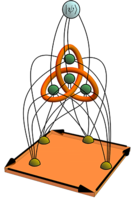
A proposed scheme for generating torus-shaped light pulses called flying doughnuts utilizes a metamaterial “sprinkled” with tiny resonators in a concentric ring pattern.

Chiral topological phases from artificial neural networks

Raphael Kaubruegger, Lorenzo Pastori, and Jan Carl Budich

Phys. Rev. B 97, 195136 (2018) - Published 18 May, 2018

Artificial neural networks and machine learning tools have become ubiquitous far beyond the field of computer science. They already smartly assist us in our daily lives in various ways. Recently, these concepts have been adopted and applied in the realm of quantum physics, for example as a computational Ansatz for the state of a quantum many-body system. In this work, the authors harness the enormous flexibility of artificial neural networks to study exotic phases of quantum matter, known as chiral topological phases, that are particularly hard to investigate microscopically with more conventional computational methods.

Gauge invariance of excitonic linear and nonlinear optical response

Alireza Taghizadeh and T. G. Pedersen

Phys. Rev. B 97, 205432 (2018) - Published 18 May, 2018

Excitons strongly influence the optical response of low-dimensional materials. Here, the authors propose a practical framework for calculating the excitonic linear and nonlinear optical response of multiband semiconductors based on the perturbative density matrix within the mean-field approximation. Using this framework, the equivalence of four different approaches is demonstrated analytically and numerically, if the correct velocity gauge interaction is used. The four approaches stem from two choices of gauge and two ways of computing the response functions. The present formalism can readily be extended to generate gauge invariant responses for higher-order nonlinear processes.

Electron and Cooper-pair transport across a single magnetic molecule explored with a scanning tunneling microscope

J. Brand, S. Gozdzik, N. Néel, J. L. Lado, J. Fernández-Rossier, and J. Kröger

Phys. Rev. B 97, 195429 (2018) - Published 17 May, 2018

The interplay of magnetism and superconductivity gives rise to the emergence of various interesting phenomena in condensed matter physics, such as the Yu-Shiba-Rusinov in-gap modes created by local magnetic moments in superconducting hosts. Using normal-metal and superconducting tips the authors have formed contacts to an individual magnetic molecule adsorbed on a conventional superconductor. Spectroscopy of the differential conductance with tunable junction transparency has unveiled the crossover from quasiparticle tunneling, which probes the Bardeen-Cooper-Schrieffer energy gap as well as the Yu-Shiba-Rusinov levels, to the contact range where multiple Andreev reflection takes over.

Hall viscosity and geometric response in the Chern-Simons matrix model of the Laughlin states

Matthew F. Lapa and Taylor L. Hughes

Phys. Rev. B 97, 205122 (2018) - Published 17 May, 2018

The authors show here that geometric properties of Laughlin fractional quantum Hall states are accurately described by the Chern-Simons matrix model, a regularization of the noncommutative Chern-Simons theory description of these states. The noncommutative Chern-Simons theory itself is an example of an exotic noncommutative field theory: a quantum field theory on a space where the coordinates do not commute. The authors revisit these noncommutative theories and show that they capture the Hall viscosity of the Laughlin states, as well as other geometric properties of these states that are of current interest.

Sum-frequency ionic Raman scattering

Dominik M. Juraschek and Sebastian F. Maehrlein

Phys. Rev. B 97, 174302 (2018) - Published 16 May, 2018

Coherently excited phonons are a unique tool to control the properties of materials in their electronic ground state on the picosecond timescale. Here, the authors complete the map of four excitation mechanisms for Raman-active phonons, which are either directly mediated by photons or work with the help of nonlinearly coupled phonons. Each process can be achieved by using a sum- or difference-frequency mixing of the scattering particles. The general model here captures all four mechanisms, which is demonstrated for different types of material using density functional theory. This study may serve as a guide for the selective excitation of phonons and Raman-active modes in general.

Quantum transport in coupled Majorana box systems

Matthias Gau, Stephan Plugge, and Reinhold Egger

Phys. Rev. B 97, 184506 (2018) - Published 16 May, 2018

Mesoscopic superconducting islands with four or more Majorana zero modes are promising candidates for topological qubits. In recent theoretical proposals, interlinked ensembles of such Majorana boxes are used to establish Majorana code networks that, in principle, can run large-scale quantum computations and quantum error correction. Here, the authors discuss transport through coupled Majorana boxes, developing theoretical approaches in which general networks can be drastically reduced in their complexity. This is followed by a discussion of several examples of recent interest, including an analysis of the so-called loop quit device, which is currently under experimental investigation.

Pair density waves in superconducting vortex halos

Yuxuan Wang, Stephen D. Edkins, Mohammad H. Hamidian, J. C. Séamus Davis, Eduardo Fradkin, and Steven A. Kivelson

Phys. Rev. B 97, 174510 (2018) - Published 14 May, 2018

The authors analyze the interplay between a d-wave uniform superconducting and a pair-density-wave order (PDW) parameter in the neighborhood of a vortex, and compute the resulting local density of states in the vortex halo. The intertwining of the two superconducting orders leads to a charge density modulation with the same periodicity as the PDW, which is twice the period of the charge density wave that arises as a second harmonic of the PDW itself. They discuss key features of the charge density modulation that can be directly compared with recent results from scanning tunneling microscopy and speculate on the role PDW order may play in the global phase diagram of the hole-doped cuprates.

Pair-density waves, charge-density waves, and vortices in high-Tc cuprates

Zhehao Dai, Ya-Hui Zhang, T. Senthil, and Patrick A. Lee

Phys. Rev. B 97, 174511 (2018) - Published 14 May, 2018

The authors analyze a recent STM experiment, reporting a period-8 charge density wave (CDW) in the vortex halo in striking contrast to the period-4 CDWs that are commonly observed in the cuprates. Inside the superconducting dome, the observation of CDWs necessarily implies the existence of a pair density wave (PDW) at the same momentum, as suggested by various theoretical proposals. The authors discuss distinct experimental features, which distiguish the case where this newly reported CDW is driven by a PDW and the case where the CDW is the primary order, and suggest follow-up experiments in order to distinguish unambiguously these two scenarios. The PDW-driven scenario is then put into a broader context in relation to the pseudo-gap phenomenology, Hc2, and different kinds of CDWs.

Candidate for a fully frustrated square lattice in a verdazyl-based salt

H. Yamaguchi, Y. Tamekuni, Y. Iwasaki, and Y. Hosokoshi

Phys. Rev. B 97, 201109(R) (2018) - Published 14 May, 2018

Frustrated spin systems prevent the formation of conventional magnetic order and can form an entangled spin state. A frustrated square lattice with only nearest-neighbor interactions is called a fully frustrated square lattice (FFSL) and expected to exhibit strong quantum fluctuations. Here, the authors present an experimental realization of an S=½ FFSL composed of a verdazyl-based salt. Ab initio calculations indicate the formation of an FFSL with competing ferro- and antiferromagnetic nearest-neighbor interactions. The magnetic behavior demonstrates that the system forms a quantum valence-bond solid state. This material provides a way to realize a variety of S=½ FFSLs through the molecular design method, proposed here.

Chemical and valence reconstruction at the surface of SmB6 revealed by means of resonant soft x-ray reflectometry

V. B. Zabolotnyy, K. Fürsich, R. J. Green, P. Lutz, K. Treiber, Chul-Hee Min, A. V. Dukhnenko, N. Y. Shitsevalova, V. B. Filipov, B. Y. Kang, B. K. Cho, R. Sutarto, Feizhou He, F. Reinert, D. S. Inosov, and V. Hinkov

Phys. Rev. B 97, 205416 (2018) - Published 14 May, 2018

SmB6 is a mixed-valence, strongly correlated Kondo insulator. Moreover, its band structure makes it a promising contender in the quest for one of the first systems with topologically nontrivial and correlated surface states. Despite the “topological protection”, surface layer reconstructions can fundamentally change the material’s properties, so that the topological state is expelled into the undisrupted bulk. Following previous indications, the authors combine resonant reflectivity, photoemission, and theory to uncover chemical and valence reconstruction and its dynamics, resulting in boron termination and Sm3+ subsurface dominance. This work reconciles earlier studies using more surface-sensitive techniques, such as photoemission and scanning tunneling spectroscopy.

Sign In to Your Journals Account

Filter

Section

Filter

Article Lookup

Enter a citation