Highlights

Observation of a pressure-induced transition from interlayer ferromagnetism to intralayer antiferromagnetism in Sr4Ru3O10

H. Zheng, W. H. Song, J. Terzic, H. D. Zhao, Y. Zhang, Y. F. Ni, L. E. DeLong, P. Schlottmann, and G. Cao

Phys. Rev. B 98, 064418 (2018) - Published 21 August, 2018

Triple-layered Sr4Ru3O10 presents a rare case of coexistence of interlayer (c-axis) ferromagnetism and intralayer (basal-plane) metamagnetism at ambient pressure. This study reveals the pressure-induced intralayer itinerant antiferromagnetism arising from the interlayer ferromagnetism. The application of modest hydrostatic pressure generates anisotropy that may cause flattening and tilting of RuO6 octahedra. These lattice distortions weaken the c-axis ferromagnetism as well as the basal-plane metamagnetism, while inducing a basal-plane, itinerant antiferromagnetic state that is remarkably uncommon. The unusually large magnetoelastic coupling inherent in this ruthenate makes it an ideal model system for studies of itinerant magnetism.

Optically excited spin pumping mediating collective magnetization dynamics in a spin valve structure

A. P. Danilov, A. V. Scherbakov, B. A. Glavin, T. L. Linnik, A. M. Kalashnikova, L. A. Shelukhin, D. P. Pattnaik, A. W. Rushforth, C. J. Love, S. A. Cavill, D. R. Yakovlev, and M. Bayer

Phys. Rev. B 98, 060406(R) (2018) - Published 13 August, 2018

An alternative method for spin pumping – injection of a pure spin current into a nonmagnetic material by the precessing magnetization in an adjacent ferromagnet – is demonstrated without the need to use microwaves. Femtosecond laser pulses trigger the magnetization precession in adjacent (Fe,Ga) layers separated by a 5-nm Cu spacer. The spin currents emerging from the two layers couple their magnetization, leading to superposition of the two collective modes, observed in time-resolved Kerr rotation measurements. For resonant precession frequencies in the (Fe,Ga) layers, the authors achieve strongly split decay rates of the collective modes, indicating a purely dissipative coupling.

Anomalous coupling between magnetic and nematic orders in quantum Hall systems

Md. Shafayat Hossain, M. A. Mueed, Meng K. Ma, Y. J. Chung, L. N. Pfeiffer, K. W. West, K. W. Baldwin, and M. Shayegan

Phys. Rev. B 98, 081109(R) (2018) - Published 13 August, 2018

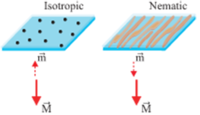
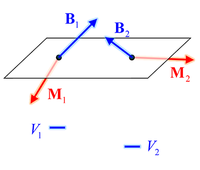
The authors reveal an intriguing interplay between magnetization and nematic charge order in an AlAs two-dimensional electron system, where the magnetization can be tuned. A set of phase transitions between isotropic Fermi liquid and anisotropic nematic phases are observed as the degree of magnetization is tuned with the application of an in-plane magnetic field. The authors find that ferromagnetism stabilizes the nematic order. Nematicity appears when the magnetization of the valence Landau level aligns with the net magnetization of the underlying Landau levels and becomes most robust when the valence and underlying Landau levels are fully magnetized.

Nonlocality of Majorana modes in hybrid nanowires

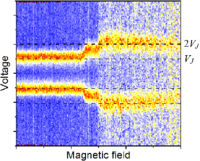
M.-T. Deng, S. Vaitiekėnas, E. Prada, P. San-Jose, J. Nygård, P. Krogstrup, R. Aguado, and C. M. Marcus

Phys. Rev. B 98, 085125 (2018) - Published 13 August, 2018

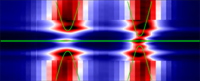
The nonlocal character of Majorana zero modes is a key feature for topological protection of Majorana qubits, and distinguishes separated Majorana bound states from localized Andreev modes. Applying recent theoretical results on the coupling of quantum dots at the wire ends to the zero-energy mode in the wire, the authors provide a first quantitative measure of the nonlocality of Majorana modes in semiconductor-superconductor hybrid nanowires. The spin character of the Majorana mode is revealed by analyzing its coupling to two consecutive quantum dot resonances. Cases of zero modes with moderate and high degrees of nonlocality are compared.

Scaling laws of the Kondo problem at finite frequency

L. E. Bruhat, J. J. Viennot, M. C. Dartiailh, M. M. Desjardins, A. Cottet, and T. Kontos

Phys. Rev. B 98, 075121 (2018) - Published 9 August, 2018

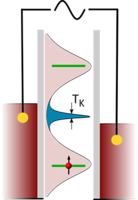
Understanding the physics of interacting electrons is crucial for modern condensed matter. Quantum dot circuits – nanoscale circuits with nodes that can involve as little as one mobile electron - are established as powerful platforms to tackle such problems and, in particular, the Kondo problem, which is at the core of many correlated electron fluids. Such devices have been used extensively in the thermodynamic limit through low-frequency transport measurements. In this work, the authors perform a high-frequency study of the dynamics of the Kondo effect and its related scaling laws, going beyond what has been done previously.

Parity-time-symmetric topological superconductor

Kohei Kawabata, Yuto Ashida, Hosho Katsura, and Masahito Ueda

Phys. Rev. B 98, 085116 (2018) - Published 8 August, 2018

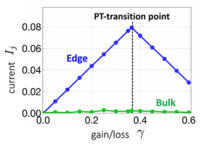
Nonequilibrium open systems effectively described by non-Hermitian Hamiltonians with parity-time (PT) symmetry have recently attracted considerable attention due to their properties with no Hermitian counterparts. In particular, there exists a growing interest in non-Hermitian topological phases of matter. Here, the authors show that a PT-symmetric topological superconducting wire possesses two distinct types of unconventional edge modes, those with complex energies and with nonorthogonal Majorana zero modes. The latter induce anomalous particle transport with nonlocal currents present only at the edges. This work explores a unique nonequilibrium topological phenomenon that results from the interplay between PT symmetry and topological superconductivity.

Topological magnons in Kitaev magnets at high fields

P. A. McClarty, X.-Y. Dong, M. Gohlke, J. G. Rau, F. Pollmann, R. Moessner, and K. Penc

Phys. Rev. B 98, 060404(R) (2018) - Published 7 August, 2018

Spin-orbit coupled honeycomb lattice magnets offer a route to novel states of matter through the presence of significant Kitaev exchange coupling. Here, the authors explored the spin-polarized paramagnetic regime in a very general model for such magnets, showing that the magnon band topology is nontrivial throughout the phase. This finding implies the presence a thermal Hall effect and, neglecting magnon interactions, topologically protected chiral magnon edge states. They further show that the edge states are robust to the presence of interactions, decisively showing that such exotic excitations are experimentally robust quasiparticles.

Topological excitations in the ferromagnetic Kitaev-Heisenberg model

Darshan G. Joshi

Phys. Rev. B 98, 060405(R) (2018) - Published 7 August, 2018

Topological aspects, widely discussed in relation to fermionic systems, need not be restricted to the ground state of electrons. The excitation spectrum in certain frustrated quantum magnets could be topological in nature. The Kitaev-Heisenberg model is a cornerstone in the study of quantum spin-liquid candidate materials such as Na2IrO3 and RuCl3. Here, the author presents the interesting and surprising result that the quasiparticles in the ferromagnetic Kitaev-Heisenberg model have a nontrivial Berry curvature leading to a nonzero Chern-number topological invariant. Consequently, there are chiral edge excitations along the zigzag edge, which can be detected in scattering and in thermal- or spin-transport experiments.

Symmetry breaking and unconventional charge ordering in single crystal Na2.7Ru4O9

Arvind Yogi, C. I. Sathish, Hasung Sim, Matthew J. Coak, Y. Noda, and Je-Geun Park

Phys. Rev. B 98, 085113 (2018) - Published 7 August, 2018

Synthesis of complex materials can lead to discoveries of novel emergent phenomena as well as innovative applications. Combined electrical resistivity, specific heat, susceptibility, and single-crystal x-ray diffraction studies reveal that Na2.7Ru4O9 undergoes a unique unconventional charge-ordering transition at room temperature while retaining metallicity. This electronic transition drives an intricate trigonal distortion in the RuO6 octahedron, which possibly enhances the localized 4d Ru electrons. Furthermore, from the intermediate phase to the low-temperature phase, the structure shows large Na ion displacements along the crystallographic b direction by about 1/4 from its normal site. The authors suggest that these effects are at the origin of the first-order phase transition and provide an unprecedented ionic displacement driven charge ordering in Na2.7Ru4O9.

Topological Bloch oscillations

J. Höller and A. Alexandradinata

Phys. Rev. B 98, 024310 (2018) - Published 31 July, 2018

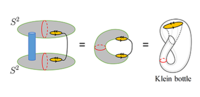
The traditional view of Bloch oscillations is that they rely on the translational symmetry of crystals. These oscillations occur with a fundamental period TB, the time it takes a semiclassical wave packet to travel across the Brillouin zone. We introduce a new type of Bloch oscillation whose period equals an integer multiple of TB. The period multiplication relies on crystalline point-group symmetries, as exemplified by rotations and reflections. The integer-valued multiplier is robust against symmetric deformations of the crystal. It is the first example of a crystalline-symmetry-protected topological invariant in electric transport.

Many-body topological invariants for fermionic short-range entangled topological phases protected by antiunitary symmetries

Ken Shiozaki, Hassan Shapourian, Kiyonori Gomi, and Shinsei Ryu

Phys. Rev. B 98, 035151 (2018) - Published 31 July, 2018

Here, the authors introduce a set of quantities to diagnose symmetry-protected topological phases of fermions protected by antiunitary symmetries. These quantities, which can be written as expectation values of nonlocal operators, effectively simulate the partition function on nonorientable spacetime manifolds in the operator formalism. The important observation is that the proposed quantities are complex valued for topological states, where the complex phase is the many-body topological invariant. Numerous symmetry classes and dimensionalities are studied in detail. The key ingredient of all quantities is the “fermionic partial transpose”. For example, the Z2 topological invariant for time-reversal symmetric topological insulators in two spatial dimensions is given.

Density-functional theory for systems with noncollinear spin: Orbital-dependent exchange-correlation functionals and their application to the Hubbard dimer

Carsten A. Ullrich

Phys. Rev. B 98, 035140 (2018) - Published 26 July, 2018

To describe noncollinear magnetism in systems such as spiral ferromagnets or spin-frustrated molecules, density-functional methods need to give a proper account of the interplay between broken spin symmetries and exchange-correlation many-body effects. Here, the author develops a class of orbital-dependent exchange-correlation functionals for systems with noncollinear spin, treating correlation via a self-consistent scheme inspired by the Singwi-Tosi-Land-Sjölander method. The approach is applied to a very simple yet nontrivial benchmark system, the asymmetric half-filled Hubbard dimer, and is found to perform well, particularly in the weakly to moderately correlated regime.

Quantum collapse of a magnetic skyrmion

Amel Derras-Chouk, Eugene M. Chudnovsky, and Dmitry A. Garanin

Phys. Rev. B 98, 024423 (2018) - Published 25 July, 2018

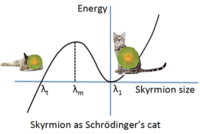
Large thermal fluctuations can destroy skyrmions - tiny speckles of rotated magnetization in two-dimensional films. Yet at low temperatures skyrmions are believed to be topologically stable, which makes them good candidates for data storage and processing. However, as the authors demonstrate here, even at zero temperature a nanoscale skyrmion is not protected against quantum decay. The theory is based on the imaginary-time dynamics of the skyrmion. Due to the fact that even the smallest skyrmion is still formed by many atomic spins, its quantum decay provides an example of a nanoscale Schrödinger’s cat that one can study with modern measuring techniques.

Revealing the hidden heavy Fermi liquid in CaRuO3

Yang Liu, Hari P. Nair, Jacob P. Ruf, Darrell G. Schlom, and Kyle M. Shen

Phys. Rev. B 98, 041110(R) (2018) - Published 25 July, 2018

CaRuO3 has long been an enigmatic compound due to reports of possible non-Fermi-liquid behavior and its proximity to a magnetic quantum critical point. Through a combination of molecular beam epitaxy growth and angle-resolved photoemission, the authors reveal that the large rotations of the RuO6 octahedra result in a complex Fermi surface with multiple quasiparticle bands and hybridization gaps lying very close to the Fermi energy. The measurements demonstrate a highly band-dependent mass renormalization, where the dispersion and temperature dependence of the heavy bands show intriguing parallels to heavy-fermion systems. These results provide a unified framework for explaining the peculiar properties of CaRuO3 and demonstrate the importance of octahedral rotations in shaping the physical properties of the ruthenates.

Full angular dependence of the spin Hall and ordinary magnetoresistance in epitaxial antiferromagnetic NiO(001)/Pt thin films

L. Baldrati, A. Ross, T. Niizeki, C. Schneider, R. Ramos, J. Cramer, O. Gomonay, M. Filianina, T. Savchenko, D. Heinze, A. Kleibert, E. Saitoh, J. Sinova, and M. Kläui

Phys. Rev. B 98, 024422 (2018) - Published 24 July, 2018

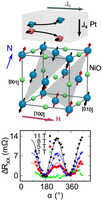
Electrical readout of the orientation of an antiferromagnet by detecting the Néel vector is necessary to exploit this class of materials for applications. Here, the authors study bilayers of thin films of the epitaxial antiferromagnetic insulator NiO(001) and the heavy metal Pt. The observed three-dimensional angular dependence of the spin Hall magnetoresistance (SMR) is analyzed, considering the reversible field-induced redistribution of magnetostrictive antiferromagnetic S and T domains in the NiO(001). The authors find that a careful subtraction of the ordinary magnetoresistance contribution in Pt is crucial to determine the SMR amplitude and thus the Néel vector average orientation.

Anomalous modulation of Josephson radiation in nanowire-based Josephson junctions

H. Kamata, R. S. Deacon, S. Matsuo, K. Li, S. Jeppesen, L. Samuelson, H. Q. Xu, K. Ishibashi, and S. Tarucha

Phys. Rev. B 98, 041302(R) (2018) - Published 19 July, 2018

In contrast to recent rapid progress with measurements in the search for Majorana fermions, the observation of a 4π-periodic Josephson effect, which would provide further experimental evidence for them, still remains a challenge for the field of nanowire-based systems. In this paper, the authors investigate quantitatively the ac Josephson effect in nanowire-based Josephson junctions. They observe anomalous modulation of the Josephson radiation in a finite magnetic field. The modulation can be explained by a change in circuit impedance.

Observation of a Dirac nodal line in AlB2

Daichi Takane, Seigo Souma, Kosuke Nakayama, Takechika Nakamura, Hikaru Oinuma, Kentaro Hori, Kouji Horiba, Hiroshi Kumigashira, Noriaki Kimura, Takashi Takahashi, and Takafumi Sato

Phys. Rev. B 98, 041105(R) (2018) - Published 17 July, 2018

The authors present measurements by soft-x-ray angle-resolved photoemission spectroscopy of hexagonal diboride AlB2, which is a cousin material of the well-known high-temperature superconductor MgB2. Via accurate determination of the three-dimensional bulk band structure corroborated by first-principles band-structure calculations, the authors demonstrate that AlB2 displays an exotic Dirac-nodal-line structure with anisotropic Dirac-cone energy band. This intriguing electronic structure provides an excellent platform to study the interplay among the line node, low-energy excitations, and topological transport properties.

Equipartition of the entanglement entropy

J. C. Xavier, F. C. Alcaraz, and G. Sierra

Phys. Rev. B 98, 041106(R) (2018) - Published 17 July, 2018

The authors present a derivation of finite-size corrections to entanglement entropies that possess an internal symmetry. They show that entanglement entropy is equally distributed among the different sectors of that internal symmetry. Its value is given by the standard area-law-violating logarithmic term, which depends on the central charge c, minus a double logarithmic correction related to the zero-temperature susceptibility. They present a very efficient way to determine the central charge and the Luttinger parameter. This opens the possibility that the measurement of these quantities can be successfully pursued in an optical lattice. The analytical predictions are verified against numerical results obtained by DMRG.

Dynamics of entanglement and transport in one-dimensional systems with quenched randomness

Adam Nahum, Jonathan Ruhman, and David A. Huse

Phys. Rev. B 98, 035118 (2018) - Published 16 July, 2018

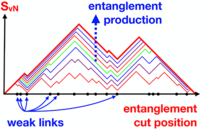
The thermalization of one-dimensional quantum systems may be severely slowed by weak links, e.g., by the Griffiths regions that dominate the long-time dynamics of a system close to the many-body-localization transition. Here, the authors construct universal coarse-grained descriptions for entanglement production and for the dynamics of quantum operators in systems with weak links. They reveal unexpected differences between these processes (for example, entanglement growth can be slower than linear in time even when operators spread ballistically). The universal physics is explained using simple classical effective models. The authors’ analysis of the spreading of quantum information and of conserved quantities shows that thermalization in the presence of weak links has a rich structure, featuring multiple dynamic length scales that diverge with different powers of time.

Observation of exciton-phonon coupling in MoSe2 monolayers

S. Shree, M. Semina, C. Robert, B. Han, T. Amand, A. Balocchi, M. Manca, E. Courtade, X. Marie, T. Taniguchi, K. Watanabe, M. M. Glazov, and B. Urbaszek

Phys. Rev. B 98, 035302 (2018) - Published 16 July, 2018

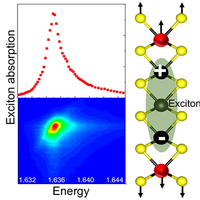
The interaction of excitons with phonons governs energy relaxation, dephasing, and optical transition line broadening with temperature in two-dimensional (2D) materials. Here, the authors observe and study unusual high-energy tails in both absorption and emission extending over several meV in energy at low temperatures. They develop a theory of the effect and show that the coupling between acoustic phonons and excitons lies at the origin for the observed high-energy tails. This work demonstrates that the exciton-phonon coupling in 2D crystals is more efficient as compared with conventional semiconductor structures, such as GaAs/AlGaAs quantum wells.

Sign In to Your Journals Account

Filter

Section

Filter

Article Lookup

Enter a citation