Highlights

Coherent control via weak measurements in P31 single-atom electron and nuclear spin qubits

J. T. Muhonen, J. P. Dehollain, A. Laucht, S. Simmons, R. Kalra, F. E. Hudson, A. S. Dzurak, A. Morello, D. N. Jamieson, J. C. McCallum, and K. M. Itoh

Phys. Rev. B 98, 155201 (2018) - Published 5 October, 2018

At the heart of quantum mechanics is the idea that we cannot observe a physical system without affecting it. This is normally taken to mean that the act of measurement produces uncontrolled disturbances, and “collapses” quantum superposition states. Here, the authors demonstrate the preparation of arbitrary quantum states of the nuclear spin of a single 31P donor in silicon, while operating and measuring only the donor-bound electron. The “partial collapse” resulting from a sequence of weak nuclear spin measurement is shown to be a fully coherent process, which can even be reversed. The change in the nuclear spin state can also be used as a physical meter to probe the measurement strength, proportional to the electron tunnel rate, by analyzing events where no tunneling occurs.

Thermal stability of metastable magnetic skyrmions: Entropic narrowing and significance of internal eigenmodes

L. Desplat, D. Suess, J-V. Kim, and R. L. Stamps

Phys. Rev. B 98, 134407 (2018) - Published 4 October, 2018

Magnetic skyrmions are particlelike, topologically nontrivial spin textures. Isolated skyrmions represent metastable excitations of the ferromagnetic ground state and can be long-lived. For potential applications such as memory and logic devices, it is essential to quantitatively understand their stability against thermal fluctuations. Here, the authors apply transition state theory to directly compute the lifetimes of isolated skyrmions for two annihilation mechanisms: escape through a boundary and collapse. The internal modes of the skyrmion are found to play a dominant role in the thermally activated transitions compared to spin wave excitations. Moreover, a strong entropic contribution to the Arrhenius prefactor, linked to the internal modes, is highlighted.

Spin-12 Heisenberg antiferromagnet on the star lattice: Competing valence-bond-solid phases studied by means of tensor networks

Saeed S. Jahromi and Román Orús

Phys. Rev. B 98, 155108 (2018) - Published 3 October, 2018

Frustrated quantum antiferromagnetism is an important physical phenomena leading to many of the key properties of quantum matter, such as quantum spin liquids and topological order. Here, the authors employ novel techniques based on tensor network methods for the triangle-honeycomb lattice in order to compute ground-state properties of a frustrated quantum antiferromagnet on the star lattice, with high accuracy, in the thermodynamic limit. Importantly, their findings contradict some of the existing results in the literature on this model. In particular, they find a new resonating valence-bond solid (VBS) phase that had not been observed before, as well as a different VBS structure at the isotropic point than the one previously conjectured by other methods. Moreover, by using tensor network techniques, they also determine the existence of a continuous quantum phase transition in the system between different VBS orders.

Electronic fingerprints of Cr and V dopants in the topological insulator Sb2Te3

Wenhan Zhang, Damien West, Seng Huat Lee, Yunsheng Qiu, Cui-Zu Chang, Jagadeesh S. Moodera, Yew San Hor, Shengbai Zhang, and Weida Wu

Phys. Rev. B 98, 115165 (2018) - Published 28 September, 2018

Ferromagnetic domain behavior has been recently reported in Cr and V codoped topological insulator (TI) films using magnetic imaging, providing direct evidence for long-range ferromagnetic order. The observed robust ferromagnetism explains the significant increase in the anomalous quantum Hall effect (AQHE) in the codoped magnetic TI thin films. To understand the mechanism of such enhancement, it is imperative to investigate the spatial distribution of magnetic dopants and their defect states. Here, the authors report electronic fingerprints of the magnetic dopants Cr and V in Sb2Te3 single crystals using spectroscopy imaging. These results have been reproduced in thin films synthesized by molecular beam epitaxy, which facilitates follow-up investigation of the mechanisms of robust ferromagnetic order and AQHE in Cr and V codoped TI films.

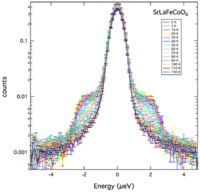
Hyperfine interaction and electronic spin fluctuation study on Sr2−xLaxFeCoO6 (x = 0, 1, 2) by high-resolution backscattering neutron spectroscopy

T. Chatterji, B. Frick, M. Zamponi, M. Appel, H. S. Nair, R. Pradheesh, G. R. Hariprya, V. Sankaranarayanan, and K. Sethupathi

Phys. Rev. B 98, 094429 (2018) - Published 27 September, 2018

The double perovskites form a class of materials with diverse tunable electronic and magnetic ground states and properties and promise to be excellent functional materials for the near future. Here, high-resolution neutron spectroscopic studies reveal their magnetic ground states and their dynamical response, which seem to be typical of their complex ground states. The studied double perovskite materials Sr2−xLaxFeCoO6 (x=0, 1, 2), of which the first (Sr2FeCoO6 with x = 0) shows a canonical spin-glass ground state, the second (SrLaFeCoO6 with x = 1) shows a so-called magnetic glass state, and the third (La2FeCoO6 with x = 2) has a magnetically ordered ground state. All these magnetic properties can be tuned and engineered by varying the proportion of Sr and La in these materials.

Strong spin-orbit coupling in the noncentrosymmetric Kondo lattice

A. Generalov, J. Falke, I. A. Nechaev, M. M. Otrokov, M. Güttler, A. Chikina, K. Kliemt, S. Seiro, K. Kummer, S. Danzenbächer, D. Usachov, T. K. Kim, P. Dudin, E. V. Chulkov, C. Laubschat, C. Geibel, C. Krellner, and D. V. Vyalikh

Phys. Rev. B 98, 115157 (2018) - Published 27 September, 2018

The authors investigate the properties of a two-dimensional Kondo lattice represented by a noncentrosymmetric Si-Ir-Si-Yb four-layer block at the surface of the heavy-fermion material YbIr2Si2. Strong spin-orbit coupling of Ir atoms induces spin polarization of two-dimensional itinerant surface states confined in this block, while the lattice of Yb 4f moments acts as a source for coherent field interplay. Remarkably, apart from the anticipated Rashba-like splitting of the two-dimensional itinerant states, a tiny spin splitting of the Yb 4f states of the block is also revealed. Electrons in these 4f states interact in a temperature-dependent fashion with highly mobile spin-polarized itinerant states, gently guiding their properties.

Strain tuning of excitons in monolayer WSe2

Burak Aslan, Minda Deng, and Tony F. Heinz

Phys. Rev. B 98, 115308 (2018) - Published 27 September, 2018

The authors investigate the influence of strain on the electronic properties of monolayer WSe2 using optical absorption and photoluminescence spectroscopy. The linewidth of the A exciton exhibits a significant and unexpected decrease, from 42 to 24 meV at room temperature. A slightly different behavior is observed for WS2; its linewidth decreases from 30 to 24 meV. They provide a model that explains both the decrease in linewidth and differences in the magnitude of the effect in these two similar material systems. Their findings reveal the utility of strain tuning for probing subtle aspects of 2D materials.

Field evolution of magnons in α−RuCl3 by high-resolution polarized terahertz spectroscopy

Liang Wu, A. Little, E. E. Aldape, D. Rees, E. Thewalt, P. Lampen-Kelley, A. Banerjee, C. A. Bridges, J.-Q. Yan, D. Boone, S. Patankar, D. Goldhaber-Gordon, D. Mandrus, S. E. Nagler, E. Altman, and J. Orenstein

Phys. Rev. B 98, 094425 (2018) - Published 26 September, 2018

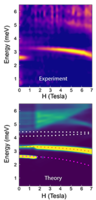
The quantum spin liquid (QSL) – a phase of matter with no ordered ground state – is of fundamental interest as excitations in this phase may break the molds of bosons and fermions and develop more complicated properties. The honeycomb magnet α-RuCl3 has emerged as a candidate for realization of a QSL. Although it orders at low temperature, an in-plane magnetic field of around 7 Tesla destroys the order; the nature of this transition is intensely studied. Here, the authors use polarized time-domain terahertz spectroscopy to study the spectrum of magnetic excitations in α-RuCl3 in an applied field. Motivated by the unusual evolution of the spectra, the authors develop a linear spin wave theory to describe the data with strikingly good agreement. These results provide clarity for ongoing work on this compound, and inform future studies aiming to detect field-induced QSL states.

Micron-scale measurements of low anisotropic strain response of local Tc in Sr2RuO4

Christopher A. Watson, Alexandra S. Gibbs, Andrew P. Mackenzie, Clifford W. Hicks, and Kathryn A. Moler

Phys. Rev. B 98, 094521 (2018) - Published 26 September, 2018

Topological superconductivity is of both fundamental and technological interest as a novel state of matter with potential applications in quantum information processing. Among the most promising materials for exhibiting intrinsic topological superconductivity is Sr2RuO4, which has shown evidence of triplet pairing and time-reversal symmetry breaking. Here, the authors use a scanning SQUID microscope to measure the local change in the critical temperature under application of anisotropic strain to test for a linear cusp at small strains, a key prediction of existing models for the superconducting state. The reported absence of such a cusp constrains future descriptions of this enigmatic material.

Generation of pure superconducting spin current in magnetic heterostructures via nonlocally induced magnetism due to Landau Fermi liquid effects

X. Montiel and M. Eschrig

Phys. Rev. B 98, 104513 (2018) - Published 26 September, 2018

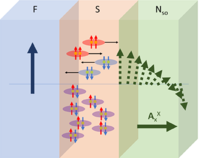
The authors propose a novel mechanism for the creation of superconducting spin currents in a ferromagnet/superconductor/normal-metal heterostructure via a non-locally induced exchange field in the normal layer, which exhibits Landau Fermi liquid interactions. When the structure enters the superconducting state, spin-triplet superconducting correlations transfer spin across the superconductor and induce remotely a magnetization in the normal layer. The authors then show that in the presence of strong spin-orbit interaction in the normal-metal layer, the induced magnetization is rotated with respect to the magnetization in the ferromagnet. This magnetization misalignment leads to a spin torque on both magnetizations and causes a superconducting spin current to flow across the superconductor. These results open new avenues for designing devices for superconducting spintronics.

Inclusion-exclusion principle for many-body diagrammatics

Aviel Boag, Emanuel Gull, and Guy Cohen

Phys. Rev. B 98, 115152 (2018) - Published 26 September, 2018

Diagrammatic resummation techniques have recently enabled new classes of quantum Monte Carlo algorithms, but are restricted by the need to sum over factorially large sets of diagrams. Here, the authors present a fast algorithm for summing over the diagrams appearing in Inchworm hybridization expansions. The method relies on the inclusion-exclusion principle to reduce the scaling from factorial to exponential. For the Inchworm hybridization expansion, when compared to the previous state of the art, the new algorithm is shown to provide practical performance gains of approximately two orders of magnitude.

Quantitative evaluation of Dirac physics in PbTe

Kazuto Akiba, Atsushi Miyake, Hideaki Sakai, Keisuke Katayama, Hiroshi Murakawa, Noriaki Hanasaki, Sadao Takaoka, Yoshiki Nakanishi, Masahito Yoshizawa, and Masashi Tokunaga

Phys. Rev. B 98, 115144 (2018) - Published 24 September, 2018

Exploration of novel macroscopic responses stemming from relativistic Dirac fermions in materials has become popular in condensed matter physics. Here, the authors carefully analyze the quantum oscillations in PbTe and evaluate the ratio of the Zeeman to the cyclotron energy, which has been proposed as a macroscopic index to find how close the system is to the ideal two-band Dirac system. The results remind us of the importance of the trivial phase shift by Zeeman splitting when considering the nontrivial Berry phase from quantum oscillations in topological materials.

Synthesizing Coulombic superconductivity in van der Waals bilayers

Valla Fatemi and Jonathan Ruhman

Phys. Rev. B 98, 094517 (2018) - Published 19 September, 2018

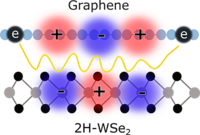
The emerging field of van der Waals heterostructures promises the engineering of quantum ground states by combining materials with different properties. A special point of interest is the synthesis of new superconductors. Here, the authors explore the idea of combining very fast electrons with very slow ones, proposing a bilayer heterostructure consisting of monolayer graphene (fast) on top of a monolayer semiconducting transition metal dichalcogenide WSe2 (slow). This interesting two liquid model generates a slow plasmonic mode that acts somewhat like phonons in a crystal, which can mediate an attractive interaction to make graphene superconducting. This mechanism for superconductivity is found to be uniquely optimized in van der Waals heterostructures, and the transition temperature is estimated to be in the range of 0.1 Kelvin. If such a superconductor were realized in an experiment, it would be a special example in which attraction between electrons is clearly mediated by electrons.

Transverse vortex commensurability effect and sign change of the Hall voltage in superconducting YBa2Cu3O7−δ thin films with a nanoscale periodic pinning landscape

G. Zechner, W. Lang, M. Dosmailov, M. A. Bodea, and J. D. Pedarnig

Phys. Rev. B 98, 104508 (2018) - Published 18 September, 2018

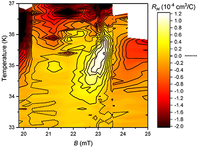
In superconductors with a periodic pinning potential, the vortices can lock into a commensurate arrangement, where each pin is filled by one vortex. Then, an intriguing duality between conduction electrons in a normal metal and mobile vortices in a superconductor arises. While the mutual repulsion of electrons can evoke a Mott insulator, the interaction between mobile and commensurably trapped vortices can lead to a vortex Mott metal-to-insulator transition with vanishing resistance. The authors report on a hitherto unknown manifestation of such a state, uncovered by measurements of the voltage orthogonal to the injected current. This vortex Hall effect exhibits a sharp peak and a change of sign when the number of vortices exactly matches that of the pins.

Optical gap and optically active intragap defects in cubic BN

Anna Tararan, Stefano di Sabatino, Matteo Gatti, Takashi Taniguchi, Kenji Watanabe, Lucia Reining, Luiz H. G. Tizei, Mathieu Kociak, and Alberto Zobelli

Phys. Rev. B 98, 094106 (2018) - Published 17 September, 2018

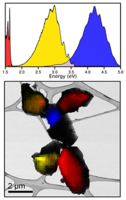
Studies on the optical properties of cubic BN are generally hindered by the very high density of crystal defects. Thus, the precise value of its optical gap is still debated, with large discrepancies between reported theoretical and experimental estimated values. Here, the authors address open questions of the cubic BN optics by employing high spatially resolved spectroscopy techniques to the highest-quality samples available and combining these observations with state-of-the-art quasiparticle calculations.

Theory of spin Bott index for quantum spin Hall states in nonperiodic systems

Huaqing Huang and Feng Liu

Phys. Rev. B 98, 125130 (2018) - Published 17 September, 2018

Quantum spin Hall effects (QSHE) arising from electron band topology are usually limited to crystals. Here, the authors extend the concept of QSHE to nonperiodic systems. They derive a spin Bott index to characterize the electronic topology in aperiodic and amorphous systems, and confirm its applicability by realizing the QSHE in quasicrystals. As in crystals, the QSHE in quasicrystals manifests with robust metallic edge states and quantized conductance. Their findings not only provide a better understanding of electronic properties of nonperiodic systems, but also extend the search of the QSH phase to aperiodic and amorphous materials that are experimentally feasible.

Transformation optics approach to singular metasurfaces

Fan Yang, Paloma A. Huidobro, and J. B. Pendry

Phys. Rev. B 98, 125409 (2018) - Published 14 September, 2018

Metasurfaces can be formed by nanostructuring a metal surface at the subwavelength scale and are used for the control of radiation in varied ways. Extremely sharp points on the surface give rise to singular metasurfaces, which efficiently convert incident radiation into surface plasmons. These plasmons slowly approach the singular points, which act as energy sinks, thus leading to increased absorption for a wide frequency band. This continuous spectrum is the main characteristic of singular metasurfaces: while being periodic they are actually equivalent to a bulk structure in one extra dimension and for that reason they present a continuous rather than discrete set of modes.

Kekulé valence bond order in an extended Hubbard model on the honeycomb lattice with possible applications to twisted bilayer graphene

Xiao Yan Xu, K. T. Law, and Patrick A. Lee

Phys. Rev. B 98, 121406(R) (2018) - Published 13 September, 2018

Motivated by recent experimental findings of correlating insulator and superconductor behavior in twisted bilayer graphene, the authors study a cluster charge interaction model on a honeycomb lattice. The cluster charge is defined on the dual lattice of honeycomb to mimic charge centers forming a triangular lattice found in experiments. Based on unbiased sign-problem-free quantum Monte Carlo simulations, the authors determine the phase diagram for this model. It features a fermionic quantum critical point with chiral XY universality and a Kekulé valence bond solid phase at intermediate interaction, which may be related to the correlating insulator phase found in experiments. This is an example of the rich phases found in a simple model without artificial design.

Ferromagnetic domain wall as a nonreciprocal string

Shu Zhang and Oleg Tchernyshyov

Phys. Rev. B 98, 104411 (2018) - Published 10 September, 2018

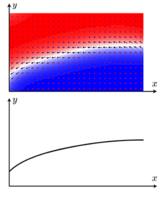
The wave equation, describing transverse vibrations of a string with mass density ρ and tension σ, can be modified by adding a mixed spatiotemporal derivative: ρ ÿ + 2g ẏ′ - σy′′ = 0. A string with g≠0 is nonreciprocal: waves traveling on it in opposite directions have different speeds. Its normal modes and response to perturbations are quite unusual. When tilted and released, it not only oscillates about its equilibrium position, but also acquires an average velocity proportional to the tilt. The nonreciprocal string is an accurate low-energy model of a domain wall in a thin-film ferromagnet.

Dyonic Lieb-Schultz-Mattis theorem and symmetry protected topological phases in decorated dimer models

Xu Yang, Shenghan Jiang, Ashvin Vishwanath, and Ying Ran

Phys. Rev. B 98, 125120 (2018) - Published 10 September, 2018

Lieb-Schultz-Mattis (LSM) theorem and its various generalizations provide powerful guidance towards the search for novel phases of matter. Here, the authors propose and prove a generalized LSM theorem suitable for 2+1D lattice models of interacting bosons or spins, with both magnetic flux and fractional spin in the unit cell. One outcome of this theorem is that, under certain conditions, the gapped ground states preserving all symmetries must be a nontrivial symmetry-protected topological (SPT) phase. Such symmetry-enforced SPTs display a dyonic character in that they associate charge with symmetry flux, which is demonstrated using quasiexactly solvable models constructed by decorating quantum dimer models.

Sign In to Your Journals Account

Filter

Section

Filter

Article Lookup

Enter a citation