Highlights

Effective edge state dynamics in the fractional quantum Hall effect

R. Fern, R. Bondesan, and S. H. Simon

Phys. Rev. B 98, 155321 (2018) - Published 29 October, 2018

The authors consider here the behavior of quantum Hall edges away from the Luttinger liquid fixed point that describes the low energy, large system limit. Using the links between quantum Hall wave functions and conformal field theories, they construct effective Hamiltonians and constrain their forms by considering bulk symmetries. In examining the effect of bulk interactions on this edge, they find remarkable simplifications to these effective theories that allow a very accurate description of the low-energy physics of quantum Hall edges relatively far away from the Luttinger liquid fixed point, and that apply to small systems and higher energies.

Signatures of atomic-scale structure in the energy dispersion and coherence of a Si quantum-dot qubit

J. C. Abadillo-Uriel, Brandur Thorgrimsson, Dohun Kim, L. W. Smith, C. B. Simmons, Daniel R. Ward, Ryan H. Foote, J. Corrigan, D. E. Savage, M. G. Lagally, M. J. Calderón, S. N. Coppersmith, M. A. Eriksson, and Mark Friesen

Phys. Rev. B 98, 165438 (2018) - Published 29 October, 2018

Valley splitting affects the energy dispersion of silicon quantum dot qubits, and occasionally manifests itself through some striking features. Here, the authors observe a strong correlation between unexpected “sweet spots” and “hot spots” in the coherence rates of a quantum-dot hybrid qubit and in some anomalous features in the energy dispersion. Through tight-binding simulations, they are able to attribute such effects to disorder at the quantum-well interface and speculate on the possibility of harnessing disorder to enhance qubit coherence times.

Magnetic structure and spin correlations in magnetoelectric honeycomb Mn4Ta2O9

N. Narayanan, A. Senyshyn, D. Mikhailova, T. Faske, T. Lu, Z. Liu, B. Weise, H. Ehrenberg, R. A. Mole, W. D. Hutchison, H. Fuess, G. J. McIntyre, Y. Liu, and D. Yu

Phys. Rev. B 98, 134438 (2018) - Published 22 October, 2018

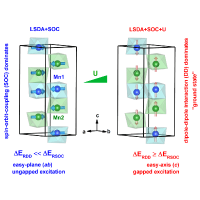
The coupling between magnetic ordering and electric polarization in magnetoelectrics is technically relevant and not yet completely understood. The elucidation of this requires a comprehension of underlying magnetic interactions and the electronic structure. Here, the authors investigate the magnetoelectric honeycomb compound Mn4Ta2O9, by means of neutron scattering and electronic structure calculations, to reveal the ingredients that determine the ground state. For this compound, the ground state is determined by an electron correlation assisted magnetic dipole-dipole interaction. The investigation here offers detailed insight into the factors that determine the ground-state manifold and the role of electron correlation on the strength of anisotropy.

Electrodynamics of Josephson junctions containing strong ferromagnets

D. Massarotti, N. Banerjee, R. Caruso, G. Rotoli, M. G. Blamire, and F. Tafuri

Phys. Rev. B 98, 144516 (2018) - Published 22 October, 2018

Triplet superconductivity, with equal-spin Cooper pairs, are of fundamental importance to develop an ultralow-dissipation version of spintronics with superconductors. The dynamical properties of Josephson junctions with triplet supercurrents have largely remained unexplored. Here, the authors analyze the phase dynamics of these junctions for possible applications in superconducting circuits. Remarkably, the junction electrodynamics can be reconstructed within the framework of the well-known resistively and capacitively shunted junction model with renormalized parameters, possibly providing a novel way to dynamically detect triplets.

Quantum scarred eigenstates in a Rydberg atom chain: Entanglement, breakdown of thermalization, and stability to perturbations

C. J. Turner, A. A. Michailidis, D. A. Abanin, M. Serbyn, and Z. Papić

Phys. Rev. B 98, 155134 (2018) - Published 22 October, 2018

Recent experiments on Rydberg-atom quantum simulators have observed surprising signatures of nonergodic quantum dynamics, which has been attributed to the emergence of “many-body quantum scars.” Here, the authors present a detailed study of the eigenstate properties of strongly interacting Rydberg-atom chains, identifying distinct families of quantum scarred states that are responsible for the revivals in the quench dynamics. The results show that quantum scarred states have distinct features, such as subthermal entanglement and anomalous expectation values of local observables. The presence of scarred eigenstates leaves an imprint on the rest of the many-body spectrum, leading to a weak breakdown of ergodicity.

Third-order frequency-resolved photon correlations in resonance fluorescence

Yamil Nieves and Andreas Muller

Phys. Rev. B 98, 165432 (2018) - Published 22 October, 2018

Recently, the concept of an ”N-photon spectrum” – a spectrally resolved N-photon correlation function – has been introduced as an innovative quantum optics characterization tool that uniquely reveals information about pathways underlying the generation of light in a given source. Here, the authors investigate experimentally the three-photon spectrum of resonance fluorescence from a single semiconductor quantum dot. The observations agree with previous theoretical work, revealing significantly more pronounced photon antibunching at the Mollow triplet sidebands and more strongly correlated emission through virtual states compared to the two-photon counterpart.

Thermodynamic evidence of a second skyrmion lattice phase and tilted conical phase in Cu2OSeO3

M. Halder, A. Chacon, A. Bauer, W. Simeth, S. Mühlbauer, H. Berger, L. Heinen, M. Garst, A. Rosch, and C. Pfleiderer

Phys. Rev. B 98, 144429 (2018) - Published 19 October, 2018

Skyrmion lattices in magnetic materials represent long-range magnetic order featuring nontrivial topological winding. Here, magnetization, ac susceptibility, and specific heat data are reported that provide thermodynamic evidence of two disconnected skyrmion lattice phases in the same material, the cubic insulator Cu2OSeO3. The magnetization and susceptibility demonstrate, moreover, that the two phases are stabilized by two inherently different mechanisms. Whereas the high-temperature skyrmion phase originates in entropic effects driven by thermal fluctuations, the low-temperature skyrmion phase is due to conventional cubic magnetic anisotropies, previously thought to be too weak to be thermodynamically relevant.

Influence of the magnetic field on the stability of the multiferroic conical spin arrangement of Mn0.80Co0.20WO4

I. Urcelay-Olabarria, E. Ressouche, V. Y. Ivanov, V. Skumryev, Z. Wang, Y. Skourski, A. M. Balbashov, Yu. F. Popov, G. P. Vorob'ev, N. Qureshi, J. L. García-Muñoz, and A. A. Mukhin

Phys. Rev. B 98, 134430 (2018) - Published 17 October, 2018

The synergetic use of macroscopic magnetization, electric polarization, and single-crystal neutron diffraction techniques allows the tracking of the evolution of the magnetic structures (in magnetic fields up to 60 T) of the multiferroic Mn0.80Co0.20WO4, which has an antiferromagnetic conical ground state. The complete magnetoelectric phase diagrams for the three distinct magnetic directions (the easy and the hard magnetic directions and the b crystallographic axis) are constructed. Marked differences are found in the topologies between the phase diagrams, which might be common for other magnetic materials possessing conical antiferromagnetic structures.

Unconventional superconductivity in the single-atom-layer alloy Si(111)−√3×√3−(Tl,Pb)

T. Nakamura, H. Kim, S. Ichinokura, A. Takayama, A. V. Zotov, A. A. Saranin, Y. Hasegawa, and S. Hasegawa

Phys. Rev. B 98, 134505 (2018) - Published 16 October, 2018

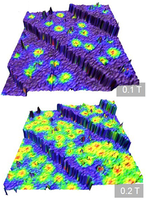
The Si(111)-3×3-(Tl, Pb) surface has recently emerged as being a two-dimensional one-atom thick superconductor with spin-split bands, due to the Rashba-Bychkov effect. Here, the authors use scanning tunneling microscopy and spectroscopy to measure its superconductivity. They observe the unconventional nature, the anisotropy of the superconducting gap, and the pseudogap structure under a magnetic field. These results promote further experimental and theoretical investigations of possible parity-broken superconductors.

Phase separation at the dimer-superconductor transition in Ir1−xRhxTe2

R. Yu, S. Banerjee, H. Lei, M. Abeykoon, C. Petrovic, Z. Guguchia, and E. S. Bozin

Phys. Rev. B 98, 134506 (2018) - Published 16 October, 2018

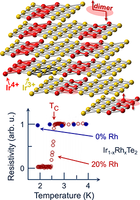
Unconventional superconductivity often appears in proximity of symmetry-breaking electronic and magnetic orders. The relevance of spatiotemporal fluctuations of these orders for the superconducting pairing remains an open question. Here, nanoscale broken-symmetry states are probed by high-energy x-rays in a layered iridium ditelluride superconductor, where superconductivity emerges from an ordered dimer state. The study finds no fingerprints of dimer fluctuations in the superconducting compositional regime, yet provides evidence for the coexistence of superconductivity and nanoscale dimerization close to the phase boundary of these two electronic states.

Velocity-dependent Lyapunov exponents in many-body quantum, semiclassical, and classical chaos

Vedika Khemani, David A. Huse, and Adam Nahum

Phys. Rev. B 98, 144304 (2018) - Published 16 October, 2018

It has been a long-standing challenge to expand the notion of exponential sensitivity to small perturbations in the initial conditions from the realm of classical chaos to that of many-body quantum systems. Recently, exponential growth in a measure known as the out-of-time-order commutator (OTOC) has been proposed as a diagnostic of chaos in the setting of many-body quantum systems. The authors examine the behavior of the OTOC along rays of different velocities for a variety of spatially local extended many-body quantum systems, both integrable and nonintegrable. They find that the velocity-dependent Lyapunov exponents are negative for velocities greater than a characteristic “butterfly speed”, which defines the light cone for the spreading of operators. It is demonstrated that a regime with well-defined positive Lyapunov exponents inside the light-cone may only exist for classical, semiclassical, weakly interacting, or large-N systems, but not for fully quantum systems with strong short-range interactions and local Hilbert space dimensions of order one.

Paradoxical extension of the edge states across the topological phase transition due to emergent approximate chiral symmetry in a quantum anomalous Hall system

Denis R. Candido, Maxim Kharitonov, J. Carlos Egues, and Ewelina M. Hankiewicz

Phys. Rev. B 98, 161111(R) (2018) - Published 15 October, 2018

In quantum anomalous Hall systems (Chern insulators) the topological Chern number defines, via bulk-boundary correspondence, the number of the edge-state bands that connect the valence and conduction bulk bands. This is the only characteristic of the edge states required by quantum Hall topology. Here, the authors present a paradoxical finding that, in the vicinity of a topological phase transition in a quantum anomalous Hall system, topology nearly always results in a significant extension of the edge-state structure beyond the minimal one required to satisfy the Chern numbers.

Half moons are pinch points with dispersion

Han Yan (闫寒), Rico Pohle, and Nic Shannon

Phys. Rev. B 98, 140402(R) (2018) - Published 12 October, 2018

Frustrated magnetism provides a fascinating playground for realizing exotic states of matter, such as the spin liquid. A characteristic signature for a U(1) spin liquid is the “pinch point”, a distinctive singular pattern observed in neutron scattering experiments. Another pattern of an anisotropic ring, dubbed the “half moon”, often accompanies the pinch point. Here, the authors reveal the underlying physics linking the two signatures. The half moons are essentially pinch points inscribed on a dispersing band. By analyzing the kagome lattice–Heisenberg antiferromagnet, this work presents a detailed study of how a unifying field theory accounts for both features intuitively.

Sign-reversal superconducting gaps revealed by phase-referenced quasiparticle interference of impurity-induced bound states in (Li1−xFex)OHFe1−yZnySe

Qiangqiang Gu, Qingkun Tang, Siyuan Wan, Zengyi Du, Xiong Yang, Huan Yang, Qiang-Hua Wang, Hai Lin, Xiyu Zhu, and Hai-Hu Wen

Phys. Rev. B 98, 134503 (2018) - Published 11 October, 2018

It is very important, but not easy, to determine the superconducting gap function in unconventional superconductors. The key issue concerns whether there is a sign change in the gap function. In iron-based superconductors, this becomes even more difficult due to the complexity of multiple Fe 3d orbitals. Here, the authors adopt a recently proposed method – phase-referenced quasiparticle interference (QPI) of defect-bound states (DBS) via scanning tunneling microscope/spectroscopy – and visualize directly the gap sign change of the superconducting gaps in the iron-based superconductor (Li1−xFex)OHFe1−yZnySe. This work provides an easy and feasible way for detecting the gap function of unconventional superconductors.

Quantized magnetic flux and the magnetohalon effect in a critical superconductor

Kun Chen and Boris Svistunov

Phys. Rev. B 98, 140503(R) (2018) - Published 11 October, 2018

If a solenoid is introduced into a superconductor at its critical temperature, the net magnetic flux is quantized. A nontrivial effect takes place at the transition between two adjacent values of the magnetic flux. On the approach to the critical point (corresponding to half-integer bare solenoid flux), the spatial distribution of magnetic flux splits into a half-integer core and a critically large halo carrying plus/minus one half of the flux quantum. The phenomenon is a direct counterpart of the recently revealed halon effect in terms of the quantized particle charge of a static impurity in the two-dimensional U(1) quantum-critical environment.

Controlling the helicity of magnetic skyrmions in a β-Mn-type high-temperature chiral magnet

K. Karube, K. Shibata, J. S. White, T. Koretsune, X. Z. Yu, Y. Tokunaga, H. M. Rønnow, R. Arita, T. Arima, Y. Tokura, and Y. Taguchi

Phys. Rev. B 98, 155120 (2018) - Published 11 October, 2018

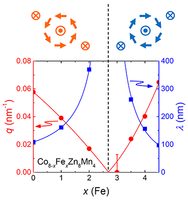
Magnetic skyrmions, vortex-like topological spin textures, are representative examples of chiral magnetic structures. Their spin swirling direction, known as magnetic helicity, is uniquely determined by the sign of the Dzyaloshinskii-Moriya interaction (DMI). Here, the authors experimentally and theoretically investigate the DMI in a metallic chiral magnet Co8−xFexZn8Mn4 with β-Mn-type structure, and found that the DMI systematically varies with increasing Fe concentration and that a sign reversal of the DMI occurs. The results demonstrate that the DMI critically depends on the band filling and that a sign change in the DMI universally occurs in metallic chiral magnets.

Mapping of the energetically lowest exciton in bulk 1T−HfS2

Carsten Habenicht, Lorenzo Sponza, Roman Schuster, Martin Knupfer, and Bernd Büchner

Phys. Rev. B 98, 155204 (2018) - Published 11 October, 2018

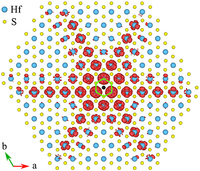
Excitons are of fundamental interest and technological importance in applications such as optoelectronic and photonic devices. The authors provide a wide-ranging picture of the excitonic processes in bulk 1T-HfS2, employing state-of-the art computational methods as well as electron energy-loss spectroscopy, a method uniquely suited to make momentum-dependent measurements of electronic excitations. The study describes the exciton’s dispersion, origins within the Brillouin zone, binding energies, and effective mass. Moreover, the calculations reveal that the electron-hole pair assumes a starlike shape in the planes, indicating a mixed Frenkel-Wannier character.

Avoided level crossing at the magnetic field induced topological phase transition due to spin-orbital mixing

G. Krizman, B. A. Assaf, M. Orlita, T. Phuphachong, G. Bauer, G. Springholz, G. Bastard, R. Ferreira, L. A. de Vaulchier, and Y. Guldner

Phys. Rev. B 98, 161202(R) (2018) - Published 11 October, 2018

A three-dimensional gapless Dirac state is expected to occur at the critical point between a topological and a trivial phase. By applying a strong magnetic field or increasing temperature, a transition from topological to trivial can be induced in the topological crystalline insulator Pb1−xSnxSe (x>0.16). Using magneto-optical spectroscopy, the authors show that the critical gapless Dirac state is unstable in the case of Pb1−xSnxSe (x=0.19). An avoided crossing of energy bands is observed when a topological phase transition is induced by a magnetic field or by increasing temperature. The avoided crossing is accompanied by a spin-orbital mixing of the band-edge parity. These results motivate research aimed at elucidating the mechanism behind this type of topological phase transition.

Competing structural instabilities in Bi2SiO5

A. Girard, H. Taniguchi, S. M. Souliou, M. Stekiel, W. Morgenroth, A. Minelli, A. Kuwabara, A. Bosak, and B. Winkler

Phys. Rev. B 98, 134102 (2018) - Published 9 October, 2018

Bi2SiO5 recently emerged as a promising ambient-temperature lead-free ferroelectric with a Curie temperature of 663 K, where the ferroelectricity arises from the tilt of quasi-one-dimensional SiO4 chains. Here, the authors analyze the competition between ferroelectric and antiferroelectric instabilities by investigating the characteristic temperature-dependent phonon energies at the center and the edge of the Brillouin zone, respectively. The direct evidence for this competition opens the way towards tuning the properties of Bi2SiO5 by application of pressure or electrical field.

Classification of atomic-scale multipoles under crystallographic point groups and application to linear response tensors

Satoru Hayami, Megumi Yatsushiro, Yuki Yanagi, and Hiroaki Kusunose

Phys. Rev. B 98, 165110 (2018) - Published 8 October, 2018

The concept of multipoles has attracted growing interest in condensed matter physics, since it is widely utilized to characterize electronic states microscopically in a unified manner. Here, the authors theoretically construct a general formalism of multipole description by considering four independent types of multipoles: electric, magnetic, electric toroidal, and magnetic toroidal. The authors systematically derive microscopic expressions of multipoles in both real and momentum spaces, and clarify how multipoles determine the structure of electronic band and linear response tensors with or without space-time parity conversion. The complete tables to summarize the active multipoles under 32 crystallographic point groups will give a comprehensive and systematic understanding of a wide variety of physical phenomena at the microscopic level.

Sign In to Your Journals Account

Filter

Section

Filter

Article Lookup

Enter a citation