Highlights

NMR relaxation in Ising spin chains

Julia Steinberg, N. P. Armitage, Fabian H. L. Essler, and Subir Sachdev

Phys. Rev. B 99, 035156 (2019) - Published 29 January, 2019

The quantum Ising chain in a transverse magnetic field is the paradigm of a quantum phase transition, displaying universal quantum criticality at low temperatures. Insights from this model have informed studies of quantum criticality in numerous modern correlated-electron materials. There have been a number of experimental studies of the quantum Ising chain, most notably in the material CoNb2O6. It has recently become clear that there was a surprising discrepancy between the observations: the energy gap in the quantum disordered regime as measured by nuclear magnetic resonance was approximately twice that measured by other methods. Here, the authors show via careful analysis of the low-temperature excitations that this is not a discrepancy, rather, it is in fact to be expected from the subtle interactions between the excitations. Although the underlying spin excitations are bosonic, their interactions transmute them into fermions, and this is a key ingredient in understanding the experiments.

Field-induced insulating states in a graphene superlattice

S. Pezzini, S. Wiedmann, A. Mishchenko, M. Holwill, R. Gorbachev, D. Ghazaryan, K. S. Novoselov, and U. Zeitler

Phys. Rev. B 99, 045440 (2019) - Published 29 January, 2019

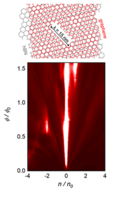
When graphene is aligned on top of hBN and subjected to a magnetic field, ‘cloning’ of Dirac fermions takes place each time rational values of flux quanta thread the superlattice unit cell. Here, the authors use high-field magnetotransport up to 35 T to address the emergence of insulating replica states in a 15-nm graphene/hBN superlattice. An analysis in the framework of Landau quantization of the replica particles in an effective magnetic field allows us to determine their energy-momentum dispersion, which is renormalized compared with the original electron states.

Disconnected elementary band representations, fragile topology, and Wilson loops as topological indices: An example on the triangular lattice

Barry Bradlyn, Zhijun Wang, Jennifer Cano, and B. Andrei Bernevig

Phys. Rev. B 99, 045140 (2019) - Published 25 January, 2019

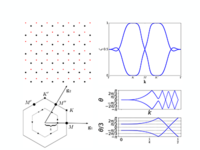
Like all topologically nontrivial bands, the recently discovered fragile topological states cannot be described with symmetric localized basis functions. Unlike the well-understood “stable” topological phases, fragile ones have a localized description in the presence of additional trivial orbitals. Here, the authors explore the properties of fragile topological bands, focusing on a family of models on a triangular lattice. The authors show how nonabelian Berry phases can be used to diagnose fragile topology. They also explore how fragile topology manifests itself in the entanglement spectrum.

Ultrahigh-resolution neutron spectroscopy of low-energy spin dynamics in UGe2

F. Haslbeck, S. Säubert, M. Seifert, C. Franz, M. Schulz, A. Heinemann, T. Keller, Pinaki Das, J. D. Thompson, E. D. Bauer, C. Pfleiderer, and M. Janoschek

Phys. Rev. B 99, 014429 (2019) - Published 24 January, 2019

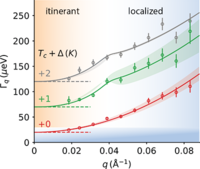
Ultraslow spin dynamics represent a key characteristic of quantum matter. Investigating a prototypical quantum material ⎯ the putative spin-triplet superconductor UGe2 ⎯ the authors demonstrate that the novel Modulated IntEnsity by Zero Effort (MIEZE) neutron spectroscopy technique with ultrahigh energy resolution of better than 1 μeV allows to disentangle spectroscopically the complex low-energy behavior of quantum states. They observe spin fluctuations with a dual nature arising from localized 5f electrons that are hybridized with the conduction electrons consistent with spin-triplet superconductivity. The study outlines a general recipe of how the advances enabled by the MIEZE technique can be used to shed light on novel quantum matter states.

Spin-wave modes in transition from a thin film to a full magnonic crystal

M. Langer, R. A. Gallardo, T. Schneider, S. Stienen, A. Roldán-Molina, Y. Yuan, K. Lenz, J. Lindner, P. Landeros, and J. Fassbender

Phys. Rev. B 99, 024426 (2019) - Published 24 January, 2019

Standing spin waves in thin films with a tiny periodic surface modulation are quantized in such a way that a multiple of their wavelength fits into one modulation period. This paper tackles the question how these film modes evolve into modes in a one-dimensional magnonic crystal consisting of periodic individual wire structures. By sequentially increasing the surface modulation and subsequent dynamic characterization of the same sample, simple transition rules are found connecting the modes of both systems with one another.

Charge fluctuations of a Cr atom probed in the optical spectra of a quantum dot

L. Besombes, H. Boukari, V. Tiwari, A. Lafuente-Sampietro, M. Sunaga, K. Makita, and S. Kuroda

Phys. Rev. B 99, 035309 (2019) - Published 24 January, 2019

Doping semiconductor quantum dots with a low density of transition elements allows us to optically probe and control spins of individual magnetic atoms. A large variety of magnetic elements can be incorporated in semiconductors, offering a large choice of localized spins. For some of these elements, optical excitation or electrical doping can change the d shell configuration and the oxidation state. This is the case for Cr in ZnTe, having both its donor and acceptor levels within the band gap of the host. Here, the authors show that the charge fluctuations of a Cr atom located close to a CdTe quantum dot in the ZnTe barrier can be detected optically. Fluctuations of the electric field produced by the three possible charge states (-e, 0, and +e) of the Cr atom are observed in magneto-optic and photon correlation measurements and can be modified by an applied bias voltage.

Topological exceptional surfaces in non-Hermitian systems with parity-time and parity-particle-hole symmetries

Ryo Okugawa and Takehito Yokoyama

Phys. Rev. B 99, 041202(R) (2019) - Published 24 January, 2019

Non-Hermiticity makes possible novel topological phenomena, which are notallowed in Hermitian systems. The authors show that topologically nontrivial band degeneracies can appear as exceptional surfaces in non-Hermitian systems with parity–time and parity–particle-hole symmetries. It is shown that when parity–time or parity–particle-hole symmetry is present, d-dimensional non-Hermitian systems can have (d−1)-dimensional exceptional surfaces. This work suggests new topological phases with nodal band structures protected by non-Hermitian topology and symmetry.

Symmetry-protected nodal phases in non-Hermitian systems

Jan Carl Budich, Johan Carlström, Flore K. Kunst, and Emil J. Bergholtz

Phys. Rev. B 99, 041406(R) (2019) - Published 24 January, 2019

Symmetry plays a paramount role for the classification of phases of matter occurring in nature. Combining symmetry analysis with concepts from topology that allow us to identify global and robust physical properties, new phases of quantum matter, such as topological insulators and semimetals, have been discovered in recent years. Here, the authors analyze in general and exemplify the importance of symmetries to the dissipative counterparts of topological semimetals in non-Hermitian systems, thus introducing the notion of symmetry-protected non-Hermitian nodal phases.

Quantum engine based on many-body localization

Nicole Yunger Halpern, Christopher David White, Sarang Gopalakrishnan, and Gil Refael

Phys. Rev. B 99, 024203 (2019) - Published 22 January, 2019

Many-body localization (MBL) is a phase of quantum matter that has attracted much experimental and theoretical attention recently. MBL particles stay fixed for long times, resisting thermalization. This athermality, the authors show, can serve as a resource in thermodynamic tasks. They formulate an engine cycle for a quantum many-body system tuned between MBL and thermal phases. MBL enables the engine to scale robustly, from mesoscale to macroscale, and improves the engine’s reliability. This work opens the door to technological applications of MBL.

Spin-dependent electron transmission model for chiral molecules in mesoscopic devices

Xu Yang, Caspar H. van der Wal, and Bart J. van Wees

Phys. Rev. B 99, 024418 (2019) - Published 18 January, 2019

Experimental observations have suggested that certain chiral molecules may be able to function as spin polarizers, an effect that promises new spintronic applications but whose mechanism remains unclear. Here, the authors bypass the microscopic origin of the effect and approach it by applying universal theorems of electrical conduction to mesoscopic devices that contain chiral molecules. This leads to a theoretical model that can quantitatively evaluate transport experiments and distinguish spin signals related to chiral molecules from other magnetic field dependent signals.

Spin stiffness and domain walls in Dirac-electron mediated magnets

Sahinur Reja, H. A. Fertig, and L. Brey

Phys. Rev. B 99, 045427 (2019) - Published 18 January, 2019

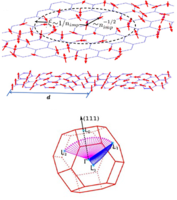
Gapless two-dimensional Dirac electrons are realized in a large variety of contexts, including graphene and topological-insulator surfaces. For many such systems considerable effort has been put into exploiting them to couple magnetic moments - magnetic impurities or moment-carrying crystal defects - to endow the system with magnetic properties. In this work, the authors show that such magnets generically support an emergent long-range interaction, realized in the spin stiffness of the resulting magnet, with remarkable consequences for domain-wall excitations.

High-pressure dc magnetic measurements on a bisdiselenazolyl radical ferromagnet using a vibrating-coil SQUID magnetometer

Kunihiko Irie, Keisuke Shibayama, Masaki Mito, Seishi Takagi, Mamoru Ishizuka, Kristina Lekin, and Richard T. Oakley

Phys. Rev. B 99, 014417 (2019) - Published 17 January, 2019

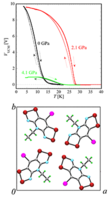
By using a vibrating-coil SQUID magnetometer, a ferromagnetic state with TC at the 30 K level is confirmed for the organic ferromagnet IBPSSEt. The high-pressure dc susceptibility has been measured in order to explore the pressure dependence on the dimensionality of the magnetic interaction network in IBPSSEt, which displays an ideal three-dimensional ferromagnetic network at 2 GPa with TC = 27.5 K. At more elevated pressures, the structure is best described in terms of a one-dimensional ferromagnetic chain.

Observation of quadrupole transitions and edge mode topology in an LC circuit network

Marc Serra-Garcia, Roman Süsstrunk, and Sebastian D. Huber

Phys. Rev. B 99, 020304(R) (2019) - Published 15 January, 2019

Higher-order topological insulators belong to a recently discovered class of materials where nontrivial topology results in boundary states with a dimensionality two or more below that of the bulk. This work realizes a higher-order topological insulator in a circuit model. By using nonlinear elements, the authors demonstrate dynamical switching between topological and trivial phases as well as controllable interactions between topologically protected states. The topological nature of the model is exhibited by direct extraction of the invariants from the measured boundary Green’s functions.

Nature of the excited states of layered systems and molecular excimers: Exciplex states and their dependence on structure

Marie-Christin Heissenbüttel, Philipp Marauhn, Thorsten Deilmann, Peter Krüger, and Michael Rohlfing

Phys. Rev. B 99, 035425 (2019) - Published 15 January, 2019

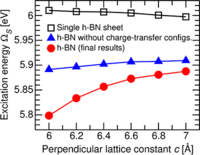
Chemically inert objects (e.g., noble-gas atoms) can show covalent-like excimer bonding when excited electronically. Analogous exciplex states are observed in layered materials such as graphite or transition-metal dichalcogenides. Here, the authors show by ab initio many-body perturbation theory that such exciplex states result from a delicate balance between on-site (or intralayer) and charge-transfer (or interlayer) electron-hole configurations. Both molecular systems and layered materials exhibit a characteristic relationship between geometric structure and excitation energetics.

Cavity superconductor-polaritons

Andrew A. Allocca, Zachary M. Raines, Jonathan B. Curtis, and Victor M. Galitski

Phys. Rev. B 99, 020504(R) (2019) - Published 14 January, 2019

Cavity polaritons have proven to be invaluable tools for probing novel quantum phenomena, including the observation of polariton Bose-Einstein condensation at room temperature. Here, the authors propose a new type of exotic polariton, continuing the recent surge of work incorporating quantum optical phenomena with interacting many-body systems. Formed from superpositions of photons and d-wave Cooper-pair fluctuations in a BCS superconductor, these superconductor-polaritons may provide a way to probe elusive collective modes and may open an avenue of research into the quantum optics of superconductors.

Topological nodal-line semimetals in ferromagnetic rare-earth-metal monohalides

Simin Nie, Hongming Weng, and Fritz B. Prinz

Phys. Rev. B 99, 035125 (2019) - Published 14 January, 2019

The topological nodal-line semimetals (TNLSs) found so far are extremely limited to nonmagnetic materials and most of them are spinless. Here, the authors find from first-principles calculations and an effective model analysis that the single-layer rare-earth monohalides LaX and single-layer GdX (where X is Cl or Br) are ideal 2D Weyl semimetals and large-gap 2D quantum anomalous Hall insulators (QAHIs), respectively. Moreover, 3D LaX and 3D GdX are TNLSs and 3D weak QAHIs, respectively. The nodal lines in 3D LaX are robust against strong spin-orbit coupling, providing a novel platform toward exploring the exotic properties in nodal-line fermions.

Detailed band structure of twinned and detwinned BaFe2As2 studied with angle-resolved photoemission spectroscopy

H. Pfau, C. R. Rotundu, J. C. Palmstrom, S. D. Chen, M. Hashimoto, D. Lu, A. F. Kemper, I. R. Fisher, and Z.-X. Shen

Phys. Rev. B 99, 035118 (2019) - Published 9 January, 2019

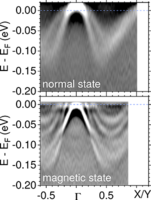
The superconducting dome of most iron-based superconductors emerges from a phase with nematic and magnetic ordering. However, the multiband and multiorbital nature of iron-based superconductors as well as twinning effects pose challenges to fully characterize the implications of these two ordering phenomena for the band structure. Here, the authors report high-quality ARPES measurements on twinned and detwinned BaFe2As2 and present a comprehensive and systematic overview of the band structure in the normal and the magnetically ordered states of this prototype parent compound.

Phenomenological theory of heat transport in the fractional quantum Hall effect

Amit Aharon-Steinberg, Yuval Oreg, and Ady Stern

Phys. Rev. B 99, 041302(R) (2019) - Published 8 January, 2019

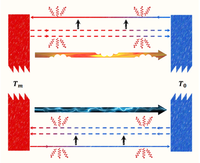
Experimental evidence shows that thermal transport in fractional quantum Hall (FQH) states involves energy loss to external degrees of freedom. However, so far, theory has disregarded this loss. Here, the authors construct and solve a phenomenological theory for heat transport in FQH states in the presence of these losses. The authors show that in contrast to the electric Hall conductance, the thermal Hall conductance is sensitive to this loss. They find the conditions for experimental extraction of the universal thermal Hall conductance for a FQH state, and the way this value quantitatively changes when the energy losses are not negligible.

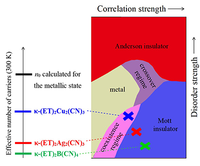
Hall effect study of the κ-(ET)2X family: Evidence for Mott-Anderson localization

M. Čulo, E. Tafra, B. Mihaljević, M. Basletić, M. Kuveždić, T. Ivek, A. Hamzić, S. Tomić, T. Hiramatsu, Y. Yoshida, G. Saito, J. A. Schlueter, M. Dressel, and B. Korin-Hamzić

Phys. Rev. B 99, 045114 (2019) - Published 8 January, 2019

Mott-Anderson localization is a very important but poorly explored phenomenon within condensed matter physics. Here, the authors present a Hall effect study of the κ-(ET)2X family, where X = Cu2(CN)3, Ag2(CN)3 and B(CN)4, which is ideal for studying the Mott-Anderson localization because correlations and disorder strengths vary with X. The results enable the determination of the proximity of the selected materials to the metal-insulator transition; in that way, one can locate them in the Mott-Anderson phase diagram.

Statistics of eigenstates near the localization transition on random regular graphs

K. S. Tikhonov and A. D. Mirlin

Phys. Rev. B 99, 024202 (2019) - Published 7 January, 2019
Anderson localization on random regular graphs (RRG) attracts much attention in view of its relation to many-body localization. Here, the authors study the statistics of eigenfunctions and energy levels on RRG, focussing on the delocalized (ergodic) phase and the critical regime. Results of exact diagonalization are in outstanding agreement with analytical theory based on the saddle-point analysis of the effective supersymmetric action supplemented by numerical solution of the corresponding self-consistency equation.

Sign In to Your Journals Account

Filter

Section

Filter

Article Lookup

Enter a citation