Highlights

Gauge theory for the cuprates near optimal doping

Subir Sachdev, Harley D. Scammell, Mathias S. Scheurer, and Grigory Tarnopolsky

Phys. Rev. B 99, 054516 (2019) - Published 25 February, 2019

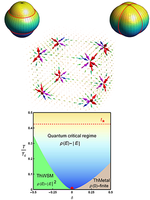
Recent experiments have revealed remarkable new features of the optimal doping state of cuprate superconductors, namely, a peak in the specific heat for the hole-doped case and a state with Fermi pockets but only fluctuating antiferromagnetic order for the electron-doped case. The authors propose a unified SU(2) gauge theory with a Higgs field and demonstrate how it can explain these disparate phenomena by way of topological phase transitions and crossovers.

Classification of topological insulators and superconductors out of equilibrium

Max McGinley and Nigel R. Cooper

Phys. Rev. B 99, 075148 (2019) - Published 25 February, 2019

The authors have discovered a topological classification of quantum many-body systems undergoing dynamical evolution, which can be applied to insulators and superconductors driven out of equilibrium. This classification is analogous to the equilibrium classification of topological insulators, which explains the remarkably quantized experimental signatures that these phases are known for. The nonequilibrium classification successfully predicts whether topological edge modes remain stable under external time-dependent fluctuations. This, in turn, has ramifications for the use of such systems in quantum technologies.

Orbital effects of a strong in-plane magnetic field on a gate-defined quantum dot

Peter Stano, Chen-Hsuan Hsu, Leon C. Camenzind, Liuqi Yu, Dominik Zumbühl, and Daniel Loss

Phys. Rev. B 99, 085308 (2019) - Published 22 February, 2019

Fermionic Lieb-Schultz-Mattis theorems and weak symmetry-protected phases

Meng Cheng

Phys. Rev. B 99, 075143 (2019) - Published 21 February, 2019

The celebrated Lieb-Schultz-Mattis theorem excludes a nondegenerate gapped ground state of a spin system with an odd number of s=12 spins per unit cell. Here, the author presents a new family of Lieb-Schultz-Mattis type theorems for fermionic systems that have no analog in spin systems. An example is a particle-hole symmetric system of spinless fermions on a lattice with an odd number of fermionic modes per unit cell. The author shows that a symmetric gapped ground state must be topologically ordered, and the lattice translation symmetries must permute anyon types, resulting in non-Abelian zero modes bound to lattice dislocations. These results can be interpreted as quantum anomalies on the surface of three-dimensional fermionic symmetry-protected phases.

Quantum many-body dynamics of the Einstein–de Haas effect

J. H. Mentink, M. I. Katsnelson, and M. Lemeshko

Phys. Rev. B 99, 064428 (2019) - Published 20 February, 2019

What is the shortest possible timescale of the Einstein–de Haas effect? Addressing this problem theoretically poses a monumental challenge, for it involves an infinite number of coupled quantum angular momenta. Here, the authors formulate for the first time the problem in a rotationally invariant way, thereby enabling its solution in terms of angulon quasiparticles. Intriguingly, the first calculations reveal already that transfer between electron spin, orbital, and lattice degrees of freedom can occur on the femtosecond time scale.

Folding approach to topological order enriched by mirror symmetry

Yang Qi, Chao-Ming Jian, and Chenjie Wang

Phys. Rev. B 99, 085128 (2019) - Published 15 February, 2019

Understanding the role of global symmetries and their quantum anomalies in two-dimensional topological order is a challenging problem, especially for time-reversal and mirror-reflection symmetries. Here, the authors develop a new folding approach to mirror-symmetry enriched topological order, which relates this problem to anyon-condensation theory. The approach is physically transparent and easy to compute for some simple, yet important examples. The folding approach can be generalized to study topological order with many other crystalline symmetries and their quantum anomalies.

Topological superconductivity of spin-3/2 carriers in a three-dimensional doped Luttinger semimetal

Bitan Roy, Sayed Ali Akbar Ghorashi, Matthew S. Foster, and Andriy H. Nevidomskyy

Phys. Rev. B 99, 054505 (2019) - Published 13 February, 2019

Spin-3/2 fermions, displaying a biquadratic band touching in the normal state of pyrochlore iridates, half-Heuslers, HgTe, and gray Sn, become susceptible toward even-parity d-wave and odd-parity p-wave pairings at finite carrier densities. Here, the authors argue that time-reversal-odd combinations of d-wave pairings, producing gapless BdG-Weyl quasiparticles, are energetically favored and yield linear-in-temperature scaling of penetration depth, as observed in YPtBi, due to the effect of impurities. Exotic d+s pairings also appear in the presence of external strain. The authors also show that the surface states of a topological p-wave pairing exhibit critical statistics in the presence of disorder, adding to mounting evidence linking topological superconductivity and surface criticality without fine tuning.

Nonequilibrium properties of graphene probed by superconducting tunnel spectroscopy

Simon Zihlmann, Péter Makk, Sebastián Castilla, Jörg Gramich, Kishan Thodkar, Sabina Caneva, Ruizhi Wang, Stephan Hofmann, and Christian Schönenberger

Phys. Rev. B 99, 075419 (2019) - Published 13 February, 2019

Energy relaxation of hot electrons in a conductor can occur by various mechanisms, including electron-phonon and electron-electron interactions. Superconducting tunnel spectroscopy is a powerful tool to study dissipation in mesoscopic and low-dimensional systems. Here, the authors investigate dissipation and heat transport in graphene through superconducting tunnel spectroscopy. This spectroscopic method is used as a local probe of the energy distribution function, yielding the electron temperature and electrochemical potential for different transport regimes.

Nearly flat Chern bands in moiré superlattices

Ya-Hui Zhang, Dan Mao, Yuan Cao, Pablo Jarillo-Herrero, and T. Senthil

Phys. Rev. B 99, 075127 (2019) - Published 12 February, 2019

The competition between the kinetic energy of electrons in a crystal and the inter-electron Coulomb repulsion underlies many fascinating phenomena in quantum materials. Superlattices formed from moiré patterns in graphene structures have emerged as tunable platforms for such physics. This paper shows that in many graphene moiré structures not only are the electronic bands narrow enough for Coulomb interaction to be important, but they are also topologically nontrivial. This setting of a strong correlated partially filled topological band promises to lead to many novel phenomena.

Probing hidden spin order with interpretable machine learning

Jonas Greitemann, Ke Liu (刘科 子竞), and Lode Pollet

Phys. Rev. B 99, 060404(R) (2019) - Published 11 February, 2019

Various types of multipolar order are ubiquitously found in frustrated spin systems, yet their identification is difficult and often causes confusion with spin liquids. In this work, by amalgamating the theory of orientational tensors and the strong interpretability of a particular machine-learning technique, the authors introduce an algorithm to detect the occurrence and the order parameter of hidden multipolar order and demonstrate its advantage over traditional methods. This approach provides a new scheme in the search for novel magnets as well as a comprehensive way to scrutinize spin liquid candidates.

Low-energy electron-mode couplings in the surface bands of Sr2RuO4 revealed by laser-based angle-resolved photoemission spectroscopy

Shuntaro Akebi, Takeshi Kondo, Mitsuhiro Nakayama, Kenta Kuroda, So Kunisada, Haruka Taniguchi, Yoshiteru Maeno, and Shik Shin

Phys. Rev. B 99, 081108(R) (2019) - Published 7 February, 2019

The low-energy electron-mode couplings are of interest in the study of superconductors as they could be the essential excitations to form electron pairs. The authors use laser-based angle-resolved photoemission spectroscopy and find a kink structure around 8 meV in the bands of Sr2RuO4. It is most pronounced for the dxy orbital, which implies that its mechanism is the electron coupling to ferromagnetic spin fluctuations. The results suggest that the ferromagnetic fluctuations are a promising candidate for the pairing mechanism in the unconventional superconductivity of Sr2RuO4.

Effect of photonic spin-orbit coupling on the topological edge modes of a Su-Schrieffer-Heeger chain

C. E. Whittaker, E. Cancellieri, P. M. Walker, B. Royall, L. E. Tapia Rodriguez, E. Clarke, D. M. Whittaker, H. Schomerus, M. S. Skolnick, and D. N. Krizhanovskii

Phys. Rev. B 99, 081402(R) (2019) - Published 7 February, 2019

Micropillar lattices offer exciting prospects for the field of topological photonics. Confinement in flexible geometries with configurable pseudospins such as the intrinsic TE-TM splitting allows for the engineering of photonic bands with nontrivial topologies. In this work, the authors study experimentally the influence of the photonic spin-orbit coupling present in microcavities on the topological edge modes of a Su-Schrieffer-Heeger model for photons using one-dimensional zigzag chains of micropillars. The findings open a route to manipulation of topological states in photonic lattices.

Hyperspatial optimization of structures

Chris J. Pickard

Phys. Rev. B 99, 054102 (2019) - Published 6 February, 2019

The atomic structure of matter determines its physical properties, and structure prediction has become an increasingly important theoretical task. The possible existence of more spatial dimensions than the usual three inspires science and literature. Whether of not they exist, these extra spatial dimensions can be created computationally, and in this article it is shown that this accelerates the search for the low-energy arrangements of atoms. Traps that exist in lower dimensions are circumvented, while knots and tangles become trivial.

Higher-order exceptional point in a cavity magnonics system

Guo-Qiang Zhang and J. Q. You

Phys. Rev. B 99, 054404 (2019) - Published 6 February, 2019

Realization of pseudo-Hermiticity is proposed in a cavity magnonics system consisting of two magnon modes coupled to a microwave cavity. By varying the coupling strengths between the magnon modes and the cavity mode, the authors show the existence of a third-order exceptional point in the parameter space, in addition to the usual second-order exceptional point known for a system with parity-time symmetry. This work provides an experimentally feasible scheme to realize pseudo-Hermiticity and a third-order exceptional point in a hybrid quantum system.

Optical characteristics of charge carrier transfer across interfaces between YBa2Cu3O6+δ and La0.7Ca0.3MnO3

A. Seo, A. V. Boris, G. Cristiani, H.-U. Habermeier, and B. Keimer

Phys. Rev. B 99, 064501 (2019) - Published 6 February, 2019

Transition metal oxides undergo many different phase transitions when doped with charge carriers. Thanks to recent advances in the synthesis of metal-oxide heterostructures, doping can now be achieved through charge transfer across interfaces. This paper reports spectral ellipsometry measurements on multilayers of superconducting cuprates and ferromagnetic manganates and demonstrates that the optical spectra reveal fingerprints of interfacial charge transfer. Optical spectroscopy can thus serve as a nondestructive probe of the doping level at buried metal-oxide interfaces.

Integrability and duality in spin chains

Eyzo Stouten, Pieter W. Claeys, Jean-Sébastien Caux, and Vladimir Gritsev

Phys. Rev. B 99, 075111 (2019) - Published 6 February, 2019

Exactly solvable models have played a key role in our understanding of low-dimensional statistical systems and condensed matter physics. Underlying these models is the famous Yang-Baxter equation, and the authors present here a large class of new integrable quantum many-body models following a rational solution to this equation. Moreover, a duality symmetry connecting different integrable models is uncovered. This is illustrated using an interacting topological system, where the topological phase transition is related to the modular subgroup of the duality symmetry.

Soft modes and nonanalyticities in a clean Dirac metal

T. R. Kirkpatrick and D. Belitz

Phys. Rev. B 99, 085109 (2019) - Published 6 February, 2019

Fermi liquids have two-particle excitations that are soft or massless at zero temperature, giving rise to the well-known nonanalytic behavior of observables, including the spin susceptibility, as functions of the wave number, temperature, magnetic field, etc. Standard Fermi liquid theory ignores the spin-orbit interaction, which is weak in many materials. It does, however, render massive some of the crucial soft modes, which eliminates the mechanism for nonanalyticities of the spin susceptibility. This is a drastic modification if the spin-orbit interaction is strong. Here, the authors show that this effect is compensated for if the spin-orbit interaction introduces a chirality degree of freedom for the electrons. Excitations that involve Fermi surfaces of different chirality form a new class of soft modes, which lead to effects very similar to those in orthodox Fermi liquids. This has important consequences for magnetic quantum phase transitions in metals.

Metric wave approach to flexoelectricity within density functional perturbation theory

Andrea Schiaffino, Cyrus E. Dreyer, David Vanderbilt, and Massimiliano Stengel

Phys. Rev. B 99, 085107 (2019) - Published 5 February, 2019

The first-principles theory of flexoelectricity, the electric polarization appearing in response to a strain gradient, has matured considerably in recent years, but some conceptual and technical issues have remained. To address these, the authors present here a novel linear-response approach based on a metric-wave formulation, in which an acoustic phonon is regarded as a geometric distortion of a curvilinear frame of reference while the atomic coordinates remain fixed in this frame. Through careful implementation and testing, the researchers demonstrate that this approach greatly facilitates the calculation of flexoelectric and related responses to inhomogeneous deformations in crystalline materials.

Interlayer excitons in bilayer MoS2 with strong oscillator strength up to room temperature

Iann C. Gerber, Emmanuel Courtade, Shivangi Shree, Cedric Robert, Takashi Taniguchi, Kenji Watanabe, Andrea Balocchi, Pierre Renucci, Delphine Lagarde, Xavier Marie, and Bernhard Urbaszek

Phys. Rev. B 99, 035443 (2019) - Published 31 January, 2019

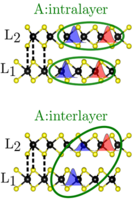
Transition metal dichalcogenides are semiconducting materials in which optical properties are governed by Coulomb-bound electron-hole pairs, called excitons. Here, the authors investigate the different excitonic properties of monolayer, bilayer, and trilayer MoS2, revealing the existence of interlayer excitons in the last two cases. The paper presents both theoretical and experimental studies. DFT calculations of absorption are underpinned by reflectivity measurements, at temperatures from 4 to 300 K, on high-quality samples encapsulated in hexagonal boron nitride (hBN).

Steady states of interacting Floquet insulators

Karthik I. Seetharam, Charles-Edouard Bardyn, Netanel H. Lindner, Mark S. Rudner, and Gil Refael

Phys. Rev. B 99, 014307 (2019) - Published 30 January, 2019

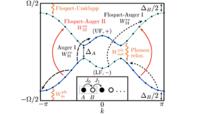
Floquet engineering offers exhilarating opportunities for controlling the dynamics of quantum many body systems and realizing new nonequilibrium phases of matter. However, generic interacting Floquet systems tend to heat up due to energy absorption from the drive, washing away the desired behavior. In this work, the authors characterize the steady states of an interacting electronic system, coupled to a phonon heat bath. They determine the regimes where the system-bath coupling stabilizes Floquet-insulator-like states, an important prerequisite for realizing topological states through Floquet engineering.

Sign In to Your Journals Account

Filter

Section

Filter

Article Lookup

Enter a citation