Highlights

Phonon dispersion in MoS2

Hans Tornatzky, Roland Gillen, Hiroshi Uchiyama, and Janina Maultzsch

Phys. Rev. B 99, 144309 (2019) - Published 24 April, 2019

The phonon dispersion is one of the most fundamental properties of a crystalline material. It determines virtually all of its physical properties, including optical, electronic, mechanical, and thermal behavior. Despite its importance, the phonon dispersion of MoS2 – one of the most investigated two-dimensional semiconductors – has not been determined experimentally in relevant parts of the Brillouin zone. In a combined experimental and theoretical approach, the authors present comprehensively the entire phonon dispersion of a MoS2 crystal and determine displacement patterns, symmetries, and scattering intensities.

Robust Majorana magic gates via measurements

Torsten Karzig, Yuval Oreg, Gil Refael, and Michael H. Freedman

Phys. Rev. B 99, 144521 (2019) - Published 24 April, 2019

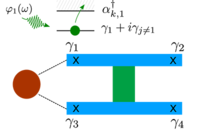
High-fidelity π/8 phase gates are an essential ingredient for the majority of universal quantum computation proposals. Here, the authors present a new way of implementing a π/8 gate in Majorana-based qubits that eliminates the leading noise sources, expected to limit other approaches. The scheme employs a combination of measurements and quantum evolution to optimize the fidelity of the final state when a favorable set of measurement outcomes has been achieved and, at the same time, guarantees a high-success probability for obtaining such measurement outcomes.

Knotted non-Hermitian metals

Johan Carlström, Marcus Stålhammar, Jan Carl Budich, and Emil J. Bergholtz

Phys. Rev. B 99, 161115(R) (2019) - Published 24 April, 2019

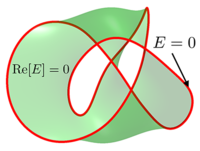
Topology, the theory of global properties invariant under continuous deformation, has proven essential for understanding the variety of forms of matter occurring in nature. Here, two paradigmatic concepts of topology in physics, namely, knots and topological properties of energy bands, are brought together to introduce a form of topological matter, best labeled as knotted non-Hermitian metals. Remarkably, non-Hermitian terms accounting for the dissipative coupling of the system to its environment are crucial for the generic stability of these exotic systems.

Radiofrequency driving of coherent electron spin dynamics in n-GaAs detected by Faraday rotation

V. V. Belykh, D. R. Yakovlev, and M. Bayer

Phys. Rev. B 99, 161205(R) (2019) - Published 24 April, 2019

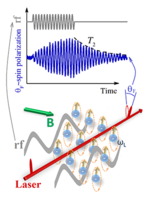
When a magnetic field is applied to an ensemble of electron spins, they all precess with the Larmor frequency. This precession is hard to detect due to the random relative spin phases. Here, the authors synchronize the ensemble spin precession by applying a radiofrequency field, followed by precession dephasing. The spin polarization is measured by the Faraday rotation of a laser pulse polarization. The authors thereby determine the homogeneous spin coherence time T2, which is almost impossible to access in standard all-optical pump-probe experiments.

Polarization-resolved Cu L3-edge resonant inelastic x-ray scattering of orbital and spin excitations in NdBa2Cu3O7−δ

R. Fumagalli, L. Braicovich, M. Minola, Y. Y. Peng, K. Kummer, D. Betto, M. Rossi, E. Lefrançois, C. Morawe, M. Salluzzo, H. Suzuki, F. Yakhou, M. Le Tacon, B. Keimer, N. B. Brookes, M. Moretti Sala, and G. Ghiringhelli

Phys. Rev. B 99, 134517 (2019) - Published 23 April, 2019

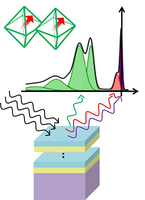
RIXS spectra are populated by features due to orbital, charge, and spin excitations. The correct assignment is usually based on their energy and on the incident polarization dependence. In addition, several ambiguities can be lifted by measuring the scattered photon polarization. Here, a polarization-resolved Cu L3 RIXS systematic study of NdBa2Cu3O7−δ as a function of doping and momentum is presented. With the help of single-ion model calculations, a definitive assessment of orbital excitations is made, even in the doped materials where the intrinsic broadening smears spectral features.

Fidelity and visibility loss in Majorana qubits by entanglement with environmental modes

Morten I. K. Munk, Reinhold Egger, and Karsten Flensberg

Phys. Rev. B 99, 155419 (2019) - Published 23 April, 2019

Majorana qubits based on Majorana bound states (MBSs) are believed to be topologically protected and therefore robust to noise. However, when the MBSs are coupled to gapless modes, such as phonons or electromagnetic modes, the quantum information is stored in entangled MBS-environment states. Moreover, the combined system becomes gapless and even though the quantum information is still topologically protected, it is challenging to read out the quantum information when the measurement device only couples to the MBS. The paper discusses the readout errors that occur when performing projective measurement on the MBSs in this situation.

Nanospot angle-resolved photoemission study of Bernal-stacked bilayer graphene on hexagonal boron nitride: Band structure and local variation of lattice alignment

Frédéric Joucken, Eberth A. Quezada-López, Jose Avila, Chaoyu Chen, John L. Davenport, Hechin Chen, Kenji Watanabe, Takashi Taniguchi, Maria Carmen Asensio, and Jairo Velasco, Jr.

Phys. Rev. B 99, 161406(R) (2019) - Published 23 April, 2019

Heterostructures composed of two-dimensional (2D) materials placed on insulating substrates are of great interest because they exhibit tunable electronic and optical properties that enable novel optoelectronic devices. Directly accessing the electronic band structure of such heterostructures is challenging because of their micron-scale size. The recent development of nanospot angle-resolved photoemission spectroscopy (nanoARPES) now provides direct access to the band structure with high resolution in space, energy, and momentum. To this end, the authors use nanoARPES to reveal the electronic structure of Bernal-stacked bilayer graphene (BLG) supported by hexagonal boron nitride (hBN). They extract tight-binding band parameters for BLG on this substrate for the first time, thus providing important information for theoretical modeling. With the help of STM, they also find spatial inhomogeneity in the lattice alignment between the supporting hBN and the top-lying BLG. Considering the dramatic influence that the alignment angle has on the properties of 2D material heterostructures, this surprisingly large inhomogeneity (up to 3) must be considered for interpreting previous and future spatially averaged experiments performed on these heterostructures.

Low-temperature infrared dielectric function of hyperbolic α-quartz

Christopher J. Winta, Martin Wolf, and Alexander Paarmann

Phys. Rev. B 99, 144308 (2019) - Published 22 April, 2019

Hyperbolic materials are attracting considerable interest in the nanophotonics community due to their ability to support highly directional, large-momentum states that can be utilized for, e.g., subdiffractional imaging or nanolithography. Here, the authors explore the infrared dielectric properties of α-quartz at low temperatures by performing infrared reflectivity measurements. The results imply remarkably high quality factors for polaritons in the pronounced hyperbolic spectral region of α-quartz as well as additional design opportunities for nanophotonic applications.

Optical coherence of diamond nitrogen-vacancy centers formed by ion implantation and annealing

S. B. van Dam, M. Walsh, M. J. Degen, E. Bersin, S. L. Mouradian, A. Galiullin, M. Ruf, M. IJspeert, T. H. Taminiau, R. Hanson, and D. R. Englund

Phys. Rev. B 99, 161203(R) (2019) - Published 19 April, 2019

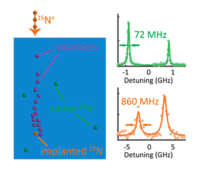
Nitrogen-vacancy (NV) centers in diamond with coherent optical transitions are a promising candidate for quantum science and technology protocols. A widely used strategy for their creation is nitrogen-ion implantation and high-temperature annealing. The data presented in this work show that while low-strain, narrow-optical-linewidth NV centers are formed from naturally occurring 14N atoms, NV centers formed from the implanted 15N atoms show broadened optical transitions and experience higher strain. These results have immediate implications for the positioning accuracy of current NV center creation protocols.

Multiscale entanglement clusters at the many-body localization phase transition

Loïc Herviou, Soumya Bera, and Jens H. Bardarson

Phys. Rev. B 99, 134205 (2019) - Published 18 April, 2019

The authors construct an efficient algorithm for extracting the entanglement structure of wave functions in the form of a cluster decomposition. They apply this to the many-body localization problem by analyzing entanglement clusters in exact eigenstates. Strongly entangled ergodic clusters are connected. Their size is distributed according to a power law at the transition, while at higher disorder the distribution is a stretched exponential. This constrains possible phenomenological renormalization group descriptions of the transition, and is consistent with a Kosterlitz-Thouless type scaling.

Diamagnetic response of a superconducting surface superstructure: Si(111)-√7×√3-In

Yanfu Wu, Ming-Chao Duan, Ningning Liu, Gang Yao, Dandan Guan, Shiyong Wang, Yao-Yi Li, Hao Zheng, Canhua Liu, and Jin-Feng Jia

Phys. Rev. B 99, 140506(R) (2019) - Published 18 April, 2019

How does one detect the Meissner effect in ultrathin superconducting films that are usually extremely sensitive to air? Here, the authors succeed in observing the diamagnetic response of a superconducting surface superstructure by using an insitu two-coil mutual inductance technique embedded in a specially designed scanning tunneling microscope. The diamagnetic measurement allows for the calculation of the penetration depth, which provides invaluable information about the nature of superconductivity and the symmetry of the underlying order parameter.

Energy-dependent spatial texturing of charge order in 1T−CuxTiSe2

M. Spera, A. Scarfato, E. Giannini, and Ch. Renner

Phys. Rev. B 99, 155133 (2019) - Published 18 April, 2019

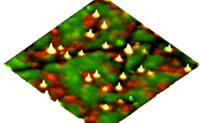
Scanning tunneling microscopy unveils an unprecedented energy-dependent patchwork of charge density wave (CDW) regions in 1T-CuxTiSe2. This Cu-induced patterning is echoing a large CDW gap opening below the Fermi level. It suggests a possible coexistence of the CDW and superconducting ground states, as the two quantum condensates involve different energy ranges in the electronic band structure of CuxTiSe2. Finally, the well-developed CDW order in Cu-doped metallic CuxTiSe2 rules out a solely excitonic CDW formation mechanism in this system.

Nonlocal effects in singular plasmonic metasurfaces

Fan Yang, Yao-Ting Wang, Paloma A. Huidobro, and John B. Pendry

Phys. Rev. B 99, 165423 (2019) - Published 18 April, 2019

Advances in nanofabrication have recently made possible plasmonic nanostructures with features on very short length scales, enabling confinement of electromagnetic fields even to subnanometric scales. On this atomic scale, a classical local description of the dielectric function is no longer valid and effects such as electron spill-out at metal surfaces become relevant. Here, the authors take this nonlocal effect into account for singular plasmic metasurfaces with sharp features, such as narrow gaps and sharp edges. Nonlocal effects are prominent in these geometric singularities and lead to a discretization of the continuous spectrum. On the surface, the oscillation of the surface plasmon polaritons propagating toward the singularity is weakened, and this microscopic effect significantly affects the far-field spectrum.

Abnormal anticrossing effect in photon-magnon coupling

Biswanath Bhoi, Bosung Kim, Seung-Hun Jang, Junhoe Kim, Jaehak Yang, Young-Jun Cho, and Sang-Koog Kim

Phys. Rev. B 99, 134426 (2019) - Published 17 April, 2019

The authors report an experimental demonstration of an opposite anticrossing effect in a photon-magnon coupled system consisting of a YIG and an inverted pattern of split-ring resonator (ISRR) structure in a planar geometry. The dispersion shape of the anticrossing effect is modifiable by changing the position/orientation of the ISRR split gap relative to the microstrip-line axis. This experimental observation, coupled with analytical calculations of various dispersion types of anticrossing, shows the potential and flexibility of photon-magnon systems for exploring emergent phenomena and light-matter interaction applications.

Instability of many-body localized systems as a phase transition in a nonstandard thermodynamic limit

Sarang Gopalakrishnan and David A. Huse

Phys. Rev. B 99, 134305 (2019) - Published 16 April, 2019

At the many-body localization transition, the dynamics of an isolated quantum system freezes out. In systems with long-range interactions (and possibly short-range systems in many spatial dimensions) this transition does not happen in the conventional thermodynamic limit: arbitrarily weak interactions prevent many-body localization. Here, the authors argue that even in these cases a sharp phase transition exists if one scales down the interaction strength with increasing system size in a specific nonstandard way.

Resonant inelastic x-ray scattering study of bond order and spin excitations in nickelate thin-film structures

K. Fürsich, Y. Lu, D. Betto, M. Bluschke, J. Porras, E. Schierle, R. Ortiz, H. Suzuki, G. Cristiani, G. Logvenov, N. B. Brookes, M. W. Haverkort, M. Le Tacon, E. Benckiser, M. Minola, and B. Keimer

Phys. Rev. B 99, 165124 (2019) - Published 16 April, 2019

The rare-earth nickelates (RNiO3) have been subject to intense investigation, mostly because of their rich phase diagrams, comprising a sharp temperature-driven metal-to-insulator transition and an unusual antiferromagnetic ground state. Here, the authors use high-resolution resonant inelastic x-ray scattering (RIXS) at the Ni L3 edge to study simultaneously the bond and magnetic orders controlled via heterostructuring. The results show that RIXS gives valuable insights into the interplay of different collective ordering phenomena in a prototypical 3d transition-metal oxide

Hyperbolic fracton model, subsystem symmetry, and holography

Han Yan (闫寒)

Phys. Rev. B 99, 155126 (2019) - Published 15 April, 2019

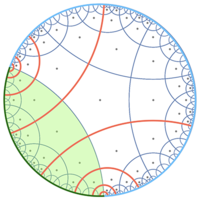
The fracton states of matter have been argued to mimic gravity. Here, the authors study a simple fracton toy model in anti-de Sitter space and show that it satisfies several important properties of holography. These properties include the correct boundary-bulk subregion duality: that the boundary mutual information (as the classical analog of entanglement entropy) obeys the well-known Ryu-Takayanagi formula, and that a naive black hole has the correct entropy. This work implies a deeper connection between fracton phases and gravity.

Strong coupling of a quantum dot molecule to a photonic crystal cavity

Patrick M. Vora, Allan S. Bracker, Samuel G. Carter, Mijin Kim, Chul Soo Kim, and Daniel Gammon

Phys. Rev. B 99, 165420 (2019) - Published 15 April, 2019

Dynamically tunable light-matter interfaces are important for the success of emerging quantum technologies. Quantum dots embedded in photonic crystal membranes provide an attractive platform as the cavities have high quality factors, low mode volumes, and can be doped to provide limited voltage tuning of the exciton states. Here, the authors demonstrate that the versatility and applications of this architecture can be extended by replacing the quantum dot with a quantum dot molecule. Two tunnel-coupled quantum dots permit molecular exciton states that have voltage-tunable energies and dipole moments. Advantage is taken of the tunable dipole moments of mixed exciton states to demonstrate in situ tuning of the vacuum Rabi splitting as well as new polariton states with hybrid spin character.

Distinct magnetotransport and orbital fingerprints of chiral bobbers

M. Redies, F. R. Lux, J.-P. Hanke, P. M. Buhl, G. P. Müller, N. S. Kiselev, S. Blügel, and Y. Mokrousov

Phys. Rev. B 99, 140407(R) (2019) - Published 12 April, 2019

Based on theoretical arguments, the authors provide a clear pathway to utilizing a new chiral particle – a chiral bobber – for the purposes of future spintronics. They discover that these novel chiral states possess inherent transport traits that allow for their unambiguous electrical detection in systems comprising several types of chiral states. The unique properties of bobbers are rooted in the nontrivial spin topology of these particles, which also bear great potential for cognitive computing.

Revisiting the Kitaev material candidacy of Ir4+ double perovskite iridates

A. A. Aczel, J. P. Clancy, Q. Chen, H. D. Zhou, D. Reig-i-Plessis, G. J. MacDougall, J. P. C. Ruff, M. H. Upton, Z. Islam, T. J. Williams, S. Calder, and J.-Q. Yan

Phys. Rev. B 99, 134417 (2019) - Published 11 April, 2019

Kitaev materials, based on bond-directional Ising interactions, offer an intriguing platform for hosting exotic magnetic ground states and excitations. Significant Kitaev interactions are most commonly realized in heavy transition metal magnets with so-called Jeff = ½ electronic ground states for the transition metal and local geometries consisting of metal-ligand edge-sharing octahedra. Here, the authors show that Kitaev materials can also be realized in Jeff = ½ magnets via extended superexchange pathways mediated by more than one anion.

Sign In to Your Journals Account

Filter

Section

Filter

Article Lookup

Enter a citation