Highlights

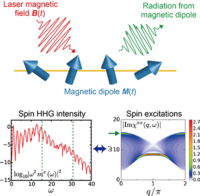
High-harmonic generation in quantum spin systems

Shintaro Takayoshi, Yuta Murakami, and Philipp Werner

Phys. Rev. B 99, 184303 (2019) - Published 20 May, 2019

High-harmonic generation (HHG), a nonlinear response to strong laser driving, has been studied extensively for electron systems excited by the laser electric field. Here, the authors extend this concept to quantum spin systems driven by the laser magnetic field and propose a novel probe for the magnetic structure. The radiation emitted by time-dependent magnetic dipoles exhibits HHG spectra with plateau structures, whose cutoff energies correspond to the energy scale of the magnetic excitations. This maps out an exciting route for the implementation of HHG in solids. In addition, the similarities and the differences between HHG in electron and spin systems are also discussed.

Anomalous Floquet insulators

Frederik Nathan, Dmitry Abanin, Erez Berg, Netanel H. Lindner, and Mark S. Rudner

Phys. Rev. B 99, 195133 (2019) - Published 20 May, 2019

Recent work has revealed that periodically driven systems may host novel topological phases that have no equilibrium counterparts. These “anomalous Floquet insulators” (AFIs) feature characteristic patterns of periodic particle motion. Until now, it has been an open question whether the driving regime necessary for achieving AFI dynamics is compatible with many-body localization, which is needed to ensure stability over long times. By identifying an appropriate separation of scales, here the authors answer the question affirmatively, thereby demonstrating the existence of stable AFIs.

Exciton condensation in quantum Hall bilayers at total filling νT=5

Zheng Zhu, Shao-Kai Jian, and D. N. Sheng

Phys. Rev. B 99, 201108(R) (2019) - Published 20 May, 2019

Quantum Hall bilayers have proven to be an inexhaustible platform for emerging exotic states and novel phase transitions in the strongly correlated arena. Here, the authors study coupled quantum Hall bilayers at half-filled first excited Landau levels by varying the layer distance. The authors find a continuous transition between the exciton superfluid phase and two copies of the Moore-Read state. This transition breaks symmetry and changes topology simultaneously, providing an exotic example of a quantum phase transition beyond the Landau paradigm.

Continuum models for twisted bilayer graphene: Effect of lattice deformation and hopping parameters

Francisco Guinea and Niels R. Walet

Phys. Rev. B 99, 205134 (2019) - Published 20 May, 2019

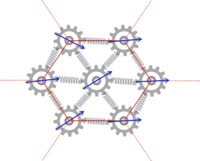
Twisted bilayer graphene is one of the most promising low-dimensional materials, showing both superconducting and insulating behavior. This is understood to be due to the occurrence of extremely flat bands at the magic angles, which enhances the residual interaction effects. Here, the authors show that the most common understanding of this problem neglects two important effects, the deformation of the graphene layers and the modification of electronic hopping between the atoms of the layers. A method to extract a continuum model in the presence of these effects is presented.

Fine-tuning of canted magnetization in stepped Fe films through thickness variation, Au capping, and quantum confinement

M. Dąbrowski, M. Cinal, A. K. Schmid, J. Kirschner, and M. Przybylski

Phys. Rev. B 99, 184420 (2019) - Published 16 May, 2019

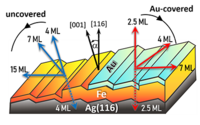
Magnetization switching by voltage pulses, microwaves, and optical pulses can be largely facilitated by canted orientation of magnetization. Here, the authors demonstrate that a canted magnetization with virtually any orientation can be achieved for thin Fe films, grown on a stepped surface. The canted state can be tuned by varying the film thickness, capping with an Au overlayer, and by taking advantage of magnetic anisotropy oscillations due to quantum well states. The observed evolution of tilted magnetization is accurately reproduced within a phenomenological model and is explained with the competition of three first-order magnetic anisotropy terms.

Magnetophotoluminescence of exciton Rydberg states in monolayer WSe2

Erfu Liu, Jeremiah van Baren, Takashi Taniguchi, Kenji Watanabe, Yia-Chung Chang, and Chun Hung Lui

Phys. Rev. B 99, 205420 (2019) - Published 16 May, 2019

In analogy to Rydberg states in hydrogen atoms, excitons in two-dimensional semiconductors host a series of internal states. The optical spectra of these Rydberg excitons are important to understand their diverse properties for novel optical and optoelectronic applications. Here, the authors have measured the photoluminescence spectra of 1s-5s exciton Rydberg states in ultraclean monolayer WSe2 under a magnetic field. From the spectra, they determine the g-factors, exciton radii, and binding energies of various Rydberg excitons.

Nodal arc of disordered Dirac fermions and non-Hermitian band theory

Michał Papaj, Hiroki Isobe, and Liang Fu

Phys. Rev. B 99, 201107(R) (2019) - Published 15 May, 2019

Disordered Dirac fermions have been studied in a variety of contexts, including quantum Hall transitions, surface states of topological insulators, and graphene. Here, the authors study a new Dirac system in which the two components of the Dirac fermion are unrelated by symmetry and, hence, disorder results in two different quasiparticle lifetimes. It is demonstrated that disorder generates a nodal arc replacing the original Dirac point, thus leading to a new universality class.

Crucial role of atomic corrugation on the flat bands and energy gaps of twisted bilayer graphene at the magic angle θ∼1.08∘

Procolo Lucignano, Dario Alfè, Vittorio Cataudella, Domenico Ninno, and Giovanni Cantele

Phys. Rev. B 99, 195419 (2019) - Published 13 May, 2019

The electronic properties of twisted bilayer graphene are being intensely investigated. The flat bands emerging at the first “magic angle” are responsible for anomalous insulating behavior at half-filling and superconductivity. Using state-of-the-art abinitio calculations, it is shown that the energy gaps and band dispersion are captured correctly only when the atomic corrugation, arising as a result of the interlayer interaction, is considered. The atomic corrugation shows a wave profile with maximum atomic out-of-plane displacements of about 0.1 angstrom.

Multipole expansion for magnetic structures: A generation scheme for a symmetry-adapted orthonormal basis set in the crystallographic point group

M.-T. Suzuki, T. Nomoto, R. Arita, Y. Yanagi, S. Hayami, and H. Kusunose

Phys. Rev. B 99, 174407 (2019) - Published 10 May, 2019

Identifying the order parameter for a magnetic phase is useful for a deeper understanding of physical phenomena, such as the anomalous Hall effect, electromagnetic effects, and optical responses. Here, the authors provide an intuitive and general procedure to deduce the proper order parameters of magnetic phases. The procedure is based on multipole expansion and the introduction of a novel concept, the virtual cluster. The method facilitates the understanding of order parameters in antiferromagnets and provides themissing link between order parameters and macroscopic phenomena.

Scalable fermionic error correction in Majorana surface codes

Oscar Viyuela, Sagar Vijay, and Liang Fu

Phys. Rev. B 99, 205114 (2019) - Published 10 May, 2019

Quantum computers based on Majorana fermions offer intrinsic robustness due to the topological nature of these quasiparticles. However, active quantum error correction is still necessary in order to perform fully protected quantum gates and reliably store information due to the presence of unwanted errors, such as quasiparticle poisoning. Here, the authors demonstrate that using networks of interacting Majorana particles achieves a higher error tolerance than traditional qubit-based quantum computers, thereby offering potential advantages for large-scale quantum information processing.

Floquet spin and spin-orbital Hamiltonians and doublon-holon generations in periodically driven Mott insulators

Kasra Hejazi, Jianpeng Liu, and Leon Balents

Phys. Rev. B 99, 205111 (2019) - Published 9 May, 2019

Intense light can alter the electronic properties of materials through its oscillating electric field. The effects on magnetic excitations in insulators, however, are indirect, since these are neutral and do not see the electric field directly. This study reports on how exchange interactions in single- and multiorbital Mott insulators are modified by electromagnetic radiation, whose frequency is assumed to be on the order of the Mott-Hubbard gap. The latter condition results in a nonvanishing creation rate of doubly occupied sites (doublons), which necessitates taking into account the finite bandwidth of the doublon excitations, a feature which goes beyond the naïve leading order strong correlation expansion. This ultimately leads to a complex-valued exchange parameter, where the real part represents the “Floquet” spin-exchange interaction, while the imaginary part reflects the creation rate of doublons.

Anatomy of skin modes and topology in non-Hermitian systems

Ching Hua Lee and Ronny Thomale

Phys. Rev. B 99, 201103(R) (2019) - Published 8 May, 2019

Non-Hermitian systems can exhibit a counterintuitive phenomenon where a single local boundary or disorder modifies the entire spectrum, no matter how large the system is. In such cases, all bulk modes become localized “skin” modes, and usual bulk topological invariants no longer correctly predict topological boundary modes. Generalizing Laughlin’s gauge argument to complex fluxes, the authors derive a geometrical approach for the exact determination of the skin-mode spectrum. They also devise a new topological criterion for non-Hermitian particle-hole symmetric Hamiltonians based on complex analysis.

Density functional perturbation theory within noncollinear magnetism

Fabio Ricci, Sergei Prokhorenko, Marc Torrent, Matthieu J. Verstraete, and Eric Bousquet

Phys. Rev. B 99, 184404 (2019) - Published 6 May, 2019

Density functional perturbation theory is a well-established and very powerful technique to compute observable response properties of materials from first principles. To date, its extension to noncollinear magnetism has not been considered, while there is strong pressure for such a development from emergent fields such as spintronics and spinorbitronics. In this paper, the formalism of density functional perturbation theory for noncollinear magnetism is developed and analyzed by exploiting locally collinear spin-polarized exchange-correlation functionals

Two-dimensional Peierls instability via zone-boundary Dirac line nodes in layered perovskite oxides

Jin-Hong Park, Seung Hun Lee, Choong H. Kim, Hosub Jin, and Bohm-Jung Yang

Phys. Rev. B 99, 195107 (2019) - Published 6 May, 2019

Peierls instability is a ubiquitous mechanism originally suggested in one-dimensional half-filled lattices. Here, the authors show that two-dimensional Peierls instability can be realized in a class of perovskite oxides. The central role is played by the zone-boundary Dirac line node, protected by two orthogonal glide mirrors induced by the rotation of oxygen octahedra. The authors propose this two-dimensional Peierls instability driven by dispersionless Dirac line nodes as the principal mechanism for spontaneous symmetry breaking in various layered perovskite oxides, including the antiferromagnetism of Sr2IrO4.

Emergence and spontaneous breaking of approximate O(4) symmetry at a weakly first-order deconfined phase transition

Pablo Serna and Adam Nahum

Phys. Rev. B 99, 195110 (2019) - Published 6 May, 2019

An unusual phenomenology is uncovered in a class of (2+1)-dimensional phase transitions. An accurate, yet not exact O(4) symmetry, relating distinct order parameters, emerges at intermediate length scales. At longer scales it becomes apparent that the transition is weakly first order. However, O(4) persists as a symmetry relating the coexisting ground states, implying very unconventional scaling properties. The transition studied is from Néel order to a twofold degenerate valence-bond solid. Via dualities, the results have implications for other deconfined critical points with four soft-order parameter components and for two-flavor QED3.

All-electron fully relativistic Kohn-Sham theory for solids based on the Dirac-Coulomb Hamiltonian and Gaussian-type functions

Marius Kadek, Michal Repisky, and Kenneth Ruud

Phys. Rev. B 99, 205103 (2019) - Published 3 May, 2019

A major challenge in computational solid-state physics is the capability of first-principles theories to treat relativistic effects nonperturbatively when modeling material properties driven by atomic-core regions or the spin-orbit interaction. Such a relativistic approach is mandatory for heavy-element containing materials that often exhibit nontrivial topological properties. Here, the first formulation and implementation of a relativistic full-potential theory for solids solving the four-component Dirac-Kohn-Sham equation within local Gaussian-type bases is presented. Time-reversal symmetry is exploited in a quaternion algebra-based formalism to significantly reduce the methodological and computational complexity of the approach. The results are demonstrated to be well converged with basis sets developed for molecules.

Absence of signatures of Weyl orbits in the thickness dependence of quantum transport in cadmium arsenide

Luca Galletti, Timo Schumann, David A. Kealhofer, Manik Goyal, and Susanne Stemmer

Phys. Rev. B 99, 201401(R) (2019) - Published 1 May, 2019

In a Weyl orbit, the Fermi arc surface states on opposite surfaces of the topological semimetal are connected through bulk Weyl or Dirac nodes. Having a real-space component, these orbits are expected to accumulate a sample thickness dependent phase. Here, it is shown that small variations in the carrier density, in combination with the relative insensitivity of the low-field Hall data to such variations, does not allow for invoking Weyl orbits based on the thickness dependence for realistic samples.

Probing transport in quantum many-fermion simulations via quantum loop topography

Yi Zhang, Carsten Bauer, Peter Broecker, Simon Trebst, and Eun-Ah Kim

Phys. Rev. B 99, 161120(R) (2019) - Published 30 April, 2019

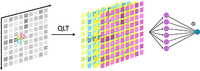
Quantum many-fermion systems give rise to diverse states of matter that often reveal themselves in distinctive transport properties. Here, the authors demonstrate that quantum loop topography can be used to probe efficiently and directly challenging transport properties by machine learning imaginary-time current-current correlations in quantum Monte Carlo simulations. Applications on the emergence of superconducting fluctuations in the negative-U Hubbard model and a spin-fermion model for a metallic quantum critical point detect changes in transport in good agreement with their established phase diagrams.

Critical opalescence across the doping-driven Mott transition in optical lattices of ultracold atoms

C. Walsh, P. Sémon, G. Sordi, and A.-M. S. Tremblay

Phys. Rev. B 99, 165151 (2019) - Published 30 April, 2019

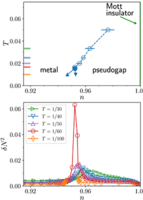
The authors show that critical opalescence - enhanced density fluctuations at all length scales - occurs in quantum matter, specifically in a doped Mott-insulating system that can be realized with ultracold atoms in optical lattices. These findings provide a theoretical framework and new predictions for ultracold-atom experiments. Looking for critical opalescence across the doping-driven Mott transition in ultracold systems may give insights on the origin of the pseudogap in cuprate high-temperature superconductors.

Ab initio theory of the Gibbs free energy and a hierarchy of local moment correlation functions in itinerant electron systems: The magnetism of the Mn3A materials class

Eduardo Mendive-Tapia and Julie B. Staunton

Phys. Rev. B 99, 144424 (2019) - Published 25 April, 2019

Phase diagrams and the temperature and field dependence of complex magnetic materials are described here by an abinitio theory. Consideration of fluctuating local degrees of freedom (‘local moments’), emerging from a material’s interacting itinerant electrons, produces naturally a picture of multisite magnetic interactions. Accurate prediction of the order of transitions and the role of both electronic and magnetoelastic effects in the Gibbs free energy coefficients are demonstrated by application to the widely varying frustrated magnetism of Mn3A .

Sign In to Your Journals Account

Filter

Section

Filter

Article Lookup

Enter a citation