Highlights

Constructing neural stationary states for open quantum many-body systems

Nobuyuki Yoshioka and Ryusuke Hamazaki

Phys. Rev. B 99, 214306 (2019) - Published 28 June, 2019

A theoretical exploration of exotic properties in open quantum many-body systems requires an efficient search of the nonequillibrum stationary states. Aiming to accelerate the process, the authors develop here a variational method, in which the ansatz for the mixed states is based on the restricted Boltzmann machine, motivated by its high expressive power shown in various recent works. It is demonstrated that the ansatz successfully simulates dissipative spin systems both in one and two dimensions.

Magnetoelastic excitation spectrum in the rare-earth pyrochlore Tb2Ti2O7

M. Ruminy, S. Guitteny, J. Robert, L.-P. Regnault, M. Boehm, P. Steffens, H. Mutka, J. Ollivier, U. Stuhr, J. S. White, B. Roessli, L. Bovo, C. Decorse, M. K. Haas, R. J. Cava, I. Mirebeau, M. Kenzelmann, S. Petit, and T. Fennell

Phys. Rev. B 99, 224431 (2019) - Published 28 June, 2019

Amongst the rare earth pyrochlores, Tb2Ti2O7 remains mysterious: no theory of purely magnetic degrees of freedom can account entirely for its behavior. The discovery of a hybrid magnetoelastic excitation, formed from crystal field and phonon excitations, suggests that spin-lattice coupling may play an important role. Here, the authors use inelastic neutron scattering to make a detailed investigation of the hybrid mode and crystal field excitons that may hold the key to understanding the microscopic interactions of Tb2Ti2O7.

Optimal power and efficiency of single quantum dot heat engines: Theory and experiment

Martin Josefsson, Artis Svilans, Heiner Linke, and Martin Leijnse

Phys. Rev. B 99, 235432 (2019) - Published 27 June, 2019

As experimental implementations of highly efficient nanoscale heat engines based on quantum dots have recently come within our technological reach, there is need for a better understanding of how to best operate these devices. By combining theory and experiment, the authors present an investigation of how to optimize the power output of a single quantum dot heat engine. Furthermore, the impact that second order tunneling effects have on the efficiency is quantified and found to be significant for the experimental device.

Order and disorder in the magnetization of the chiral crystal CrNb3S6

Gary W. Paterson, Tsukasa Koyama, Misako Shinozaki, Yusuke Masaki, Francisco J. T. Goncalves, Yusuke Shimamoto, Tadayuki Sogo, Magnus Nord, Yusuke Kousaka, Yusuke Kato, Stephen McVitie, and Yoshihiko Togawa

Phys. Rev. B 99, 224429 (2019) - Published 26 June, 2019

Nanoscale spin solitons in CrNb3S6 are notable for their macroscale coherence, creating an ordered chiral soliton lattice (CSL) that may be tuned by the application of a magnetic field. Through studying experimentally the transitions between the CSL and field-polarized phases, this work shows the existence of a hysteretic disordered phase and reveals the importance of CSL dislocations in mediating the transitions. Gaining control and understanding of dislocations may lead to configurable nanochannels of field-polarized spins, suitable for the propagation of spin waves.

Quantization of fractional corner charge in Cn-symmetric higher-order topological crystalline insulators

Wladimir A. Benalcazar, Tianhe Li, and Taylor L. Hughes

Phys. Rev. B 99, 245151 (2019) - Published 26 June, 2019

Building upon the concepts of band representations and their relation to localized Wannier functions, the authors systematically study charge fractionalization in higher-order topological insulators. They show that, when protected by Cn rotation symmetries, charge can be fractionally quantized in units of e/n. The authors build topological indices for Cn-symmetric higher-order topological insulators in class AI. Due to an algebraic structure of the topological classification of these phases, these indices apply even to fragile phases, which lack a Wannier description, but for which a “generalized” Wannier description can be formulated.

Probing defect states in few-layer MoS2 by conductance fluctuation spectroscopy

Suman Sarkar, Aveek Bid, K. Lakshmi Ganapathi, and Sangeneni Mohan

Phys. Rev. B 99, 245419 (2019) - Published 26 June, 2019

The authors study conductance and conductance fluctuations for MoS2 flakes encapsulated between layers of high-κ dielectrics. This new architecture makes the devices extremely stable against environmental degradation, enabling reproducible measurements on the same sample over a time scale of more than one year. The conductance fluctuations of the MoS2 channel also reduce by orders of magnitude as compared to conventional transition metal dichalcogenide devices. The remnant conductance fluctuations are shown to arise from charge excitations from S-vacancy levels to the mobility edge of the conduction band.

Scaling of intrinsic domain wall magnetoresistance with confinement in electromigrated nanocontacts

Robert M. Reeve, André Loescher, Hamidreza Kazemi, Bertrand Dupé, Mohamad-Assaad Mawass, Thomas Winkler, Daniel Schönke, Jun Miao, Kai Litzius, Nicholas Sedlmayr, Imke Schneider, Jairo Sinova, Sebastian Eggert, and Mathias Kläui

Phys. Rev. B 99, 214437 (2019) - Published 25 June, 2019

Magnetic domain walls are useful functional elements that exhibit magnetoresistive response in transport. This includes anisotropic magnetoresistance effects and, in particular, intrinsic domain wall magnetoresistance effects due to the changing magnetization direction. The intrinsic contribution is theoretically predicted to scale with the wall width, as confirmed by quantum mechanical transport simulations. Experimentally, the magnetization gradient in the wall is controlled by tailoring the wall confinement in electromigrated permalloy nanocontacts, revealing a positive intrinsic domain wall magnetoresistance that scales with the domain wall width, in excellent agreement with theory.

Electron hydrodynamics with a polygonal Fermi surface

Caleb Q. Cook and Andrew Lucas

Phys. Rev. B 99, 235148 (2019) - Published 25 June, 2019

The authors identify a geometric effect that constrains scattering on polygonal Fermi surfaces and leads to an intermediate transport regime that alters traditional signatures of the ballistic-to-hydrodynamic crossover, including a modification of the well-known Gurzhi effect. In the hydrodynamic limit, the authors find a new dissipative “rotational viscosity”, which arises from anisotropy in the Fermi surface and opposes rotations of the electronic fluid. Finally, the authors revisit the putative hydrodynamic transport data in PdCoO2, an ultrapure metal with an approximately hexagonal Fermi surface.

Anomalous attenuation of plasmons in strange metals and holography

Aurelio Romero-Bermúdez, Alexander Krikun, Koenraad Schalm, and Jan Zaanen

Phys. Rev. B 99, 235149 (2019) - Published 25 June, 2019

The plasmon is a ubiquitous collective mode in charged liquids. Due to the long-range Coulomb interaction, this mode is gapped and lives infinitely long at long wavelengths in Fermi liquids when the system is translationally invariant. In contrast, the authors show that in strongly entangled strange metals plasmons are always short lived, regardless of their wavelength, and decay into a quantum critical continuum, which replaces Landau damping at any wavelength.

Orientation of the ground-state orbital in CeCoIn5 and CeRhIn5

M. Sundermann, A. Amorese, F. Strigari, B. Leedahl, L. H. Tjeng, M. W. Haverkort, H. Gretarsson, H. Yavaş, M. Moretti Sala, E. D. Bauer, P. F. S. Rosa, J. D. Thompson, and A. Severing

Phys. Rev. B 99, 235143 (2019) - Published 21 June, 2019

The 4f orbital shape correlates with the ground state of the strongly correlated CeMIn5 family, with M=Co, Rh, and Ir. The remaining question as to how these orbitals are oriented has now been answered through nonresonant inelastic x-ray scattering (NIXS) measurements. Quantitative analysis reveals a hybridization-induced contribution of the first excited crystal-field state to the ground state of superconducting CeCoIn5, an important finding that suggests a degeneracy larger than two and that constrains realistic calculations of the electronic structure.

Continuous magnetic phase transition in artificial square ice

Oles Sendetskyi, Valerio Scagnoli, Naëmi Leo, Luca Anghinolfi, Aurora Alberca, Jan Lüning, Urs Staub, Peter Michael Derlet, and Laura Jane Heyderman

Phys. Rev. B 99, 214430 (2019) - Published 20 June, 2019

At a continuous phase transition, different systems can show the same behavior and are said to belong to the same universality class. Combining synchrotron x-ray scattering and numerical simulations, we establish that artificial square ice, a magnetic metamaterial consisting of a two-dimensional array of nanomagnets, admits of such a transition. The authors show that the transition belongs to the two-dimensional Ising universality class, extending the applicability of the fundamental concepts of continuous phase transitions to mesoscopic magnetic systems.

Polaronic interacceptor hopping transport in intrinsically doped nickel oxide

Robert Karsthof, Marius Grundmann, Arthur Markus Anton, and Friedrich Kremer

Phys. Rev. B 99, 235201 (2019) - Published 20 June, 2019

The authors show here that electronic conduction in moderately to highly doped nickel oxide (NiO) occurs via interacceptor hopping of heavy, self-trapped charge carriers (polarons). These carriers remain localized around acceptors, and are transported by moving exclusively among those sites. This is in contrast to previous assumptions, namely that all NiO lattice sites take part in the electronic transport process (‘free’ small polaron hopping). Furthermore, disorder is demonstrated to play a vital role in the transport characteristics.

Topology and exceptional points of massive Dirac models with generic non-Hermitian perturbations

W. B. Rui, Y. X. Zhao, and Andreas P. Schnyder

Phys. Rev. B 99, 241110(R) (2019) - Published 20 June, 2019

Recently, there has been a lot of activity in the research field of topological non-Hermitian physics, driven by both fundamental interest and potential applications. Here, the authors systematically investigate and classify Dirac-type systems with non-Hermitian perturbations. They find that there are three different types of non-Hermitian terms. For each case, they determine the bulk exceptional points, the boundary modes, and the band topology. These findings serve as guiding principles for the design of applications, for example, in photonic lattices.

Ab initio theory of polarons: Formalism and applications

Weng Hong Sio, Carla Verdi, Samuel Poncé, and Feliciano Giustino

Phys. Rev. B 99, 235139 (2019) - Published 19 June, 2019

A new method enables abinitio calculations of large and small polarons on the same footing. The authors develop the theory and computational methodology required to determine the ground-state energy and wave functions of electron and hole polarons in semiconductors and insulators, without performing explicit supercell calculations. As initial applications, the authors investigate polarons in LiF and Li2O2.

Nonlinear electromagnetic response and Higgs-mode excitation in BCS superconductors with impurities

Mikhail Silaev

Phys. Rev. B 99, 224511 (2019) - Published 18 June, 2019

Recently, light-induced excitation of Higgs modes, i.e., oscillations of the order-parameter amplitude in superconductors, has been observed. The mechanism of this effect has remained not fully understood. In the absence of relaxation processes, the order-parameter amplitude is not affected by the irradiation, since the systems of quasiparticle excitations and Cooper pairs move together and remain in equilibrium with each other. This work demonstrates how the relaxation of quasiparticles by impurity scattering leads to finite coupling between the Higgs mode and light. The suggested theory can be used to study light-matter interaction in anisotropic and multiband superconductors, such as high-temperature cuprates, iron pnictides, and magnesium diboride.

Creating anomalous Floquet Chern insulators with magnetic quantum walks

Muhammad Sajid, János K. Asbóth, Dieter Meschede, Reinhard F. Werner, and Andrea Alberti

Phys. Rev. B 99, 214303 (2019) - Published 17 June, 2019

Charged particles in a two-dimensional lattice behave like a Chern topological insulator when subject to a perpendicular magnetic field. Here, the authors propose a realistic scheme to use neutral atoms in optical lattices to simulate the effect of the magnetic field and to study transport in the strong field regime, which is not accessible when working with conventional materials. Importantly, the topological behavior of these so-called magnetic quantum walks extends even beyond the Chern insulator model because they are periodically driven in time,. Magnetic quantum walks may open a new route to studying topological properties of charged particles in strong magnetic fields.

Chemical composition induced quantum phase transition in Cs1−xRbxFeCl3

S. Hayashida, L. Stoppel, Z. Yan, S. Gvasaliya, A. Podlesnyak, and A. Zheludev

Phys. Rev. B 99, 224420 (2019) - Published 17 June, 2019

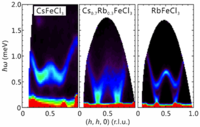
Much of what we know about quantum criticality comes from studies of quantum phase transitions between paramagnetic and magnetically ordered phases. These are usually driven by magnetic field or pressure. Here, the authors report that in CsFeCl3, one of the precious few materials exhibiting pressure-induced magnetic order, a similar transition can also be induced by chemical substitution. Cs1−xRbxFeCl3 continuously evolves from a gapped quantum paramagnet to a critical gapless state and finally to magnetic long-range order. No bulky pressure cells are required, which makes all thermodynamic and spectroscopic properties easily accessible to measurement.

Critical behavior at the localization transition on random regular graphs

K. S. Tikhonov and A. D. Mirlin

Phys. Rev. B 99, 214202 (2019) - Published 11 June, 2019

Anderson localization on random regular graphs (RRG) attracts much attention as a toy model of many-body localization. Here, the critical behavior at the localization transition on RRG, related to that on infinite Bethe lattices, is studied numerically by means of a population dynamics approach. Proceeding up to correlation volumes as large as 1019, the authors obtain the value of one half for the correlation-length critical exponent, in agreement with analytical predictions. They find very well pronounced corrections to scaling, similar to those in models with high spatial dimensionality and with many-body localization transitions.

Discrete time quasicrystals

Krzysztof Giergiel, Arkadiusz Kuroś, and Krzysztof Sacha

Phys. Rev. B 99, 220303(R) (2019) - Published 11 June, 2019

Periodically driven quantum many-body systems can spontaneously reorganize their motion and start moving with a period different than the driving period. These are “discrete time crystals” and they have been realized already in the laboratory. It turns out that systems from the same class can spontaneously reveal quasicrystalline structures in time. The interaction between the particles forces them into a quasicrystal pattern in the time domain, in spite of the fact that the driving is periodic.

Comprehensive magnetic phase diagrams of the polar metal Ca3(Ru0.95Fe0.05)2O7

Shiming Lei, Shalinee Chikara, Danilo Puggioni, Jin Peng, Mengze Zhu, Mingqiang Gu, Weiwei Zhao, Yu Wang, Yakun Yuan, Hirofumi Akamatsu, Moses H. W. Chan, Xianglin Ke, Zhiqiang Mao, James M. Rondinelli, Marcelo Jaime, John Singleton, Franziska Weickert, Vivien S. Zapf, and Venkatraman Gopalan

Phys. Rev. B 99, 224411 (2019) - Published 10 June, 2019

The authors report on comprehensive magnetic phase diagrams of the novel magnetic polar metal Ca3(Ru0.95Fe0.05)2O7. The small amount of Fe acts like a “magnetic softener”, resulting in incommensurate spin order, in contrast to the collinear magnetic order seen in pure Ca3Ru2O7. The authors show that the complex magnetic order is extremely sensitive to magnetic field and that Ca3(Ru0.95Fe0.05)2O7 can exhibit a net ferromagnetic moment.

Sign In to Your Journals Account

Filter

Section

Filter

Article Lookup

Enter a citation