Highlights

Magnetohydrodynamics in graphene: Shear and Hall viscosities

B. N. Narozhny and M. Schütt

Phys. Rev. B 100, 035125 (2019) - Published 24 July, 2019

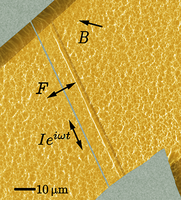
Electronic hydrodynamics has matured into a vibrant field with new experiments regularly uncovering exciting aspects of collective behavior of strongly interacting many-body systems. Henceforth, quantitative explanation of the observed phenomena would be required from the theory. Here, the authors calculate experimentally relevant values of the shear and Hall viscosities in graphene as functions of temperature, carrier density, and magnetic field, showing quantitative agreement with the available experimental data without resorting to any fitting procedures.

Increased lifetime of metastable skyrmions by controlled doping

M. T. Birch, R. Takagi, S. Seki, M. N. Wilson, F. Kagawa, A. Štefančič, G. Balakrishnan, R. Fan, P. Steadman, C. J. Ottley, M. Crisanti, R. Cubitt, T. Lancaster, Y. Tokura, and P. D. Hatton

Phys. Rev. B 100, 014425 (2019) - Published 22 July, 2019

Metastable magnetic skyrmions possess a nonzero temperature-dependent lifetime, which poses an obstacle for their application in devices. Here, the authors show that, for skyrmions in Cu2OSeO3, a small quantity of Zn substitution significantly increases this lifetime, dramatically reducing the cooling rate required to create a substantial metastable population. Time-resolved AC magnetometry measurements suggest that the effect is due to an increase in the pinning-site density that leads to slowing-down the unwinding of the skyrmion lattice, rather than to an alteration of the energy barrier.

Hamiltonian symmetries in auxiliary-field quantum Monte Carlo calculations for electronic structure

Mario Motta, Shiwei Zhang, and Garnet Kin-Lic Chan

Phys. Rev. B 100, 045127 (2019) - Published 19 July, 2019

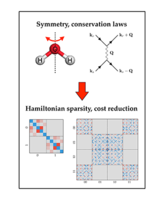
Quantum Monte Carlo simulations provide a powerful tool to compute static properties of quantum many-particle models and realistic systems. Here, the authors present a technique to reduce the computational cost of computing ground-state energies, properties, and correlation functions in the framework of the auxiliary-field quantum Monte Carlo method. This is based on a simple application of group theory, and can be readily transferred to other computational methodologies for many-particle systems.

Group theoretical approach to computing phonons and their interactions

Lyuwen Fu, Mordechai Kornbluth, Zhengqian Cheng, and Chris A. Marianetti

Phys. Rev. B 100, 014303 (2019) - Published 18 July, 2019

The authors introduce a formalism for computing phonons and their interactions based upon space group irreducible derivatives, yielding an approach that satisfies all symmetries by construction. The formalism provides the most efficient finite-displacement algorithm allowed by group theory, resulting in speedups of more than an order of magnitude compared to competing approaches. These gains will make possible the study of vibrations in far more complex materials by means of DFT in addition to allowing expensive methods beyond DFT to be employed.

On-the-fly machine learning force field generation: Application to melting points

Ryosuke Jinnouchi, Ferenc Karsai, and Georg Kresse

Phys. Rev. B 100, 014105 (2019) - Published 17 July, 2019

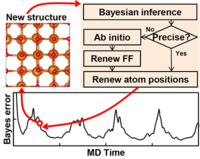
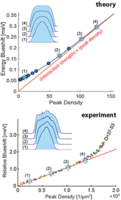
An on-the-fly force field generation method is developed and applied to liquid-solid phase transitions. The method allows the machine to automatically self-learn interatomic potentials during molecular dynamics simulations and to generate force fields with the distinctive chemical precision of first-principles methods. Applications show that more than 99% of the expensive first-principles calculations are bypassed, and molecular dynamics simulations are accelerated by more than two orders of magnitude already during learning, with many more orders during production runs.

Probing superfluid He4 with high-frequency nanomechanical resonators down to millikelvin temperatures

A. M. Guénault, A. Guthrie, R. P. Haley, S. Kafanov, Yu. A. Pashkin, G. R. Pickett, M. Poole, R. Schanen, V. Tsepelin, D. E. Zmeev, E. Collin, O. Maillet, and R. Gazizulin

Phys. Rev. B 100, 020506(R) (2019) - Published 17 July, 2019

Superfluids, such as superfluid 3He and 4He, exhibit a broad range of quantum phenomena and excitations, which are unique to these systems. Nanoscale mechanical resonators are highly sensitive force detectors with the ability to operate over many orders of magnitude in damping. Using nanomechanical doubly clamped beams, the authors probe superfluid 4He from the superfluid transition temperature down to millikelvin temperatures. They demonstrate excellent agreement with a ballistic model, incorporating thermal quasiparticles with acoustic emission limiting performance at the lowest temperatures.

Dynamics of photodoped charge transfer insulators

Denis Golež, Lewin Boehnke, Martin Eckstein, and Philipp Werner

Phys. Rev. B 100, 041111(R) (2019) - Published 17 July, 2019

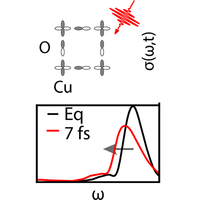
Cuprate superconductors remain a mysterious and intensely studied class of materials. New insights into their properties may be obtained by driving these systems out of equilibrium by strong laser pulses. Up to now, most theoretical works on photoexcited cuprates have employed a minimalistic single-band description of these complex materials. In order to treat cuprates and other charge transfer insulators more realistically, the authors develop a multiband theoretical scheme based on GW+EDMFT and Hartree-Fock+EDMFT and apply it to the paradigmatic Emery model. They demonstrate that photoexcitations across the charge transfer gap lead to a strong renormalization of this gap by relative band shifts as well as a substantial broadening of the bands. Comparison with several experimental probes on cuprates, e.g., time-resolved ARPES or optical experiments, shows a remarkable agreement with these simulation results. The new theoretical framework opens a path to explore optical manipulations in charge transfer insulators.

Quantum paramagnetism and helimagnetic orders in the Heisenberg model on the body centered cubic lattice

Pratyay Ghosh, Tobias Müller, Francesco Parisen Toldin, Johannes Richter, Rajesh Narayanan, Ronny Thomale, Johannes Reuther, and Yasir Iqbal

Phys. Rev. B 100, 014420 (2019) - Published 16 July, 2019

It is a well-known fact that with increasing spatial dimensionality magnetic systems have a progressively higher tendency towards developing long-range magnetic order. Here, the authors investigate whether frustration could potentially counter this trend already in three dimensions. To this end, they investigate interacting spins on the body centered cubic lattice using a state-of-the-art functional renormalization group framework. The results indicate that strong frustration effects do lead to melting of the magnetic orders and have the potential to stabilize quantum spin liquid phases.

Seeing beyond the light: Vison and photon electrodynamics in quantum spin ice

Attila Szabó and Claudio Castelnovo

Phys. Rev. B 100, 014417 (2019) - Published 15 July, 2019

Quantum spin liquids are massively entangled phases of matter dominated by quantum fluctuations. While semiclassical approaches prove surprisingly powerful to study them analytically and numerically, they do not always capture the dynamical behavior and quasiparticle excitations correctly. Here, the authors develop a generic approach to obviate these problems and demonstrate its power on the example of quantum spin ice. They obtain detailed insights into the hitherto elusive vison quasiparticles in spin ice and uncover strong vison-photon interactions that may become manifest in inelastic scattering experiments.

Universal level statistics of the out-of-time-ordered operator

Efim B. Rozenbaum, Sriram Ganeshan, and Victor Galitski

Phys. Rev. B 100, 035112 (2019) - Published 15 July, 2019

Here, the authors introduce the “Lyapunovian” – a new tool to study quantum chaos. It unifies the conventional random matrix theory approach with that based on the out-of-time-ordered correlator and generalizes them. Level statistics of the Lyapunovian under appropriate projections transitions as a function of time from an uncorrelated Poisson-like distribution to the Wigner-Dyson form. This new tool connects the semiclassical Lyapunov growth at early times, when the quantum effects are weak, to universal level repulsion that hinges on strong quantum interference effects.

Direct measurement of polariton-polariton interaction strength in the Thomas-Fermi regime of exciton-polariton condensation

E. Estrecho, T. Gao, N. Bobrovska, D. Comber-Todd, M. D. Fraser, M. Steger, K. West, L. N. Pfeiffer, J. Levinsen, M. M. Parish, T. C. H. Liew, M. Matuszewski, D. W. Snoke, A. G. Truscott, and E. A. Ostrovskaya

Phys. Rev. B 100, 035306 (2019) - Published 15 July, 2019

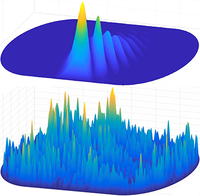
Bosonic condensates of exciton polaritons typically coexist and interact with an incoherent reservoir, which undermines measurements of key parameters of the condensate. Here, the authors overcome this limitation by creating a high-density polariton condensate in an optically induced box trap. In this interaction-dominated Thomas-Fermi regime, the condensate is fully separated from the reservoir, which enables a direct measurement of the polariton-polariton interaction strength. The results of the measurement are in agreement with theoretical predictions.

Symmetry-enforced fractonicity and two-dimensional quantum crystal melting

Ajesh Kumar and Andrew C. Potter

Phys. Rev. B 100, 045119 (2019) - Published 15 July, 2019

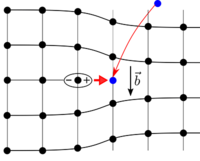
Utilizing a dual description of two-dimensional elasticity theory as a rank-2 tensor gauge theory, the authors show that zero-temperature quantum melting of a two-dimensional crystal differs crucially from the Halperin-Nelson thermal melting scenario. This is due to the particle number conservation symmetry enforced dislocation glide constraint, or fractonicity. The authors show that quantum crystal fluctuations favor a supersolid phase before melting can occur and, furthermore, discuss applications to the quantum melting of a vortex-lattice and charge-stripe order in a metal.

Unconventional pairing in single FeSe layers

Jasmin Jandke, Fang Yang, Patrik Hlobil, Tobias Engelhardt, Dominik Rau, Khalil Zakeri, Chunlei Gao, Jörg Schmalian, and Wulf Wulfhekel

Phys. Rev. B 100, 020503(R) (2019) - Published 11 July, 2019

Superconductivity in single FeSe layers on SrTiO3 shows a much higher critical temperature Tc than in bulk FeSe, illustrating the potential of interface engineering. Yet the underlying mechanism of boosting Tc is not understood. Both conventional and unconventional pairing mechanisms have been suggested to be responsible for this effect. Here, the authors show experimentally that phonons do not contribute significantly to the high Tc but instead the intrinsic spin fluctuations of the electrons themselves lead to Cooper pairing.

Ultrafast relaxation dynamics of highly excited hot electrons in silicon

Hiroshi Tanimura, Jun'ichi Kanasaki, Katsumi Tanimura, Jelena Sjakste, and Nathalie Vast

Phys. Rev. B 100, 035201 (2019) - Published 9 July, 2019

This combined experimental and theoretical investigation reveals that the relaxation of electrons at high excess energy in the conduction band of silicon takes place as two distinctive processes with different time scales, an ultrafast momentum quasiequilibration over the Brillouin zone within 10 fs and a slower energy relaxation of the hot-electron ensembles. The energy relaxation rate is proportional to the electronic density of states over a large range of excess energies. The work generalizes the concept of hot-electron ensembles in semiconductors.

Mapping the perturbation potential of metallic and dipolar tips in tunneling spectroscopy on MoS2

Nils Krane, Christian Lotze, Nils Bogdanoff, Gaël Reecht, Lei Zhang, Alejandro L. Briseno, and Katharina J. Franke

Phys. Rev. B 100, 035410 (2019) - Published 9 July, 2019

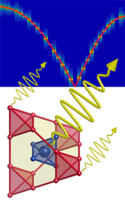
Scanning tunneling spectroscopy is a powerful tool to investigate the electronic structure of molecules on surfaces. The technique requires the application of a potential difference between sample and tip. Whereas the potential is constant along a metallic substrate, it is inhomogeneous along the surface of an insulating layer such as MoS2. The authors now show that the inhomogeneous shape of the electric potential and dipole contributions perturb the electronic states of the molecules leading to an apparent shift of the electronic states along extended molecules.

Spin excitations of magnetoelectric LiNiPO4 in multiple magnetic phases

L. Peedu, V. Kocsis, D. Szaller, J. Viirok, U. Nagel, T. Rõõm, D. G. Farkas, S. Bordács, D. L. Kamenskyi, U. Zeitler, Y. Tokunaga, Y. Taguchi, Y. Tokura, and I. Kézsmárki

Phys. Rev. B 100, 024406 (2019) - Published 8 July, 2019

In magnetoelectric (ME) materials, magnetic moments and electric polarization are entangled, leading to the static and optical ME effects. This can be used in logical devices or for the manipulation of electromagnetic radiation in the GHz and THz spectral range where the oscillating magnetic moments absorb radiation. The authors use THz spectroscopy to study LiNiPO4, a four-spin system known to exhibit the static ME effect. Using linearly polarized THz radiation, they show that beside ordinary magnon resonances excited by the magnetic field of radiation there are electromagnons and ME spin excitations activated by the electric field of radiation, thus demonstrating that spin and charge dynamics are coupled in LiNiPO4. They refine the spin Hamiltonian parameters by mapping the spin resonance spectrum over a broad magnetic field range and fitting it with a mean-field spin model.

Room temperature local nematicity in FeSe superconductor

R. J. Koch, T. Konstantinova, M. Abeykoon, A. Wang, C. Petrovic, Y. Zhu, E. S. Bozin, and S. J. L. Billinge

Phys. Rev. B 100, 020501(R) (2019) - Published 3 July, 2019

Electronic nematicity may be crucial for understanding the superconductivity in FeSe but its origin is still controversial. Here, the authors report the unexpected result, from local structural measurements, that nematic fluctuations exist preformed at temperatures far above the transition to the long-range-ordered nematic state. Perhaps even more surprisingly, the amplitude of the local nematicity is always larger than in the long-range ordered nematic state, suggesting that local nematic fluctuations persist even into the ordered state.

The sixteenfold way and the quantum Hall effect at half-integer filling factors

Ken K. W. Ma and D. E. Feldman

Phys. Rev. B 100, 035302 (2019) - Published 3 July, 2019

Cooper pairing of composite fermions is responsible for the observed half-integer quantum Hall plateaus. Different pairing types are believed to be present in different materials under different conditions. Their nature is hotly debated. Here, the authors uncover mother-daughter relations among all possible topological orders in composite-fermion superfluids. The mother-daughter relations allow for a uniform description of the sixteen types of order and are used to predict smoking-gun experimental signatures of each of the types.

Imaging Dirac fermions flow through a circular Veselago lens

B. Brun, N. Moreau, S. Somanchi, V.-H. Nguyen, K. Watanabe, T. Taniguchi, J.-C. Charlier, C. Stampfer, and B. Hackens

Phys. Rev. B 100, 041401(R) (2019) - Published 3 July, 2019

Simulations and experiments are combined to visualize current density through a circular graphene pn junction, formed by biasing the metallic tip of an atomic force microscope. To image current density, the tip is moved around a graphene constriction, acting as a detector probing a subset of trajectories depending on the tip position with respect to the constriction. The results reveal the crucial role of junction smoothness on current focusing and anti-focusing, thereby establishing the technique as a new tool for electron optics in graphene.

Frustrated spin-12 Heisenberg magnet on a square-lattice bilayer: High-order study of the quantum critical behavior of the J1−J2−J1⊥ model

R. F. Bishop, P. H. Y. Li, O. Götze, and J. Richter

Phys. Rev. B 100, 024401 (2019) - Published 1 July, 2019

The frustrated spin-½ J1-J2 Heisenberg antiferromagnet on the 2D square lattice is a paradigmatic model of quantum magnetism. Despite extensive investigations over the last 30 years, no consensus has emerged for its zero-temperature quantum phase diagram. The authors explore its bilayer J1-J2-J1┴ counterpart by including an exchange coupling J1┴ between partner sites on the two layers. As well as being of great interest in its own right, the model provides considerable insight into the single-layer case by expanding to a two-parameter regime that includes the monolayer as a single slice.

Sign In to Your Journals Account

Filter

Section

Filter

Article Lookup

Enter a citation