Highlights

Effective dynamics of two-dimensional Bloch electrons in external fields derived from symmetry

E. A. Fajardo and R. Winkler

Phys. Rev. B 100, 125301 (2019) - Published 3 September, 2019

Symmetry is a powerful tool for understanding the dynamics of Bloch electrons in a crystal. Here, the authors develop a general theory to characterize the symmetry of Bloch electrons in a tight-binding description, focusing in particular on the possibility that the symmetry labels called irreducible representations are not always unique, although this does not affect observable physics. The theory is used to construct a generic effective Hamiltonian for electrons in monolayer MoS2, which incorporates spin-orbit coupling, strain, and external electric and magnetic fields.

Determining the depairing current in superconducting nanowire single-photon detectors

S. Frasca, B. Korzh, M. Colangelo, D. Zhu, A. E. Lita, J. P. Allmaras, E. E. Wollman, V. B. Verma, A. E. Dane, E. Ramirez, A. D. Beyer, S. W. Nam, A. G. Kozorezov, M. D. Shaw, and K. K. Berggren

Phys. Rev. B 100, 054520 (2019) - Published 30 August, 2019

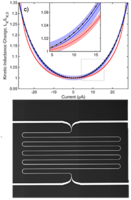
This work presents a method to estimate experimentally the superconducting depairing current of ultrathin films by means of nanowire-style resonators. Measuring the depairing current allows for a better determination of the figure of merit for the quality of superconducting nanowires. The resonance is set by impedance mismatch between the nanowire and the transmission line. Bias current dependent shifts in the measured resonant frequency correspond to the change in the kinetic inductance, which can be compared with theoretical predictions to estimate the resonator superconducting depairing current. The experiments lead to an unexpected and original result - a decrease of the switching-to-depairing current ratio with increasing temperature.

Topological Hall effect and emergent skyrmion crystal at manganite-iridate oxide interfaces

Narayan Mohanta, Elbio Dagotto, and Satoshi Okamoto

Phys. Rev. B 100, 064429 (2019) - Published 30 August, 2019

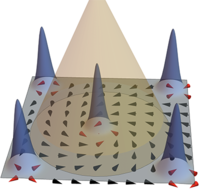
The competition between the Dzyaloshinskii-Moriya interaction and magnetic exchange interactions is known to create exotic spin textures such as spin-spiral and skyrmion-crystal phases. Using Monte Carlo simulations, this work explores novel magnetic textures at the interface between two perovskite oxides, strontium iridate and lanthanum manganite, where the double-exchange hopping and the Dzyaloshinskii-Moriya interaction coexist. The formation of various possible noncollinear spin textures at the interface as a function of temperature and applied magnetic field as well as the emergent topological Hall effect in the skyrmion crystal phase are revealed.

Hole mobility of strained GaN from first principles

Samuel Poncé, Debdeep Jena, and Feliciano Giustino

Phys. Rev. B 100, 085204 (2019) - Published 29 August, 2019

Wurzite GaN possesses a low hole mobility, preventing its mass adoption for applications in high-power transistors. The authors perform predictive abinitio calculations of the phonon-limited mobility of GaN and find that hole mobilities as high as 120 cm2/Vs at room temperature could potentially be achieved by reversing the sign of the crystal-field splitting via uniaxial compressive strain or biaxial tensile strain. The experimental realization of this proposal will contribute to the development of high-power electronics based on GaN.

Optical Thouless conductance and level-spacing statistics in two-dimensional Anderson localizing systems

Sandip Mondal, Randhir Kumar, Martin Kamp, and Sushil Mujumdar

Phys. Rev. B 100, 060201(R) (2019) - Published 28 August, 2019

Anderson localization is associated with a definite spectral behavior whereby the widths and spacings of eigenvalues characterize the transport via subunity Thouless conductance. Towards experimental measurements, a formidable challenge is to identify a sufficient number of eigenvalues in a statistically consistent manner. Here, the authors extract the spectral peaks of a multitude of localizing configurations over an ultrabroad spectral band, and directly determine the optical Thouless conductance. The log-normal distribution of the conductance is consistent with Anderson localization, while the spacing statistics remain an approximate Wigner-Dyson. A theoretical model associates the observed spectral behavior to the degree of localization.

Phase separation in the vicinity of Fermi surface hot spots

T. Jaouen, B. Hildebrand, M.-L. Mottas, M. Di Giovannantonio, P. Ruffieux, M. Rumo, C. W. Nicholson, E. Razzoli, C. Barreteau, A. Ubaldini, E. Giannini, F. Vanini, H. Beck, C. Monney, and P. Aebi

Phys. Rev. B 100, 075152 (2019) - Published 28 August, 2019

The authors reveal an intimate relationship between intrinsic impurities and Fermi surface topology as a previously overlooked degree of freedom for understanding the emergence of complex electronic landscapes in the prominent transition metal dichalcogenide 1T-TiSe2. They find a fundamental tendency towards phase separation in the vicinity of Fermi surface hot spots, which are locations in reciprocal space with band crossings close to, but not at, the Fermi level. The study highlights the key role of the Fermi surface topology for driving phase-separated states that emerge upon doping or pressure in many transition metal dichalcogenides and other charge density wave compounds.

Study of the high pressure phase evolution of Co3O4

Federico Cova, Maria Valeria Blanco, Michael Hanfland, and Gaston Garbarino

Phys. Rev. B 100, 054111 (2019) - Published 26 August, 2019

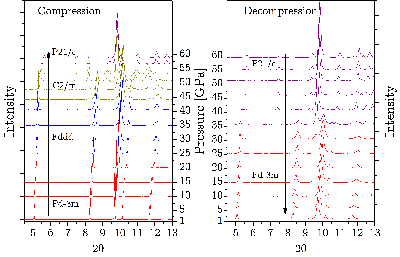
This work presents a detailed study of the crystal structure of Co3O4 under pressure. Insitu high-resolution x-ray diffraction coupled with Raman spectroscopy at pressure up to 60 GPa reveals the occurrence of three phase transitions. The ambient-pressure cubic Fd-3m structure distorts to an Fddd orthorhombic lattice, followed by the monoclinic C2/m and P21/c phases at higher pressure. This systematic experimental approach leads to the determination of so far unreported phase transitions and equations of state as well as to the solution of contradictory results reported in the literature.

Quantum supercapacitors

Dario Ferraro, Gian Marcello Andolina, Michele Campisi, Vittorio Pellegrini, and Marco Polini

Phys. Rev. B 100, 075433 (2019) - Published 26 August, 2019

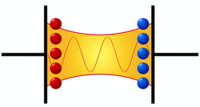
Conventional capacitors are able to store electrostatic energy due to the geometrical arrangement of electric charges. Here, the authors show that it is possible to go beyond this classical idea. Studying the quantum phase diagram of an array of electron- and hole-based charge qubits embedded in a microwave cavity, they observe that the interplay between Coulomb interactions and matter-radiation coupling can lead to a configuration where charges arrange in a nonclassical way, with a relevant increasing of the stored electrostatic energy.

Chiral twist on the high-Tc phase diagram in moiré heterostructures

Yu-Ping Lin and Rahul M. Nandkishore

Phys. Rev. B 100, 085136 (2019) - Published 26 August, 2019

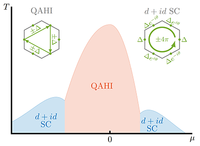
Moiré heterostructures involving graphene realize a host of ill-understood insulating and superconducting phases with high tunability. In this work, the authors develop an asymptotically exact treatment of the weak-coupling instabilities in such systems at a particular doping value. The analysis predicts a remarkable high-Tc-like phase diagram where, upon doping, an exotic chiral insulator gives way to an equally exotic chiral superconductor. The results are unambiguous and independent of the details of the microscopic interactions.

Higher-order Floquet topological phases with corner and bulk bound states

Martin Rodriguez-Vega, Abhishek Kumar, and Babak Seradjeh

Phys. Rev. B 100, 085138 (2019) - Published 26 August, 2019

Periodically driven systems can be quite different from those in equilibrium. For example, vortices stirred in a fluid can trap nearby objects, such as bubbles. The authors report their theoretical discovery of new phases of a two-dimensional quantum system under periodic drive, in which nonequilibrium states are stabilized at the corners as well as within stirred vortices in the bulk. These are higher-order topological phases, exhibiting the intimate connection between corner and bulk vortex structures generated by spatiotemporal modulations.

Spinning radiation from a topological insulator

Emroz Khan and Evgenii E. Narimanov

Phys. Rev. B 100, 081408(R) (2019) - Published 22 August, 2019

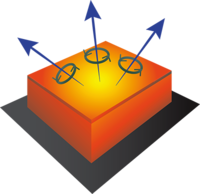
Axion coupling in topological insulators dramatically changes the electromagnetic response of these materials. Here, the authors show that this coupling leads to the emergence of spin angular momentum in the associated thermal radiation where all emitted light is elliptically polarized in the same direction. In contrast to conventional thermal emitters with a structured interface, a slab of a topological insulator with a thin magnetic coating would radiate thermal photons with the same magnitude and direction of circular polarization in all emission angles.

Phonon engineering with superlattices: Generalized nanomechanical potentials

O. Ortíz, M. Esmann, and N. D. Lanzillotti-Kimura

Phys. Rev. B 100, 085430 (2019) - Published 22 August, 2019

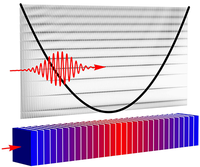
Acoustic phonons constitute a promising platform for single-particle quantum simulations. To this end, the implementation of effective phononic potentials is a key requirement. In this work, the authors propose a method to mimic the effects of one-dimensional potentials on high-frequency acoustic phonons. Based on perturbed periodic superlattices, the theoretical study introduces nanostructures that are much more compact than previous implementations. This compactness enables the realization of experimental studies, even when absorption effects are considered.

Generalized Fourier's law for nondiffusive thermal transport: Theory and experiment

Chengyun Hua, Lucas Lindsay, Xiangwen Chen, and Austin J. Minnich

Phys. Rev. B 100, 085203 (2019) - Published 21 August, 2019

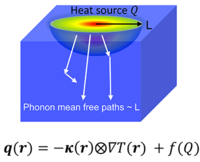
Fourier’s law, which relates the heat flux and temperature fields at macroscopic length scales, is fundamental to the mathematical description of heat transport. While it is well-known that Fourier’s law breaks down at lengths comparable to the mean free path of the heat carriers, an appropriate modification has remained unknown until now. In the present work, the authors derive analytically a generalized Fourier’s law that is valid over transport regimes spanning ballistic to diffusive. This relation shows that in the nondiffusive regime the heat flux and temperature fields not only have a nonlocal relationship but also depend on the properties of the heat source itself, a prediction that is verified by thermal spectroscopy experiments. This constitutive law provides a theoretical basis to understand nonlocal effects in the transport of heat at mesoscopic length scales.

Two-dimensional Weyl half-semimetal and tunable quantum anomalous Hall effect

Jing-Yang You, Cong Chen, Zhen Zhang, Xian-Lei Sheng, Shengyuan A. Yang, and Gang Su

Phys. Rev. B 100, 064408 (2019) - Published 19 August, 2019

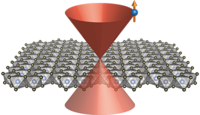
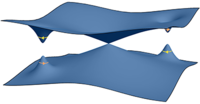
A Weyl point is topologically stable in three dimensions, but is typically vulnerable in two dimensions of space, especially when spin-orbit coupling (SOC) and magnetic ordering are considered. Here, the authors predict a state, labeled as a Weyl half-semimetal, which hosts a stable magnetic Weyl point in two dimensions in the presence of SOC. It is simultaneously a Weyl semimetal and a half metal, such that the low-energy electrons are fully spin-polarized two-dimensional Weyl fermions. A specific material, the monolayer PtCl3, is proposed to realize this state.

Implicit renormalization approach to the problem of Cooper instability

Andrey Chubukov, Nikolay V. Prokof'ev, and Boris V. Svistunov

Phys. Rev. B 100, 064513 (2019) - Published 16 August, 2019

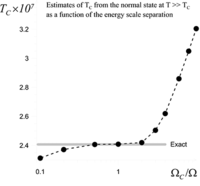
In electronic systems, the superconducting instability develops as a result of nontrivial renormalization of the overall repulsive, yet essentially frequency-dependent interaction. Starting with simple models that admit of explicit analytical treatment, the authors develop a generic method of implicit renormalization that makes possible the solution of the challenging problem of extracting the transition temperature and of the effective pairing interaction from first-principles data in the normal state.

Proximity exchange effects in MoSe2 and WSe2 heterostructures with CrI3: Twist angle, layer, and gate dependence

Klaus Zollner, Paulo E. Faria Junior, and Jaroslav Fabian

Phys. Rev. B 100, 085128 (2019) - Published 16 August, 2019

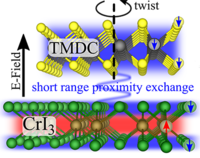
Proximity effects in two-dimensional heterostructures allow to transform nonmagnetic materials into synthetic magnets that do not involve magnetic ions. Based on density functional theory calculations, the present study predicts a sizeable proximity exchange interactions, induced by ferromagnetic CrI3, in transition metal dichalcogenides. Remarkably, the exchange coupling depends qualitatively on the twist angle, while being also tunable by an electric field. The authors establish the short-range character of the proximity effect and make specific predictions for the excitonic level splittings, due to the induced exchange coupling.

Polarized inelastic neutron scattering of nonreciprocal spin waves in MnSi

T. Weber, J. Waizner, P. Steffens, A. Bauer, C. Pfleiderer, M. Garst, and P. Böni

Phys. Rev. B 100, 060404(R) (2019) - Published 12 August, 2019

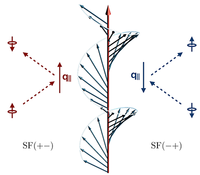
Systems lacking time-inversion or centrosymmetry exhibit nonreciprocal magnon transport. Their dynamical magnetic structure factor is asymmetric with respect to the inversion of the reduced momentum, transferred to the system. In this work, the authors establish the helical itinerant-electron magnet MnSi as an archetypical model for nonreciprocal phenomena by comparing polarized inelastic neutron scattering data with mean-field linear spin-wave calculations.

Classes of metastable thermodynamic quantum time crystals

S. I. Mukhin and T. R. Galimzyanov

Phys. Rev. B 100, 081103(R) (2019) - Published 12 August, 2019

Quantum field theories of many-body systems predict “instantonic crystals” connecting degenerate thermodynamic states with classically broken symmetries. The instantons break continuous translation symmetry of Euclidean space along the axis of imaginary time. The possibility for the emergence of “thermodynamic quantum time crystals” that extremize the Euclidean action of the system appeals to the imagination. However, the authors prove here that at least two general classes of “instantonic crystals”, connecting states of Fermi systems with charge, spin, or superconducting orders can constitute neither thermodynamic equilibrium nor the ground state.

Topology and observables of the non-Hermitian Chern insulator

Mark R. Hirsbrunner, Timothy M. Philip, and Matthew J. Gilbert

Phys. Rev. B 100, 081104(R) (2019) - Published 12 August, 2019

Given the rising importance of non-Hermitian theories that describe open lossy systems, significant research has focused on studying non-Hermitian topological invariants. However, recent work suggests that related observables may no longer be quantized. Here, the authors illustrate the underlying structure of the Green’s function of non-Hermitian Hamiltonians that precludes the quantization of the Chern-Simons coefficient, resulting in the nonquantization of the Hall response of non-Hermitian Chern insulators. By showing nonquantization across a broad class of non-Hermitian Hamiltonians, the authors demonstrate the disconnect in non-Hermitian systems between a topological invariant, the Chern number, and its associated observable, the Hall conductivity.

Topology in time-reversal symmetric crystals

Jorrit Kruthoff, Jan de Boer, and Jasper van Wezel

Phys. Rev. B 100, 075116 (2019) - Published 9 August, 2019
Topology and symmetry are cornerstones of modern condensed matter physics. They are not independent, and the symmetries of a particular material determine how many topologically distinct phases it may host. Unlike external symmetries, such as time-reversal symmetry, the relation between atomic lattice symmetries and electron topology is not known in general. The authors present an algorithm for classifying all time-reversal symmetric crystalline topological insulators. It yields an intuitive picture of the relations between topological invariants, and predicts new invariants in particular lattices.

Sign In to Your Journals Account

Filter

Section

Filter

Article Lookup

Enter a citation