Highlights

Kondo effect due to a hydrogen impurity in graphene: A multichannel Kondo problem with diverging hybridization

Zheng Shi, Emilian M. Nica, and Ian Affleck

Phys. Rev. B 100, 125158 (2019) - Published 25 September, 2019

Magnetic impurities in conducting media are often Kondo screened by conduction electrons. However, for hydrogen impurities in graphene, which also induce magnetic moments, the picture is complicated by the energy-dependent, unusually enhanced local density of states. Here, the authors study the Kondo effect in this system, which is intimately related to the Kondo problem of three impurity spins on an equilateral triangle in a metallic host. The induced magnetic moment is found to be underscreened for local potential scattering that is not too strong, leaving a residual spin of ½.

Growth of nematic susceptibility in the field-induced normal state of an iron-based superconductor revealed by elastoresistivity measurements in a 65 T pulsed magnet

J. A. W. Straquadine, J. C. Palmstrom, P. Walmsley, A. T. Hristov, F. Weickert, F. F. Balakirev, M. Jaime, R. McDonald, and I. R. Fisher

Phys. Rev. B 100, 125147 (2019) - Published 23 September, 2019

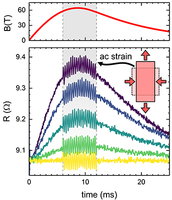
In iron-based superconductors, questions surrounding a putative nematic quantum critical point motivate study of the nematic susceptibility at low temperatures. By suppressing superconductivity with pulsed magnetic fields, this work extends the range of elastoresistivity measurements in nearly optimally doped Ba(CoxFe1−x)2As2 an order of magnitude lower in temperature. The authors show that the nematic susceptibility in the field-induced normal state grows monotonically as temperature decreases. This is consistent with the existence of a nearby quantum critical point with nematic character.

Electronic band structure of a two-dimensional oxide quasicrystal

Cheng-Tien Chiang, Martin Ellguth, Florian O. Schumann, Christian Tusche, Richard Kraska, Stefan Förster, and Wolf Widdra

Phys. Rev. B 100, 125149 (2019) - Published 23 September, 2019

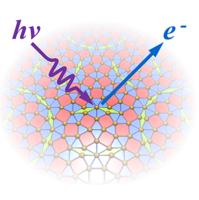
Since the discovery of quasicrystals, the study of their electronic structure has been a challenging topic due to the absence of translational symmetry. Here, the valence bands of a novel two-dimensional ultrathin BaTiO3-derived oxide quasicrystal are determined by momentum-resolved photoelectron spectroscopy. The dispersion of the oxygen 2p bands and the occupation of the Ti 3d states are identified. They bridge the knowledge deriving from free-electron-like wave functions in bulk quasicrystals to that of the more localized electrons in confined dimensions.

Fractonic matter in symmetry-enriched U(1) gauge theory

Dominic J. Williamson, Zhen Bi, and Meng Cheng

Phys. Rev. B 100, 125150 (2019) - Published 23 September, 2019

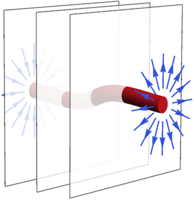
This study reveals the relation between symmetry restrictions on the mobility of quasiparticles and symmetry-enriched topological order, where the actions of translation and global symmetries on quasiparticle excitations do not commute. The approach is demonstrably fruitful as one can systematically classify U(1) gauge theories enriched by translation and certain global symmetry and identify new examples of fractonic matter. It is conjectured that all such theories can be constructed by gauging layered symmetry-protected topological phases.

Excitation of unidirectional exchange spin waves by a nanoscale magnetic grating

Jilei Chen, Tao Yu, Chuanpu Liu, Tao Liu, Marco Madami, Ka Shen, Jianyu Zhang, Sa Tu, Md Shah Alam, Ke Xia, Mingzhong Wu, Gianluca Gubbiotti, Yaroslav M. Blanter, Gerrit E. W. Bauer, and Haiming Yu

Phys. Rev. B 100, 104427 (2019) - Published 20 September, 2019

Unidirectional propagation of spin waves is key to the realization of magnonic logic devices. Here, the authors experimentally demonstrate excitations of unidirectional exchange spin waves by a nanoscale magnetic grating fabricated on an ultrathin yttrium iron garnet film. The authors explain and model the nearly perfect unidirectional excitation by the chirality of the magnetodipolar interactions. Reversal of the magnetic configurations changes the direction of the exchange spin waves. Such results raise the prospect of a chiral magnonic logic without the need for fragile surface states.

Symmetry fractionalization, defects, and gauging of topological phases

Maissam Barkeshli, Parsa Bonderson, Meng Cheng, and Zhenghan Wang

Phys. Rev. B 100, 115147 (2019) - Published 20 September, 2019

This paper develops a comprehensive theory of symmetry fractionalization together with the properties of symmetry defects in topologically ordered phases of matter in two spatial dimensions. To do this, the authors also introduce the full set of data, consistency conditions, and equivalences for a mathematical theory, known as a G-crossed braided tensor category, that characterizes the algebraic braiding and fusion properties of symmetry defects. This theoretical framework can completely characterize and classify symmetry-enriched topological phases of matter in the presence of arbitrarily strong interactions in quantum many-body systems in two spatial dimensions.

Emergent symmetry and conserved current at a one-dimensional incarnation of deconfined quantum critical point

Rui-Zhen Huang, Da-Chuan Lu, Yi-Zhuang You, Zi Yang Meng, and Tao Xiang

Phys. Rev. B 100, 125137 (2019) - Published 17 September, 2019

Although great efforts have been expended on the deconfined quantum critical point (DQCP) for 2D systems, ambiguities are still not completely clarified. Here, the authors focus on a recently proposed 1D incarnation of DQCP in a spin-½ chain. Using the variational matrix product state, a continuous transition between a valence-bond solid phase and a ferromagnetic phase is discovered. Two emergent O(2) symmetries together with the associated conserved current operators are revealed and in perfect agreement with the controlled field theory predictions.

Cooper pairing of incoherent electrons: An electron-phonon version of the Sachdev-Ye-Kitaev model

Ilya Esterlis and Jörg Schmalian

Phys. Rev. B 100, 115132 (2019) - Published 16 September, 2019

Characterizing the interplay between non-Fermi-liquid physics and superconductivity is an important open problem in condensed matter physics. From a theoretical standpoint, the challenge stems from the difficulty in identifying controlled models where these phenomena can be simultaneously treated on equal footing. Here, the authors propose a new model of strongly interacting electrons and phonons, in close analogy with the well-known Sachdev-Ye-Kitaev model, and, via exact solution, explore how superconductivity can emerge from quantum critical and highly incoherent non-Fermi-liquid normal states. Many of the results are in qualitative agreement with observations made in iron-based, heavy-fermion, and cuprate superconductors.

Coexistence of static and dynamic magnetism in the Kitaev spin liquid material Cu2IrO3

Eric M. Kenney, Carlo U. Segre, William Lafargue-Dit-Hauret, Oleg I. Lebedev, Mykola Abramchuk, Adam Berlie, Stephen P. Cottrell, Gediminas Simutis, Faranak Bahrami, Natalia E. Mordvinova, Gilberto Fabbris, Jessica. L. McChesney, Daniel Haskel, Xavier Rocquefelte, Michael J. Graf, and Fazel Tafti

Phys. Rev. B 100, 094418 (2019) - Published 12 September, 2019

A spin liquid is a state of matter where the spins do not freeze and remain liquidlike even at T=0. It is a question of whether the impurity spins can interact and freeze within a spin-liquid environment. This could happen in a material with mixed-valence ions. Here, the authors show that Cu2IrO3 includes both Cu+ and Cu2+. The former is nonmagnetic and participates in the spin-liquid phase. The latter forms magnetic impurities that segregate in distinct domains.

Melting of vortex lattice in the magnetic superconductor RbEuFe4As4

A. E. Koshelev, K. Willa, R. Willa, M. P. Smylie, J.-K. Bao, D. Y. Chung, M. G. Kanatzidis, W.-K. Kwok, and U. Welp

Phys. Rev. B 100, 094518 (2019) - Published 12 September, 2019

Thermal fluctuations always melt the vortex lattice in type-II superconductors at temperatures below the mean-field transition. The extent of the intermediate vortex-liquid state varies widely among different materials. Exploring the vortex-lattice melting in the magnetic iron arsenide RbEuFe4As4 via calorimetry and transport, the authors demonstrate here that the vortex liquid occupies a significant portion of the phase diagram and that the location of the melting line agrees with theoretical predictions without fitting parameters. Comparison with other materials reveals the universality of melting behavior.

Eigenstate thermalization scaling in Majorana clusters: From chaotic to integrable Sachdev-Ye-Kitaev models

Masudul Haque and P. A. McClarty

Phys. Rev. B 100, 115122 (2019) - Published 12 September, 2019

This work addresses the question of whether the eigenstate thermalization hypothesis in its scaling form is satisfied in Sachdev-Ye-Kitaev models.Going substantially beyond previous treatments of eigenstate expectation values in such models, the authors present a scaling analysis and identify the situations where eigenstate thermalization holds and where it does not.

Embedded topological insulators

Thomas I. Tuegel, Victor Chua, and Taylor L. Hughes

Phys. Rev. B 100, 115126 (2019) - Published 12 September, 2019

What happens if two insulators, topological or trivial, of different dimensionalities but belonging to a common symmetry class, are combined and coupled? This question can be partially addressed with the notion of embedded topological insulators. These are lower dimensional topological insulators that are embedded, sometimes as defects, within a trivial insulating environment of higher dimensionality, whereby they remain topologically nontrivial despite stability equivalence and can be identified by entanglement-based methods or from defects such as partial dislocations.

Surface states and Rashba-type spin polarization in antiferromagnetic MnBi2Te4(0001)

R. C. Vidal et al.

Phys. Rev. B 100, 121104(R) (2019) - Published 11 September, 2019

The layered van der Waals antiferromagnet MnBi2Te4 has been predicted previously to realize the first intrinsic magnetic topological insulator. Here, the authors report spin- and angle-resolved photoemission experiments for the MnBi2Te4(0001) surface, revealing a surface state in the bulk band gap and providing evidence for the interplay between magnetic exchange interaction and spin-orbit coupling in the surface electronic structure. MnBi2Te4 thus constitutes a promising candidate to exploit the interplay of topological states and magnetic order in spintronic device concepts.

Magnetic frustration and spontaneous rotational symmetry breaking in PdCrO2

Dan Sun, Dmitry A. Sokolov, Jack M. Bartlett, Jhuma Sannigrahi, Seunghyun Khim, Pallavi Kushwaha, Dmitry D. Khalyavin, Pascal Manuel, Alexandra S. Gibbs, Hidenori Takagi, Andrew P. Mackenzie, and Clifford W. Hicks

Phys. Rev. B 100, 094414 (2019) - Published 10 September, 2019

In the delafossite lattice structure of the triangular antiferromagnet PdCrO2, the interlayer stacking means that the net interlayer exchange interaction is zero. Through neutron scattering measurements under uniaxial stress, the authors show here that magnetism relieves this frustration through a spontaneous tilt of the spins that breaks the threefold rotational symmetry of the nonmagnetic lattice. It is also demonstrated through resistivity measurements that uniaxial stress can suppress thermal magnetic fluctuations within the magnetically ordered state.

Exceptional points and their coalescence of PT-symmetric interface states in photonic crystals

Xiaohan Cui, Kun Ding, Jian-Wen Dong, and C. T. Chan

Phys. Rev. B 100, 115412 (2019) - Published 9 September, 2019

Interface modes that exist in the band gap of Hermitian systems are well studied. This work looks at the interface modes localized at the loss-gain boundary of 𝓟𝓣-symmetric photonic crystals. These interface bands exhibit zigzag dispersions that exist only in open systems, and the turning points are found to be exceptional points, which are characteristic of non-Hermitian systems. By building a non-Hermitian Hamiltonian model and an effective medium theory, the authors analyze the evolution of the interface bands as the system parameters change.

Multiple ferromagnetic transitions and structural distortion in the van der Waals ferromagnet VI3 at ambient and finite pressures

Elena Gati, Yuji Inagaki, Tai Kong, Robert J. Cava, Yuji Furukawa, Paul C. Canfield, and Sergey L. Bud'ko

Phys. Rev. B 100, 094408 (2019) - Published 5 September, 2019

van der Waals (vdW) materials are versatile systems for the study of magnetism in low dimensions. Motivated by the potential tunability of the new vdW ferromagnet VI3, the authors perform here a microscopic and thermodynamic study under hydrostatic pressure on bulk single crystals. Their main findings include: (i) VI3 undergoes two ferromagnetic transitions for ambient and low pressures, implying a complex magnetic structure; (ii) at higher pressures, the magnetic transitions merge with a structural one – a hallmark of magnetoelastic coupling.

Light-induced nonequilibrium response of the superconducting cuprate La2−xSrxCuO4

Hiroaki Niwa, Naotaka Yoshikawa, Kaito Tomari, Ryusuke Matsunaga, Dongjoon Song, Hiroshi Eisaki, and Ryo Shimano

Phys. Rev. B 100, 104507 (2019) - Published 5 September, 2019

Recent observations of a light-induced superconducting-like state above Tc in stripe-ordered cuprate superconductors have triggered intensive theoretical and experimental studies to elucidate the mechanism. How the superconducting state of these cuprates is affected by photoexcitation has remained elusive even below Tc. Here, the authors perform optical pump-probe terahertz spectroscopy on La2−xSrxCuO4 where no long-range stripe order exists. The authors demonstrate that in this material, upon strong photoexcitation, the spectrum in the quasiequilibrium state is described by light-induced thermalization that exhibits a temperature gradient along the pump-penetration direction. The authors also show that a conventional method of analysis can lead to artifacts when the penetration-depth mismatch between the pump and probe can’t be neglected.

Evolution of structural, magnetic, and transport properties in MnBi2−xSbxTe4

J.-Q. Yan, S. Okamoto, M. A. McGuire, A. F. May, R. J. McQueeney, and B. C. Sales

Phys. Rev. B 100, 104409 (2019) - Published 4 September, 2019

Here, the authors report a thorough study of the evolution of structural, magnetic, and electrical properties of MnBi2−xSbxTe4 single crystals. This investigation reveals an intimate correlation between the structural, magnetic, and transport properties. Partial substitution of Bi by Sb is an effective approach to tuning both the magnetism and the Fermi level, which are two key components of magnetic topological insulators. This work provides an important guide for exploring the topological properties in MnBi2Te4-based materials. The effect of doping on the magnetic properties also suggests complex competing interactions, which should be considered when tuning the magnetic properties.

Imaging propagative exciton polaritons in atomically thin WSe2 waveguides

F. Hu, Y. Luan, J. Speltz, D. Zhong, C. H. Liu, J. Yan, D. G. Mandrus, X. Xu, and Z. Fei

Phys. Rev. B 100, 121301(R) (2019) - Published 4 September, 2019

This work reports a nano-optical imaging study of the transverse-electric exciton polaritons in atomically thin WSe2 nanoflakes by using a scattering-type scanning near-field optical microscope excited by an s-polarized laser. These exciton polaritons demonstrate the signature back-bending polariton dispersion, a long propagation length, and a tailored polariton wavelength by controlling the thickness of WSe2. The discovery of long-propagating exciton polaritons in WSe2 atomic layers paves the way for the future development of actively tunable polaritonic devices in the near-infrared region.

Origin of the butterfly magnetoresistance in a Dirac nodal-line system

Y.-C. Chiu, K.-W. Chen, R. Schönemann, V. L. Quito, S. Sur, Q. Zhou, D. Graf, E. Kampert, T. Förster, K. Yang, G. T. McCandless, Julia Y. Chan, R. E. Baumbach, M. D. Johannes, and L. Balicas

Phys. Rev. B 100, 125112 (2019) - Published 4 September, 2019
ZrSiSe, similar to ZrSiS and ZrSiTe, displays a set of Dirac nodal lines at nonsymmorphic (and symmorphic) positions that are (are not) protected from gap opening due to spin-orbit coupling. The fourfold angular dependence of its magnetoresistivity was recently claimed to result from a topological phase transition as a function of field orientation. Instead, the calculations here reveal that this compound does not display a (strong) topological character, while the measurements here indicate that this anomalous magnetoresistivity results from the angular dependence of its quasiparticle quantum lifetime(s).

Sign In to Your Journals Account

Filter

Section

Filter

Article Lookup

Enter a citation