Highlights

Symmetry and quantum kinetics of the nonlinear Hall effect

S. Nandy and Inti Sodemann

Phys. Rev. B 100, 195117 (2019) - Published 12 November, 2019

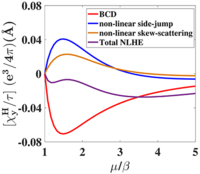
Unlike the ordinary Hall effect, the nonlinear Hall effect (NLHE) can occur in time-reversal-invariant metals lacking inversion symmetry. The authors uncover that two disorder-mediated corrections to the NLHE, namely, the nonlinear side jump and the nonlinear skew scattering, can be as large as the intrinsic Berry curvature dipole contribution. These findings will help to understand recent experiments searching for NLHE in various materials. They also offer a description of the role of disorder in current rectification in materials without inversion symmetry that could be relevant for wireless energy harvesting technology.

Electron spin resonance in spiral antiferromagnet linarite: Theory and experiment

S. K. Gotovko, L. E. Svistov, A. M. Kuzmenko, A. Pimenov, and M. E. Zhitomirsky

Phys. Rev. B 100, 174412 (2019) - Published 8 November, 2019

Spin structures realized in magnetic materials with competing exchange interactions depend crucially on weak additional interactions, such as relativistic magnetic anisotropies, farther-neighbor exchanges, etc. This is the case in the natural magnetic mineral linarite, which has attracted a lot of attention due to its rich phase diagram. Electron spin resonance (ESR) is a sensitive experimental technique that allows to probe the presence and magnitude of magnetic anisotropies. The authors have measured the ESR modes in linarite over a broad frequency range and for various field geometries. The accompanying theoretical analysis provides accurate estimates for the magnetic anisotropy constants that, in turn, influence the presence of exotic multipolar states.

Interaction-induced charge transfer in a mesoscopic electron spectrometer

Stefan G. Fischer, Jinhong Park, Yigal Meir, and Yuval Gefen

Phys. Rev. B 100, 195411 (2019) - Published 8 November, 2019

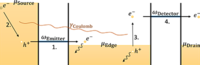
A theoretical analysis reveals the physical origin behind energetic signatures, measured in an electron spectrometer, that have recently been realized experimentally. In the device, electrons are injected and detected at specific energies. Surprisingly, signals arise in which the detection energy exceeds the injection energy. The theoretical treatment shows that these signals can be linked to interactions that were so far thought to be negligible in the description of mesoscopic samples, between electrons that propagate in spatially separate parts of the spectrometer.

Electron-phonon coupling and Kohn anomaly due to floating two-dimensional electronic bands on the surface of ZrSiS

Siwei Xue, Tiantian Zhang, Changjiang Yi, Shuyuan Zhang, Xun Jia, Luiz H. Santos, Chen Fang, Youguo Shi, Xuetao Zhu, and Jiandong Guo

Phys. Rev. B 100, 195409 (2019) - Published 7 November, 2019

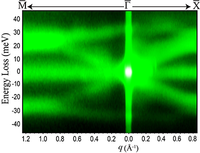
Electron phonon coupling (EPC) between surface electronic states and surface phonons is significant for low-dimensional devices. This is especially important for topological materials with exotic surface states. The authors experimentally map out the surface phonon dispersions of a topological nodal line semimetal ZrSiS with exotic surface floating two-dimensional electronic bands. They reveal a prominent Kohn anomaly in a surface phonon branch, originating from the interactions with the two-dimensional electrons. This discovery provides an EPC picture, important for the applications of topological nodal line semimetals.

Microscopic nonequilibrium energy transfer dynamics in a photoexcited metal/insulator heterostructure

N. Rothenbach, M. E. Gruner, K. Ollefs, C. Schmitz-Antoniak, S. Salamon, P. Zhou, R. Li, M. Mo, S. Park, X. Shen, S. Weathersby, J. Yang, X. J. Wang, R. Pentcheva, H. Wende, U. Bovensiepen, K. Sokolowski-Tinten, and A. Eschenlohr

Phys. Rev. B 100, 174301 (2019) - Published 5 November, 2019

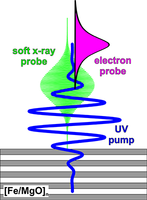
Heterostructures promise tailored, ultrafast functionality. However, the nonequilibrium pathways for the relaxation of optical excitations and attendant energy transfer are highly complex, as they involve the interaction of electronic and lattice degrees of freedom both within and among the constituents. With complementary femtosecond time-resolved probes, the authors analyze the microscopic nonequilibrium dynamics in metal/insulator heterostructures. They identify subpicosecond coupling of hot electrons in the metal to hybrid interface phonon modes extending into the insulator.

Theory of exciton dynamics in time-resolved ARPES: Intra- and intervalley scattering in two-dimensional semiconductors

Dominik Christiansen, Malte Selig, Ermin Malic, Ralph Ernstorfer, and Andreas Knorr

Phys. Rev. B 100, 205401 (2019) - Published 1 November, 2019

The family of two-dimensional semiconductors exhibits a variety of bright and dark exciton states with many possible interaction channels. Here, the authors develop a theoretical description of exciton dynamics in time- and angle-resolved photoemission spectroscopy (trARPES). Due to its simultaneous time and momentum resolution, trARPES has direct access to the interplay of optically bright and dark excitons and allows resolution of exciton formation and thermalization on a femtosecond time scale throughout the Brillouin zone.

Natural analog to cosmology in basic condensed matter physics

Eugene B. Kolomeisky

Phys. Rev. B 100, 140301(R) (2019) - Published 31 October, 2019

What do charge oscillations in conductors and expansion of the Universe have in common? More than meets the eye as the author demonstrates. A collection of identical charged particles in the presence of a uniform compensating background charge could evolve as if the system were part of an expanding or contracting homogeneous and isotropic Universe with the “wrong” sign of interaction: while gravity is attractive, the charges repel each other. Otherwise, the equations of motion are identical with the cosmological equations of general theory of relativity.

Crystal-to-fracton tensor gauge theory dualities

Michael Pretko, Zhengzheng Zhai, and Leo Radzihovsky

Phys. Rev. B 100, 134113 (2019) - Published 30 October, 2019

Fractons are a new class of emergent quasiparticles with restricted mobility. Previously, fractons were only known to occur in complicated spin models without direct material realization. Here, the authors detail various duality relationships, which map directly the physics of fractons onto topological defects of quantum crystals. Fractons and dipoles correspond to disclinations and dislocations, respectively, while elastic phonons map onto tensor gauge modes. The authors discuss several applications of the duality, such as a simplified reformulation of two-dimensional melting.

An integrated nanophotonic quantum register based on silicon-vacancy spins in diamond

C. T. Nguyen, D. D. Sukachev, M. K. Bhaskar, B. Machielse, D. S. Levonian, E. N. Knall, P. Stroganov, C. Chia, M. J. Burek, R. Riedinger, H. Park, M. Lončar, and M. D. Lukin

Phys. Rev. B 100, 165428 (2019) - Published 30 October, 2019

Quantum networks hold the promise of secure communication, guaranteed by fundamental laws of physics. Building such networks, however, requires quantum nodes that can relay this quantum information. Here, the authors address practical considerations necessary for building a quantum network node using silicon-vacancy color centers (SiVs) in diamond. Specifically, they describe improvements in nanophotonic cavity design and fabrication, as well as the roles that strain, spin bath, and heating have in performing spin-photon and spin-spin entanglement experiments with SiVs at 100-mK temperatures.

Ground state and low-temperature magnetism of the quasi-two-dimensional honeycomb compound InCu2/3V1/3O3

M. Iakovleva, O. Janson, H.-J. Grafe, A. P. Dioguardi, H. Maeter, N. Yeche, H.-H. Klauss, G. Pascua, H. Luetkens, A. Möller, B. Büchner, V. Kataev, and E. Vavilova

Phys. Rev. B 100, 144442 (2019) - Published 29 October, 2019

The compound InCu2/3V1/3O3 is a rare realization of the quasi-two-dimensional (2D) honeycomb spin lattice with XY anisotropy and strongly frustrated interlayer coupling. Despite substantial interest, its ground state has not been unambiguously identified. The authors, using NQR, NMR, and μSR spectroscopies and theoretical calculations, have ultimately settled the existing controversies. They find evidence for a quasi-2D static antiferromagnetic state below 39 K gradually transforming into a 3D Néel state at 15 K. Interestingly, signatures of the topological Berezinsky-Kosterlitz-Thouless transition were observed in the 2D regime of this compound.

Gauging fractons: Immobile non-Abelian quasiparticles, fractals, and position-dependent degeneracies

Daniel Bulmash and Maissam Barkeshli

Phys. Rev. B 100, 155146 (2019) - Published 29 October, 2019

Fracton phases of matter contain quasiparticles that are constrained, not by energetics but by the structure of local operators, to move along lower dimensional submanifolds. Here, the authors present a very general scheme for producing exactly solvable, non-Abelian fracton models by gauging symmetries that permute fractons, exploring several examples in detail. One of the resulting models contains immobile, non-Abelian quasiparticles that can only be created at the corners of operators with fractal support.

Weak localization measurements of electronic scattering rates in Li-doped epitaxial graphene

A. Khademi, K. Kaasbjerg, P. Dosanjh, A. Stöhr, S. Forti, U. Starke, and J. A. Folk

Phys. Rev. B 100, 161405(R) (2019) - Published 29 October, 2019

The influence of adatoms on graphene’s electronic structure remains poorly understood, although promising opportunities for adatom-induced modifications have been proposed. Here, the authors report a magnetotransport investigation of electronic scattering rates in Li-decorated graphene. They compare the results with those from tight-binding calculations. The work provides a comprehensive picture of intervalley and intravalley processes induced by lithium, and points to band-structure modifications that have been hinted at by angle-resolved photoemission spectroscopy and density functional theory but have not yet been well understood.

Evolution of two-time correlations in dissipative quantum spin systems: Aging and hierarchical dynamics

Stefan Wolff, Jean-Sébastien Bernier, Dario Poletti, Ameneh Sheikhan, and Corinna Kollath

Phys. Rev. B 100, 165144 (2019) - Published 29 October, 2019

Two-time correlations are powerful tools to capture the dynamical features of strongly interacting systems. While in equilibrium their connection to spectral functions is well established, their physical content away from equilibrium is still unclear. Here, the authors investigate the nonequilibrium evolution of two-time correlations in an extended dissipative many-body quantum system using numerically quasiexact methods, revealing multiple dynamical regimes. This analysis unambiguously connects the evolution mechanisms to the Hamiltonian structure, demonstrating that dissipation is a useful resource to probe the system’s full spectrum.

Suppressing quasiparticle poisoning with a voltage-controlled filter

Gerbold C. Ménard, Filip K. Malinowski, Denise Puglia, Dmitry I. Pikulin, Torsten Karzig, Bela Bauer, Peter Krogstrup, and Charles M. Marcus

Phys. Rev. B 100, 165307 (2019) - Published 29 October, 2019

Topological quantum computation requires parity conservation of the bound states in the extended superconducting networks in which nonequilibrium quasiparticles are often observed. Here, the authors demonstrate that a section of a nanowire with epitaxial aluminum and hard superconducting gap can prevent the quasiparticle tunneling between the two gapless regions. Such a quasiparticle filter can be used to prevent spreading of nonequilibrium quasiparticles to regions of the device that need to have conserved parity.

Multifaceted machine learning of competing orders in disordered interacting systems

Michael Matty, Yi Zhang, Zlatko Papić, and Eun-Ah Kim

Phys. Rev. B 100, 155141 (2019) - Published 28 October, 2019

There are growing efforts to use artificial neural networks (ANNs) for phase recognition. The authors target the problem of competition between topological order and broken symmetry states in the presence of disorder. The lack of traditional diagnostics for this problem makes any progress using ANNs particularly significant. The authors successfully obtain a phase diagram consisting of fractional quantum Hall, charge density wave, and localized phases using multifaceted inputs that inform defining traits of these phases to the ANN.

Evidence for charge transfer and proximate magnetism in graphene–α−RuCl3 heterostructures

Boyi Zhou, J. Balgley, P. Lampen-Kelley, J.-Q. Yan, D. G. Mandrus, and E. A. Henriksen

Phys. Rev. B 100, 165426 (2019) - Published 28 October, 2019

In this study of electronic transport in devices where flakes of the layered antiferromagnetic insulator α-RuCl3 are placed on top of monolayer graphene, a significant charge transfer is found to occur, with graphene becoming strongly hole doped as electrons move into the α-RuCl3. Due to imperfect contact between the two materials, transport through intrinsic graphene is observed in parallel, which unexpectedly reveals signatures of magnetic transitions in the neighboring α-RuCl3.

Single-parameter scaling in the magnetoresistance of optimally doped La2−xSrxCuO4

Christian Boyd and Philip W. Phillips

Phys. Rev. B 100, 155139 (2019) - Published 25 October, 2019

Single-parameter scaling is a heralded consequence of criticality. In magnetotransport, however, the electron mobility typically couples to magnetic field and produces a form of single-parameter scaling in noncritical systems. Here, the authors examine recent magnetoresistance data on thin film La2−xSrxCuO4 and find that, unlike the case of the quantum critical iron superconductors, single-parameter scaling ceases in conjunction with the breakdown of a classical disorder description for the magnetoresistance at the lowest temperatures. This call into question the relationship between material inhomogeneity and critical scaling in cuprates.

Anomalous charge noise in superconducting qubits

B. G. Christensen, C. D. Wilen, A. Opremcak, J. Nelson, F. Schlenker, C. H. Zimonick, L. Faoro, L. B. Ioffe, Y. J. Rosen, J. L. DuBois, B. L. T. Plourde, and R. McDermott

Phys. Rev. B 100, 140503(R) (2019) - Published 24 October, 2019

Low-frequency charge noise is a dominant source of decoherence in many solid-state qubit platforms. Conventionally, the noise is modeled as a bath of two-level fluctuators that activate or tunnel between minima in a potential energy landscape. Here, the authors describe measurements of charge noise in a superconducting qubit that suggest an unexpected dependence of the noise on the device scale. The measurements cannot be explained by the two-level fluctuate model. Rather, they are consistent with charge drift.

Gapless spin-liquid state in the structurally disorder-free triangular antiferromagnet NaYbO2

Lei Ding, Pascal Manuel, Sebastian Bachus, Franziska Grußler, Philipp Gegenwart, John Singleton, Roger D. Johnson, Helen C. Walker, Devashibhai T. Adroja, Adrian D. Hillier, and Alexander A. Tsirlin

Phys. Rev. B 100, 144432 (2019) - Published 24 October, 2019

The long-sought quantum spin liquid phase of the triangular antiferromagnet has been concealed by various effects, including structural disorder, geometrical distortion, and Dzyaloshinskii-Moriya anisotropy. NaYbO2 has emerged as a model material that overcomes such obstacles and has been found to show the generic physics of a quantum spin liquid in a triangular antiferromagnet. In the experiments here, NaYbO2 shows persistent spin dynamics, continuous magnetic excitations emanating from the K point of the Brillouin zone, and absence of a spin gap down to the lowest measured temperatures, suggesting that the spin-liquid state is gapless.

Magnetic structure and excitations of the topological semimetal YbMnBi2

Jian-Rui Soh, Henrik Jacobsen, Bachir Ouladdiaf, Alexandre Ivanov, Andrea Piovano, Tim Tejsner, Zili Feng, Hongyuan Wang, Hao Su, Yanfeng Guo, Youguo Shi, and Andrew T. Boothroyd

Phys. Rev. B 100, 144431 (2019) - Published 22 October, 2019

One of the major themes in solid-state physics is the realization of exotic types of relativistic electrons that travel at speeds much slower than the speed of light. These electrons live in crystals with very specific structural properties, one such material being the Weyl semimetal. The compound YbMnBi2 has been proposed as a candidate if it possesses a very specific type of magnetic order. In this work, the authors establish conclusively that YbMnBi2 is not a Weyl semimetal.

Sign In to Your Journals Account

Filter

Section

Filter

Article Lookup

Enter a citation