Highlights

Magnetic order in Nd2PdSi3 investigated using neutron scattering and muon spin relaxation

M. Smidman, C. Ritter, D. T. Adroja, S. Rayaprol, T. Basu, E. V. Sampathkumaran, and A. D. Hillier

Phys. Rev. B 100, 134423 (2019) - Published 17 October, 2019

Rare-earth intermetallics can exhibit complex magnetic phases, driven by competing interactions. Here, the authors use neutron scattering and muon-spin relaxation to show that Nd2PdSi3 is one such example, where there are both ferromagnetic and antiferromagnetic components to the magnetism and they coexist microscopically across the whole sample volume. The intensity of the antiferromagnetic Bragg peaks features an unusual temperature dependence, reaching a maximum at intermediate temperatures, while at low temperature the system approaches uniform ferromagnetism. These results may help understand the skyrmion phase very recently observed in isostructural Gd2PdSi3.

Machine-learning interatomic potential for radiation damage and defects in tungsten

J. Byggmästar, A. Hamedani, K. Nordlund, and F. Djurabekova

Phys. Rev. B 100, 144105 (2019) - Published 17 October, 2019

Tungsten will be used as a plasma-facing material in fusion power reactors, where the absorption of high-energy neutrons leads to permanent damage in the crystal structure. A comprehensive understanding of the atom-level damage in tungsten has been limited by the slowness of quantum simulations and the insufficient accuracy of classical simulations. This study bridges the gap between the two by developing a machine-learning interatomic potential that allows the simulation of tungsten in extreme environments with quantum accuracy.

Entropy-cooled nonequilibrium states of the Hubbard model

Philipp Werner, Jianju Li, Denis Golež, and Martin Eckstein

Phys. Rev. B 100, 155130 (2019) - Published 16 October, 2019

An entropy cooling scheme based on electron or hole evaporation into full or empty narrow bands is used to prepare several interesting nonequilibrium states of the Hubbard model: (i) cold photo-doped Mott insulating states with long-lived quasiparticles, (ii) superconducting states in the repulsive model with an inverted population, and (iii) η-paired states in systems with a large density of doublons and holons.

Measurement-driven entanglement transition in hybrid quantum circuits

Yaodong Li, Xiao Chen, and Matthew P. A. Fisher

Phys. Rev. B 100, 134306 (2019) - Published 15 October, 2019

Quantum information tends to spread out in interacting systems, leading to thermalization as characterized by the volume-law entropy of entanglement, while local measurements that extract classical information of the state tend to interrupt the propagation of information and reduce the entanglement entropy. Can entanglement sustain repeated measurements? The authors address this question in a toy hybrid-circuit model, where qubits undergo both unitary time evolution and sporadic local measurements. The phase diagram features a stable volume-law phase of entanglement for weak measurements and an area-law phase for strong measurements. The two domains in the diagram are separated by a single second-order phase transition. Characterization of both phases as well as of the critical point are presented.

Magnetoelectric spectroscopy of spin excitations in LiCoPO4

V. Kocsis, S. Bordács, Y. Tokunaga, J. Viirok, L. Peedu, T. Rõõm, U. Nagel, Y. Taguchi, Y. Tokura, and I. Kézsmárki

Phys. Rev. B 100, 155124 (2019) - Published 14 October, 2019

Magnetoelectric spectroscopy is a powerful tool to determine all off-diagonal elements of the magnetoelectric tensor in a contactless fashion. Here, the authors demonstrate the efficiency of this optical method by measuring the off-diagonal magnetoelectric response of LiCoPO4 in the GHz-THz regime. They find that the magnetoelectric effect in this antiferromagnet is dominated by the symmetric (quadrupolar) part of the magnetoelectric tensor.

Unusual pressure-induced metallic state in the correlated narrow band-gap semiconductor FeSi

G. R. Hearne, P. Musyimi, S. Bhattacharjee, M. K. Forthaus, and M. M. Abd-Elmeguid

Phys. Rev. B 100, 155118 (2019) - Published 10 October, 2019

The extent of electron correlations in FeSi and Fe-3d/Si-3p hybridization embeds a narrow gap in the resultant quasiparticle peak at the Fermi level. Here, the authors investigate the effect of compression tuning of this electronic fine structure and demonstrate its sensitivity to lattice heterogeneities, e.g., those resulting from extrinsic lattice strains. Pressurization tunes the mobility edge relative to the Fermi level until an unusual metallic state ensues beyond about 15 GPa, which does not involve any structural instability of the original B20-type cubic structure.

Entanglement transitions from holographic random tensor networks

Romain Vasseur, Andrew C. Potter, Yi-Zhuang You, and Andreas W. W. Ludwig

Phys. Rev. B 100, 134203 (2019) - Published 9 October, 2019

Universal features in patterns of entanglement of quantum states provide valuable information-theoretical insights into complex quantum many-body phases and dynamics. This work uncovers a novel class of phase transition between weakly- and strongly- entangled quantum states, described holographically at the boundary of a random tensor network. The univeral scaling structure of these transitions is explored via an exact mapping onto a classical spin model, which also opens the door to efficient numerical methods to study these complex quantum phenomena.

Superconducting order parameter and bosonic mode in hydrogen-substituted NdFeAsO0.6H0.36 revealed by multiple-Andreev-reflection spectroscopy

T. E. Kuzmicheva, S. A. Kuzmichev, and N. D. Zhigadlo

Phys. Rev. B 100, 144504 (2019) - Published 9 October, 2019

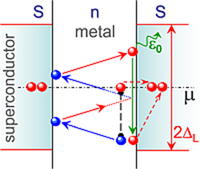
Synthesized under high pressure, hydrogen-substituted NdFeAsO0.6H0.36 (with a critical temperature of 48 K) possibly demonstrates a double-dome superconducting state in its phase diagram, thus foreshadowing extraordinary physics as compared with other iron-based oxypnictides. Ballistic Andreev transport in superconductor–normal metal–superconductor junctions provides direct information about the superconducting order parameter at any temperatures up to Tc, and specific boson emission. The authors discuss here the characteristics found of the multiple-band superconducting state, the boson energy, and their nature.

Surface structure and stacking of the commensurate (13×13)R13.9∘ charge density wave phase of 1T−TaS2(0001)

Gevin von Witte, Tilman Kißlinger, Jan Gerrit Horstmann, Kai Rossnagel, M. Alexander Schneider, Claus Ropers, and Lutz Hammer

Phys. Rev. B 100, 155407 (2019) - Published 8 October, 2019

Layered materials forming charge-density-wave (CDW) states exhibit an intriguing interplay between crystallographic structure and electronic properties. Using quantitative low-energy electron diffraction, the authors determine with picometer accuracy the complex surface structure of the transition-metal dichalcogenide 1T-TaS2 in its commensurate CDW phase. The key findings are the vertical CDW stacking between first and second trilayer and the broken inversion symmetry in the first S-Ta-S trilayer, due to an expansion of the topmost S layer.

Probing the many-body localization phase transition with superconducting circuits

Tuure Orell, Alexios A. Michailidis, Maksym Serbyn, and Matti Silveri

Phys. Rev. B 100, 134504 (2019) - Published 7 October, 2019

Chains of superconducting devices provide a natural platform for exploration of synthetic bosonic quantum matter, and the possibility to tune parametric disorder in situ makes them an ideal framework for the study of localization physics in particular. Here, the authors demonstrate that by tuning disorder strength via external magnetic field, one can probe both ergodic and many-body localized phases in a disordered bosonic Hubbard model. Simulations of time evolution suggest that coherence times of currently available devices are sufficiently long to distinguish between the two phases using the temporal fluctuations of local occupations.

Exceptional points in tunable superconducting resonators

Matti Partanen, Jan Goetz, Kuan Yen Tan, Kassius Kohvakka, Vasilii Sevriuk, Russell E. Lake, Roope Kokkoniemi, Joni Ikonen, Dibyendu Hazra, Akseli Mäkinen, Eric Hyyppä, Leif Grönberg, Visa Vesterinen, Matti Silveri, and Mikko Möttönen

Phys. Rev. B 100, 134505 (2019) - Published 7 October, 2019

Exceptional points enable the fastest possible dissipative energy transfer between quantum systems and, hence, are potentially required in optimal cooling of qubits. The realization of exceptional points in superconducting circuits is particularly appealing because quantum circuits are key candidates for the emerging quantum computing. In the present work, the exceptional points are realized using a superconducting resonator with a tunable frequency and damping rate, provided by a superconducting quantum interference device and a quantum-circuit refrigerator, respectively.

Physics of arbitrarily doped Kondo lattices: From a commensurate insulator to a heavy Luttinger liquid and a protected helical metal

A. M. Tsvelik and O. M. Yevtushenko

Phys. Rev. B 100, 165110 (2019) - Published 7 October, 2019

Kondo lattices are systems where itinerant and localized electrons coexist. If the density of the localized electrons is high and the space is one dimensional, the physics is determined by the Ruderman-Kittel-Kasuya-Yosida interaction, which dominates over the Kondo effect and governs a rich phase diagram. Depending on the band occupation, the ground state realizes commensurate insulators (at fillings 12, 14, or 34), Tomonaga-Luttinger liquids, or 4kF charge density wave phases. The latter are exotic helical metals with protected transport.

Internal screening and dielectric engineering in magic-angle twisted bilayer graphene

J. M. Pizarro, M. Rösner, R. Thomale, R. Valentí, and T. O. Wehling

Phys. Rev. B 100, 161102(R) (2019) - Published 3 October, 2019

Magic-angle twisted bilayer graphene (MA-tBLG) hosts intricate quantum many-body states. A critical contributor to these states are electron-electron interactions. What is the profile of the effective Coulomb interaction in MA-tBLG? And what determines this profile? Are intrinsic screening processes of MA-tBLG dominant or is the effective interaction mostly controlled by screening processes taking place in the surrounding dielectrics? Here, the authors show that the influence of the dielectric environment on the effective interaction depends decisively on the electronic state of MA-tBLG and propose experimental tailoring of the dielectric environment as a promising path towards resolving the nature of the quantum many-body states in MA-tBLG.

Three-dimensional topological magnon systems

Hiroki Kondo, Yutaka Akagi, and Hosho Katsura

Phys. Rev. B 100, 144401 (2019) - Published 1 October, 2019

Here, the authors propose the concept of topological magnon systems, which are bosonic generalizations of three-dimensional topological insulators. Introducing the notion of pseudo-time-reversal symmetry, they define the Z2 topological invariants, whose values correspond to the presence or absence of symmetry-protected surface states. Since bosonic systems described by the Bogoliubov–de Gennes Hamiltonian are intrinsically non-Hermitian, the definition differs from that of fermionic systems. In addition, they show that placing a system in proximity to a ferromagnet induces the thermal Hall effect at their interface.

Negative piezoelectric response of van der Waals layered bismuth tellurohalides

Jinwoong Kim, Karin M. Rabe, and David Vanderbilt

Phys. Rev. B 100, 104115 (2019) - Published 30 September, 2019

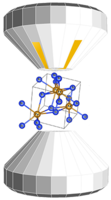
While not physically forbidden, a negative piezoelectric response – defined as an enhancement of polarization under compression – is rare in nature. However, this effect has recently been found in several van der Waals bonded materials, among them the polar BiTeX (X=I, Cl, Br) compounds studied here. First-principles calculations reveal that their negative piezoelectric response is mainly induced by a charge-center shift of the Wannier functions (shown in the figure) under compression, especially on the halide, increasing the layer dipole moment and thus the polarization.

Prethermal quantum many-body Kapitza phases of periodically driven spin systems

Alessio Lerose, Jamir Marino, Andrea Gambassi, and Alessandro Silva

Phys. Rev. B 100, 104306 (2019) - Published 30 September, 2019

The action of external drive on a physical system can cause novel dynamical behavior with no counterpart in equilibrium. A paradigmatic example is provided by the so-called Kapitza pendulum, where the upside-down configuration of the rigid rod of the pendulum is made stable by modulating its suspension point periodically in time. The present work demonstrates that driving periodically a quantum many-body system with long-range interactions may generate a multiparticle analog of the Kapitza pendulum, which is stabilized against all possible microscopic quantum fluctuations.

Optical excitation of magnons in an easy-plane antiferromagnet: Application to Sr2IrO4

Urban F. P. Seifert and Leon Balents

Phys. Rev. B 100, 125161 (2019) - Published 27 September, 2019

Probing and controlling the dynamics of quantum materials is a growing theme in condensed matter physics. In recent experiments on Mott-insulating antiferromagnets, the excitation of low-energy magnons via an ultrafast subgap laser beam has been demonstrated, implying a direct coupling of the light field to spin excitations. Here, the authors develop a quantum theory for this “Inverse Faraday effect”, with the specific example of the spin-orbit Mott insulator Sr2IrO4 in mind. Their formalism determines the effect’s dependence on the frequency and polarization of the pump laser, revealing a tight relationship to the two-magnon density of states.

Materials property prediction using symmetry-labeled graphs as atomic position independent descriptors

Peter Bjørn Jørgensen, Estefanía Garijo del Río, Mikkel N. Schmidt, and Karsten Wedel Jacobsen

Phys. Rev. B 100, 104114 (2019) - Published 26 September, 2019

Accurate property prediction for structures without knowledge of exact atomic positions is achieved with a machine-learning model. The model is formulated as neural-message passing on Voronoi graphs using a new method for the encoding of local symmetry information.

Enhancement of superconductivity mediated by antiferromagnetic squeezed magnons

Eirik Erlandsen, Akashdeep Kamra, Arne Brataas, and Asle Sudbø

Phys. Rev. B 100, 100503(R) (2019) - Published 25 September, 2019

Spin states in quantum antiferromagnets are coherent superpositions of “up” and “down” spin flips. The average spin on each sublattice associated with an antiferromagnetic magnon is, therefore, much larger than its unit net spin. Here, the authors demonstrate that proximity, which couples the electronic states in a metal asymmetrically to the two sublattices of an antiferromagnet, enhances the strength of the magnon-induced electronic interactions in the metal, and dramatically increases the transition temperature for the resulting magnon-mediated superconductivity.

Magnetoelectric control of topological phases in graphene

Hiroyuki Takenaka, Shane Sandhoefner, Alexey A. Kovalev, and Evgeny Y. Tsymbal

Phys. Rev. B 100, 125156 (2019) - Published 25 September, 2019

A new paradigm for voltage controlled topological antiferromagnetic spintronics is envisioned via proximity of a magnetoelectric antiferromagnet to a two-dimensional material. Using graphene/chromia as a model system, the authors predict the emergence of unconventional anomalous Hall effects that are electrically controlled by the Néel vector as well as the appearance and transformation of different topological phases and the emergence of chiral edge states. The results advance the research field of topological phenomena and establish connection between the subfields of antiferromagnetism, magnetoelectricity, topology, spintronics, and valleytronics.

Sign In to Your Journals Account

Filter

Section

Filter

Article Lookup

Enter a citation