Highlights

Transient response of the spin Peltier effect revealed by lock-in thermoreflectance measurements

Takumi Yamazaki, Ryo Iguchi, Tadakatsu Ohkubo, Hosei Nagano, and Ken-ichi Uchida

Phys. Rev. B 101, 020415(R) (2020) - Published 28 January, 2020

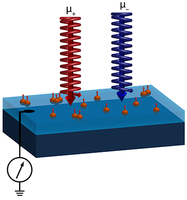
The transient response and length scale of the spin Peltier effect (SPE) – heat-current generation due to magnon spin currents – are revealed by frequency-domain lock-in thermoreflectance. The amplitude of the SPE-induced temperature modulation decreases when the excitation frequency exceeds 1 kHz. The frequency dependence is determined by the characteristic length of the SPE, which is estimated to be 0.94 µm for yttrium iron garnet. This length is similar to, but smaller than, the length scale of the spin Seebeck effect, suggesting that the electrically excited magnons in SPE are of a different nature when compared with the thermally excited magnons in the spin Seebeck effect.

Complete state tomography of a quantum dot spin qubit

Dan Cogan, Giora Peniakov, Zu-En Su, and David Gershoni

Phys. Rev. B 101, 035424 (2020) - Published 28 January, 2020

Semiconductor quantum dots are the preferred choice for interfacing anchored matter spin qubits and flying photonic qubits. They are particularly attractive for generating highly entangled hybrid spin-multiphoton entangled cluster and graph states. These highly entangled multiqubit states are required for measurement-based quantum communication and computing. Here, the authors develop a novel all-optical method for conducting full tomography of the confined electronic spin qubits. This method is essential for characterization and benchmarking these hybrid entangled spin-multiphoton cluster and graph states.

Comparing magnetic ground-state properties of the V- and Cr-doped topological insulator (Bi,Sb)2Te3

A. Tcakaev, V. B. Zabolotnyy, R. J. Green, T. R. F. Peixoto, F. Stier, M. Dettbarn, S. Schreyeck, M. Winnerlein, R. Crespo Vidal, S. Schatz, H. B. Vasili, M. Valvidares, K. Brunner, C. Gould, H. Bentmann, F. Reinert, L. W. Molenkamp, and V. Hinkov

Phys. Rev. B 101, 045127 (2020) - Published 27 January, 2020

The combination of x-ray magnetic circular dichroism with multiplet ligand field theory is a powerful method to study magnetic ground state properties. Here, the authors use this approach to reveal a strongly covalent ferromagnetic ground state of V and Cr impurities embedded in BixSb2−xTe3 topological-insulator thin films. They find a substantial charge transfer from the Te ligands to the impurities and a surprisingly negligible contribution from ionic V3+ and Cr3+. The authors also succeed in quantifying the magnetic moments and orbital occupations, which are key parameters for theories of the magnetic coupling mechanism.

Higher-order acoustic phonon oscillations in Au nanoparticles controlled by a sequence of ultrashort strain pulses generated by superdiffusive hot electrons

Yooleemi Shin, Yu Liu, Mircea Vomir, and Ji-Wan Kim

Phys. Rev. B 101, 020302(R) (2020) - Published 22 January, 2020

One of the quests in ultrafast plasmonics is the development of devices, based on surface plasmons and operating at high frequency and negligible heating conditions. Towards this goal, the authors use ultrashort strain pulses, generated by superdiffusive hot electrons to excite high-order spheroidal modes of Au nanoparticles. Their vibrations are accessed via periodic shifts of the surface plasmon band and further coherently controlled by a sequence of strain pulses. These results open new perspectives for ultrafast acoustoplasmonics towards the terahertz frequency regime.

Spin-dimer ground state driven by consecutive charge and orbital ordering transitions in the anionic mixed-valence compound Rb4O6

T. Knaflič, P. Jeglič, M. Komelj, A. Zorko, P. K. Biswas, A. N. Ponomaryov, S. A. Zvyagin, M. Reehuis, A. Hoser, M. Geiß, J. Janek, P. Adler, C. Felser, M. Jansen, and D. Arčon

Phys. Rev. B 101, 024419 (2020) - Published 22 January, 2020

A comprehensive study of the molecular mixed-valence compound Rb4O6 led the authors to the discovery of a peculiar π* orbital ordering transition of magnetic O2− anions within the charge ordered state, which promotes the formation of an orbital order-driven quantum spin state, composed of spin dimers. The experiments suggest that a delicate interplay between an electron-lattice coupling and Kugel-Khomskii-type superexchange in π-electron systems determines the magnetostructural properties. These results establish a fruitful analogy between π- and more conventional 3d-mixed-valence systems and push the research of such systems into new directions to tackle the intertwining of various active degrees of freedom.

Systematic derivation of realistic spin models for beyond-Heisenberg solids

Markus Hoffmann and Stefan Blügel

Phys. Rev. B 101, 024418 (2020) - Published 21 January, 2020

The magnetic properties of many ultrathin films on metal substrates cannot be explained by the Heisenberg exchange interaction. Other known interactions, such as the biquadratic or the four-spin interaction, are also insufficient. This suggests the existence of further multispin interactions. The authors provide a systematic derivation of those interactions based on a multiband Hubbard model combined with a downfolding technique and propose a three-spin interaction. They show that it is strong in the systems with Fe on Ru(0001) and Fe on Rh(111), and even comparable in size to the Heisenberg interaction.

Multiple embedded eigenstates in nonlocal plasmonic nanostructures

Solange V. Silva, Tiago A. Morgado, and Mário G. Silveirinha

Phys. Rev. B 101, 041106(R) (2020) - Published 15 January, 2020

Some time ago, it was theoretically shown that materials with precisely zero permittivity offer a unique opportunity to observe light oscillations in an open system with infinite lifetime. Here, the authors investigate how the nonlocal response due to electron-electron interactions in the material affects such “embedded eigenstates.” Heuristically, one might expect that the repulsive-type electron-electron interactions should act against the light localization in an open resonator. Surprisingly, the authors prove instead that it creates the opportunity to observe eigenstates with suppressed radiation loss at multiple frequencies.

Chiral spin liquids with crystalline Z2 gauge order in a three-dimensional Kitaev model

Petr A. Mishchenko, Yasuyuki Kato, Kevin O'Brien, Troels A. Bojesen, Tim Eschmann, Maria Hermanns, Simon Trebst, and Yukitoshi Motome

Phys. Rev. B 101, 045118 (2020) - Published 15 January, 2020

Chiral spin liquids (CSLs) are exceptional magnetic states that break time-reversal symmetry without long-range magnetic ordering. Here, the authors showcase a family of CSLs in a three-dimensional extension of the Kitaev model on the hypernonagon lattice, using quantum Monte Carlo simulations supplemented by variational calculations. Notably, all the CSLs are found to not only break time-reversal symmetry but concurrently also a number of lattice symmetries by forming a crystalline ordering of the underlying ℤ2 gauge structure. It is further shown that some of the CSLs exhibit topological features with gapless Majorana modes.

Tuning entanglement by squeezing magnons in anisotropic magnets

Ji Zou, Se Kwon Kim, and Yaroslav Tserkovnyak

Phys. Rev. B 101, 014416 (2020) - Published 13 January, 2020

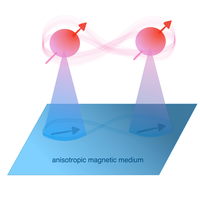
There has been much recent interest in coherently preparing and manipulating entanglement in various systems, stimulated by its importance in quantum information science. Here, the authors discuss entanglement between individual spins within anisotropic magnets in thermodynamic equilibrium, suggesting magnetic materials as a natural resource for processing quantum information. Furthermore, they show that entanglement can jump discontinuously by varying an applied magnetic field, which can potentially serve as a switch for quantum information processing tasks.

Exciton dynamics in two-dimensional MoS2 on a hyperbolic metamaterial-based nanophotonic platform

Kwang Jin Lee, Wei Xin, Chunhao Fann, Xinli Ma, Fei Xing, Jing Liu, Jihua Zhang, Mohamed Elkabbash, and Chunlei Guo

Phys. Rev. B 101, 041405(R) (2020) - Published 13 January, 2020

Here, the authors report on the nonlocal effect of hyperbolic metamaterials as a tool for controlling the migration dynamics of A and C excitons in two-dimensional MoS2. They demonstrate that the Förster-type resonance energy transfer (FRET) process, as a migration mechanism of A excitons, can be controlled by hyperbolic metamaterials in such a way that the Förster radius and FRET efficiency can be enhanced. This study constitutes a significant step forward in enabling nanophotonic hybrid applications based on two-dimensional transition metal dichalcogenides.

Variational Schrieffer-Wolff transformations for quantum many-body dynamics

Jonathan Wurtz, Pieter W. Claeys, and Anatoli Polkovnikov

Phys. Rev. B 101, 014302 (2020) - Published 10 January, 2020

The description of nonequilibrium dynamics in interacting quantum systems is a long-standing challenge within condensed matter physics. In this theoretical work, the authors introduce a method to block-diagonalize low-energy sectors of strongly interacting Hamiltonians by variationally computing generators of rotations, equivalent to a nonperturbative dressing of quasiparticle excitations. This procedure allows for the calculation of effective dynamics including quenches and response functions, as is demonstrated in a Fermi-Hubbard model and an integrability-broken XY model, both of which demonstrate excellent convergence.

Universal finite-size scaling around tricriticality between topologically ordered, symmetry-protected topological, and trivial phases

Ke Wang and T. A. Sedrakyan

Phys. Rev. B 101, 035410 (2020) - Published 10 January, 2020

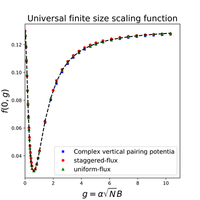
Quantum one-dimensional criticality with conformal invariance is known to be characterized by conformal field theory with the inherent central charge (c), and universal finite-size amplitudes. Here, the authors demonstrate that around a quantum criticality with c=½ and two Majorana boundary modes, the symmetry-breaking effect modifies the finite-size amplitudes from a universal constant to be a universal function of an emergent scale. This finding provides a new perspective to study the interplay of topology and quantum criticality.

Acoustic signatures of the phase transitions in the antiferromagnet U2Rh2Sn

D. I. Gorbunov, A. V. Andreev, I. Ishii, K. Prokeš, T. Suzuki, S. Zherlitsyn, and J. Wosnitza

Phys. Rev. B 101, 014408 (2020) - Published 8 January, 2020

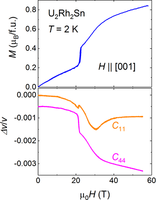
The 5f electrons of uranium-based intermetallic compounds are known to be between localized and itinerant. It is very hard to determine the degree of their localization. Here, by using sophisticated ultrasound experiments and a crystal electric field analysis for U2Rh2Sn, the authors conclude that the 5f electrons tend to be localized in the paramagnetic regime.

Spin-polarized multiple Andreev reflections in spin-split superconductors

Bo Lu, Pablo Burset, and Yukio Tanaka

Phys. Rev. B 101, 020502(R) (2020) - Published 8 January, 2020

Superconductors with spin-split energy bands are an important building block for superconducting spintronic designs. Motivated by the recent measurement of tunneling quasiparticle currents between spin-split superconductors, this work investigates theoretically voltage-biased Josephson junctions of arbitrary transparency. The authors show that an exotic subharmonic gap structure arises due to spin-polarized multiple Andreev reflections (MARs), where the odd-order MARs split, but the even-order ones remain unaffected by the spin-split fields. These findings provide a tool to determine the amplitude and alignment of Zeeman fields in spin-split superconductors.

Self-doped Mott insulator for parent compounds of nickelate superconductors

Guang-Ming Zhang, Yi-feng Yang, and Fu-Chun Zhang

Phys. Rev. B 101, 020501(R) (2020) - Published 7 January, 2020

Motivated by analyses of the reported electrical resistivity and Hall coefficient data in the normal state, the authors propose that the parent compound of the newly discovered superconducting nickelate Nd1−xSrxNiO2 is a self-doped Mott insulator, in which the low-density Nd 5d conduction electrons couple to localized Ni 3dx2−y2 electrons to form Kondo spin singlets at low temperature. The antiferromagnetic long-range order is suppressed and an insulator-metal transition results.

Nickelate superconductors: Multiorbital nature and spin freezing

Philipp Werner and Shintaro Hoshino

Phys. Rev. B 101, 041104(R) (2020) - Published 7 January, 2020

Superconductivity has recently been reported in Sr-doped NdNiO2 thin films. This work considers the effect of Hund coupling and crystal field splitting in a simple model system and shows that a multiorbital description of nickelate superconductors is warranted, especially in the strongly hole-doped regime. An analysis of this system, inspired by the spin-freezing theory of unconventional superconductivity, furthermore reveals that Nd0.8Sr0.2NiO2 has strongly enhanced local spin fluctuations due to the interplay of two spin-freezing crossovers.

Many-body localization landscape

Shankar Balasubramanian, Yunxiang Liao, and Victor Galitski

Phys. Rev. B 101, 014201 (2020) - Published 6 January, 2020

Recently, a structure called the localization landscape was shown to accurately predict the location of eigenfunctions in the single-particle Anderson model. Here, the authors generalize the localization landscape to a large class of interacting many-body systems. They use the many-body localization landscape (MBLL) to prove decay estimates of eigenstates, and show robustness of the MBLL to weak interactions and hopping by deriving a convergent locator expansion. This establishes the MBLL as a method for efficiently estimating low-energy eigenstates and understanding possible phases in MBL models.

Kohn-Luttinger correction to Tc in a phonon superconductor

Dan Phan and Andrey V. Chubukov

Phys. Rev. B 101, 024503 (2020) - Published 6 January, 2020

In recent years, there has been a surge of interest in superconductivity in low-carrier-density materials, propelled by advances in experimental studies in systems such as SrTiO3. Here, the authors analyze how the superconducting transition temperature Tc varies in two dimensions as one tunes the Fermi energy EF with respect to Debye frequency ωD of a pairing boson. The authors work at weak coupling, by which they go beyond lowest order in the coupling and find the values of Tc with the exact prefactor.

Magnetic polaron and antiferromagnetic-ferromagnetic transition in doped bilayer CrI3

D. Soriano and M. I. Katsnelson

Phys. Rev. B 101, 041402(R) (2020) - Published 6 January, 2020

Recent experiments have proven that few-layer CrI3, a two-dimensional ferromagnetic insulator, orders antiferromagnetically between layers and shows very small critical fields, which allows for full electrical control of interlayer magnetism. Here, the authors propose a switching mechanism based on the formation of magnetic polarons, or ferrons. Electrons in bilayer CrI3 become self-trapped, forming ferromagnetic droplets in an antiferromagnetic insulating matrix. If the concentration of electrons is high enough, the system becomes ferromagnetic. For holes, the self-trapping never occurs.

Ordering phenomena of spin trimers accompanied by a large geometrical Hall effect

Shang Gao, Max Hirschberger, Oksana Zaharko, Taro Nakajima, Takashi Kurumaji, Akiko Kikkawa, Junichi Shiogai, Atsushi Tsukazaki, Shojiro Kimura, Satoshi Awaji, Yasujiro Taguchi, Taka-hisa Arima, and Yoshinori Tokura

Phys. Rev. B 100, 241115(R) (2019) - Published 27 December, 2019

Noncoplanar spin trimers are the basic units that define nonzero scalar spin chirality. They are the key ingredients to achieve the chirality-induced geometrical Hall effect. Here, through neutron diffraction, the authors reveal the emergence of noncoplanar Dy3+ spin-trimer units in metallic Dy3Ru4Al12. With a magnetic field, they can control the local spin chirality of the spin trimers as well as its ferroic/antiferroic order. In phases with nonzero total scalar spin chirality, a large geometrical Hall effect is observed. The study reveals that systems composed of tunable spin trimers can be a fertile field for the exploration of a large emergent electromagnetic response, arising from real-space topological magnetic order.

Sign In to Your Journals Account

Filter

Section

Filter

Article Lookup

Enter a citation