Highlights

Interplay of excitonic complexes in p-doped WSe2 monolayers

Sven Borghardt, Jhih-Sian Tu, Takashi Taniguchi, Kenji Watanabe, and Beata E. Kardynał

Phys. Rev. B 101, 161402(R) (2020) - Published 7 April, 2020

Photoluminescence from WSe2 monolayers reflects its rich system of excitonic complexes. Here, the authors explore the surprising competition between the formation of bright and dark trions at different concentrations of a hole gas in the monolayer. The competition, which leads to the most intense neutral exciton signal at nonzero hole doping, is explained by the screening of disorder by the free charge carriers and the hole-concentration dependent scattering rates of neutral excitons into bright trions.

Prediction of perovskite-related structures in ACuO3−x (A = Ca, Sr, Ba, Sc, Y, La) using density functional theory and Bayesian optimization

Atsuto Seko and Shintaro Ishiwata

Phys. Rev. B 101, 134101 (2020) - Published 6 April, 2020

Here, the authors predict the stability of oxygen-deficient perovskite structures in cuprates by density functional theory calculations. They introduce a combination of cluster expansion, Gaussian process, and Bayesian optimization to find stable oxygen-deficient structures. The calculations not only reproduce the reported structures but suggest the presence of unknown oxygen-deficient perovskite structures, some of which are stabilized at high pressures. This work demonstrates the great applicability of the present computational procedure for the elucidation of the structural stability of strongly correlated oxides.

Emergent topological spin structures in the centrosymmetric cubic perovskite SrFeO3

S. Ishiwata, T. Nakajima, J.-H. Kim, D. S. Inosov, N. Kanazawa, J. S. White, J. L. Gavilano, R. Georgii, K. M. Seemann, G. Brandl, P. Manuel, D. D. Khalyavin, S. Seki, Y. Tokunaga, M. Kinoshita, Y. W. Long, Y. Kaneko, Y. Taguchi, T. Arima, B. Keimer, and Y. Tokura

Phys. Rev. B 101, 134406 (2020) - Published 6 April, 2020

The authors unveil topological spin structures composed of skyrmion strings in a cubic centrosymmetric iron oxide that provides the missing experimental link between centrosymmetric lattices and a rich variety of helimagnetic order. This is the first observation of a three-dimensional topological spin texture in a bulk perovskite-type oxide, one of the most ubiquitous and important systems for oxide electronics. The study enlarges the family of topological spin textures and offers a promising route toward the design of novel oxide skyrmionics.

Observation of strong higher-order lattice anharmonicity in Raman and infrared spectra

Xiaolong Yang, Tianli Feng, Joon Sang Kang, Yongjie Hu, Ju Li, and Xiulin Ruan

Phys. Rev. B 101, 161202(R) (2020) - Published 6 April, 2020

It has been well-known that Raman and infrared linewidths are associated with third-order lattice anharmonicity. Here, the authors go further and establish by means of first-principles calculations and Raman measurements that the previously neglected fourth-order anharmonicity may play a significant, or even dominating, role. The predicted strong fourth-order lattice anharmonicity results from the large four-phonon scattering phase space of zone-center optical phonons. It explains well the significantly broadened Raman or infrared peaks, observed for a wide range of materials at various temperatures. This finding may significantly impact spectroscopy techniques and the understanding of radiative transport.

Ultracold quantum wires with localized losses: Many-body quantum Zeno effect

Heinrich Fröml, Christopher Muckel, Corinna Kollath, Alessio Chiocchetta, and Sebastian Diehl

Phys. Rev. B 101, 144301 (2020) - Published 1 April, 2020

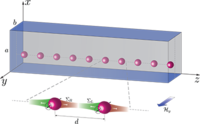
The effect of localized loss on a one-dimensional gas of interacting fermions is investigated. Here, the interplay of gapless quantum fluctuations and particle interactions strongly renormalizes the dissipative impurity. As a result, the loss probability for modes close to the Fermi energy vanishes for arbitrary strength of the dissipation, as a many-body incarnation of the quantum Zeno effect. This is reflected in the shape of the particle momentum distribution, exhibiting a peak close to the Fermi momentum.

Enhancement of local pairing correlations in periodically driven Mott insulators

Francesco Peronaci, Olivier Parcollet, and Marco Schiró

Phys. Rev. B 101, 161101(R) (2020) - Published 1 April, 2020

Periodically driving strongly correlated systems offers new opportunities to control their properties. Heating effects, however, often hinder the actual realization of interesting states. Here, the authors study a model of a Mott insulator with a time-periodic Hubbard on-site potential U coupled to a dissipative reservoir. Tuning the frequency above a characteristic value, they unveil a regime where the creation of doublon-holon excitations is greatly enhanced with respect to equilibrium. Below a certain effective temperature, this far-from-equilibrium state would give rise to the exotic η-pairing superconduting state.

Quantum Hall criticality in Floquet topological insulators

Kun Woo Kim, Dmitry Bagrets, Tobias Micklitz, and Alexander Altland

Phys. Rev. B 101, 165401 (2020) - Published 1 April, 2020

Topological Floquet Anderson Insulators (TFAIs) are systems in which an interplay of topology, driving, and static disorder stabilizes a unique form of topological quantum matter. Here, the authors present a first-principles theory, describing the topological phases and quantum criticality of the two-dimensional TFAIs in symmetry class A. Within this framework, they demonstrate how disorder is key to the formation of topological quantization, and that its critical behavior is in the quantum Hall universality class.

Exciton diffusion in monolayer semiconductors with suppressed disorder

Jonas Zipfel, Marvin Kulig, Raül Perea-Causín, Samuel Brem, Jonas D. Ziegler, Roberto Rosati, Takashi Taniguchi, Kenji Watanabe, Mikhail M. Glazov, Ermin Malic, and Alexey Chernikov

Phys. Rev. B 101, 115430 (2020) - Published 30 March, 2020

Monolayer semiconductors with suppressed environmental disorder from encapsulation in high-quality insulators provide a versatile platform to study the propagation of excitonic quasiparticles at ambient conditions. Using time-resolved emission microscopy, the authors monitored linear and nonlinear exciton diffusion in single layers of tungsten disulfide, observing highly mobile excitons with nonmonotonic density dependence of the diffusion. Combining experiment and theory, the authors discuss the impact of multivalley band structure, the role of bound and free charge carriers, the interplay of nonradiative recombination and diffusion as well as the suppressed Auger recombination.

Manipulating anomalous Hall antiferromagnets with magnetic fields

Hua Chen, Tzu-Cheng Wang, Di Xiao, Guang-Yu Guo, Qian Niu, and Allan H. MacDonald

Phys. Rev. B 101, 104418 (2020) - Published 26 March, 2020

Here, the authors show that in noncollinear antiferromagnets that have the anomalous Hall effect the net orbital magnetization can dominate the spin magnetization when the spin-orbit coupling is weak. This trend is verified by first-principles calculations on Mn3X (X=Ir, Pt, Rh, Sn, Ge) using modern theory of orbital magnetization. They then discuss how the noncollinear magnetic order parameter is rotated coherently by external magnetic fields, which couple to the dominant orbital magnetization in the framework of relativistic spin density functional theory, and they provide a toy model example based on cubic Mn3X.

Statistical localization: From strong fragmentation to strong edge modes

Tibor Rakovszky, Pablo Sala, Ruben Verresen, Michael Knap, and Frank Pollmann

Phys. Rev. B 101, 125126 (2020) - Published 25 March, 2020

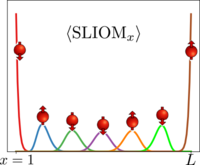
Certain disorder-free Hamiltonians are nonergodic due to a strong fragmentation of the Hilbert space. Here, the authors introduce the notion of “statistically localized integrals of motion” (SLIOM) to characterize these systems. Despite SLIOMs being nonlocal operators, they become spatially localized to subextensive regions when their expectation value is taken in typical states. These can also result in statistically localized strong zero modes, leading to topological string order for certain highly excited eigenstates as well as infinitely long-lived edge magnetization along with a thermalizing bulk.

Edge states and topological pumping in stiffness-modulated elastic plates

Emanuele Riva, Matheus I. N. Rosa, and Massimo Ruzzene

Phys. Rev. B 101, 094307 (2020) - Published 23 March, 2020

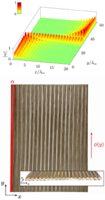
The authors demonstrate the existence of edge states in elastic plates with spatial modulations of stiffness. They show that smooth variations of the phase of the modulation profile along one spatial dimension produces a transition of the edge states from one edge to another, thus implementing a “topological pump.” The results on a mechanical substrate open new pathways for the efficient transfer of information through topological protection, for the general investigation of topological phases of matter relying on continuous property modulations, and for the pursuit of topology-based waveguiding relying on slow modulations along a second dimension, spatial or temporal.

Strained bilayer WSe2 with reduced exciton-phonon coupling

Burak Aslan, Minda Deng, Mark L. Brongersma, and Tony F. Heinz

Phys. Rev. B 101, 115305 (2020) - Published 23 March, 2020

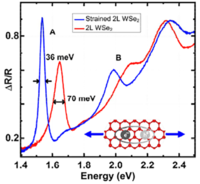
The authors investigate here the influence of strain on bilayer WSe2 using optical reflection and photoluminescence spectroscopy. The linewidth of the A exciton exhibits a significant decrease, from 70 to 36 meV at room temperature under 2.1% strain. They note that this behavior is quite different in monolayer WSe2. They apply the model used earlier on monolayer WSe2 and show that the distinct behavior under strain stems from having different indirect-to-direct gap separations. Their findings are inspiring for utilizing strain for further studies on two-dimensional materials.

Robust cycloid crossover driven by anisotropy in the skyrmion host GaV4S8

E. M. Clements, R. Das, G. Pokharel, M. H. Phan, A. D. Christianson, D. Mandrus, J. C. Prestigiacomo, M. S. Osofsky, and H. Srikanth

Phys. Rev. B 101, 094425 (2020) - Published 19 March, 2020

In the axially symmetric lacunar spinel GaV4S8, skyrmion vortices are confined along specific orientations, resulting in enhanced robustness against oblique magnetic fields and in altered spin dynamics as compared to other skyrmion hosts. In addition, the authors show that the strong magnetic anisotropy in GaV4S8 drives an extended crossover of the zero-field cycloid texture on approaching its ferromagnetic ground state. The time-dependent magnetic response displays anomalous nonlinearity - a signature of enhanced thermodynamic rigidity and robust domain dynamics.

LDA+DMFT approach to resonant inelastic x-ray scattering in correlated materials

Atsushi Hariki, Mathias Winder, Takayuki Uozumi, and Jan Kuneš

Phys. Rev. B 101, 115130 (2020) - Published 18 March, 2020

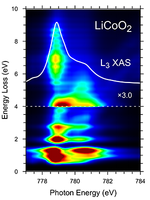
Motivated by recent improvement of the energy resolution of resonant inelastic x-ray scattering (RIXS), the authors develop a theoretical framework based on the local density approximation and dynamical mean-field theory (LDA+DMFT). It provides a computationally feasible material-specific approach to RIXS spectra in a wide range of materials, including strongly correlated ones. A good agreement with recent experimental data for typical transition-metal oxides is obtained. The relationship of RIXS fluorescencelike features and the electronic structure is explained.

Quantum limit cyclotron resonance in monolayer epitaxial graphene in magnetic fields up to 560 T: The relativistic electron and hole asymmetry

Daisuke Nakamura, Hiroaki Saito, Hiroki Hibino, Kenichi Asano, and Shojiro Takeyama

Phys. Rev. B 101, 115420 (2020) - Published 17 March, 2020

Electron-hole symmetry breaking of Dirac electrons has been evidenced as a well-resolved cyclotron resonance (CR) peak splitting at magnetic fields around 300-500 T in epitaxial monolayer graphene. The magnetic field was swept up to 560 T for the infrared CR by means of the electromagnetic flux compression technique in a 1000-T class megagauss generator. The authors argue that it is the CR mode repulsion, caused by the electron-electron correlation, which is responsible for the observed CR intensity transfer from the hole to the electron.

Electrically controlled dielectric band gap engineering in a two-dimensional semiconductor

Anders C. Riis-Jensen, Jiong Lu, and Kristian S. Thygesen

Phys. Rev. B 101, 121110(R) (2020) - Published 16 March, 2020

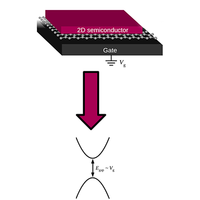
This work proposes and investigates a new physical concept of electrically controlled dielectric band gap engineering in a two-dimensional (2D) semiconductor. The authors show, using first-principles many-body calculations, that the band gap of a 2D semiconductor can be varied by several hundred meV’s by varying the doping concentration in a supporting graphene sheet as illustrated in the accompanying image. This provides a method for continuous and dynamical insitu tuning of the band gap. Importantly, the band gap adjustment is achieved via nonlocal Coulomb interactions and does not involve changes in the atomic structure, or even the shape or hybridization pattern, of the wave functions of the 2D semiconductor.

Topological models in rotationally symmetric quasicrystals

Callum W. Duncan, Sourav Manna, and Anne E. B. Nielsen

Phys. Rev. B 101, 115413 (2020) - Published 13 March, 2020

The presence and construction of topological states in two-dimensional quasicrystalline models are investigated. Interesting topological states that exist in the bulk but not at the boundary are found for single-particle Hofstadter models on quasicrystalline quasilattices. The destruction of the periodic nature of the Hofstadter butterfly, due to incommensurate fluxes, is demonstrated. Furthermore, the authors describe an approach to construct topologically ordered states for quasicrystals starting from an analytical fractional quantum Hall type wave function.

Tracking the ultrafast nonequilibrium energy flow between electronic and lattice degrees of freedom in crystalline nickel

P. Maldonado, T. Chase, A. H. Reid, X. Shen, R. K. Li, K. Carva, T. Payer, M. Horn von Hoegen, K. Sokolowski-Tinten, X. J. Wang, P. M. Oppeneer, and H. A. Dürr

Phys. Rev. B 101, 100302(R) (2020) - Published 12 March, 2020

Femtosecond laser excitation of ferromagnetic Ni opened up the field of ultrafast magnetism in the mid-1990’s. However, it is only today that it has become possible to track the ultrafast energy flow between laser-heated electrons and lattice vibrations. Ultrafast electron scattering and first-principles calculations establish that the phonon system remains in a nonequilibrium state for many picoseconds and that it can even transfer energy back to the electrons.

Universal spin dynamics in infinite-temperature one-dimensional quantum magnets

Maxime Dupont and Joel E. Moore

Phys. Rev. B 101, 121106(R) (2020) - Published 12 March, 2020

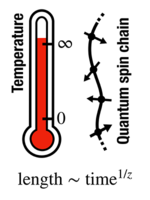
The spin dynamics of strongly interacting one-dimensional quantum magnets at high-temperature displays an emergent coarse-grained hydrodynamic behavior, understood as the result of conserved quantities. Different kinds of emergent hydrodynamics can be characterized by the dynamical exponent z governing the length-time scaling x∼t1/z. Relying on extensive numerical simulations, the authors extract the exponent z for various microscopic quantum spin-S models. They identify three universal regimes for the spin transport (superdiffusive with z=3/2, ballistic with z=1, and diffusive with z=2), which depend only on the isotropy and integrability of the system, but are independent of its microscopic details.

Chiral coupling of magnons in waveguides

Tao Yu, Xiang Zhang, Sanchar Sharma, Yaroslav M. Blanter, and Gerrit E. W. Bauer

Phys. Rev. B 101, 094414 (2020) - Published 11 March, 2020

Dissipative coupling can generate non-Hermitian states of matter with interesting characteristics as, for instance, subradiant states with long lifetimes and novel topological phases. Here, the authors show that magnons and photons can interact in a chiral fashion, whereby distant magnets are dissipatively and nonreciprocally coupled in waveguides of long range. Theyformulate the basic theory of chiral magnon coupling of one to many magnets via waveguide photons and emphasize the emerging physics, involvingunidirectional pumping and superradiant edge states in chains of magnets that support large magnon accumulations.

Sign In to Your Journals Account

Filter

Section

Filter

Article Lookup

Enter a citation