Highlights

Quantum many-body scars from virtual entangled pairs

Sambuddha Chattopadhyay, Hannes Pichler, Mikhail D. Lukin, and Wen Wei Ho

Phys. Rev. B 101, 174308 (2020) - Published 18 May, 2020

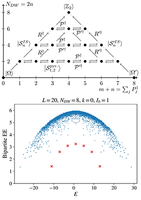
Quantum many-body scarring is a recently discovered weak ergodicity-breaking phenomenon in quantum many-body systems. It was first seen in experiments with Rydberg atom array simulators, and characterized by nonthermalizing periodic revivals of certain initial-state configurations. Here, the authors extend our understanding of the physical origins of this phenomenon by showing through an explicit construction that scars can arise through the presence of entangled virtual degrees of freedom undergoing periodic dynamics. This demonstrates a novel analytic scenario, whereby intrinsically entangled states can exhibit periodic revivals in an otherwise chaotic many-body system, enriching the phenomenology of quantum many-body scarring.

Non-Abelian topology of nodal-line rings in PT-symmetric systems

Apoorv Tiwari and Tomáš Bzdušek

Phys. Rev. B 101, 195130 (2020) - Published 18 May, 2020

The paradigm of topological band theory has been recently challenged by the discovery of band nodes with non-Abelian topological charges. Here, the authors simplify the description of the non-Abelian topology using elementary geometric rules, and they use them to prove a relation between the monopole charge and the linking structure of nodal-line rings. Furthermore, they establish a novel braiding phenomenon induced by topological interaction of the monopole charge with the Berry phase. The analysis suggests unexpected richness of topological structures in PT-symmetric systems.

Unified structure for exact towers of scar states in the Affleck-Kennedy-Lieb-Tasaki and other models

Daniel K. Mark, Cheng-Ju Lin, and Olexei I. Motrunich

Phys. Rev. B 101, 195131 (2020) - Published 18 May, 2020

Exact “towers” of quantum many-body scar states are recently discovered sets of states in some many-body nonintegrable systems. They are evenly spaced in energy and do not obey the eigenstate thermalization hypothesis. Here, the authors provide a unified framework of proving several towers of states known in the literature. This sheds light on the general structure of exact scar towers, and on the specific models themselves: the 1D AKLT models, spin-1 XY model, and a spin-½ domain wall conserving model. In particular, they provide a simple proof for the scars in the AKLT models and discover a “pyramid” of exact states in the spin-½ model.

Localization from Hilbert space shattering: From theory to physical realizations

Vedika Khemani, Michael Hermele, and Rahul Nandkishore

Phys. Rev. B 101, 174204 (2020) - Published 15 May, 2020

Known routes to ergodicity breaking – integrability and many-body localization – require extensively many explicit or emergent conservation laws. Here we show that two conservation laws are sufficient to provably and robustly break ergodicity by “shattering” Hilbert space into exponentially many dynamically disconnected sectors. This represents a new paradigm for localization, which does not rely on disorder or energy conservation, which works in any number of spatial dimensions, and which should be realizable in near-term ultracold atom experiments.

Gauge theories for the thermal Hall effect

Haoyu Guo, Rhine Samajdar, Mathias S. Scheurer, and Subir Sachdev

Phys. Rev. B 101, 195126 (2020) - Published 15 May, 2020

The remarkable recent observation of a negative thermal Hall coefficient in the cuprate superconductors presents yet another puzzle about the nature of their ‘pseudogap’ regime. Here, the authors propose an emergent gauge theory framework to understand the sign change of the thermal Hall coefficient and the violation of the Wiedemann-Franz law. They compute the thermal Hall effect in Chern-Simons theories, and find that the emergent gauge fields yield a negative thermal Hall response. The theory captures the main observed trends, but the overall magnitude of the effect is smaller than that observed, suggesting that proper account of phonons could be the missing ingredient.

Thermodynamic uncertainty relation in atomic-scale quantum conductors

Hava Meira Friedman, Bijay K. Agarwalla, Ofir Shein-Lumbroso, Oren Tal, and Dvira Segal

Phys. Rev. B 101, 195423 (2020) - Published 15 May, 2020

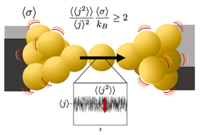
Recent advances in stochastic thermodynamics unraveled a thermodynamic uncertainty relation (TUR), which is a trade-off relation between cost (dissipation) and precision (fluctuations). In this study, the authors test its validity in nanoscale systems. Measurements of the electron current and its noise in gold atomic-scale junctions demonstrate that the TUR holds in this quantum coherent system. Based on calculations, the authors go on to argue that the TUR can identify transport mechanisms and pinpoint deviations from noninteracting-electron coherent dynamics.

Homotopy characterization of non-Hermitian Hamiltonians

Charles C. Wojcik, Xiao-Qi Sun, Tomáš Bzdušek, and Shanhui Fan

Phys. Rev. B 101, 205417 (2020) - Published 15 May, 2020

There has been much recent interest in understanding topological band theory of non-Hermitian systems. Most work has focused on the Chern number in these systems, although interesting phenomena related to an eigenvalue winding number has also been reported. Here, the authors give a complete topological classification using homotopy theory. They find that the Chern number can be reduced modulo 2 depending on the winding number, and this is interpreted in terms of braiding of Weyl points and exceptional nodal rings.

Decoupling spin-orbital correlations in a layered manganite amidst ultrafast hybridized charge-transfer band excitation

L. Shen, S. A. Mack, G. Dakovski, G. Coslovich, O. Krupin, M. Hoffmann, S.-W. Huang, Y-D. Chuang, J. A. Johnson, S. Lieu, S. Zohar, C. Ford, M. Kozina, W. Schlotter, M. P. Minitti, J. Fujioka, R. Moore, W-S. Lee, Z. Hussain, Y. Tokura, P. Littlewood, and J. J. Turner

Phys. Rev. B 101, 201103(R) (2020) - Published 12 May, 2020

Femtosecond optical lasers can be used to trigger drastic modifications of a material’s physical properties on the ultrafast timescale, revealing complex, otherwise inaccessible quantum mechanics as well as new processes with potential for creating novel devices with unprecedented high performance. Here, the authors report that the interaction of near-infrared laser light with a promising spin-orbitronics candidate, the layered mixed-valence manganite Nd1−xSr1+xMnO4, produces unexpected results, triggering dramatic modifications in the spin state of the material while leaving its orbital state unperturbed. These observations are made with an x-ray free-electron laser, while optical spectroscopy further reveals the specific way electrons transfer within the system. The results open an opportunity to selectively control the spin state while keeping the orbital one intact, an extremely challenging task in strongly correlated electron systems. They pave an avenue for the next generation of multistate logic and memory devices.

Chiral quantum optics using a topological resonator

Sabyasachi Barik, Aziz Karasahin, Sunil Mittal, Edo Waks, and Mohammad Hafezi

Phys. Rev. B 101, 205303 (2020) - Published 12 May, 2020

Topological physics has introduced a modern design principle in optics, providing build-in protection to specific types of disorder. This work demonstrates how such principles could be used to create a topological resonator in nanophotonic crystals so as to enable chiral light-matter interaction in the context of cavity quantum electrodynamics. A moderate Purcell effect is shown as an experimental proof of principle.

Collective modes in excitonic insulators: Effects of electron-phonon coupling and signatures in the optical response

Yuta Murakami, Denis Golež, Tatsuya Kaneko, Akihisa Koga, Andrew J. Millis, and Philipp Werner

Phys. Rev. B 101, 195118 (2020) - Published 11 May, 2020

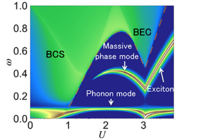
The spontaneous condensation of excitons into an excitonic insulator phase has been proposed to occur in several materials. However, spontaneous condensation of phonons (i.e., lattice distortions) can produce similar effects. An important open question is whether the exciton or the phonon mechanism is dominant and how phonons affect the ideal excitonic insulator. This work reveals the characteristic features of the collective excitations of coupled exciton-phonon systems and shows how this information can be used to experimentally identify the dominant condensation mechanism.

Theory of exciton-electron scattering in atomically thin semiconductors

Christian Fey, Peter Schmelcher, Atac Imamoglu, and Richard Schmidt

Phys. Rev. B 101, 195417 (2020) - Published 11 May, 2020

Interacting electrons and excitons promise fascinating applications, such as exciton-mediated superconductors or semiconductor-based quantum simulators. A detailed understanding of the force, coupling electrons, and excitons is crucial to realize such applications in atomically thin semiconductors. The authors achieve this by developing an approach that simulates the physics of three charges in monolayer transition metal dichalcogenides (TMD). Their approach predicts novel rotational bound trions as well as collisional states. This allows for the derivation of an accurate model of exciton-electron interactions and, as an application, for the prediction of the photoabsorption properties of electron-doped TMD, revealing the existence of exciton-polarons.

Quantum paraelectricity in the Kitaev quantum spin liquid candidates H3LiIr2O6 and D3LiIr2O6

K. Geirhos, P. Lunkenheimer, M. Blankenhorn, R. Claus, Y. Matsumoto, K. Kitagawa, T. Takayama, H. Takagi, I. Kézsmárki, and A. Loidl

Phys. Rev. B 101, 184410 (2020) - Published 8 May, 2020

H3LiIr2O6 shows no magnetic order down to lowest temperatures, raising hopes for a true Kitaev spin liquid. Its structure reveals H bonds between honeycomb layers and theory has proposed hydrogen disorder to affect the magnetic exchange. Using dielectric spectroscopy, the authors report here dipolar relaxations in H3LiIr2O6 and D3LiIr2O6, mirroring the dynamics of protons or deuterons within the double-well potentials of the H bonds. Under cooling, thermal activation crosses over into quantum tunneling, establishing a quantum paraelectric state with quasistatic disorder. This supports the realization of the long-pursued Kitaev spin liquid.

Optical spectroscopy and ultrafast pump-probe study on Bi2Rh3Se2: Evidence for charge density wave order formation

T. Lin, L. Y. Shi, Z. X. Wang, S. J. Zhang, Q. M. Liu, T. C. Hu, T. Dong, D. Wu, and N. L. Wang

Phys. Rev. B 101, 205112 (2020) - Published 8 May, 2020

Here, the authors present a detailed investigation of the electrodynamic response of the ternary chalcogenide Bi2Rh3Se2 (of parkerite type), which is a putative charge density wave material. The study implements a combination of broadband optical conductivity and ultrafast pump-probe measurements of photoinduced changes in the reflectivity. Their measurements provide compelling evidence that the phase transition at 240 K in Bi2Rh3Se2 is not a purely structural phase transition, rather, it is linked to the formation of charge density wave order.

Observation of topological edge states induced solely by non-Hermiticity in an acoustic crystal

He Gao, Haoran Xue, Qiang Wang, Zhongming Gu, Tuo Liu, Jie Zhu, and Baile Zhang

Phys. Rev. B 101, 180303(R) (2020) - Published 6 May, 2020

Most existing non-Hermitian topological systems derive their nontrivial topology from Hermitian factors. Here, the authors report on the experimental observation of acoustic topological edge states induced solely by non-Hermiticity. They show that non-Hermiticity is able to create a topological band gap from a gapless Hermitian system. The study offers the possibilities for actively steerable topological wave manipulations in applications ranging from acoustics to photonics.

Impact of nematicity on the relationship between antiferromagnetic fluctuations and superconductivity in FeSe0.91S0.09 under pressure

K. Rana, L. Xiang, P. Wiecki, R. A. Ribeiro, G. G. Lesseux, A. E. Böhmer, S. L. Bud'ko, P. C. Canfield, and Y. Furukawa

Phys. Rev. B 101, 180503(R) (2020) - Published 6 May, 2020

Relationships between nematicity, antiferromagnetism, and superconductivity have been a central theme for studies of iron-based superconductors. When these systems undergo a nematic transition, the fourfold rotational symmetry (C4) of antiferromagnetic correlations reduces to twofold (C2). The positive relationship between antiferromagnetic correlations and superconducting transition temperatures Tc is clearly seen in unconventional superconductors, but does it depend on the symmetry of the correlations? Here, the NMR study on sulfur-doped FeSe systems demonstrates that the relationship changes with the presence/absence of nematicity and also that C4-symmetric antiferromagnetic correlations are better in enhancing Tc than their C2-symmetric counterparts.

Spin caloritronics in a CrBr3-based magnetic van der Waals heterostructure

Tian Liu, Julian Peiro, Dennis K. de Wal, Johannes C. Leutenantsmeyer, Marcos H. D. Guimarães, and Bart J. van Wees

Phys. Rev. B 101, 205407 (2020) - Published 6 May, 2020

Exploration of the coupling of charge, heat, and spin is the key for spintronics in two-dimensional van der Waals magnets, as Joule heating is a practical source of generating spin currents strongly linked to the magnetization. Here, the authors present the first measurements of spin caloritronic effects in a two-dimensional ferromagnetic insulator/heavy metal system, paving the way to deeper understanding of magnonic technology, hosted by two-dimensional materials.

Coupled quasimonopoles in chiral magnets

Gideon P. Müller, Filipp N. Rybakov, Hannes Jónsson, Stefan Blügel, and Nikolai S. Kiselev

Phys. Rev. B 101, 184405 (2020) - Published 4 May, 2020

It is shown that in isotropic crystals of a chiral magnet, the dipole strings (DSs), representing coupled magnetic singularities (Bloch points) of the opposite sign, can emerge as stable states in geometrically confined samples as well as in the interior of bulk crystals. Here, the authors also report an intriguing effect of spontaneous nucleation of DSs at elevated temperatures near the paramagnetic phase transition, which may shed light on the nature of the A phase (anomalous phase) observed in bulk crystals of B20-type chiral magnets.

d-wave superconductivity and Bogoliubov-Fermi surfaces in Rarita-Schwinger-Weyl semimetals

Julia M. Link, Igor Boettcher, and Igor F. Herbut

Phys. Rev. B 101, 184503 (2020) - Published 4 May, 2020

Quasiparticles appearing in Dirac or Weyl semimetals connect relativistic physics at high energies to ongoing studies of novel condensed matter states. Recently, the standard model of emergent particles in solids got a new entry with the observation in several candidate compounds, such as PdBiSe, of the spin-32 Rarita-Schwinger-Weyl fermion. In this work, the authors explore the uncharted territory of possible unconventional superconductivity in these materials. They find that for small carrier densities the d-wave order parameter forms the uniaxial nematic state known from liquid crystals, while at a higher chemical potential it yields the exotic ‘cyclic state’ which breaks time-reversal symmetry without showing any magnetization. Surprisingly, the latter phase also features sixteen small Bogoliubov-Fermi surfaces.

Very large Dzyaloshinskii-Moriya interaction in two-dimensional Janus manganese dichalcogenides and its application to realize skyrmion states

Jinghua Liang, Weiwei Wang, Haifeng Du, Ali Hallal, Karin Garcia, Mairbek Chshiev, Albert Fert, and Hongxin Yang

Phys. Rev. B 101, 184401 (2020) - Published 1 May, 2020

The intense recent research on skyrmions has focused on multilayers of classical magnetic materials, such as Co, CoFeB, or Fe. Here, the authors explore skyrmions in van der Waals bi-dimensional magnets, a new type of magnetic material in the broad family of 2D materials that contains graphene. Using ab initio and Monte Carlo calculations, they demonstrate that skyrmions should exist in the so-called Janus transition metal dichalcogenides. The temperature and magnetic field range for observation of skyrmions are also predicted, as a guide for experimental exploration.

Ferromagnetism and superconductivity in twisted double bilayer graphene

Fengcheng Wu and Sankar Das Sarma

Phys. Rev. B 101, 155149 (2020) - Published 30 April, 2020

Twisted double bilayer graphene is a highly tunable moiré system to study strongly interacting physics. Here, the authors present a theory of competing ferromagnetic and superconducting orders in this system. They show that the single-particle moiré bands can be drastically modified by a perpendicular electric displacement field. As a result, the ferromagnetic insulating gap driven by Coulomb interaction has a dome shape dependence on the layer potential difference, as observed in several experiments. The stability of the ferromagnetic insulator against collective excitations, including spin and valley magnons, is theoretically verified. Furthermore, the authors investigate the possibility of phonon-mediated intervalley equal-spin pairing, using the property that the acoustic phonon mediated attraction respects an enlarged SU(2)×SU(2) symmetry.

Sign In to Your Journals Account

Filter

Section

Filter

Article Lookup

Enter a citation