Highlights

Optical enhancement of superconductivity via targeted destruction of charge density waves

Hossein Dehghani, Zachary M. Raines, Victor M. Galitski, and Mohammad Hafezi

Phys. Rev. B 101, 224506 (2020) - Published 8 June, 2020

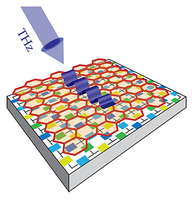
Recently, there has been much interest in enhancing superconductivity using optical toolboxes. Here, motivated by the recent experimental advances in engineering surface plasmon polaritons, the authors propose a new method for enhancing superconductivity in cuprates via melting the collective fluctuations of the competing orders. Exploiting the fact that, in cuprates, superconductivity and charge density waves compete with each other, they derive the optical properties of the gapless collective fluctuations of the charge density wave. It is demonstrated that by using an intermediate surface plasmon polariton material, these collective modes can be excited optically. This leads to a more efficient melting of the charge density wave, whereby stronger enhancements of superconductivity can be achieved.

Optical resonance shift spin-noise spectroscopy

D. S. Smirnov and K. V. Kavokin

Phys. Rev. B 101, 235416 (2020) - Published 8 June, 2020

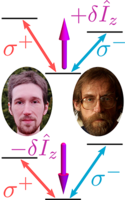
The developed theory outlines a new approach to the spectroscopy of spin fluctuations. It applies to localized electron or nuclear spins in optically transparent solids, e.g., Mn spins in diluted magnetic semiconductor nanostructures. The probed spins do not directly participate in optical transitions. Instead, they shift such transitions via spin-spin interactions. The ensued nonlinear optical response to the fluctuating spin polarization allows one to measure spin correlation functions of all orders, which contain complete information about the quantum spin dynamics.

Symmetry-based indicators for topological Bogoliubov–de Gennes Hamiltonians

Max Geier, Piet W. Brouwer, and Luka Trifunovic

Phys. Rev. B 101, 245128 (2020) - Published 8 June, 2020

Determining the topological phases in crystalline systems requires a complete set of topological invariants, whose definition and evaluation is, in general, a complicated task. Symmetry-based indicators, such as the Fu-Kane formula for inversion-symmetric topological insulators, utilize the crystalline symmetry to define easy-to-compute topological invariants. These indicators can be generalized to extract the maximal information about the topology of the band structure and of the associated anomalous boundary states from data at the high-symmetry momenta only. Using the concept of relative topology, the authors show how to construct symmetry-based indicators for band superconductors.

Approaching the quantum critical point in a highly correlated all-in–all-out antiferromagnet

Yishu Wang, T. F. Rosenbaum, D. Prabhakaran, A. T. Boothroyd, and Yejun Feng

Phys. Rev. B 101, 220404(R) (2020) - Published 4 June, 2020

All-in–all-out (AIAO) antiferromagnets demonstrate vividly the effects of correlated charge and spin with strong spin-orbit coupling. Here, using resonant magnetic x-ray diffraction, the authors directly track the evolution of AIAO order in the pyrochlore Sm2Ir2O7 across a pressure-tuned quantum critical point. The results demonstrate a powerful approach to the quantum critical state driven by electron correlations U/t and spin orbit coupling λ/t. The authors find prominent Ising-type spin fluctuations under pressure instead of the Heisenberg-type seen via chemical doping. This work also circumscribes the region of interest for the putative magnetic Weyl semimetal state in Pressure-Temperature space.

Magic-angle semimetals with chiral symmetry

Yang-Zhi Chou, Yixing Fu, Justin H. Wilson, E. J. König, and J. H. Pixley

Phys. Rev. B 101, 235121 (2020) - Published 4 June, 2020

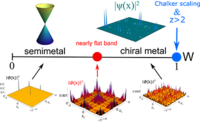
The authors introduce a two-dimensional, chirally symmetric model of Dirac electrons subjected to a quasiperiodic modulation which harbors a rich phase diagram at the Dirac node energy: A semimetal phase with Dirac dispersion, a “chiral metal” phase with a nontrivial real-space structure, and – for strongest quasiperiodic modulation – subdiffusive dynamics and Chalker scaling. A natural link with higher order topological phases is identified and potential experimental realizations of the model are discussed.

Anomalous magnetic suppression of spin relaxation in a two-dimensional electron gas in a GaAs/AlGaAs quantum well

V. V. Belykh, M. V. Kochiev, D. N. Sob'yanin, D. R. Yakovlev, and M. Bayer

Phys. Rev. B 101, 235307 (2020) - Published 4 June, 2020

Motion of an electron and precession of its spin are tightly interrelated via the spin-orbit interaction. In a two-dimensional magnetized system, the electron occupies a cyclotron orbit, which limits spin deviation and suppresses spin relaxation. Starting with this classical scenario at low magnetic fields, the authors unexpectedly encounter a peculiar spin relaxation at higher fields. It reveals an anomaly in the electron diffusion that was previously observed in magnetized plasmas and has found no unique explanation so far. In the quantum limit, the authors find a strong enhancement of the longitudinal spin relaxation time when Landau levels are fully occupied by electrons.

Four-wave mixing dynamics of a strongly coupled quantum-dot–microcavity system driven by up to 20 photons

Daniel Groll, Daniel Wigger, Kevin Jürgens, Thilo Hahn, Christian Schneider, Martin Kamp, Sven Höfling, Jacek Kasprzak, and Tilmann Kuhn

Phys. Rev. B 101, 245301 (2020) - Published 4 June, 2020

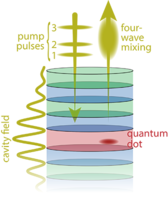
The Jaynes-Cummings (JC) model is at the heart of cavity QED and suitable to describe many different systems. Here, the authors use it to investigate a quantum dot strongly coupled to a micropillar cavity. Supported by experiments, they apply four-wave mixing spectroscopy to study the system’s dynamics. They push the limits of JC physics by injecting up to ∼20 photons using ultrashort laser pulses. Starting with complicated dynamics, the signal evolves into a single-frequency oscillation monitoring the relaxation down the JC ladder.

Pressure-induced suppression of ferromagnetism in the itinerant ferromagnet LaCrSb3

Z. E. Brubaker, J. S. Harvey, J. R. Badger, R. R. Ullah, D. J. Campbell, Y. Xiao, P. Chow, C. Kenney-Benson, J. S. Smith, C. Reynolds, J. Paglione, R. J. Zieve, J. R. Jeffries, and V. Taufour

Phys. Rev. B 101, 214408 (2020) - Published 3 June, 2020

The experimental characterization of materials under high pressure is often limited to a few properties. Usually, this is insufficient for a detailed understanding of the underlying physics. Here, the authors report a suite of high-pressure experiments probing the ferromagnetic state in LaCrSb3. They assess the Curie temperature, crystal structure, and evolution of the magnetic moment as obtained from the integrated absolute difference in x-ray emission spectroscopy. The Curie temperature appears to be driven by the Cr moment, which decreases smoothly in contrast to the pair of steplike decrease features predicted by density functional theory.

Exciton g factors of van der Waals heterostructures from first-principles calculations

Tomasz Woźniak, Paulo E. Faria Junior, Gotthard Seifert, Andrey Chaves, and Jens Kunstmann

Phys. Rev. B 101, 235408 (2020) - Published 3 June, 2020

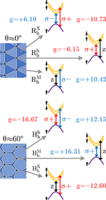
Interlayer excitons present in van der Waals heterostructures of transition metal dichalcogenides exhibit remarkably distinct effective g factors compared to their monolayer counterparts. Here, the authors employ first-principles calculations to investigate the interlayer exciton g factors in MoSe2/WSe2 vdW heterostructures revealing that they are strongly spin and stacking dependent. Furthermore, within the present approach it is possible to unambiguously identify the nature of various previously measured interlayer exciton peaks. This first-principles approach can potentially be applied to calculate exciton g factors of any semiconductor.

Towards supersensitive optical phase measurement using a deterministic source of entangled multiphoton states

G. Peniakov, Z.-E. Su, A. Beck, D. Cogan, O. Amar, and D. Gershoni

Phys. Rev. B 101, 245406 (2020) - Published 3 June, 2020

In principle, the use of entangled photons provides enhanced precision in optical phase measurements. This precision significantly surpasses the classical shot-noise limit, and thereby has many possible applications in science and technology. In practice, however, entangled multiphoton states have been generated so far using various intrinsically probabilistic and unscalable processes, thereby counteracting the advantages that the entangled photon states might have. The authors overcome these limitations here by using a quantum knitting machine, based on a single semiconductor quantum dot, to generate a polarization-entangled multiphoton state in a deterministic manner. The multiphoton state is then used to demonstrate super-sensitive optical phase measurement. The results pave the way for realizing genuine quantum enhanced optical measurements in the very near future.

Ferrotoroidic polarons in antiferrodistortive SrTiO3

Takahiro Shimada, Yuuki Ichiki, Gen Fujimoto, Le Van Lich, Tao Xu, Jie Wang, and Hiroyuki Hirakata

Phys. Rev. B 101, 214101 (2020) - Published 1 June, 2020

Discovery of new quasiparticles with nontrivial topological field textures, such as polar vortices, skyrmions, and merons, holds promise in technological paradigms. Here, the authors demonstrate a ferroelectric quasiparticle with topological polarization vortices by engineering excess electron polarons. They further show that the electron polaron carries a magnetic moment coupled with ferrotoroidicity, i.e., the magnetoelectric effect. This result provides insight into the ultimate miniaturization of ferrotoroic materials and a new class of functional polaron families.

Nonexistence of the decahedral Si20H20 cage: Levinthal's paradox revisited

Deb Sankar De, Bastian Schaefer, Bernd von Issendorff, and Stefan Goedecker

Phys. Rev. B 101, 214303 (2020) - Published 1 June, 2020

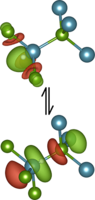
For C60, the potential energy surface exhibits a driving force toward the ground state that allows it to be found rapidly. However, the potential energy surface of a cluster can also exhibit features that prevent us from finding its global minimum. In the case of decahedral Si20H20, which is a theoretically postulated stable ground state but was never synthesized, there is no driving force towards the global minimum. The system visits a huge number of low energy structures during its evolution without ever falling into the global minimum. This is exactly the scenario described by Levinthal in his famous paradox about protein folding.

Electric field controllable high-spin SrRuO3 driven by a solid ionic junction

Jingdi Lu, Liang Si, Xiefei Yao, Chengfeng Tian, Jing Wang, Qinghua Zhang, Zhengxun Lai, Iftikhar Ahmed Malik, Xin Liu, Peiheng Jiang, Kejia Zhu, Youguo Shi, Zhenlin Luo, Lin Gu, Karsten Held, Wenbo Mi, Zhicheng Zhong, Ce-Wen Nan, and Jinxing Zhang

Phys. Rev. B 101, 214401 (2020) - Published 1 June, 2020

A high-spin ruthenate phase is achieved at the SrRuO3/SrTiO3 interface via a solid ionic chemical junction, which benefits from the distinct formation energies and diffusion barriers of oxygen vacancies across the heterostructure. This high-spin SrRuO3 phase can be reversibly switched by electric field in a solid-state ionic gating device, providing a framework for atomic design of controllable functionalities in strongly correlated oxides using solid-chemistry tools.

Maximally localized Wannier functions within the (L)APW+LO method

Sebastian Tillack, Andris Gulans, and Claudia Draxl

Phys. Rev. B 101, 235102 (2020) - Published 1 June, 2020

Maximally localized Wannier functions (MLWFs) form a valuable alternative to Bloch waves. They offer insight into chemical bonding and form an excellent starting point for a variety of numerical problems. Here, the authors present a robust and automated scheme for the construction of MLWFs from atomiclike orbitals in an all-electron first-principles framework. They demonstrate its applicability to a vast variety of materials covering semiconductors, (semi)metals, and complex organic-inorganic interfaces. This allows them to access electronic single-(quasi)particle energies and wavefunctions for both occupied and unoccupied states at several thousands of arbitrary points in reciprocal space at low computational cost, while retaining high precision.

Transition between canted antiferromagnetic and spin-polarized ferromagnetic quantum Hall states in graphene on a ferrimagnetic insulator

Yang Li, Mario Amado, Timo Hyart, Grzegorz P. Mazur, Vetle Risinggård, Thomas Wagner, Lauren McKenzie-Sell, Graham Kimbell, Joerg Wunderlich, Jacob Linder, and Jason W. A. Robinson

Phys. Rev. B 101, 241405(R) (2020) - Published 1 June, 2020

Electron-electron and electron-phonon interactions break valley symmetry in graphene, favoring a ν = 0 quantum Hall state. These interactions could result in a canted antiferromagnetic state or a spin-polarized ferromagnetic state with magnetic fields of 15-30 T. By placing graphene on the ferrimagnet Y3Fe5O12, the authors lower the magnetic field required to modulate the magnetic state at the zeroth Landau level, and demonstrate tunability of the energy gap of the edge modes in graphene with magnetic fields above 6 T.

Quasiparticle energies and excitonic effects of chromium trichloride: From two dimensions to bulk

Linghan Zhu and Li Yang

Phys. Rev. B 101, 245401 (2020) - Published 1 June, 2020

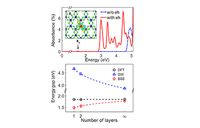
Two-dimensional (2D) van der Waals magnetic structures provide precious opportunities to study excited-state properties of correlated materials under quantum confinement. This paper reveals enhanced excitonic effects in 2D and bulk CrCl3, in which the electron-hole (e-h) binding energy reaches more than 2 eV. The calculated exciton positions agree with measurements. Particularly, the e-h binding energy is more sensitive to quantum confinement than the self-energy correction. As a result, an unusual red shift of the “optical gap” is observed in thinner samples, which is opposite to the widely observed blue shift trend.

Thermoelectric power of Sachdev-Ye-Kitaev islands: Probing Bekenstein-Hawking entropy in quantum matter experiments

Alexander Kruchkov, Aavishkar A. Patel, Philip Kim, and Subir Sachdev

Phys. Rev. B 101, 205148 (2020) - Published 29 May, 2020

One of the remarkable properties of the Sachdev-Ye-Kitaev model of randomly interacting electrons is that it has a nonvanishing extensive entropy in the limit of zero temperature. In its dual representation as the low energy theory of a charged black hole, this entropy is the Bekenstein-Hawking black hole entropy. This work shows how the entropy can be measured by thermoelectric probes of mesoscopic electronic realizations of Sachdev-Ye-Kitaev models.

Long spin coherence times in the ground state and in an optically excited state of Er3+167:Y2SiO5 at zero magnetic field

Jelena V. Rakonjac, Yu-Hui Chen, Sebastian P. Horvath, and Jevon J. Longdell

Phys. Rev. B 101, 184430 (2020) - Published 27 May, 2020

Although superconducting qubits are one of the most promising systems for quantum information applications, a separate interface is required to allow for information distribution through optical links. Here, the authors investigate the suitability of 167Er3+:Y2SiO5 as a microwave-to-optical memory interface. This material holds considerable promise as it has an optical transition in the telecommunication band. The authors identify hyperfine transitions with long coherence times without an external magnetic field, which are suitable for interfacing with superconducting qubit systems.

Orientation dependence of the magnetic phase diagram of Yb2Ti2O7

S. Säubert, A. Scheie, C. Duvinage, J. Kindervater, S. Zhang, H. J. Changlani, Guangyong Xu, S. M. Koohpayeh, O. Tchernyshyov, C. L. Broholm, and C. Pfleiderer

Phys. Rev. B 101, 174434 (2020) - Published 21 May, 2020

When interactions support quantum fluctuations in frustrated magnets, one may hope to realize a quantum spin liquid. Here, the authors report a detailed experimental and theoretical study of the low-temperature phase diagram of the pyrochlore quantum magnet Yb2Ti2O7. Despite the geometric frustration associated with this structure, the material exhibits anisotropic ferromagnetism at low temperatures. The reentrant phase diagram and the reversed anisotropy of the upper critical field reported here are, however, inconsistent with a classical description and indicate that the reentrant low-field regime is driven by quantum fluctuations.

Electromagnetic coupling in tight-binding models for strongly correlated light and matter

Jiajun Li, Denis Golez, Giacomo Mazza, Andrew J. Millis, Antoine Georges, and Martin Eckstein

Phys. Rev. B 101, 205140 (2020) - Published 21 May, 2020
The rapidly developing collaboration of condensed matter and quantum optical physics opens up exciting new possibilities for creating novel photon-matter states that allow manipulating material properties using optical cavities. This paper addresses the important challenge of formulating consistent, accurate, and convenient forms of the light-matter coupling for the low-energy tight-binding-type models useful for theoretical analysis. It achieves this by constructing precise mappings from the fundamental ab initio description of the cavity-matter system to low-energy theories, producing a truncated Hamiltonian coupling to a quantum Peierls phase. In a simple model system, the authors demonstrate the quick convergence of the truncated Hamiltonian with the number of bands, paving the way for rigorous theoretical studies in this emerging research field.

Sign In to Your Journals Account

Filter

Section

Filter

Article Lookup

Enter a citation