Highlights

Phonon rotoelectric effect

Masato Hamada and Shuichi Murakami

Phys. Rev. B 101, 144306 (2020) - Published 29 April, 2020

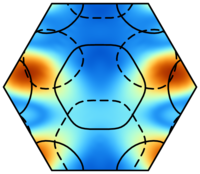
Here, the authors theoretically propose a new method to generate phonon angular momenta – rotational motions of atoms in crystals by the electric field. From a symmetry analysis, they consider multiferroic materials without both time-reversal and inversion symmetries and with their product being conserved. When the electric field is applied, the phonon angular momentum is generated via the spin-phonon interaction and the lattice distortion due to the electric field.

Interplay between local response and vertex divergences in many-fermion systems with on-site attraction

D. Springer, P. Chalupa, S. Ciuchi, G. Sangiovanni, and A. Toschi

Phys. Rev. B 101, 155148 (2020) - Published 29 April, 2020

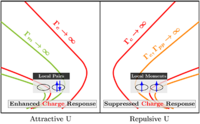
Surprising singularities occur, almost ubiquitously, when inverting the Bethe-Salpeter equations of fundamental many-fermion models. For systems with repulsive interactions, they were interpreted as nonperturbative manifestations of a progressive suppression of fluctuations. By studying here the case of attractive interactions, the authors provide a counterexample to this interpretation: they find that singularities also affect a dominant sector of the attractive model, the charge channel. The fact that singularities are not confined to suppressed sectors poses additional challenges to the many-fermion theory, whose clarification calls for dedicated studies in the near future.

Searching for fracton orders via symmetry defect condensation

Nathanan Tantivasadakarn and Sagar Vijay

Phys. Rev. B 101, 165143 (2020) - Published 29 April, 2020

Fracton phases are exotic quantum states of matter that are characterized by the presence of pointlike excitations with fundamentally restricted mobility. Important open questions remain about how to characterize the universal properties of distinct types of fracton order when viewed as conventional quantum phases. The authors provide substantial progress towards answering this question by deriving constraints on the ground-state wavefunctions of fracton phases, which generalize the string-net equations used to characterize two-dimensional topological order. These constraints yield new types of fracton order, and provide a starting point for characterizing their essential data.

Ground-state magnetic structure of Mn3Ge

J.-R. Soh, F. de Juan, N. Qureshi, H. Jacobsen, H.-Y. Wang, Y.-F. Guo, and A. T. Boothroyd

Phys. Rev. B 101, 140411(R) (2020) - Published 27 April, 2020

The antiferromagnet Mn3Ge has been recently shown to exhibit a large spontaneous anomalous Hall effect, which can be switched by a small magnetic field and which has been attributed to topologically protected Weyl nodes. Up till now, the true ground-state magnetic structure of the compound has eluded countless experimental studies, which began some fifty years ago. Here, the authors report the use of an advanced polarized neutron scattering technique to resolve unambiguously the magnetic structure of this compound.

Efficient simulation of open quantum systems coupled to a fermionic bath

Alexander Nüßeler, Ish Dhand, Susana F. Huelga, and Martin B. Plenio

Phys. Rev. B 101, 155134 (2020) - Published 27 April, 2020

The problem of open quantum systems coupled to fermionic environments arises in a variety of fields, ranging from quantum dots to quantum transport at zero and finite temperature. This work presents and analyzes a tensor network based time integration scheme for this problem, which enables simulations of such systems with controllable and certified error. Furthermore, it is shown that performing simulations in the Heisenberg picture can lead to significant efficiency gains.

Quantum scars as embeddings of weakly broken Lie algebra representations

Kieran Bull, Jean-Yves Desaules, and Zlatko Papić

Phys. Rev. B 101, 165139 (2020) - Published 27 April, 2020

Recently, much effort has focused on understanding weak ergodicity breaking in many-body quantum systems that could lead to wavefunction revivals in their dynamics far from equilibrium. An example of such nonthermalizing behavior is the phenomenon of quantum many-body scars, which has been experimentally observed in Rydberg-atom quantum simulators. Here, the authors show that many-body scars can generally be viewed as forming approximate subspaces of “broken” Lie algebra representations. Furthermore, they use an iterative process to identify perturbations which “correct” the broken Lie algebra, resulting in improved quantum revivals from special initial states. The description of embedded Lie algebra representations unifies several theoretical models, which feature exact many-body scars, with experimentally realized models, such as the constrained Rydberg-atom system, where scars only form an approximate Lie algebra representation.

Transient optics of gold during laser irradiation: From first principles to experiment

A. Blumenstein, E. S. Zijlstra, D. S. Ivanov, S. T. Weber, T. Zier, F. Kleinwort, B. Rethfeld, J. Ihlemann, P. Simon, and M. E. Garcia

Phys. Rev. B 101, 165140 (2020) - Published 27 April, 2020

The reflectivity of noble metals can dramatically change upon ultrashort laser irradiation due to the heating of d electrons to high temperatures. Knowledge of the resulting transient optics is fundamental for determining and controlling the absorbed energy. In this work, high-accuracy self-reflectivity measurements are performed and interpreted using a theory for the space-resolved and time-resolved energy absorption and dissipation. The combined approach yields the reflectivity of gold in dependence on the incident laser fluence for a wide spectral range.

High-field quantum disordered state in α−RuCl3: Spin flips, bound states, and multiparticle continuum

A. Sahasrabudhe, D. A. S. Kaib, S. Reschke, R. German, T. C. Koethe, J. Buhot, D. Kamenskyi, C. Hickey, P. Becker, V. Tsurkan, A. Loidl, S. H. Do, K. Y. Choi, M. Grüninger, S. M. Winter, Zhe Wang, R. Valentí, and P. H. M. van Loosdrecht

Phys. Rev. B 101, 140410(R) (2020) - Published 24 April, 2020

Raman and terahertz spectroscopy, combined with exact diagonalization studies, reveal the nature of the high-field phase of the proximate Kitaev material α-RuCl3 as a partially polarized quantum disordered state. The state is characterized by a gapped multiparticle continuum, out of which a two-particle bound state emerges, together with a well-defined single-particle excitation at low energy. The results underline the unusual nature of the high-field phase, and the important role of Kitaev and off-diagonal interactions in α-RuCl3.

Lattice dynamics in the spin-12 frustrated kagome compound herbertsmithite

Ying Li, A. Pustogow, M. Bories, P. Puphal, C. Krellner, M. Dressel, and Roser Valentí

Phys. Rev. B 101, 161115(R) (2020) - Published 24 April, 2020

Distorting a crystal affects its magnetic properties; vice versa, magnetic interactions can influence the lattice and its vibrations. By probing optical phonons – quantized sound waves excited by infrared radiation – we identify changes in the crystal symmetry related to the magnetic ground state of the widely studied quantum spin liquid candidate herbertsmithite. We determine the atomic motion of all 54 phonon modes and specify a possible symmetry breaking associated with the slowest phonons, providing insight into the coupling of magnetic and structural properties.

Fock-space correlations and the origins of many-body localization

Sthitadhi Roy and David E. Logan

Phys. Rev. B 101, 134202 (2020) - Published 23 April, 2020

The authors approach the problem of many-body localization on the Fock space, with nodes and links representing many-body states and Hamiltonian matrix-elements. The problem maps exactly onto a tight-binding model on a complex high-dimensional graph with nontrivial correlated disorder. These correlations are shown to lie at the heart of many-body localization. The central result from this theory is that the correlations in the Fock-space disorder must be maximal for a many-body localized phase to be stable.

Emergent spin-1 Haldane gap and ferroelectricity in a frustrated spin-12 ladder

H. Ueda, S. Onoda, Y. Yamaguchi, T. Kimura, D. Yoshizawa, T. Morioka, M. Hagiwara, M. Hagihala, M. Soda, T. Masuda, T. Sakakibara, K. Tomiyasu, S. Ohira-Kawamura, K. Nakajima, R. Kajimoto, M. Nakamura, Y. Inamura, N. Reynolds, M. Frontzek, J. S. White, M. Hase, and Y. Yasui

Phys. Rev. B 101, 140408(R) (2020) - Published 22 April, 2020

Combined experimental and theoretical studies reveal that the low-temperature magnetic properties of Rb2Cu2Mo3O12 are nicely explained in terms of a two-leg ladder of frustrated ferromagnetic spin-12 chains. The system hosts a nonmagnetic tetramer ground state that is adiabatically connected to a couple of isolated Haldane dimer spin-12 chains. Remarkably, ferroelectricity emerges at much lower magnetic fields than the spin gap, suggesting a rare case of ferroelectricity induced by vector spin chirality.

Presence and absence of itinerant gapless excitations in the quantum spin liquid candidate EtMe3Sb[Pd(dmit)2]2

M. Yamashita, Y. Sato, T. Tominaga, Y. Kasahara, S. Kasahara, H. Cui, R. Kato, T. Shibauchi, and Y. Matsuda

Phys. Rev. B 101, 140407(R) (2020) - Published 21 April, 2020

The presence or absence of itinerant gapless excitations in the organic quantum spin liquid (QSL) candidate EtMe3Sb[Pd(dmit)2]2, probed by a finite residual linear term in the thermal conductivity κ0/T, has been a controversial hot topic. Here, the authors find that κ0/T strongly depends on the cooling process. A finite κ0/T is observed in a slowly cooled sample, but not in a rapidly cooled sample. These results provide evidence that the true ground state of EtMe3Sb[Pd(dmit)2]2 is a QSL with itinerant gapless excitations.

Nonlinear one-way edge-mode interactions for frequency mixing in topological photonic crystals

Zhihao Lan, Jian Wei You, and Nicolae C. Panoiu

Phys. Rev. B 101, 155422 (2020) - Published 21 April, 2020

Unlike solid-state physics, the common test bed for new ideas in topological physics, topological photonics provides an ideal platform to study nonlinear wave interactions. Here, the authors investigate nonlinear interactions of one-way edge modes in frequency mixing processes in topological photonic crystals and demonstrate that more exotic phenomena, such as slow-light enhancement of nonlinear interactions and harmonic generation upon interaction of backward-propagating edge modes, can also be realized. This paper paves the way for the investigation of topology-protected frequency mixing processes in photonics.

Gapless Dirac surface states in the antiferromagnetic topological insulator MnBi2Te4

Przemyslaw Swatek, Yun Wu, Lin-Lin Wang, Kyungchan Lee, Benjamin Schrunk, Jiaqiang Yan, and Adam Kaminski

Phys. Rev. B 101, 161109(R) (2020) - Published 16 April, 2020

A topological insulator can be converted to an axion insulator when time reversal symmetry is broken, which leads to the opening of a gap in the Dirac surface state. Recently, MnBi2Te4 was predicted to host such a state upon antiferromagnetic ordering. Collecting and analyzing very detailed photoemission data, the authors demonstrate that this does not occur and that the Dirac surface state remains gapless well below the Néel temperature. Most likely, this is due to the complexity of the magnetic ordering at the surface. The quest for the discovery of an axion insulator is, therefore, still on.

Ultrafast light-driven simultaneous excitation of coherent terahertz magnons and phonons in multiferroic BiFeO3

Pritam Khan, Masataka Kanamaru, Keita Matsumoto, Toshimitsu Ito, and Takuya Satoh

Phys. Rev. B 101, 134413 (2020) - Published 13 April, 2020

Of late, magnetoelectric multiferroics have gained tremendous importance because they possess coexisting magnetic and ferroelectric phases, with cross-correlation effects between magnetic and electric degrees of freedom. BiFeO3 stands out as a canonical material in the multiferroics, because it exhibits ferroelectricity and antiferromagnetism at room temperature. Here, the authors demonstrate for the first time that linearly polarized ultrafast light pulse leads to simultaneous excitation of coherent magnon and optical-phonon modes below the few terahertz frequency regime. Excitation of the terahertz magnon and optical phonon could pave the way to developing ultrafast magnetoelectro-optical devices.

Spin mechanics with levitating ferromagnetic particles

P. Huillery, T. Delord, L. Nicolas, M. Van Den Bossche, M. Perdriat, and G. Hétet

Phys. Rev. B 101, 134415 (2020) - Published 13 April, 2020

The authors propose a new platform for spin-mechanics experiments, in which nitrogen-vacancy (NV) electron spins are coupled to the librational motion of ferromagnetic particles levitating in an electrostatic Paul trap. They experimentally demonstrate magnetic librational confinement of ferromagnetic particles exceeding state-of-the-art NV decoherence rates, offering prospects for resolved side-band operations. Two schemes are proposed for implementing spin-mechanics coupling. Either nonlevitating diamonds could be placed near the trap, or hybrid diamond/ferromagnetic particles could be directly trapped. By implementing the second scheme, readout of the librational motion by the NV spins is demonstrated.

Direct observation of sixfold exotic fermions in the pyrite-structured topological semimetal PdSb2

Z. P. Sun, C. Q. Hua, X. L. Liu, Z. T. Liu, M. Ye, S. Qiao, Z. H. Liu, J. S. Liu, Y. F. Guo, Y. H. Lu, and D. W. Shen

Phys. Rev. B 101, 155114 (2020) - Published 13 April, 2020

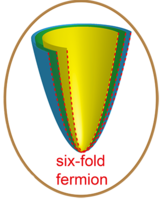
Rather than Poincarè symmetry, it is the invariance under crystal symmetry of space groups that constrains fermions in solids, and thus there might exist some exotic fermions beyond elementary particles in high-energy physics. Here, the authors verify the existence of the long-sought-after sixfold fermions in pyrite PdSb2 by means of high-resolution ARPES and first-principles calculations. They show that this sixfold degeneracy is a heretofore unknown single fermion node carrying zero Chern number, quite unlike the previously reported sixfold double spin-1 chiral fermions.

Low-energy magnons in the chiral ferrimagnet Cu2OSeO3: A coarse-grained approach

Yi Luo, G. G. Marcus, B. A. Trump, J. Kindervater, M. B. Stone, J. A. Rodriguez-Rivera, Yiming Qiu, T. M. McQueen, O. Tchernyshyov, and C. Broholm

Phys. Rev. B 101, 144411 (2020) - Published 8 April, 2020

The asymmetric magnetic interactions that control the low-energy excitations and the skyrmionic spin texture of the chiral breathing pyrochlore ferrimagnet Cu2OSeO3 have been determined through inelastic neutron scattering and a coarse-grained spin-wave theory. The complex low-energy excitation spectrum, including the equal-time structure factor through multiple Brillouin zones, is accurately described with great simplification by treating each tetrahedron as a spin-1 molecule. A strongly momentum selective X-point magnon decay into two long-wavelength magnons is discovered.

Mean-field phase diagram and spin-glass phase of the dipolar kagome Ising antiferromagnet

Leticia F. Cugliandolo, Laura Foini, and Marco Tarzia

Phys. Rev. B 101, 144413 (2020) - Published 8 April, 2020

Frustrated magnets are among the most fascinating condensed matter systems that are still not fully understood. Here, the authors outline, with mean-field analytic tools, the phase diagram of the classical dipolar antiferromagnet on the kagome lattice. They show that the properties of the low-temperature phase and the slow dynamics are inherited from a spin-glass transition that is avoided in two dimensions.

Ab initio phonon self-energies and fluctuation diagnostics of phonon anomalies: Lattice instabilities from Dirac pseudospin physics in transition metal dichalcogenides

Jan Berges, Erik G. C. P. van Loon, Arne Schobert, Malte Rösner, and Tim O. Wehling

Phys. Rev. B 101, 155107 (2020) - Published 7 April, 2020
The origin of lattice instabilities in layered materials has been controversial for several decades. In this work, the authors disentangle the underlying interplay of electrons and lattice vibrations (phonons) for the prototypical case of a TaS2 monolayer. They introduce the technique of fluctuationdiagnostics to the field of electron-phonon physics and identify unambiguously the electronic degrees of freedom that are responsible for the phonon-mode softening. Here, the physics of massive Dirac fermions is shown to drive the lattice instability.

Sign In to Your Journals Account

Filter

Section

Filter

Article Lookup

Enter a citation