Highlights

Kinetic approach to nuclear-spin polaron formation

Andreas Fischer, Iris Kleinjohann, Frithjof B. Anders, and Mikhail M. Glazov

Phys. Rev. B 102, 165309 (2020) - Published 19 October, 2020

Strong hyperfine interactions between a localized electron spin and the surrounding nuclear spins can lead to the formation of a nuclear-spin polaron state at low temperatures. Here, the authors show that the smooth evolution in thermodynamic equilibrium is replaced by a relatively sharp crossover in a steady, but nonequilibrium, situation where the electronic and the nuclear subsystems are dynamically kept at different temperatures. The transition line of the crossover obtained from the developed kinetic approach can be understood within the framework of mean-field theory.

Optically induced flat bands in twisted bilayer graphene

Or Katz, Gil Refael, and Netanel H. Lindner

Phys. Rev. B 102, 155123 (2020) - Published 16 October, 2020

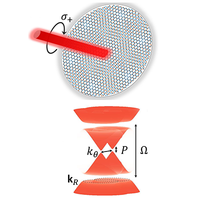
Twisted bilayer graphene exhibits strong electronic correlations at the “magic angle” – a special angle of the twist, at which isolated flat bands emerge in the material’s band structure. The authors present here a new mechanism to induce isolated flat bands at angles below the magic angle using visible/infrared light. This mechanism enables optical control of the flatness, spectral isolation, and topological properties of the bands, using frequencies which are well below the material’s bandwidth. Floquet engineering using optical fields and moiré superlattices may therefore play an important role in the exploration of on-demand nonequilibrium quantum phases of matter.

Generalized hydrodynamics with dephasing noise

Alvise Bastianello, Jacopo De Nardis, and Andrea De Luca

Phys. Rev. B 102, 161110(R) (2020) - Published 16 October, 2020

Noise is a ubiquitous phenomenon, but treating its effect in the presence of strong interactions between microscopic components is difficult in general. Here, the authors provide a method to study the effect of external noise on strongly correlated systems, combining integrability and hydrodynamics. The out-of-equilibrium dynamics is described as a gas of quasiparticles perturbed by the presence of a random force. They show that in some cases, the presence of conserved quantities can prevent the complete heating of the system.

Magnetic skyrmions, chiral kinks, and holomorphic functions

Vladyslav M. Kuchkin, Bruno Barton-Singer, Filipp N. Rybakov, Stefan Blügel, Bernd J. Schroers, and Nikolai S. Kiselev

Phys. Rev. B 102, 144422 (2020) - Published 15 October, 2020

Here, the authors propose an alternative approach to the description and classification of 2D chiral skyrmions in terms of closed domain walls and chiral kinks. Combining analytical solutions at the Bogomol’nyi point given in terms of holomorphic functions with advanced numerical methods, the authors find many previously unknown chiral skyrmion states, and estimate their stability for a wide range of parameters.

Evaluation of the switching rate for magnetic nanoparticles: Analysis, optimization, and comparison of various numerical simulation algorithms

Elena K. Semenova, Dmitry V. Berkov, and Natalia L. Gorn

Phys. Rev. B 102, 144419 (2020) - Published 14 October, 2020

Here, the authors address one of the most important problems of statistical physics in magnetism – evaluation of the escape rate over high energy barriers – using the archetypal example of a biaxial macrospin. After deriving an analytical expression for the corresponding rate, predictions of two analytical and four numerical methods for the switching time dependence on the barrier height in the range 10–60 kT (so that the switching time spans 20 orders of magnitude) are compared. It is shown that for large barriers only the forward flux method provides physically reasonable results.

Geometric properties of adiabatic quantum thermal machines

Bibek Bhandari, Pablo Terrén Alonso, Fabio Taddei, Felix von Oppen, Rosario Fazio, and Liliana Arrachea

Phys. Rev. B 102, 155407 (2020) - Published 8 October, 2020

A quantum thermal machine can be controlled by time-periodic perturbations that define a cycle, as in conventional macroscopic thermal machines. This paper presents a general and unified approach to the study of quantum thermal machines, including both heat engines and refrigerators, which operate under periodic adiabatic driving and are in contact with thermal reservoirs kept at different temperatures. Importantly, many observables characterizing the operation and the performance of these machines are geometric in nature.

Magnetic anisotropy and exchange paths for octahedrally and tetrahedrally coordinated Mn2+ ions in the honeycomb multiferroic Mn2Mo3O8

D. Szaller, K. Szász, S. Bordács, J. Viirok, T. Rõõm, U. Nagel, A. Shuvaev, L. Weymann, A. Pimenov, A. A. Tsirlin, A. Jesche, L. Prodan, V. Tsurkan, and I. Kézsmárki

Phys. Rev. B 102, 144410 (2020) - Published 7 October, 2020

Magnetization, magnetic torque, and terahertz absorption spectroscopy measurements reveal various magnetic phases in the polar ferrimagnet Mn2Mo3O8. The metamagnetic transitions as well as the spin-wave resonances in the center and at the boundary of the Brillouin zone are quantitatively described by a mean-field spin model. Supplemented by abinitio calculations, the authors identify the competition between easy-plane and easy-axis single-ion anisotropies, acting respectively on tetrahedral and octahedral Mn sites, as the key feature leading to the rich phase diagram in this compound family.

Intertwined magnetic sublattices in the double perovskite compound LaSrNiReO6

Ola Kenji Forslund, Konstantinos Papadopoulos, Elisabetta Nocerino, Gerald Morris, Bassam Hitti, Donald Arseneau, Vladimir Pomjakushin, Nami Matsubara, Jean-Christophe Orain, Peter Svedlindh, Daniel Andreica, Somnath Jana, Jun Sugiyama, Martin Månsson, and Yasmine Sassa

Phys. Rev. B 102, 144409 (2020) - Published 6 October, 2020

Double perovskite compounds present a smörgåsbord of fascinating magnetic and electronic properties. The complex interactions between two different sublattices give rise to unexpected phenomena and rich phase diagrams. By combining muon spin spectroscopy and neutron scattering techniques, the authors clarify the complex magnetic states of the double perovskite compound LaSrNiReO6. In particular, the low-temperature magnetic ground state, previously deemed as spin glass, is unveiled to in fact be from an incommensurate long-range magnetic order.

High magnetic field spin-valley-split Shubnikov–de Haas oscillations in a WSe2 monolayer

Banan Kerdi, Mathieu Pierre, Robin Cours, Bénédicte Warot-Fonrose, Michel Goiran, and Walter Escoffier

Phys. Rev. B 102, 155106 (2020) - Published 6 October, 2020

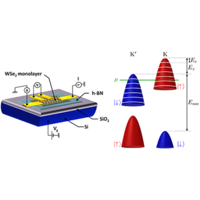
Here, the resistance of a WSe2 monolayer is measured under a strong, pulsed magnetic field. Non-1B-periodic Shubnikov–de Haas oscillations are observed and attributed to a large spin-valley splitting of the valence band. The authors develop a model to simulate the magnetoresistancein the regime of partially resolved Zeeman splitting of the Landau levels. The ratio between the Zeeman and cyclotron energies, obtained from the fit of the oscillations, translates into a density-dependent, large-hole Landé factor.

Quantifying nonequilibrium thermodynamic operations in a multiterminal mesoscopic system

Fatemeh Hajiloo, Rafael Sánchez, Robert S. Whitney, and Janine Splettstoesser

Phys. Rev. B 102, 155405 (2020) - Published 6 October, 2020

This theoretical work studies a nanoscale machine that converts a nonequilibrium distribution (e.g., a mixture of hot and cold electrons) into useful work, with an efficiency that “appears” to exceed the Carnot efficiency. This is called an N-demon (”N” for nonequilibrium) in analogy with a Maxwell demon. The authors show here that the laws of thermodynamics are not violated because the machine consumes the free energy of the nonequilibrium distribution. Why not use such machines to exploit the nonequilibrium distributions that are the “waste” output of other nanoscale device operations?

Dirac fermions in antiferromagnetic FeSn kagome lattices with combined space inversion and time-reversal symmetry

Zhiyong Lin, Chongze Wang, Pengdong Wang, Seho Yi, Lin Li, Qiang Zhang, Yifan Wang, Zhongyi Wang, Hao Huang, Yan Sun, Yaobo Huang, Dawei Shen, Donglai Feng, Zhe Sun, Jun-Hyung Cho, Changgan Zeng, and Zhenyu Zhang

Phys. Rev. B 102, 155103 (2020) - Published 2 October, 2020

The authors demonstrate experimentally the existence of theoretically predicted antiferromagnetic Dirac states in the kagome compound FeSn, where the P and T symmetries are individually broken but the combined PT symmetry is present. Moreover, their theoretical analysis reveals that, due to the salient antiferromagnetic structure, the Dirac fermions can be transformed into either massless/massive Weyl or massive Dirac fermions via symmetry manipulation, and the study does report the experimental observation of Weyl-like cones at the surface driven by PT symmetry breaking that is induced by the Stark effect.

Towards dark space stabilization and manipulation in driven dissipative Majorana platforms

Matthias Gau, Reinhold Egger, Alex Zazunov, and Yuval Gefen

Phys. Rev. B 102, 134501 (2020) - Published 1 October, 2020

An important ingredient in the quest for a quantum information toolbox is to provide protection to elementary quantum bits and arrays thereof. Here, the authors show that combining the topological features of Majorana-based qubits and protected dark states of drive and dissipation protocols gives rise to an exceptionally good performance. For a single qubit device, arbitrary pure states can be stabilized. Two qubit setups support protected dark space manifolds, facilitating stabilization of fault-tolerant Bell states. Once a working Majorana platform becomes available, only standard hardware requirements would be needed to implement these schemes.

Space-time dependent thermal conductivity in nonlocal thermal transport

Chengyun Hua and Lucas Lindsay

Phys. Rev. B 102, 104310 (2020) - Published 30 September, 2020

Here, a direct solution is provided of a time-space-dependent Peierls-Boltzmann equation with a linearized collision matrix. This will expand the state-of-the-art of thermal transport prediction and provide an avenue for understanding novel nonlocal transport measurements. Application ofmethodology developed here will illuminate physical insights into length and time scale dependent transport behavior in ultrahigh thermal conductivity materials, thus guiding interpretation of measurements and enabling critical understanding of materials for design of novel thermal management applications.

Spin thermometry and spin relaxation of optically detected Cr3+ ions in ruby Al2O3

Vikas K. Sewani, Rainer J. Stöhr, Roman Kolesov, Hyma H. Vallabhapurapu, Tobias Simmet, Andrea Morello, and Arne Laucht

Phys. Rev. B 102, 104114 (2020) - Published 25 September, 2020

After 150 years of research, the gemstone ruby (Cr3+ in Al2O3) still reveals interesting properties. Here, the authors use its spin properties to conduct all-optical thermometry inside a dilution refrigerator, reaching lattice temperatures as low as 143 mK under continuous, low-power laser excitation. They measure the spin relaxation time down to these unprecedented low temperatures, and demonstrate optically detected magnetic resonance within the rich spin structure of the Cr3+ ions.

Entanglement transition in the projective transverse field Ising model

Nicolai Lang and Hans Peter Büchler

Phys. Rev. B 102, 094204 (2020) - Published 23 September, 2020

Random quantum circuits have emerged as useful toy models for entanglement transitions in quantum many-body systems. Here, the authors study a projective version of the transverse-field Ising model without unitary dynamics where the competition between two noncommuting measurements drives an entanglement transition. The authors identify a nonlocal classical process that captures the entanglement dynamics and relate the model to bond percolation in space-time. This leads to a conformal field theory description of the system at criticality which they verify numerically for large systems.

Co(NO3)2 as an inverted umbrella-type chiral noncoplanar ferrimagnet

I. L. Danilovich, E. B. Deeva, K. Y. Bukhteev, A. A. Vorobyova, I. V. Morozov, O. S. Volkova, E. A. Zvereva, O. V. Maximova, I. V. Solovyev, S. A. Nikolaev, D. Phuyal, M. Abdel-Hafiez, Y. C. Wang, J.-Y. Lin, J. M. Chen, D. I. Gorbunov, K. Puzniak, B. Lake, and A. N. Vasiliev

Phys. Rev. B 102, 094429 (2020) - Published 23 September, 2020

Low-dimensional magnetic systems tend to reveal exotic spin liquid ground states or form peculiar types of long-range order. The realization of either ordered or disordered ground states in triangular, honeycomb, or kagome lattices is dictated by the competition of exchange interactions, being sensitive also to anisotropy and to the spin value of magnetic ions. Here, the authors present the case of a chiral noncoplanar umbrella-type ferrimagnet formed in cobalt (II) dinitrate, Co(NO3)2.

Correlating structural, electronic, and magnetic properties of epitaxial VSe2 thin films

Guannan Chen, Sean T. Howard, Aniceto B. Maghirang, III, Kien Nguyen Cong, Rovi Angelo B. Villaos, Liang-Ying Feng, Kehan Cai, Somesh C. Ganguli, Waclaw Swiech, Emilia Morosan, Ivan I. Oleynik, Feng-Chuan Chuang, Hsin Lin, and Vidya Madhavan

Phys. Rev. B 102, 115149 (2020) - Published 23 September, 2020

Monolayer films of transition metal dichalcogenides can have very different electronic and structural properties compared to their bulk counterparts. Here, the authors stabilize different structural phases of VSe2 monolayer and bilayer films and study the effects on the electronic properties, charge density wave state, and magnetic properties, using a combination of techniques including scanning tunneling microscopy and first-principles calculations. They find that a new distorted 1T phase can be stabilized in the films that is not found in the bulk compound.

Local control of improper ferroelectric domains in YMnO3

Lukas Kuerten, Stephan Krohns, Peggy Schoenherr, Katharina Holeczek, Ekaterina Pomjakushina, Thomas Lottermoser, Morgan Trassin, Dennis Meier, and Manfred Fiebig

Phys. Rev. B 102, 094108 (2020) - Published 21 September, 2020

In improper ferroelectrics, polar order emerges as a byproduct of a primary order parameter, such as magnetic ordering or a structural distortion. Therefore, it is believed that improper ferroelectrics react differently to electric field poling compared to usual ferroelectrics . Here, using cryogenic scanning probe microscopy, the authors show for the improper ferroelectric YMnO3 that, surprisingly, this is not necessarily the case. Improper ferroelectrics can behave similarly to proper ferroelectrics in many ways, while exhibiting intriguing additional functionalities.

Many-body localization near the critical point

Alan Morningstar, David A. Huse, and John Z. Imbrie

Phys. Rev. B 102, 125134 (2020) - Published 21 September, 2020

The authors study the phase transition between thermal and many-body localized phases in one-dimensional systems with quenched randomness and short-range interactions. The approach uses a renormalization group model, very similar to those of previous works, that puts the avalanche instability of the many-body localized phase at center stage. Within that model, the universal critical behavior is determined analytically, and the phase transition is found to belong to a new universality class that differs from the previously found Kosterlitz-Thouless result in important ways.

Floating topological phases

Trithep Devakul, S. L. Sondhi, S. A. Kivelson, and Erez Berg

Phys. Rev. B 102, 125136 (2020) - Published 21 September, 2020
While quasi-two-dimensional (layered) materials can be highly anisotropic, their asymptotic long-distance behavior generally reflects the properties of a fully three dimensional phase of matter. However, certain topologically ordered quantum phases can be asymptotically impervious to interplane couplings. Here, the authors discuss the stability of such “floating topological phases”. Such a phase can produce a divergent ratio of the interlayer to intralayer resistivity at low temperatures. Experimental observation of such a divergence would constitute proof of the existence of a topological (e.g., spin liquid) phase.

Sign In to Your Journals Account

Filter

Section

Filter

Article Lookup

Enter a citation