Highlights

Theory of photon condensation in a spatially varying electromagnetic field

G. M. Andolina, F. M. D. Pellegrino, V. Giovannetti, A. H. MacDonald, and M. Polini

Phys. Rev. B 102, 125137 (2020) - Published 21 September, 2020

Whether or not superradiant phase transitions (photon condensates) can occur in equilibrium systems is a long-debated open question. The realization of photon condensation in a spatially uniform cavity field is forbidden by a “no-go” theorem stemming from gauge invariance. Here, bypassing the theorem by considering a spatially varying electromagnetic field, the authors derive a series of criteria for the occurrence of photon condensation. The cases of both three-dimensional and two-dimensional electronic systems are analyzed. This work paves the way for the realization of equilibrium photon condensation in solid-state systems.

Experimental evidence for orbital magnetic moments generated by moiré-scale current loops in twisted bilayer graphene

Si-Yu Li, Yu Zhang, Ya-Ning Ren, Jianpeng Liu, Xi Dai, and Lin He

Phys. Rev. B 102, 121406(R) (2020) - Published 18 September, 2020

One of the most remarkable properties of magic-angle twisted bilayer graphene is that the low-energy bands can have nonzero valley Chern numbers, which enable the realization of the first example of a material with purely orbital-based magnetism. In this work, evidence for orbital magnetic moment generated by the moiré-scale current loops circulating in the moiré pattern of a twisted bilayer graphene is reported. This paves the way to explore orbital magnetism in slightly twisted graphene systems.

Squaring the fermion: The threefold way and the fate of zero modes

Qiao-Ru Xu, Vincent P. Flynn, Abhijeet Alase, Emilio Cobanera, Lorenza Viola, and Gerardo Ortiz

Phys. Rev. B 102, 125127 (2020) - Published 16 September, 2020

In the spirit of Dirac’s derivation of a fermionic theory by “taking the square root” of the bosonic Klein-Gordon equation, the authors present here a squaring procedure, mapping fermionic to bosonic theories, that helps establish a threefold-way topological classification of stable noninteracting bosonic matter. The ephemeral nature of boundary states and the topological triviality of noninteracting, zero-temperature bosonic phases are supported by three no-go theorems, although excitations of those same phases may display topologically nontrivial characteristics.

Topolectrical-circuit realization of a four-dimensional hexadecapole insulator

Weixuan Zhang, Deyuan Zou, Jiacheng Bao, Wenjing He, Qingsong Pei, Houjun Sun, and Xiangdong Zhang

Phys. Rev. B 102, 100102(R) (2020) - Published 11 September, 2020

It is very attractive to explore topological physics beyond three-dimensional space. This work experimentally demonstrates the realization of a classical analog of higher order/dimensional topological phases in electric circuits. Multiple robust corner states have been observed. These result from the nontrivial hexadecapole moment and may have potential applications in the field of topological analog signal processing with multiple channels. The authors expect that experimental access to higher order/dimensional topological physics with electric circuits can provide a valuable reference for investigating the higher-dimensional topological phase in full real space.

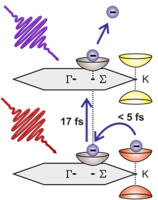
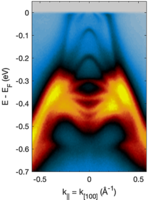
Momentum-resolved observation of ultrafast interlayer charge transfer between the topmost layers of MoS2

R. Wallauer, P. Marauhn, J. Reimann, S. Zoerb, F. Kraus, J. Güdde, M. Rohlfing, and U. Höfer

Phys. Rev. B 102, 125417 (2020) - Published 11 September, 2020

How fast is the charge transfer between two layers of transition metal dichalcogenides and where does it take place in momentum space? Two-photon photoemission using high-harmonic probe pulses can answer this question, as the authors demonstrate here for the topmost layers of MoS2. By tuning pump pulses below the topmost-layer gap, they excite electrons in deeper layers and probe only the topmost layer. GW-based tight-binding calculations support the experimental findings and explain why the electron transfer takes place at Σ¯.

Spin crossovers and superdiffusion in the one-dimensional Hubbard model

Michele Fava, Brayden Ware, Sarang Gopalakrishnan, Romain Vasseur, and S. A. Parameswaran

Phys. Rev. B 102, 115121 (2020) - Published 10 September, 2020

Using the framework of generalized hydrodynamics for integrable systems, the authors study finite-temperature transport in the 1D Hubbard model. At strong coupling, the authors characterize transport in the spin-incoherent regime – where spin degrees of freedom are “hot” while charge degrees of freedom are “cold” – and its crossover to the Luttinger liquid regime. Furthermore, using a combination of analytical arguments and numerical simulations, the authors show that when the Hamiltonian features a spin or η-pairing SU(2) symmetry or both, spin or charge transport is superdiffusive with Kardar-Parisi-Zhang scaling.

Magnon antibunching in a nanomagnet

H. Y. Yuan and Rembert A. Duine

Phys. Rev. B 102, 100402(R) (2020) - Published 9 September, 2020

Looking for signatures of elementary particles is a long-lasting topic in physics. The magnon is the emergent particle associated with spin fluctuations in a magnet. The preparation of a single-magnon state is yet to be realized and is crucial for the interplay of magnetism with quantum information science. Here, the authors demonstrate that a single-magnon state is accessible in a wide class of low-damping magnetic nanoparticles at low temperatures and that this may boost its use in quantum information processing.

Thickness dependence of electronic structures in VO2 ultrathin films: Suppression of the cooperative Mott-Peierls transition

D. Shiga, B. E. Yang, N. Hasegawa, T. Kanda, R. Tokunaga, K. Yoshimatsu, R. Yukawa, M. Kitamura, K. Horiba, and H. Kumigashira

Phys. Rev. B 102, 115114 (2020) - Published 9 September, 2020

The long-standing problem surrounding the metal-insulator transition of VO2 is the relative role of Mott and Peierls instabilities. Here, the authors investigate the change in electronic and crystal structures of nanostructured VO2 films, where the balance between the two instabilities is controlled as a function of thickness. In situ photoemission spectroscopy reveals that VO2 in the thin limit exhibits a Mott insulating nature without the V-V dimerization characteristic of bulk VO2, owing to the dominance of the Mott instability over the Peierls one.

Crystallographic splitting theorem for band representations and fragile topological photonic crystals

A. Alexandradinata, J. Höller, Chong Wang, Hengbin Cheng, and Ling Lu

Phys. Rev. B 102, 115117 (2020) - Published 9 September, 2020

Two complementary themes in foundational band theory have recently emerged in full force: (i) A particle traversing a loop in momentum space does not always return to itself, but may acquire a Berry phase that reflects the geometric curvature of wave functions. (ii) In the dual real-space perspective, a basic question regards whether electrons can form exponentially localized wave packets, known as Wannier functions. Here, the authors rigorously derive the correspondence between the Berry phase (in momentum space) and the symmetry constraint of Wannier functions for nearly all crystallographic space groups.

Thickness-dependent electronic transport through epitaxial nontrivial Bi quantum films

Doaa Abdelbarey, Julian Koch, Zamin Mamiyev, Christoph Tegenkamp, and Herbert Pfnür

Phys. Rev. B 102, 115409 (2020) - Published 9 September, 2020

In bismuth quantum films, a fascinating interplay between (bulk) quantum well and interface (edge) states is observed in this comprehensive study of DC magnetoconductance and Hall resistivity as a function of film thickness. While for thin layers (up to 40 bilayers, BL) conductance is governed by the surface states, strong contributions of a quantum well state dominate above 70 BL. Quantum corrections in a magnetic field normal to the surface, however, are dominated by the interface states for all thicknesses investigated for reasons discussed in the paper.

Quantum-well states in fractured crystals of the heavy-fermion material CeCoIn5

Nicolas Gauthier, Jonathan A. Sobota, Makoto Hashimoto, Heike Pfau, Dong-Hui Lu, Eric D. Bauer, Filip Ronning, Patrick S. Kirchmann, and Zhi-Xun Shen

Phys. Rev. B 102, 125111 (2020) - Published 8 September, 2020

Confinement of electronic wave functions is a well-studied phenomenon in nanoscale structures, such as quantum dots and thin films. These structures are typically grown to specific dimensions under controlled conditions. Here, in contrast, the authors observe quantum-well states, the spectral signature of confinement, in fractured single crystals. This result shows that thin film like structures can be obtained by fracturing hard crystals. Furthermore, the observed wave-function confinement provides insights about the three-dimensional electronic structure of the heavy-fermion material CeCoIn5.

Stable Higgs mode in anisotropic quantum magnets

Ying Su, A. Masaki-Kato, Wei Zhu, Jian-Xin Zhu, Yoshitomo Kamiya, and Shi-Zeng Lin

Phys. Rev. B 102, 125102 (2020) - Published 2 September, 2020

The Higgs mode associated with the amplitude fluctuation of an order parameter can decay into other low-energy bosonic modes, which renders the Higgs mode usually unstable in condensed matter systems. Here, the authors propose a mechanism to stabilize the Higgs mode in anisotropic quantum magnets. They show that magnetic anisotropy gaps out the Goldstone magnon mode and stabilizes the Higgs mode near a quantum critical point. The results are supported by three independent approaches: a bond-operator method, field theory, and quantum Monte Carlo simulation with analytic continuation.

Optical and plasmonic properties of twisted bilayer graphene: Impact of interlayer tunneling asymmetry and ground-state charge inhomogeneity

Pietro Novelli, Iacopo Torre, Frank H. L. Koppens, Fabio Taddei, and Marco Polini

Phys. Rev. B 102, 125403 (2020) - Published 1 September, 2020

Twisted bilayer graphene (TBG) at twist angles θ≈1° has recently attracted a great deal of interest for its rich transport phenomenology. Here, the authors present a theoretical study of the local optical conductivity, plasmon spectra, and thermoelectric properties of TBG at different filling factors and twist angles. The theory developed by the authors is based on the electronic band structures obtained from a continuum model with two tunable parameters that parametrize the relevant tunneling rates.

Supersymmetry method for interacting chaotic and disordered systems: The Sachdev-Ye-Kitaev model

Tigran A. Sedrakyan and Konstantin B. Efetov

Phys. Rev. B 102, 075146 (2020) - Published 31 August, 2020

The supersymmetry technique has proven to be an efficient method for studying disordered and chaotic systems as well as random matrix models. So far, it has been used for noninteracting systems only. Here, contrary to general belief, the robust methodology of supersymmetry to handle disordered and chaotic many-body systems is shown to work in effectively zero space dimensions. Within this framework, nonperturbative results are obtained for the celebrated Sachdev-Ye-Kitaev non-Fermi-liquid theory.

Experimental observation of the acoustic Z2 Weyl semimetallic phase in synthetic dimensions

Farzad Zangeneh-Nejad and Romain Fleury

Phys. Rev. B 102, 064309 (2020) - Published 27 August, 2020

Scalar waves, such as airborne sound, lack an intrinsic spin degree of freedom, making the realization of sonic Z2 topological phases based on spin degeneracy challenging. In this article, the authors demonstrate the relevance of synthetic dimensions and higher-dimensional topological physics for exploring topological phases based on acoustic pseudospin.

Symmetry-protected topological phases beyond groups: The q-deformed Affleck-Kennedy-Lieb-Tasaki model

Thomas Quella

Phys. Rev. B 102, 081120(R) (2020) - Published 26 August, 2020

Symmetry-protected topological phases are defined and classified in reference to symmetries that are described by groups. The author argues that there exist such phases that are not captured by this classification. To support this claim a q-deformation of the Affleck-Kennedy-Lieb-Tasaki model is discussed, which exhibits quantum group and duality-type symmetries but breaks all standard group symmetries known to protect the Haldane phase. Its nontrivial topology is linked to a twofold degeneracy in a suitably deformed notion of entanglement spectrum.

Time-reversal symmetry breaking versus chiral symmetry breaking in twisted bilayer graphene

J. González and T. Stauber

Phys. Rev. B 102, 081118(R) (2020) - Published 25 August, 2020

Dynamical symmetry breaking is a mechanism by which a strong Coulomb interaction can give mass and open a gap in the spectrum of Dirac-like quasiparticles. The authors demonstrate that the large interaction strength in twisted bilayer graphene leads actually to a competition between the breakdown of chiral symmetry and time-reversal symmetry, with a gap being generated by the Dirac and the Haldane masses, respectively. They find quite an abrupt transition between the two phases, indicating the existence of a quantum critical point at the magic angle of twisted bilayer graphene.

Behavior of Sm in the boron cage of Sm-doped RB6 (R=Yb, La) observed by multiple-wavelength neutron holography

Shoichi Uechi, Kenji Ohoyama, Yohei Fukumoto, Yuki Kanazawa, Naohisa Happo, Masahide Harada, Yasuhiro Inamura, Kenichi Oikawa, Wataru Matsuhra, Fumitoshi Iga, Artoni Kevin R. Ang, and Kouichi Hayashi

Phys. Rev. B 102, 054104 (2020) - Published 24 August, 2020

Using multiple-wavelength neutron holography (MNH), the behavior of Sm in 2% Sm-doped RB6 (R=La, Yb) is quantitatively evaluated. This work reveals that the fluctuation of Sm in YbB6 is 1.5 times larger than in LaB6. Furthermore, Sm doping causes lattice distortions that are limited to only the nearest neighboring B, while the effects on R and more distant B atoms are negligible. MNH is effective for the direct visualization of local atomic structures around dopants, particularly light elements.

Avoided quasiparticle decay and enhanced excitation continuum in the spin-12 near-Heisenberg triangular antiferromagnet Ba3CoSb2O9

David Macdougal, Stephanie Williams, Dharmalingam Prabhakaran, Robert I. Bewley, David J. Voneshen, and Radu Coldea

Phys. Rev. B 102, 064421 (2020) - Published 21 August, 2020

The authors report inelastic neutron scattering measurements to directly visualize the effects of collective quantum fluctuations in a spin-½ near-Heisenberg antiferromagnet on a triangular lattice. They observe a rich spectrum of sharp magnons at low energies with strongly renormalized dispersions and much reduced spectral weight, which are accompanied at higher energies by a very strong and highly structured continuum of excitations. The dispersion renormalizations and transfer of spectral weight to continuum states are attributed to the effect of quantum fluctuations and interactions beyond the spin-wave approximation.

Absence of a giant Rashba effect in the valence band of lead halide perovskites

M. Sajedi, M. Krivenkov, D. Marchenko, A. Varykhalov, J. Sánchez-Barriga, E. D. L. Rienks, and O. Rader

Phys. Rev. B 102, 081116(R) (2020) - Published 21 August, 2020

The high efficiency of lead halide perovskite solar cells is revolutionizing photovoltaics and, at the same time, puzzling the scientific community. Here, the authors take up the prediction that a large Rashba-type spin-orbit effect slows down carrier recombination. From their experiments on organic perovskites, they conclude that this effect is much smaller than so far believed. For the inorganic CsPbBr3 perovskite, they probe the electron spin and reduce the upper limit for a Rashba effect by two orders of magnitude.

Sign In to Your Journals Account

Filter

Section

Filter

Article Lookup

Enter a citation