Highlights

Substrate screening approach for quasiparticle energies of two-dimensional interfaces with lattice mismatch

Chunhao Guo, Junqing Xu, Dario Rocca, and Yuan Ping

Phys. Rev. B 102, 205113 (2020) - Published 11 November, 2020

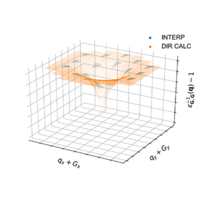
The authors develop an efficient and accurate interpolation technique for the matrix elements of dielectric matrices in the entire q + G reciprocal space between material and substrate.The method makes possible quasiparticle energy calculations within the GW approximation for arbitrarily mismatched interfaces, free of strain and symmetry constraints. This is extremely important for practical applications.

Experimental observation of Dirac cones in artificial graphene lattices

Shaosheng Yue, Hui Zhou, Daiyu Geng, Zhenyu Sun, Masashi Arita, Kenya Shimada, Peng Cheng, Lan Chen, Sheng Meng, Kehui Wu, and Baojie Feng

Phys. Rev. B 102, 201401(R) (2020) - Published 9 November, 2020

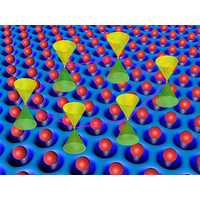
Here, the authors synthesize macroscopic artificial graphene via self-assembly of C60 molecules on metal surfaces. The macroscopic scale of these systems enables direct investigation of their electronic structure by angle-resolved photoemission spectroscopy. The long-expected Dirac cones of artificial graphene at the K points of the Brillouin zone are directly observed. These results will stimulate ongoing efforts to fabricate molecular quantum devices based on artificial graphene.

Magnetic and vibronic terahertz excitations in Zn-doped Fe2Mo3O8

B. Csizi, S. Reschke, A. Strinić, L. Prodan, V. Tsurkan, I. Kézsmárki, and J. Deisenhofer

Phys. Rev. B 102, 174407 (2020) - Published 5 November, 2020

Doping with Zn makes the rich spectrum of low-energy excitations in the polar antiferromagnet Fe2Mo3O8 even richer and leads to a beautiful example of a broad electric-dipole active vibronic excitation band. In an applied magnetic field, the evolution of the spectra clearly reflects the emergence of a metastable ferrimagnetic polar state that could host interesting dynamic magnetoelectric phenomena.

Information scrambling at finite temperature in local quantum systems

Subhayan Sahu and Brian Swingle

Phys. Rev. B 102, 184303 (2020) - Published 5 November, 2020

Quantum information scrambling provides diagnostics about how information spreads when an isolated quantum system evolves in time. Here, the authors study the temperature dependence of scrambling in locally gapped systems. Using tensor networks, they numerically evaluate out-of-time-ordered commutators in a large, strongly interacting spin chain as a function of temperature. They find that scrambling crucially depends on the ordering of operators around the thermal circle, exposing subtleties in information propagation at finite temperature. For a regulated operator ordering, the butterfly velocity decreases with lowering the temperature, as seen in the figure. The low temperature behavior is derived from a field-theoretical analysis.

Theory of moiré localized excitons in transition metal dichalcogenide heterobilayers

David A. Ruiz-Tijerina, Isaac Soltero, and Francisco Mireles

Phys. Rev. B 102, 195403 (2020) - Published 4 November, 2020

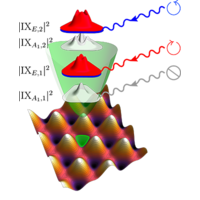
Excitons in transition metal dichalcogenide heterostructures experience a periodic moiré potential, featuring deep wells with trigonal (C3v) symmetry. This paper studies the localization of interlayer excitons at these potential wells and the influence of the localized state’s symmetry on the optical selection rules. Degenerate doublets from the symmetry group’s E representation are found to dominate the optical response in the localized state sector. The authors discuss how these bright excitons respond to external perturbations, laying the groundwork for controlling their optical response.

Out-of-plane corrugations in graphene based van der Waals heterostructures

Simon Zihlmann, Péter Makk, Mirko K. Rehmann, Lujun Wang, Máté Kedves, David I. Indolese, Kenji Watanabe, Takashi Taniguchi, Dominik M. Zumbühl, and Christian Schönenberger

Phys. Rev. B 102, 195404 (2020) - Published 4 November, 2020

Graphene, the first truly two-dimensional material isolated, is never perfectly flat. Even when it is sandwiched between other atomically flat crystals, it still slightly ripples. These out-of-plane corrugations, deformations of the graphene layer into the third dimension, have profound implications on graphene’s properties. They reduce the mobility of electrons moving within graphene just like bumps on a road slow down a car. Here, the authors demonstrate the presence of such corrugations by studying the quantum mechanical phase electrons acquire in the presence of a magnetic field.

Partial equilibration of anti-Pfaffian edge modes at ν=5/2

Hamed Asasi and Michael Mulligan

Phys. Rev. B 102, 205104 (2020) - Published 4 November, 2020

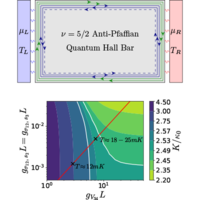
The recent thermal Hall conductance measurement of K≈2.5π2kBT/3h of the ν=5/2 quantum Hall state provides strong evidence for the realization of a topological ground state whose quasiparticles exhibit non-Abelian statistics. However, the precise identity of the state depends on the degree of edge-mode equilibration. Here, the authors show that in the limit of strong Coulomb interaction and approximate spin degeneracy, the anti-Pfaffian state admits low-temperature edge phases that exhibit fully equilibrated electrical transport coexisting with partially equilibrated thermal transport, consistent with current experimental measurements.

Incipient antiferromagnetism in the Eu-doped topological insulator Bi2Te3

A. Tcakaev, V. B. Zabolotnyy, C. I. Fornari, P. Rüßmann, T. R. F. Peixoto, F. Stier, M. Dettbarn, P. Kagerer, E. Weschke, E. Schierle, P. Bencok, P. H. O. Rappl, E. Abramof, H. Bentmann, E. Goering, F. Reinert, and V. Hinkov

Phys. Rev. B 102, 184401 (2020) - Published 2 November, 2020

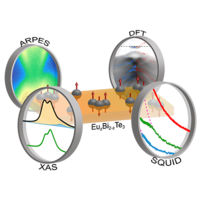
Magnetic topological insulators combine two cornerstones of modern solid-state physics: band topology and electron correlations. To understand this class of materials, methods that address both itinerant and correlated electron properties are necessary. Here, the authors describe a systematic study of Eu-doped Bi2Te3 based on SQUID magnetometry, photoemission, resonant x-ray spectroscopy, and density functional theory. The synergy between these tools provides a comprehensive picture of a system, in which antiferromagnetism and topological surface states coexist, and which holds substantial promise for the realization of exotic states of matter such as the quantum anomalous Hall effect.

Hund's metal physics: From SrNiO2 to LaNiO2

Y. Wang, C.-J. Kang, H. Miao, and G. Kotliar

Phys. Rev. B 102, 161118(R) (2020) - Published 29 October, 2020

Using SrNiO2 as a reference system, the authors find multiorbital Hund’s metal behavior in the new Ni-based superconductor Nd1−x SrxNiO2 by many-body ab initio calculations. They show that both the weights of Ni 3d multiplets and total Ni 3d occupancy are barely changed from the typical Hund’s metal SrNiO2 to LaNiO2 in spite of the large charge-carrier doping. The calculations are well justified by existing experiments with important implications on the pairing mechanism.

Finite-temperature density-matrix renormalization group method for electron-phonon systems: Thermodynamics and Holstein-polaron spectral functions

David Jansen, Janez Bonča, and Fabian Heidrich-Meisner

Phys. Rev. B 102, 165155 (2020) - Published 29 October, 2020

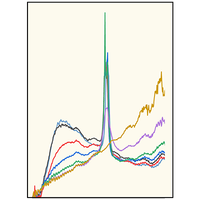
This work introduces an efficient numerical tool to calculate thermodynamic and spectral properties for electron-phonon problems at finite temperature in one dimension. Combining a finite-temperature density-matrix renormalization group method with local basis optimization allows one to access system sizes out of reach for other wave-function based approaches. The authors demonstrate the method’s capabilities by computing several spectral functions of the Holstein polaron problem. The image shows the electron spectral function for two different system sizes (L=21, 101).

η-pairing in correlated fermion models with spin-orbit coupling

Kai Li

Phys. Rev. B 102, 165150 (2020) - Published 28 October, 2020

The authors study the η-pairing phenomenon in correlated fermion models with spin-orbit coupling. Spin-orbit coupled systems are usually thought to possess no continuous symmetries, except the conventional U(1) particle-number symmetry. The η-pairing reveals an exact SU(2) pseudospin symmetry in a broad class of spin-orbit coupled Hubbard models. Furthermore, the authors construct an exactly solvable interacting Dirac-semimetal model that exhibits an exact pseudospin symmetry with fine-tuned parameters. This model hosts η-pairing and charge density wave ground states, which meet at an exactly solvable multicritical line.

Quantum impurity model for anyons

E. Yakaboylu, A. Ghazaryan, D. Lundholm, N. Rougerie, M. Lemeshko, and R. Seiringer

Phys. Rev. B 102, 144109 (2020) - Published 27 October, 2020

One of the hallmarks of quantum statistics, tightly entwined with the concept of topological phases of matter, is the prediction of anyons. Here, the authors introduce a simple quantum impurity model, where bosonic or fermionic impurities turn into anyons as a consequence of their interaction with the surrounding bath. This model opens up simple numerical approaches to investigate the spectra of many anyons. More importantly, the model paves the way towards realizing anyons using impurities in standard condensed matter systems, such as crystal lattices and ultracold gases.

Entanglement spectrum as a marker for phase transitions in the density embedding theory for interacting spinless fermionic models

Xavier Plat and Chisa Hotta

Phys. Rev. B 102, 140410(R) (2020) - Published 26 October, 2020

Here, the authors show that the entanglement spectrum – a fingerprint of the quantum many-body wave function – of strongly correlated fermionic systems can be evaluated almost exactly by density embedding theory. An accurate entanglement spectrum guarantees the accuracy of the local density matrix or the physical properties, and their anomalies generally serve as markers for phase transitions, including not only the Landau symmetry-breaking ones but also topological transitions.

Magnon polaron formed by selectively coupled coherent magnon and phonon modes of a surface patterned ferromagnet

F. Godejohann, A. V. Scherbakov, S. M. Kukhtaruk, A. N. Poddubny, D. D. Yaremkevich, M. Wang, A. Nadzeyka, D. R. Yakovlev, A. W. Rushforth, A. V. Akimov, and M. Bayer

Phys. Rev. B 102, 144438 (2020) - Published 26 October, 2020

In a metallic ferromagnet, fast dephasing of phonons and magnons typically prevents their strong coupling. Here, the authors overcome this limitation and demonstrate a hybridized coherent state of phonon and magnon known as a “magnon polaron” in a metallic ferromagnetic film under femtosecond optical excitation. Surface patterning provides magnons and phonons with long lifetimes in the ferromagnetic film, while spatial matching of their wave distributions enhances their coupling strength and selects particular modes in the broad phonon and magnon spectra for hybridization.

Dirac quantum well engineering on the surface of a topological insulator

X. Lu and M. O. Goerbig

Phys. Rev. B 102, 155311 (2020) - Published 26 October, 2020

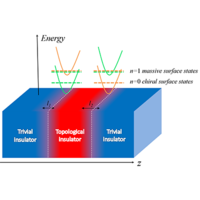
Making topological insulators into thin films is a promising way to rule out the undesirable bulk contribution for applications, but one then needs to worry about coupling between surface states at opposite sides of the film. The understanding of this coupling is addressed here. The coupling and the resulting gap opening in the chiral states (n=0) turn out to be qualitatively different and quantitatively much smaller compared to those in massive Volkov-Pankratov surface states (n>0), which are not protected by chirality.

Viscous Maxwell-Chern-Simons theory for topological electromagnetic phases of matter

Todd Van Mechelen and Zubin Jacob

Phys. Rev. B 102, 155425 (2020) - Published 26 October, 2020

Chern-Simons theories, initially developed for high-energy physics, have been very successful in explaining integer and fractional quantum Hall phases of matter, topological insulators, and Weyl semimetals. However, it was an open question as to whether Chern-Simons theories can be adapted to topological photonics. Here, the authors develop a viscous Maxwell-Chern-Simons theory to capture the fundamental physics of a topological electromagnetic phase of matter. The theory applies to viscous Hall fluids and predicts the existence of unique spin-1 photonic skyrmions in momentum space.

Majorana end states in an interacting quantum wire

Ren-Bo Wang, Akira Furusaki, and Oleg A. Starykh

Phys. Rev. B 102, 165147 (2020) - Published 26 October, 2020

Here, the authors show that a realistic single-channel quantum wire with a repulsive interaction between electrons and a strong spin-orbit interaction (but without proximity to an s-wave superconductor) becomes topological when an external magnetic field perpendicular to the spin-orbit axis is applied. Under these simple conditions, the electron pair tunneling between spin “up” and “down” subbands turns the wire into a topological state like a p-wave superconductor, capable of hosting zero-energy Majorana states at the wire’s open ends.

Enhanced spin correlations in the Bose-Einstein condensate compound Sr3Cr2O8

T. Nomura, Y. Skourski, D. L. Quintero-Castro, A. A. Zvyagin, A. V. Suslov, D. Gorbunov, S. Yasin, J. Wosnitza, K. Kindo, A. T. M. N. Islam, B. Lake, Y. Kohama, S. Zherlitsyn, and M. Jaime

Phys. Rev. B 102, 165144 (2020) - Published 23 October, 2020

Enhanced spin correlations are key to understand phase transitions and specific types of order in magnetic systems. They help us classify critical phenomena that are oblivious to microscopic details, allowing predictions for bigger, farther, and more consequential systems. By studying here the thermal and sound propagation properties of spin states in Sr3Cr2O8, and their coupling to the crystal lattice, the authors find some of the strongest spin correlations in the quantum magnetism family of compounds in the absence of frustration or reduced dimensionality. This is remarkable.

Circular dichroism in higher-order harmonic generation: Heralding topological phases and transitions in Chern insulators

Alexis Chacón, Dasol Kim, Wei Zhu, Shane P. Kelly, Alexandre Dauphin, Emilio Pisanty, Andrew S. Maxwell, Antonio Picón, Marcelo F. Ciappina, Dong Eon Kim, Christopher Ticknor, Avadh Saxena, and Maciej Lewenstein

Phys. Rev. B 102, 134115 (2020) - Published 21 October, 2020

The future technological revolution in the production of ultrafast devices lies in the control of materials that will speed-up transistors. The recent discovery of topological states of matter promises a unique opportunity to address this challenge. However, the control and diagnostics of topological materials remain hard to achieve. Here, the authors show an alternative to distinguish a topological phase by its nonlinear-light circular dichroism (CD): the asymmetry of the material-light emissivity while the topological phase is subjected to right-circularly (RCP) and left-circularly polarized (LCP) mid-infrared lasers. This CD exhibits striking distinction in a topological phase, as depicted in the schematic.

Changes of Fermi surface topology due to the rhombohedral distortion in SnTe

Christopher D. O'Neill, Oliver J. Clark, Harry D. J. Keen, Federico Mazzola, Igor Marković, Dmitry A. Sokolov, Andreas Malekos, Phil D. C. King, Andreas Hermann, and Andrew D. Huxley

Phys. Rev. B 102, 155132 (2020) - Published 21 October, 2020
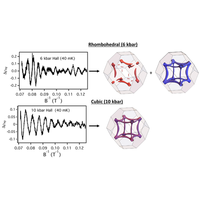
Cubic SnTe is known to undergo a rhombohedral structural distortion on cooling. Here, the authors show via measuring quantum oscillations that the distortion has a significant impact on the Fermi surface topology. In the distorted structure, several neighboring oscillation frequencies exist as a result of the rhombohedral symmetry breaking and of the spin-orbit splitting, lifting the band degeneracy. By applying a pressure of 10 kbars, it is found that the oscillation spectrum changes and the distortion is suppressed. This allows the authors to determine the contribution to the Hall effect for each feature of the Fermi surface. Additionally, they find unusual linear magnetoresistance that they attribute to regions of the Fermi surface with high curvature.

Sign In to Your Journals Account

Filter

Section

Filter

Article Lookup

Enter a citation