Highlights

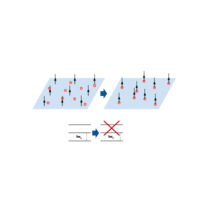
Determining non-Abelian topological order from infinite projected entangled pair states

Anna Francuz and Jacek Dziarmaga

Phys. Rev. B 102, 235112 (2020) - Published 4 December, 2020

The iPEPS tensor network, which is free of the sign problem notorious for the quantum Monte Carlo, is the method of choice to search for topological order in two-dimensional strongly correlated systems. However, finding a ground state represented by iPEPS is one problem, while extracting from this representation the desired information about topological order is quite another. The algorithm, proposed by the authors, does precisely this in a wide class of non-Abelian string net models.

Hyperbolicity in two-dimensional transition metal ditellurides induced by electronic bands nesting

Hongwei Wang and Tony Low

Phys. Rev. B 102, 241104(R) (2020) - Published 4 December, 2020

Naturally occurring in-plane hyperbolic response, where metallic and dielectric response along orthogonal crystal axes coexists, is rarely observed in nature. Here, the authors find that in an anisotropic transition metal dichalcogenide (i.e., the 1T′ phase of WTe2), a pair of nested bands around its Fermi level provides the conditions for hyperbolicity to occur. The band-nesting induced resonant interband optical transitions, which in conjunction with the strong in-plane anisotropic optical processes, leads to hyperbolic plasmons in the near-infrared spectral regime. The physical principle is general, and the authors demonstrate similar hyperbolic response in other 1T′ transition metal dichalcogenides by modulating the degree of band nesting through strain engineering.

Entanglement transitions as a probe of quasiparticles and quantum thermalization

Tsung-Cheng Lu and Tarun Grover

Phys. Rev. B 102, 235110 (2020) - Published 3 December, 2020

The authors find that the entanglement between two subsystems in tripartite quantum states can reveal novel aspects of quantum thermalization. In particular, it can probe the presence or absence of long-lived quasiparticles. Systems without quasiparticles exhibit an “entanglement transition” from area to volume law as one tunes the subsystem volume fraction within a single representative state, a feature invisible in conventional schemes based on bipartite entanglement. Such a transition is absent in systems with quasiparticles.

Precise control of Jeff=12 magnetic properties in Sr2IrO4 epitaxial thin films by variation of strain and thin film thickness

Stephan Geprägs, Björn Erik Skovdal, Monika Scheufele, Matthias Opel, Didier Wermeille, Paul Thompson, Alessandro Bombardi, Virginie Simonet, Stéphane Grenier, Pascal Lejay, Gilbert Andre Chahine, Diana Lucia Quintero-Castro, Rudolf Gross, and Danny Mannix

Phys. Rev. B 102, 214402 (2020) - Published 2 December, 2020

The 5d transition metal oxides offer a plethora of possibilities to further enrich the fascinating physics of complex 3d compounds by generating novel physical properties at the strong spin-orbit coupling limit. Here, the authors demonstrate that the magnetic correlation length in Sr2IrO4 thin films strongly depends on the film thickness, while it is completely independent of their strain state. This creates the opportunity to fine-tune the magnetic correlation length and may open up important inroads into the stabilization of superconductivity in Sr2IrO4.

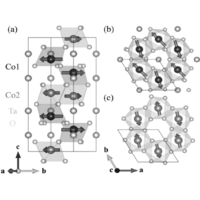
Noncollinear antiferromagnetic order in the buckled honeycomb lattice of magnetoelectric Co4Ta2O9 determined by single-crystal neutron diffraction

Sungkyun Choi, Dong Gun Oh, Matthias J. Gutmann, Shangke Pan, Gideok Kim, Kwanghyo Son, Jaewook Kim, Nara Lee, Sang-Wook Cheong, Young Jai Choi, and Valery Kiryukhin

Phys. Rev. B 102, 214404 (2020) - Published 2 December, 2020

Controlling electric polarization with a magnetic field is of technological and fundamental significance. This can be achieved in magnetoelectric materials. A4B2O9 (A=Fe, Co; B=Nb, Ta) are promising magnetoelectrics because they combine magnetic ions possessing large orbital moments with heavy elements exhibiting strong spin-orbit coupling. Magnetic symmetry is key for the magnetoelectric properties. Neutron diffraction and anisotropic magnetic susceptibility measurements reported in this paper revise the magnetic structure of Co4Ta2O9 and explain its previously puzzling magnetoelectric tensor.

Efficient lattice dynamics calculations for correlated materials with DFT+DMFT

Can P. Koçer, Kristjan Haule, G. Lucian Pascut, and Bartomeu Monserrat

Phys. Rev. B 102, 245104 (2020) - Published 2 December, 2020

This paper reports a method for the calculation of phonons in correlated materials. The approach combines a DFT+DMFT implementation in order to calculate forces with the direct method for lattice dynamics. Phonons for a number of typical correlated materials are calculated efficiently by using nondiagonal supercells. In addition, a fixed self-energy approximation for lattice dynamics is proposed and shown to lead to excellent results. The work opens up many possibilities for the study of lattice dynamics and associated phenomena in correlated materials.

Anisotropic fractal magnetic domain pattern in bulk Mn1.4PtSn

A. S. Sukhanov, B. E. Zuniga Cespedes, P. Vir, A. S. Cameron, A. Heinemann, N. Martin, G. Chaboussant, V. Kumar, P. Milde, L. M. Eng, C. Felser, and D. S. Inosov

Phys. Rev. B 102, 174447 (2020) - Published 30 November, 2020

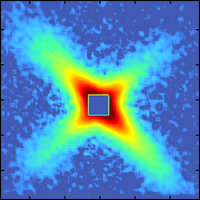
While magnetic skyrmions have been explored in various materials, their antipodes known as antiskyrmions have been experimentally observed only recently in very thin samples of the tetragonal ferromagnet Mn1.4PtSn. Here, the authors present an experimental study on bulk single crystals of Mn1.4PtSn by means of neutron scattering and magnetic force microscopy. The results indicate that antiskyrmions are not stable in bulk samples. Instead, the magnetic texture takes the form of an unusual fractal pattern of magnetic domains with a characteristic length scale of about 50 nm to 3 μm.

Spin-orbit coupled superconductivity: Rashba-Hubbard model on the square lattice

Sebastian Wolf and Stephan Rachel

Phys. Rev. B 102, 174512 (2020) - Published 30 November, 2020

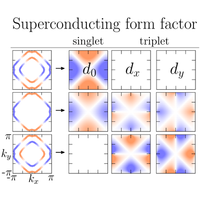
Rashba type spin-orbit coupling breaks inversion and spin symmetry, which can lead to a mixing of superconducting spin-singlet and spin-triplet states. Here, the authors present a numerical investigation of superconducting phases of the Rashba-Hubbard model. They study the two-dimensional square lattice as a paradigm and discuss how the arising superconducting phases, including helical spin-triplet condensates, emerge in detail and how to deal with them within a method which restricts paired electrons to momenta on the Fermi surface.

Establishing nonthermal regimes in pump-probe electron relaxation dynamics

M. X. Na, F. Boschini, A. K. Mills, M. Michiardi, R. P. Day, B. Zwartsenberg, G. Levy, S. Zhdanovich, A. F. Kemper, D. J. Jones, and A. Damascelli

Phys. Rev. B 102, 184307 (2020) - Published 30 November, 2020

How do electrons relax after optical excitation? When does temperature become a well-defined quantity to describe the system, and what can nonthermal electrons tell us about microscopic interactions? Using state-of-the-art time- and angle-resolved photoemission, the authors track the evolution of nonthermal electrons dynamics in graphite over hundreds of femtoseconds. The Boltzmann formalism is used to model the dynamics beyond the use of effective temperature. Based on a quantitative analysis, distinct nonthermal phases in electron relaxation are identified.

Strongly correlated multi-impurity models: The crossover from a single-impurity problem to lattice models

Fabian Eickhoff and Frithjof B. Anders

Phys. Rev. B 102, 205132 (2020) - Published 25 November, 2020

A mathematical criterion for the number of screening channels in multi-impurity Anderson models is given, dividing these models into two classes. As a consequence, the notion of independent single-ion Kondo effects can be ruled out as the mechanism for a collective singlet formation in heavy-fermion systems. Heavy Fermi liquid formation and its concomitant antiferromagnetic order are linked to an effective hopping between correlated orbitals, whereby the Mott-Hubbard transition in the correlated band provides a microscopic mechanism for the conjectured Lifshitz transition.

Nonequilibrium steady state phases of the interacting Aubry-André-Harper model

Yongchan Yoo, Junhyun Lee, and Brian Swingle

Phys. Rev. B 102, 195142 (2020) - Published 23 November, 2020

Recent studies of quantum many-body dynamics uncover many intriguing phenomena of thermalization and localization in the presence of a quasiperiodic potential. In this paper, the authors study nonequilibrium steady states of the one-dimensional interacting Aubry-Andre-Harper model by taking advantage of tensor network-based algorithms. In a weak potential regime, they find a superdiffusive to subdiffusive transition in spin transport within the thermal phase. The correlation structure of the steady states derived from the quantum mutual information shows an unusual oscillation pattern before reaching the localization transition. Our results suggest a rich phase diagram for the model.

Noncommutative field theory and composite Fermi liquids in some quantum Hall systems

Zhihuan Dong and T. Senthil

Phys. Rev. B 102, 205126 (2020) - Published 20 November, 2020

This paper addresses long-standing fundamental questions on the validity of the classic Halperin-Lee-Read (HLR) theory, which is thought to describe metallic composite Fermi liquids in quantum Hall systems. The authors derive a novel “noncommutative” field theory as a low-energy description, and obtain the HLR action and its microscopic parameters in a further approximation. The work demonstrates the importance of noncommutative field theory for future microscopic studies of composite Fermi liquids in quantum Hall systems.

Electronic energy gap closure and metal-insulator transition in dense liquid hydrogen

Vitaly Gorelov, David M. Ceperley, Markus Holzmann, and Carlo Pierleoni

Phys. Rev. B 102, 195133 (2020) - Published 19 November, 2020

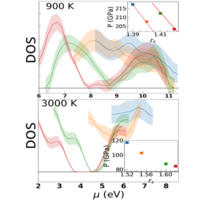
A first-order liquid-liquid phase transition from molecular to atomic fluid hydrogen has been predicted to occur at high pressure below a critical temperature of ∼ 2000 K. Based on quantum Monte Carlo calculations, the authors study the associated metallization process. Below the critical temperature, they find a discontinuous closure of the fundamental gap, supporting a scenario where both transitions, insulator to metal and molecular to atomic fluid, coincide. Above the critical temperature, molecular dissociation is shown to set-in while the gap is still open. At higher pressures, the liquid enters a gapless, but localized, phase, indicating a crossover from the insulating to the metallic liquid.

Entanglement dynamics in the three-dimensional Anderson model

Yang Zhao, Dingyi Feng, Yongbo Hu, Shutong Guo, and Jesko Sirker

Phys. Rev. B 102, 195132 (2020) - Published 18 November, 2020

The authors study the metal-insulator transition in the three-dimensional Anderson model from the entanglement perspective. They show that at the transition point the entanglement entropy after a quantum quench grows logarithmically in time, while the number entropy shows a double logarithmic growth. This behavior is consistent with exact bounds. It is also the same scaling recently found in many-body localized (MBL) phases, suggesting that the MBL phase might be more akin to an extended critical regime, rather than a fully localized phase.

Higher-order non-Hermitian skin effect

Kohei Kawabata, Masatoshi Sato, and Ken Shiozaki

Phys. Rev. B 102, 205118 (2020) - Published 17 November, 2020

A unique feature of non-Hermitian systems is the skin effect, for which an extensive number of boundary modes appear in the presence of boundaries. Here, the authors discover higher-order counterparts of the non-Hermitian skin effect that exhibit new boundary physics. As a prime example, the second-order skin effect in two dimensions hosts corner skin modes induced by spatial symmetry protected non-Hermitian topology, which contrasts with both the conventional skin effect and Hermitian higher-order topological phases.

Single femtosecond laser pulse excitation of individual cobalt nanoparticles

Tatiana M. Savchenko, Michele Buzzi, Ludovic Howald, Sergiu Ruta, Jaianth Vijayakumar, Martin Timm, David Bracher, Susmita Saha, Peter M. Derlet, Armand Béché, Jo Verbeeck, Roy W. Chantrell, C. A. F. Vaz, Frithjof Nolting, and Armin Kleibert

Phys. Rev. B 102, 205418 (2020) - Published 16 November, 2020

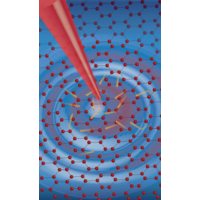
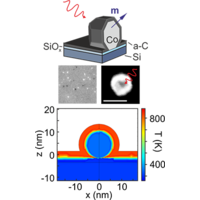
The interaction of light and magnetism at the nanoscale is a topic of fundamental interest with potential impact on future spintronics applications. This work addresses theoretically and experimentally the effect of femtosecond laser pulse excitation on the magnetic, structural, and chemical stability of individual magnetic cobalt nanoparticles, including the role of the substrate or matrix. Based on their results, the authors discuss possible pathways to achieve laser-induced magnetic switching in individual nanostructures.

Lee-Yang theory, high cumulants, and large-deviation statistics of the magnetization in the Ising model

Aydin Deger, Fredrik Brange, and Christian Flindt

Phys. Rev. B 102, 174418 (2020) - Published 12 November, 2020

The authors determine the Lee-Yang zeros of an Ising spin lattice in one, two, and three dimensions from the thermodynamic fluctuations that are inherent to critical regions. They can thereby predict the critical behavior of the lattice from remarkably small system sizes and, furthermore, express the large-deviation statistics of the magnetization in terms of the Lee-Yang zeros. The method used by the authors can be applied to a wide range of critical systems both in theory and experiment.

Similarities and differences between nickelate and cuprate films grown on a SrTiO3 substrate

Yang Zhang, Ling-Fang Lin, Wenjun Hu, Adriana Moreo, Shuai Dong, and Elbio Dagotto

Phys. Rev. B 102, 195117 (2020) - Published 11 November, 2020

Nickel oxides appear to have a fundamentally different superconductivity from that of copper oxides, according to new calculations.

Superconductivity, pseudogap, and phase separation in topological flat bands

Johannes S. Hofmann, Erez Berg, and Debanjan Chowdhury

Phys. Rev. B 102, 201112(R) (2020) - Published 11 November, 2020

Can superconductivity exist even if the electron kinetic energy is completely quenched, as in a flat band? This is fundamentally a nonperturbative problem, since the interaction strength is the only relevant energy scale. Here, the authors study a two-dimensional model of an isolated Chern band at partial filling with local attractive interactions. Their quantum Monte Carlo calculations demonstrate unambiguously that the ground state is a superconductor, emerging from an incoherent Cooper-pair liquid at temperatures above a critical temperature. Strikingly, the latter scales almost linearly with the interaction strength.

Efficient simulation of moiré materials using the density matrix renormalization group

Tomohiro Soejima (副島智大), Daniel E. Parker, Nick Bultinck, Johannes Hauschild, and Michael P. Zaletel

Phys. Rev. B 102, 205111 (2020) - Published 11 November, 2020

Despite considerable interest, it has been difficult to conclusively determine the ground state of twisted bilayer graphene (tBLG), due to the long-range nature of the Coulomb interaction and the fragile topology of the tBLG flat bands. This paper puts forward a method for studying tBLG more efficiently: mixed-xk space density-matrix renormalization group (DMRG) with matrix product operator (MPO) compression. The method enables the authors to calculate accurately the ground state of single-valley single-spin tBLG, and it puts DMRG with more degrees of freedom, such as valley, within reach.

Sign In to Your Journals Account

Filter

Section

Filter

Article Lookup

Enter a citation